Fish
Fish Fire
Fire Hike
Hike Bird
Bird

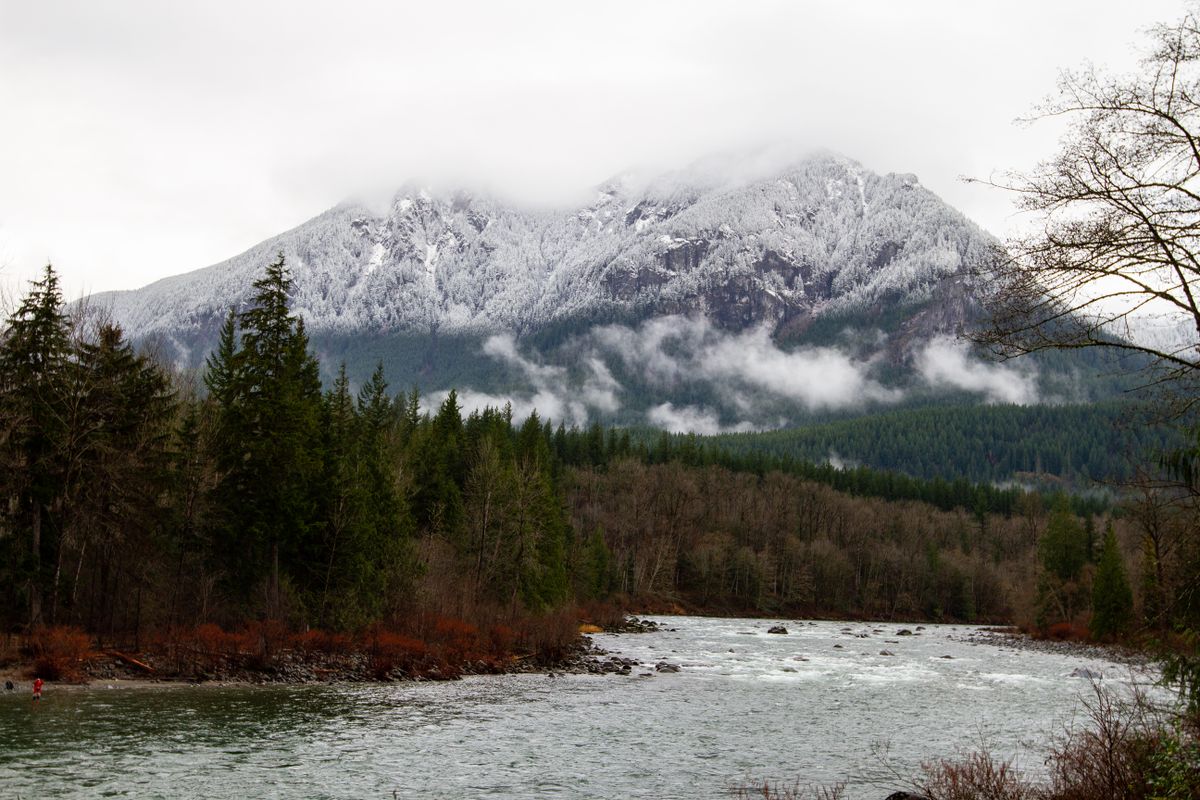

The Skagit River will break your heart. Not in the dramatic, sudden way of losing a fish at the net, though it will do that, too, but in the slow, grinding way of a river that gives you nothing for weeks at a time and then, on some gray February morning when you've stopped expecting anything at all, puts a wild winter steelhead on the end of your line that makes every empty day feel like it was worth it. And then it goes quiet again. For weeks. Maybe for the rest of the season.
This is the most frustrating river in the Pacific Northwest. It is also, by almost any measure, the most important. The Skagit is the largest river system draining into Puget Sound, the only watershed in Washington that supports all five species of Pacific salmon, one of the last strongholds for wild winter steelhead in the lower 48, and the river where modern spey casting was literally invented. It is a cathedral. It is also a place where you will stand in freezing rain for eight hours and never feel a pull.
If you fish the Skagit long enough, you will learn something about yourself that the easy rivers never teach you. You will learn whether you actually love fly fishing, or whether you just love catching fish. The Skagit doesn't care which one it is. It will treat you the same either way.
A River That Starts in Canada and Ends in Tulip Fields

The Skagit begins at Allison Pass in the Canadian Cascades of British Columbia, crosses into Washington, and flows roughly 150 miles through some of the most dramatic mountain terrain in the lower 48 before spreading into the broad agricultural flats of the Skagit Valley, the tulip fields, the dairy farms, the quiet delta towns, and emptying into Puget Sound near La Conner. Its drainage basin covers 1.7 million acres of the Cascade Range. It is enormous.
The upper river, above the town of Newhalem, is impounded by three Seattle City Light dams, Ross, Diablo, and Gorge, built in the 1920s and 1930s to power the city of Seattle. These dams produce 805 megawatts of hydroelectric power and create the turquoise reservoirs that tourists photograph from the North Cascades highway overlooks. They also block anadromous fish from the upper 60-plus miles of the river system, eliminating what was historically some of the most productive spawning habitat in the watershed. That's a wound the Skagit has never recovered from.
Below the dams, the river picks up its major tributaries as it flows west. The Cascade River enters at Marblemount, a tiny town at the edge of the North Cascades wilderness that serves as the unofficial gateway to Skagit steelhead country. The Sauk River, itself a major steelhead river fed by the Suiattle, joins at Rockport. The Baker River, dammed by Puget Sound Energy for another 170 megawatts, enters near Concrete. By the time the Skagit reaches Sedro-Woolley and Burlington, it's a big, slow valley river braiding through cottonwood bottomland, carrying the glacial runoff of a thousand mountain streams.
The section that matters for steelhead fly fishing, the section that has consumed lifetimes, runs roughly from the Dalles Bridge at Concrete upstream to the Cascade River Road bridge at Marblemount. This is maybe 25 miles of river. Twenty-five miles of gravel bars, boulder gardens, deep green slots, sweeping bends, and water the color of jade when the glacial tributaries are running and the color of weak tea after a rain. Highway 20 parallels most of it. You can see the river from your truck. You can pull over and be casting in five minutes. The access is easy. Everything else about the Skagit is hard.
The Mythology of Difficulty
Here's the thing about the Skagit that nobody tells you until you've already committed: the fish-per-day ratio is terrible. Not "challenging" in the way that a spring creek in Montana is challenging, where the fish are right there and you just need to make a better presentation. Terrible in the way that you might fish for an entire season, December through April, every weekend, plus some midweek days when you can't stand it anymore, and never touch a steelhead. Not "rarely catch." Never.
Steelhead are called the fish of a thousand casts, and on the Skagit, that number feels optimistic. The wild winter run, which is the whole reason anyone is out there, enters the river starting in late December and trickles in through March and into April. In a decent year, the run might total 5,000 to 7,000 fish spread across the entire Skagit-Sauk system. In a bad year, and there have been many bad years, the number drops below 3,000. In 2007, the run hit a nadir of 2,502 wild steelhead. Compare that to the historical runs of 30,000 or more, or the estimated 150,000 fish that returned at the turn of the 20th century, and you begin to understand the scale of what's been lost.
Now take those 5,000 fish and distribute them across 150 miles of river over a four-month window, and consider that each fish is moving upstream at its own pace, holding in water that may or may not be fishable, in a river that may or may not be at the right height, in weather that will almost certainly be awful. The odds of your fly swinging through the right six-foot-wide lane at the right depth at the right moment when a steelhead happens to be holding there and happens to be in the mood to eat, those odds are terrible. They're always terrible.
This is the fundamental truth of the Skagit: the river is too big, the fish are too few, and the conditions are too hostile for consistent success. The Skykomish is closer to Seattle and has hatchery fish that improve the numbers. The Olympic Peninsula rivers have tighter water where you can cover more holding lies per day. The Deschutes in Oregon has summer steelhead that cooperate in shirtsleeve weather. The Skagit has none of these comforts. It has big water, wild fish, bad weather, and the particular brand of stubbornness that keeps you coming back anyway.
Why It's Worth It
So why does anyone fish the Skagit? Because the fish that come out of this river are unlike anything else in the Pacific Northwest. A wild Skagit winter steelhead is a deep-bodied, broad-tailed, chrome-bright animal that has spent two or three years in the North Pacific and come back through Puget Sound and up 50 or 60 miles of river in the dead of winter to spawn in the same gravel where it was born. These fish average 8 to 12 pounds, with 15-pounders taken every season and 20-pound fish, the dream, the grail, the thing that keeps the whole cult going, showing up just often enough to remain plausible.
A 20-pound wild winter steelhead on a swung fly in the Skagit River is, by most accounts, the pinnacle of freshwater fly fishing in North America. It is the fish that Ed Ward and Scott Howell and Jerry French and Dec Hogan and all the other legends of Northwest steelheading spent their lives pursuing. It is the fish that drove the invention of an entirely new casting system. It is the fish that will, if you hook one, make you shake so badly that you can barely hold your rod. And then, if you land it, chrome flanks flashing in the gray winter light, the North Cascades rising behind you into the clouds, the river roaring around your knees, you will understand why people rearrange their entire lives around this river.
You will also understand why they're so angry about what's happened to it.
The River That Invented a Casting System
The Skagit didn't just produce legendary fish. It produced an entirely new way of fly fishing. The Skagit casting system, short, heavy shooting heads designed to turn over big flies on heavy sink tips in tight quarters, was born on this river in the late 1990s, and it changed steelhead fly fishing worldwide.
The problem was specific to the Skagit and rivers like it: big water, heavy current, deep holding lies, limited backcasting room (old-growth timber crowds the banks), and the need to present large, heavily weighted flies, Intruders, bunny leeches, string leeches, at depths that traditional spey lines couldn't reach. The long-belly Scandi-style lines that worked on open European salmon rivers were useless here. You couldn't aerialize 60 feet of line with a wall of Douglas fir behind you, and even if you could, those lines didn't have the mass to turn over a 4-inch articulated fly on a 15-foot T-14 sink tip.
Ed Ward, fishing the Skagit and the rivers of the Olympic Peninsula, started experimenting with short, fat, heavy shooting heads, 20 to 25 feet of dense line that could be cast with a sustained-anchor technique (the water loads the rod, not airborne line) and could throw virtually any fly-and-tip combination you could dream up. He called the technique "Skagit casting" after the river where he and others, Mike Kinney, Scott O'Donnell, Scott Howell, Mike McCune, Jerry French, and the legendary Harry Lemire, were developing it. The name stuck. Ward later co-founded OPST (Olympic Peninsula Skagit Tactics) to produce commercial Skagit heads, and RIO, Airflo, and other manufacturers followed.
Today, Skagit casting is the dominant method for winter steelhead fishing throughout the Pacific Northwest, British Columbia, the Great Lakes, and anywhere else anglers swing flies for steelhead in big, cold, fast water. It's used on the Skykomish, the Methow, the Hoh and the Sol Duc, the Pere Marquette, and dozens of other rivers. But it was born here, on the Skagit, out of the specific frustration of trying to get big flies deep in enormous water with timber at your back.
If you fish the Skagit, you're fishing the river that taught the sport how to swing flies for winter steelhead. That's not nothing.
The Flies That Skagit Regulars Actually Fish
Forget the generic steelhead fly lists. The Skagit has its own canon, patterns developed by or for the anglers who fish this river obsessively, designed for the specific combination of big water, variable visibility, and fish that may or may not eat on any given day.
Intruders are the signature Skagit fly. Created by Scott Howell and Ed Ward, the Intruder is an articulated pattern built on a shank-and-trailer-hook system with marabou, ostrich herl, and flash that creates an enormous underwater profile, sometimes 4 to 5 inches of undulating material, without the weight that would make it impossible to cast. The Intruder was designed specifically for the Skagit's conditions: high, off-color water where fish need to sense the fly with their lateral lines before they can see it. Black and blue, pink and orange, chartreuse and white, Intruders come in every color, and everyone who fishes the Skagit has a box full of them.
Bunny leeches and string leeches, rabbit-strip patterns tied long and sparse on shanks or trailing hooks, are the other workhorses. A string leech is essentially a single strip of rabbit fur lashed to a hook, and in the water it moves with a lifelike undulation that marabou can't quite match. These are confidence flies. When the water is up and dirty and you can't see your fly two feet into the current, a big black or purple string leech on a T-14 tip is the pattern that keeps you casting.
The General Practitioner (GP) is a classic British shrimp pattern that Northwest steelheaders adopted decades ago. It's tied with golden pheasant body feathers and hackle, and in smaller sizes it remains a deadly swing fly on the Skagit, particularly when the water drops and clears in late winter.
The Skagit Minnow is a local pattern, a baitfish imitation built with bucktail or craft fur on a long-shank hook, designed to mimic the sculpins and juvenile salmon that steelhead feed on in the river. It fishes best on a moderate sink tip in water that's clearing after a blow.
Ed Ward's Pick Yer Pocket and the Popsicle round out the local menu, both are big, flashy, profile-heavy flies that are fished on tips in the Skagit's classic boulder-garden runs. The Hoh Bo Spey, originally developed for the Hoh River on the Olympic Peninsula, is another pattern that crosses over to the Skagit regularly.
If you're coming from a trout background where you carry 400 flies in 30 patterns and agonize over whether the fish want a Parachute Adams or an Elk Hair Caddis in size 18 vs. size 20, the Skagit will be a relief. Leave the Pheasant Tails and Hare's Ears and Zebra Midges in the truck. You need maybe a dozen flies in three or four patterns in a few color combinations. The fly selection is the easy part. Everything else is the hard part.
How to Fish It (Or: The Art of Doing the Same Thing for Eight Hours)
Fishing the Skagit for winter steelhead is, at its core, brutally simple. You stand at the top of a run. You cast quartering downstream, or upstream, depending on the water type, let your fly sink and swing across the current on a tight line, take two steps downstream, and do it again. Step, cast, swing. Step, cast, swing. For hours. For days. For weeks.
The gear is straightforward. An 11.5- to 13-foot spey rod in 7- or 8-weight, a Skagit head matched to the rod (420 to 600 grains, depending on the rod and the water), a sink tip (T-11 through T-17, with T-14 as the all-around default), 4 to 6 feet of 12- to 16-pound fluorocarbon, and one of the flies described above. You don't need a net, you can't keep the fish anyway, and you'll be releasing them in the water. You don't need a vest full of fly boxes. You need maybe a dozen flies, a spool of tippet, nippers, and the fortitude to keep casting when everything in your body wants to go back to the truck and turn on the heater.
The water you're looking for is walking-speed current over cobble and boulder bottom, 3 to 6 feet deep, with some structure, large rocks, ledges, depth changes, that gives steelhead a reason to stop and rest. The classic Skagit steelhead run is a long, even-paced slick below a riffle, with a gravel bar on one side and a deeper slot on the other. You fish from the bar side, casting across to the slot, and swing your fly through the transition zone where fast water meets slow. These runs can be 200 yards long. It takes an hour to fish one properly.
The grab, when it comes, is unmistakable. Your line goes tight, the rod loads, and something heavy and angry is pulling toward the middle of the river. A winter steelhead's first run is a freight train, 30 or 40 yards of backing peeling off the reel before the fish either jumps (and you see the size of it and start shaking) or bulldogs into the current and makes you wonder if you hooked the bottom. The fight is nothing like trout fishing. It's nothing like summer steelhead fishing. A wild winter Skagit fish, fresh from the ocean and full of salt-water strength, is the hardest-fighting freshwater fish in North America, and on a two-handed rod in big water it will test your tackle, your knots, and your nerves in ways that no Yellowstone cutthroat or Madison River rainbow ever will.
The Sauk: The Skagit's Wilder Sibling
The Sauk River, which enters the Skagit at Rockport, is its own steelhead fishery and shouldn't be overlooked. The Sauk is smaller, tighter, more intimate, a river you can actually wade across in some spots, which is something you can rarely do on the mainstem Skagit. It drains the Monte Cristo peaks and the Glacier Peak wilderness through its tributary, the Suiattle, and carries its own run of wild winter steelhead.
The Sauk fishes differently than the Skagit. The runs are shorter and more defined. The water is faster and shallower in many spots, closer in scale to the Snoqualmie or the upper Skykomish, though carrying far bigger fish. You can sight-fish structure, boulder pockets, log jams, undercut banks, rather than blind-swinging through 200 yards of featureless slick. In some ways, the Sauk is a better teacher: it shows you what steelhead water looks like in a format you can actually read, rather than the Skagit's enormous, intimidating expanses where every run looks fishable and almost none of them hold a fish on any given day.
When the Skagit is blown out, too high, too muddy after a rain, the Sauk often fishes. When the Skagit is low and clear and the fish are spooky, the Sauk's stained water can be an advantage. Many regulars fish both rivers in a single day: morning on the Sauk, afternoon on the Skagit, or vice versa, following the water conditions and chasing the best shot at a grab.
The Sauk's influence extends beyond the watershed. If you've ever browsed fly lines and noticed how many come in a teal-green color called "Sauk Blue," that's not a coincidence, it's named after the color of the Sauk River itself. The same glacial melt that makes the river beautiful makes it iconic enough that line manufacturers use it as a color standard. When you strip line off a reel and see that pale blue-green coil at your feet, you're looking at the Sauk.
The Conservation Story You Need to Understand
You cannot write honestly about the Skagit without reckoning with what's been lost. This river once returned 150,000 wild steelhead annually. At the turn of the 20th century, the Skagit was one of the great steelhead rivers on earth, an endless, self-renewing flood of chrome fish pouring out of the North Pacific and into the Cascade foothills every winter. Today, the run is roughly 3% to 5% of that historical abundance.
The causes are the usual litany: three dams blocking the upper river, decades of overharvest (both commercial and recreational), habitat degradation from logging and development, changing ocean conditions, and a hatchery program that planted domesticated steelhead into the system for decades, competing with and diluting the wild genetics. The hatchery plants were finally discontinued in 2017 after a lawsuit, and today the Skagit is a wild-fish-only system, no hatchery supplementation, no planted smolts, no safety net. What you fish for on the Skagit is the remnant of a wild population that has survived everything we've thrown at it.
Puget Sound steelhead were listed as threatened under the Endangered Species Act in 2007. The Skagit's wild run, while one of the largest remaining in Puget Sound, is still a fraction of what it needs to be for long-term recovery. Every year, WDFW and the treaty tribes negotiate whether to open a recreational fishery at all. Some years they do, typically February through mid-April, catch-and-release only for wild fish, with a possible retention of hatchery-origin steelhead (though those are increasingly rare). Some years they don't. The 2025 season was cut short in April when returns came in below forecast. The 2026 season is uncertain as of this writing, with a preseason forecast of roughly 4,500 fish.
This uncertainty is itself part of the Skagit experience. You don't just show up on opening day and start fishing. You check WDFW emergency rules. You read the forecast. You watch the trap counts. You follow the online arguments about escapement goals and harvest models and tribal allocations. You argue with strangers on fishing forums about whether catch-and-release mortality justifies opening the season at all. And then, if the season opens, you drive two hours north from Seattle into the gray January drizzle and stand in water that's 38 degrees and swing your Intruder through a run that you've fished a hundred times before and never touched a fish in, because this is what you do. This is what the Skagit makes you do.
The Culture of the Skagit
The Skagit has a culture that's distinct from any other steelhead river in Washington. The Skykomish has its hatchery-run regulars and its plunking crowd. The OP rivers have their solitude-seeking traditionalists. The Yakima has its trout-bum drift-boat scene. The Skagit has the spey casters.
The Skagit spey community is part fishing subculture, part engineering obsession, part endurance sport. These are the people who own six two-handed rods and can tell you the grain weight difference between a 450 Skagit head and a 475. Who tie their own Intruders from materials sourced from three continents. Who have opinions about T-14 vs. T-17 sink tips that they will share at length whether or not you ask. Who drive to Marblemount every Saturday from December through April, a five-hour round trip from Seattle, and consider it a good day if they see one fish jump, even if they never get a grab.
The towns along the river, Marblemount, Rockport, Concrete, are tiny, quiet communities where the gas station sells bait and the diner closes at 2 p.m. In winter, the bald eagles gather along the river by the hundreds to feed on spawned-out salmon, and the Skagit Eagle Festival draws bird watchers and photographers to Rockport. The steelheaders barely notice the eagles. They're too busy watching the river.
There's a gravity to the Skagit community that comes from shared suffering. When you run into someone on the gravel bar at 7 a.m. in February, you don't need to explain yourself. They know why you're here. They know what it costs, the cold, the gas money, the blown weekends, the frozen guides, the reel seats icing up, the marriage-testing absences. They know because they're paying the same price. There's a nod, maybe a brief conversation about water level and what flies they're swinging, and then everyone goes back to the work of covering water and trying not to think about the fish they're probably not going to catch.
Planning Your First Trip (And Managing Your Expectations)
If you've read this far and you still want to fish the Skagit, here's what you need to know.
When to go: The wild steelhead season, when it opens, typically runs February through mid-April. February and March are prime time, with the peak of the run usually occurring in late February through mid-March. Check WDFW emergency rules before every trip, the season can close early if returns fall below forecast. Outside of steelhead season, the Skagit holds bull trout (catch-and-release year-round, one of the best populations in the lower 48), Dolly Varden, sea-run cutthroat, and salmon in season, chinook, coho, pink (odd years), and chum. Bull trout will eat Woolly Buggers, Muddler Minnows, and Clouser Minnows swung on a single-hand rod in summer, a completely different and far more forgiving fishery than the winter steelhead game. Pink salmon on odd years will slash at egg patterns and San Juan Worms drifted through the lower river pools.
Where to go: The steelhead fly water runs from Concrete upstream to Marblemount, with the best access along Highway 20. Key access points include Rockport State Park, the gravel bars above and below the Sauk River confluence, and several pulloffs between Rockport and Marblemount. Boat ramps at Marblemount, Rockport, and Howard Miller Steelhead Park (at the Sauk confluence) serve drift-boat anglers. A drift boat opens up more water, but plenty of fish are caught by wade anglers working the bars.
What to bring: A 12- to 13-foot, 7- or 8-weight spey rod. A Skagit head in the 450-to-550-grain range. Sink tips in T-11, T-14, and T-17 (carry all three, the right tip depends on the water speed and depth of the run you're fishing). A spool of 12- to 16-pound fluorocarbon. A small box of Intruders, bunny leeches, string leeches, and a few GPs in natural and bright colors. Waders with a wading belt. Layers, lots of layers. Rain gear. Fingerless gloves. Hand warmers. A thermos of coffee. The willingness to stand in cold water for a long time.
What to expect: Honestly? Nothing. Expect nothing. If you go to the Skagit expecting to catch a steelhead, you will be disappointed. If you go expecting to spend a day on one of the most beautiful rivers in the Pacific Northwest, surrounded by mountains and old-growth forest and bald eagles, practicing a casting technique that was invented within sight of where you're standing, swinging flies through water that has produced legendary fish for people who have dedicated their lives to this pursuit, if you go expecting that, and nothing more, you might have a good day. And if a steelhead happens to eat your fly, you'll have the best day of your fishing life.
Guided trips: If it's your first time, consider hiring a guide. The Skagit is big water and it's easy to waste a day fishing the wrong runs at the wrong level. A good guide knows which runs are fishing, what depth to target, and where the fish are likely holding based on the day's flow. Guides typically run $650 to $750 for a full day, and they'll provide rods, lines, and flies if you don't have spey gear. It's worth the investment for at least your first trip.
The Skagit Isn't for Everyone
I want to be clear about this: the Skagit is not a beginner river. It is not the river to learn spey casting on (the Yakima is better for that, wider, calmer, and the trout will eat a Copper John or a Prince Nymph and at least give you feedback). It is not the river to fish if you need to catch something to have a good day. It is not the river to fish if you don't own proper cold-weather gear, or if you haven't squared away your anchor placement and your casting stroke, or if you're not prepared to drive two hours each way for the chance, not the certainty, the chance, of touching a fish.
But if you've put in your time on easier water, if you've caught hatchery fish on the Skykomish and wild summer steelhead on the Methow and trout on the Yakima on a Stimulator and maybe even sea-run cutthroat on the Puget Sound beaches, then at some point the Skagit starts calling. Every serious Northwest fly angler feels it eventually. The pull of the big river, the wild fish, the tradition, the difficulty. The sense that this is where the real test is, and that everything else has been practice.
The Skagit is the final exam. Most of us never pass it. We just keep showing up and taking it again, year after year, wading into the same cold water with the same flies and the same stubborn hope that this will be the day. And on the rare morning when it is, when the line goes tight and the rod bends and a chrome-bright wild steelhead launches itself out of the Skagit's green current and hangs there for a heartbeat against the gray winter sky, you will understand why people call this the most frustrating river in the Pacific Northwest.
And you will understand why they never stop fishing it.