Fish
Fish Fire
Fire Hike
Hike Bird
Bird

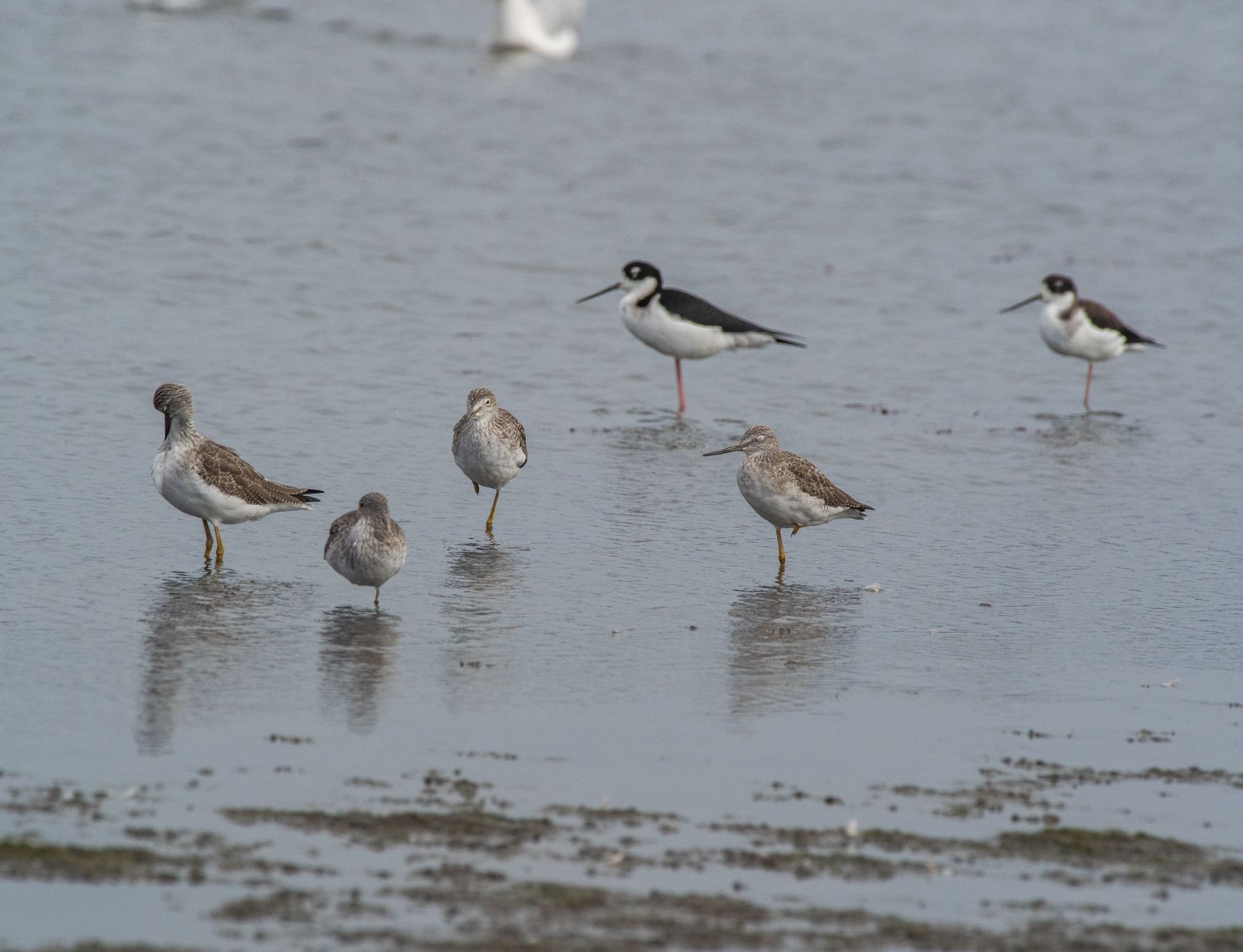

Most birding is a habitat problem. You go where the bird lives. Shorebirding is a timing problem, and the timing is set by the moon.
A mudflat that holds twenty thousand western sandpipers on a spring tide is empty water at high tide and empty mud at low, and the difference between a spectacular morning and a wasted one is often ninety minutes.
What the birds are doing
Shorebirds on migration have one job, which is to eat enough to keep flying. Many are moving between the Arctic and South America, so an estuary stop is a refueling problem with a deadline. The food is in the mud, in the form of worms, small crustaceans, molluscs and biofilm, and it becomes available as the tide uncovers it and unavailable as the tide covers it again.
That produces a daily cycle you can set your watch by. On a falling tide the birds follow the retreating edge out across the flats, feeding continuously and spreading over an enormous area, getting further from you the whole time. At low water they are at maximum dispersal, the flock is a mile out, the heat haze sits between you and it, and this is both the worst time to look at them and the time most people turn up. Then the rising tide pushes them back in, concentrating them into a shrinking band and moving them steadily toward you, until the feeding ground is gone entirely and they gather at a high-tide roost, packed tight and standing, often on one leg, waiting it out.
That push phase, and the roost at the end of it, are what you came for.
The window
The rule that transforms shorebirding is short. Arrive about two hours before high tide.
That puts you in place while the birds are still feeding but already being pushed in, gives you an hour or more of birds getting steadily closer, and delivers you to a packed roost at the top. Then stay through the high water, because the roost is where the scarce ones turn up: everything is in one place and standing still, and scanning five thousand dunlin for the one curlew sandpiper is difficult but possible, where scanning a mile of open flat is neither. The half hour either side of high water is usually the densest of the day.
Check the range as well as the time. A spring tide covers more flat, concentrates birds harder and produces a better roost than a neap, and the difference between the two at the same site can be the difference between a good morning and a great one.
Dunlins and the Importance of a High Tide RoostReading a tide table properly
More people get this wrong than admit it, starting with the fact that predictions are issued for a specific station. An estuary can run an hour or more behind the open-coast station you looked up, so find the station closest to your actual site and apply a correction if one is published for your point.
Height matters as much as timing. A nine-foot high tide and a twelve-foot high tide do completely different things to the same flat, and the twelve may cover the roost entirely and push the birds somewhere you cannot see them. Weather then overrides the prediction anyway: a strong onshore wind or low pressure raises the actual water above the forecast, offshore wind and high pressure drop it, and half a meter of surge changes everything. Local knowledge is often expressed as a height rather than a time, and "it is good on an eleven-foot tide" is more useful than any general rule.
The guidance also travels badly between coasts, which catches out visiting birders. The Atlantic runs a clean semidiurnal cycle of two roughly equal highs and lows a day, with substantial range in the north-east, and the standard two-hours-before-high advice was written for that coast. The Pacific is mixed semidiurnal, with two unequal highs and two unequal lows daily, and the difference matters: the lower low exposes dramatically more feeding habitat than the higher one, and the two can differ by several feet on the same day. The Gulf is largely diurnal, with one high and one low and a small range that a sustained onshore blow can simply overwhelm.
Finding the roost
Locating the roost is the whole game, and the good news is that there are only a handful of places it will be. Look above the highest tide line on a beach or spit, where the substrate stays dry and the sight lines are open. Look at salt marsh pannes and levees, particularly on managed wetlands where somebody has deliberately created loafing habitat. Look at managed impoundments behind a sea wall, which is why refuges next to estuaries so often turn out to be the answer.
Then look at the industrial ground, because some of the best roosts in the country are on it: jetties, breakwaters, dredge-spoil islands, oyster racks, disused piers and occasionally parking lots. And look at islands, which is where the birds would rather be than anywhere else.
That last point is the underlying logic. Birds choose roosts primarily for safety from ground predators, which is why so many sit on islands, spits and structures, and why a roost that gets disturbed regularly is simply abandoned for a worse one further away.
Local guides and recent checklists will usually tell you where the birds go at high water, and that is the single most valuable piece of local knowledge in shorebirding. Check the access separately, though, because a great many of the best roosts sit on refuge units that close seasonally, on tribal land, or behind a levee with no legal parking. That is the question Guidepole Bird answers: whose ground, open when, and where the boundary falls.
A High Tide RoostThe roost is fragile, which is the ethical part
A high-tide roost is the most disturbable thing in birding, and disturbing one is costly to the birds. They are there because they have nowhere else to be, since the feeding ground is underwater, so being flushed means burning energy they are actively trying to store, and there may be no alternative roost within miles. Repeated flushing at a roost has measurable effects on condition and survival in studies of disturbed estuaries. A single dog off a lead can clear a roost of ten thousand birds in one pass, several times a morning.
The etiquette follows from that:
-
Approach from behind cover and stop while the birds are still settled.
-
Use a scope. There is no shorebird that needs to be approached in order to be identified.
-
Never walk out onto the flats toward a roost.
-
Sit down. A seated silhouette is far less alarming than a standing one, and birds will often settle back.
-
Watch for sentinel behavior. Heads up, birds shifting, a few lifting off: you are already too close and the flock is deciding.
-
Leave the dog at home on any estuary in migration season.
Why these birds cannot afford you
The reason roost disturbance matters more here than in most birding is arithmetic rather than sentiment.
Many of the shorebirds using an American estuary in autumn are making one of the longest migrations of any animal. Semipalmated sandpipers stage on the Atlantic coast and then fly non-stop over open ocean to South America, a flight of several days. Bar-tailed godwits in the Pacific hold the record for the longest non-stop flight of any bird, going from Alaska to New Zealand without landing.
To do that they roughly double their body weight at staging sites, laying down fat at a rate that requires near-continuous feeding whenever the tide allows it. The daily budget therefore has no slack in it at all. Feeding time is fixed by the tide and cannot be extended, so energy spent flying because a dog ran through the roost has to be regained inside the same unchanged window. At a site used by tens of thousands of birds for a few weeks a year, that repeated cost measurably reduces the condition in which they leave, and condition on departure is a decent predictor of whether they arrive.
That is why experienced shorebirders are quietly fierce about roost etiquette. It is not fussiness about getting a good view.
The gear
Shorebirding at a roost is a stationary activity done at a specific hour, and the gear list is short because the timing does most of the work.
A spotting scope, which is not optional. Roosting shorebirds pack tightly at distance and the identification problems are subtle: bill length against head length, leg color, tertial pattern, the exact shade of a scapular. None of that is binocular work.
A tide table for the nearest station, corrected. This is the item that decides whether the trip happens at the right hour, and an uncorrected table from a distant reference point can be an hour out, which is the whole window.
A low stool or a foam mat, because the productive position is sitting still and low, well back from the flock, for two hours.
Something windproof, since roosts are on open flats, beaches and spits by definition.
A shorebird-specific field guide, because the general guides compress exactly the plumages that matter. Juvenile, worn adult and moulting birds in August are the hard cases and they are where a dedicated guide earns its weight.
No dog, for the same reason as at any nesting beach. A roost put up by a dog is a roost that costs the birds energy they have flown thousands of miles to conserve.
And patience through the turn, which is the technique. Arrive before the birds do, settle, and let the rising water bring them to you rather than walking out to find them.
Season, because the tide is only half of it
Autumn migration is the long one, with adults moving south from late June and juveniles following into September and October. It spreads across two or three months and it is when the plumage variety is at its most confusing and most interesting. Spring is the compressed version: a few weeks in April and May, birds in full breeding plumage, moving hard and in large flocks. Smaller totals, far better looking birds, and much less time to catch it.
Winter is the underrated season and the best one for learning. The flocks are stable, which means the same birds in the same plumage in the same place for months, at close range, with time to work through them properly. Numbers at some temperate sites are higher than during passage, particularly for dunlin and black-bellied plover, and the roosts are more predictable because the birds are settled rather than passing through. Wintering birds are also on a maintenance budget rather than a fuel-loading one, so they are marginally less time-pressed, though disturbance still costs them. Then in April the whole thing leaves within about a week, in fresh breeding plumage, looking better than they will at any other point in the year.
Midsummer is the only real gap, and even that is short, since southbound adults start returning while northbound birds are barely finished.
Learning autumn waders
This is the hardest common identification problem in North American birding and it is worth a framework rather than a field guide.
Age the bird first, then work out the species. An autumn flock contains worn adults, fresh juveniles and adults in active moult, and the three look strikingly different from each other. Juveniles are usually the neatest birds present, with crisp pale feather edges that give them a scaly appearance.
Then use structure rather than plumage, because bill length relative to the head, bill shape and droop, leg length and primary projection beyond the tail do not change with the season. Behavior helps more than people expect, since feeding action is often diagnostic: sewing-machine probing, pecking, running, teetering. Flight calls separate several pairs that are difficult to split visually.
Most of all, learn the common ones cold. Ninety-five percent of what you see will be a handful of species, and knowing dunlin, your local peeps and the common larger waders absolutely is what makes an odd bird stand out on its own. And expect not to identify everything, because distant, backlit, moulting waders defeat everybody, and letting one go is a normal outcome rather than a failure.
The short version
Do not ask where the shorebirds are. Ask when.
Two hours before high water, with a scope, sitting down, on a big tide, and the same site that disappointed you last month will be the best morning of your year.
Access questions are in that bird is on private land and a wildlife refuge is not a park. Nesting-season restrictions on the same beaches are in nesting closures explained. The equivalent tidal reasoning for hikers is in hiking the Oregon Coast.
The disturbance argument here is the same one made in nesting and seasonal closures explained and playback ethics. Sites in this library where the tide is the entire trip plan include Nisqually National Wildlife Refuge, birding San Francisco Bay and Chincoteague National Wildlife Refuge. Working out when the tide is worth the drive is easier with the reasoning in minus tides for clamming, which is the same arithmetic applied to a different purpose.