Fish
Fish Fire
Fire Hike
Hike Bird
Bird


On the night of August 16, 2020, a dry lightning storm crossed the central California coast and started hundreds of fires. Several merged into the CZU Lightning Complex, which burned through the Santa Cruz Mountains and straight over Big Basin Redwoods State Park.
It destroyed the headquarters, the historic lodge, the store, the campgrounds, the maintenance yard, and nearly every other structure. Roughly 97 percent of the park burned.
And then, within a few months, the redwoods started growing again out of their own charred trunks.
California's oldest state park
Big Basin was established in 1902, which makes it the first state park in California and one of the earliest anywhere in the country. It exists because of the Sempervirens Club, formed in 1900 by a group including the photographer Andrew P. Hill, who had been ejected from private redwood land while trying to photograph the trees, and the group campaigned to buy the basin before it was logged, and succeeded.
The park protects some of the southernmost significant old-growth coast redwood in the world, with trees over 1,500 years old and more than 300 feet tall. A great deal of that old growth is still standing.
What a coast redwood is
The recovery only makes sense in the context of the organism. Coast redwood is the tallest tree species on Earth, reaching over 380 feet, and individuals live well beyond two thousand years. They are restricted to a narrow coastal strip from southern Oregon to just south of Monterey, and the constraint is fog, because redwoods draw a meaningful fraction of their water directly from summer fog condensing on their needles and dripping to the ground, which allows them to survive a Mediterranean climate with no summer rain.
They are also clonal, which is the key to the fire story. A redwood is not only an individual tree, it is a genetic entity that can regenerate from its own root crown indefinitely, so a fairy ring of trunks is one organism and the current trunks may be the latest of many. That is why a fire that destroys a crown does not necessarily kill anything: the genetic individual is older than any of its trunks and is arranged to lose them.
Redwood wood is rot-resistant and insect-resistant, which is why it was logged so intensively and why fallen trunks persist on the forest floor for centuries. About five percent of the original old-growth coast redwood forest survives, and Big Basin protects a meaningful piece of it, which is why the 1902 campaign mattered and why the fire was watched so anxiously.
How a redwood survives being burned
Three mechanisms do the work. The first is bark, because mature coast redwood bark can be a foot or more thick, is very low in resin and rich in tannin, so it does not carry flame well and it insulates the living tissue beneath, which means a fire that incinerates everything else can char a redwood's surface without killing it.
The second is basal sprouting. Redwoods carry dormant buds in a swelling at the base called a burl or lignotuber, and when the crown is damaged those buds activate and a ring of new shoots comes up around the trunk, which is why redwood groves often grow in circles, called fairy rings, around the site of a long-dead parent tree.
The third is epicormic sprouting, and it is the one that made the news. Redwoods also carry dormant buds under the bark along the entire trunk, and after the CZU fire thousands of blackened trunks put out bright green needles directly from their sides, from ground level to the crown. The effect was extraordinary and widely photographed: black columns covered in fuzzy green growth.
The trees that died were mostly the non-redwood species, meaning Douglas fir and the younger, thinner-barked trees.
What is open now
This is the practical question, and the answer keeps changing, which is the single most important thing to know. The park reopened in stages from July 2022, initially as a limited day-use area with a reservation system operated with the Friends of Santa Cruz State Parks, and access has expanded steadily since, with further trails and roads opening each year, including access to Sempervirens Falls and segments of the Skyline to the Sea Trail. A facilities plan for rebuilding was approved in 2026, setting the direction for the next decade.
So check the current reservation requirement and open trail list before you go, because this is not a park where last year's information holds. That is an unusual situation: most access questions are stable for years at a time, and here the set of trails you are allowed to walk has changed every season since 2022 and will keep changing. Guidepole Hike carries current trail and access status against the routes rather than a snapshot, which at Big Basin is the difference between a planned day and a gate.
Camping is currently minimal, with a small number of walk-in sites and a bike-in site rather than the large campgrounds that existed before, and facilities are limited, so assume portable toilets and no store.
The walking
What is accessible is worth the visit, and the character has changed. Redwood Loop near the old headquarters is the short accessible walk through big trees, and Sempervirens Falls is a modest waterfall reached on a moderate walk whose reopening was a notable milestone.
The Skyline to the Sea Trail is the park's great route, running about 30 miles from Castle Rock State Park down through Big Basin to the sea at Waddell Beach, with sections reopening progressively. Berry Creek Falls is the classic objective, a long day of roughly 10 to 12 miles depending on route to a series of waterfalls in a side canyon, and it is worth checking status before planning around it.
What it feels like now is open. The canopy that made Big Basin dim and cathedral-like was thinned enormously, so light reaches the forest floor in a way it did not before, and the understory has responded with dense growth. It is a different park, and it is not a lesser one.
Fire policy, and what changed
The CZU fire has reshaped how these forests are managed, and the reasoning is worth following. These woods burned regularly for millennia at low intensity, with Indigenous burning adding to the natural cycle, and frequent light fire consumed the understory and kept fuel loads down, which is exactly what redwoods evolved with. Old redwoods commonly carry fire scars from repeated burns over centuries.
A century of fire suppression removed that, fuel accumulated, and when ignition finally came under extreme conditions in 2020 the fire that resulted burned hotter and higher into the canopy than the historical pattern. What was abnormal in 2020 was the intensity rather than the fire itself.
The policy response across California has been to expand prescribed burning and mechanical fuel reduction, and to recognize Indigenous fire knowledge as an operational practice rather than a historical footnote. Big Basin's rebuilding plan reflects the same shift, moving facilities away from the most fire-exposed locations rather than reconstructing what stood before in the same place.
Big Basin's Story: The CZU Lightning Complex FireWatching a forest change
There is one genuine reason to make repeat visits over the next decade. Year one to three was the sprouting phase, with epicormic shoots covering trunks, basal sprouts ringing burls, and a fireweed-and-bracken understory exploding in the new light.
Years three to ten are the sorting phase, when some sprouts thicken and persist while most are shed, Douglas fir seedlings colonize gaps, and the dead trees begin falling, which changes the light again and adds structure to the forest floor. Beyond that the canopy slowly closes, the redwoods re-establish crowns, and the burned trunks become fire scars indistinguishable from the ones already there from previous centuries.
The timescale is worth internalizing. A redwood recovering a crown takes decades and the forest recovering its structure takes a century or more, and the trees do not care, because they routinely live twenty times that long. If you visit once you see a burned forest, and if you visit every year or two you see one of the more instructive things available in California: a very slow process, running fast enough to notice.
The gear
Big Basin is California's oldest state park and it burned almost entirely in 2020, which makes this a gear list for a park still rebuilding.
A checked reservation, because access has been managed by advance day-use reservation during the reopening rather than by driving in, and the arrangement has changed several times as more of the park has reopened.
A current trail status list, which is the item that matters most. Trails here reopen in pieces as crews clear them, and a map from before the fire describes a park that no longer exists in that configuration.
Rain gear in winter and spring, since this is the wettest corner of the Santa Cruz Mountains.
Awareness of snags, which is the specific post-fire hazard and the reason large parts of the park stayed closed for years. Fire-killed trees fall without warning, they fall in wind, and the standing dead in a burned redwood forest is a genuine and ongoing danger rather than a formality.
Water and food, because the park's facilities were destroyed and the services that existed before are largely not back.
A Golden Poppy annual pass if you use California state parks often, which pays for itself quickly.
And patience with the roads, several of which were damaged and have been repaired slowly.
The other redwood parks nearby
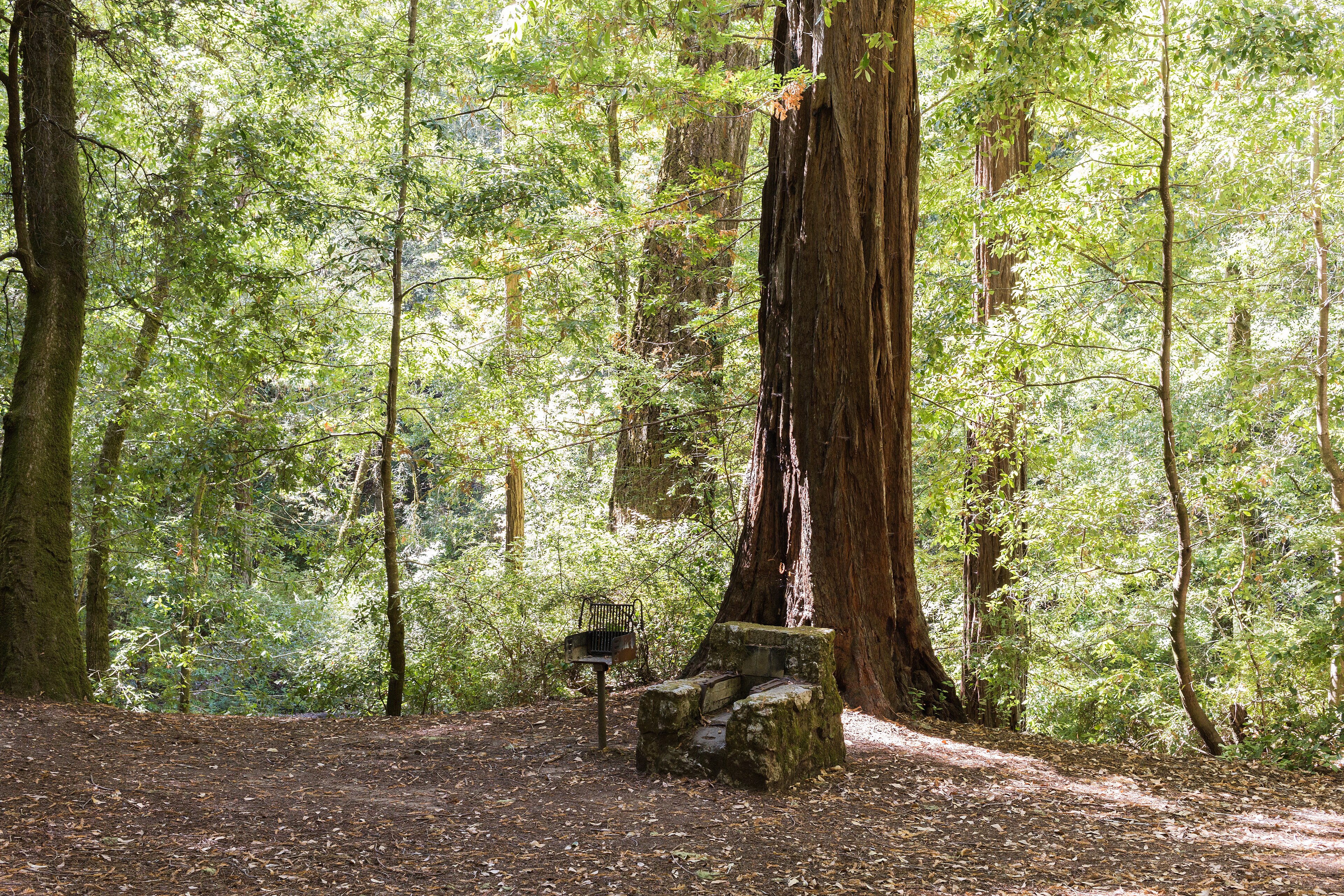
If Big Basin is fully booked or you want to see unburned old growth for comparison, the Santa Cruz Mountains hold several alternatives. Henry Cowell Redwoods State Park near Felton has an accessible loop through a fine old-growth grove and was largely spared by the CZU fire, and Portola Redwoods State Park on the other side of the ridge is quieter and holds substantial old growth.
Butano State Park and Castle Rock State Park were both affected by the fire to varying degrees and are worth checking on. Purisima Creek Redwoods on the Peninsula is Midpeninsula open space rather than state park, which makes it free and dog-friendly on some trails, and it holds excellent second growth, while Sanborn County Park and the wider Skyline corridor fill in the rest.
Seeing an unburned grove and then a burned one within the same trip is the clearest way to understand what happened in 2020, and how much of what looks like destruction is a process these trees are built for.
New Life Springs Up in Fire-Scarred Big Basin Redwoods State ParkSeason, and practical notes
Winter and spring are the best, because the waterfalls run, the understory is green, and the coast redwood belt gets its rain between November and April. Spring brings wildflowers, and post-fire years have produced unusual displays as light reaches ground that had been shaded for centuries. Summer is dry, and the fog these forests depend on is at its most reliable, which keeps the basin cool. Autumn is the fire-risk season and closures are possible.
A reservation may be required for day use, so check before traveling, and a day-use parking fee applies where the park is charging, with California's Golden Poppy annual pass at $125 covering most state park day use. Dogs are heavily restricted, as in most California state parks, and are generally confined to paved areas rather than trails. It is about an hour from San Jose and an hour and a half from San Francisco on winding mountain roads, and signal is poor in the basin.
One hazard is specific to a burned forest: standing dead trees are dangerous, particularly in wind, so do not linger under snags and take closures seriously.
Going there honestly, and why
Some people find it upsetting, and that is worth saying. If you knew Big Basin before, the loss of the historic buildings and the change to the canopy is real, and the first visit can be difficult. If you did not, what you will see is one of the best available demonstrations of ecological recovery anywhere in California, on a scale and timescale you can watch, and coming back in five years it will be visibly different again. Both reactions are legitimate. The trees are the point, and most of them are alive.
Which is the argument for going. Almost nowhere lets you watch a 1,500-year-old organism recover from something that would kill any other tree. The fire took the buildings and a great deal of the younger forest. It did not take the redwoods, which have been through this before, repeatedly, over lifespans measured in millennia, and whose entire biology is arranged around surviving exactly this.
Walk through a grove of black trunks covered in new green growth and the argument for protecting this basin in 1902 makes itself.
California's other redwood parks and the state's dog rules are covered in the state parks that want your dog and six states, six ways to charge you for a trailhead. The Bay Area's wider network is in hiking the San Francisco Bay Area, and the fire-and-sequoia story further inland is in one day in Sequoia National Park.
The redwood parks that did not burn are in Humboldt Redwoods, Prairie Creek and Fern Canyon and Jedediah Smith Redwoods. The nearest city is in hiking the San Francisco Bay Area. The fire ecology here rewards reading alongside red flag warnings explained, and the reservation system is the kind described in state park camping reservations.