Fish
Fish Fire
Fire Hike
Hike Bird
Bird

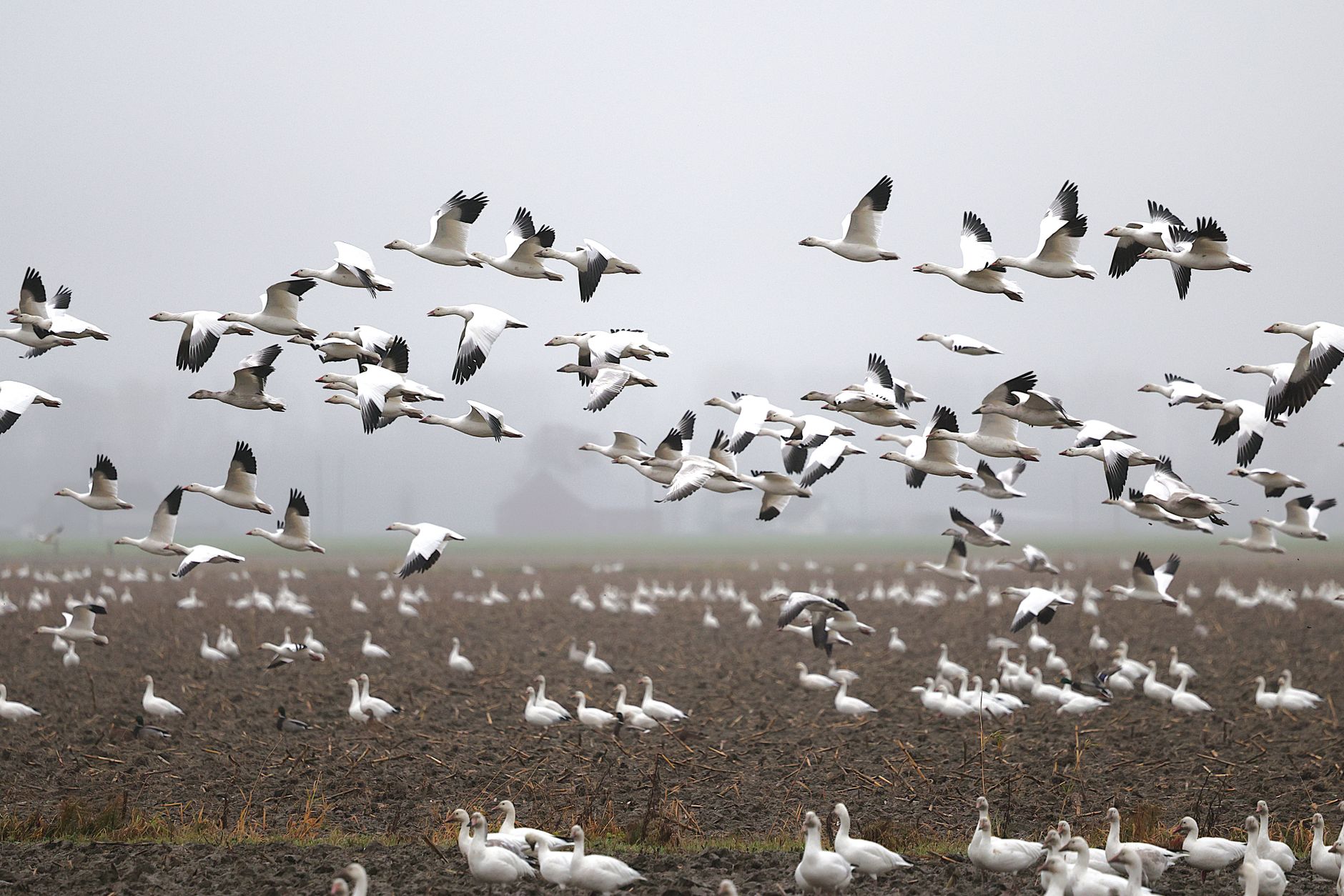

The first time is disorienting. You are driving a straight farm road between flat fields in flat winter light, and then a field to your left detaches from the ground and becomes ten thousand birds, all at once, with a noise you feel in your chest.
Then they settle four hundred yards away, in a different field, and you realize the second thing about Skagit snow geese: you almost never get to choose where they are.
The birds are on farmland, and the farmland is private
This is the fact that shapes every visit and that almost nobody tells you in advance. The Skagit and Stillaguamish flats are working agricultural land. The geese are there because harvested fields, winter cover crops and flooded stubble are enormously productive food, and because the delta sits exactly where the flyway does. The farms are businesses, actively worked in winter, and the birds move between them daily depending on what has been grazed down, what has been disturbed, and where the eagles are.
So on any given morning the flock may be on a field with public access, or on a field with none, and you have no control over which. What you can control is where you position yourself and how you behave when the birds are out of reach, which is most of the time. The public ground is real but small, and it is worth knowing precisely.
Fir Island Farm Reserve, the anchor site
Fir Island Farm Reserve is a 280-acre unit of the Skagit Wildlife Area, managed by the Washington Department of Fish and Wildlife, and it is where most people should start. Before you go:
-
A Discover Pass is required. WDFW lands need one unless you already hold a Vehicle Access Pass issued with an eligible hunting or fishing license. Enforcement is real, and the parking area is small enough that a rover can check every car in a minute.
-
Public access is restricted to the entrance road, the parking area and a short dike-top walking trail. That is the whole footprint. The restored estuary either side is not open ground you wander across, and neither is the working farmland.
-
It is closed during hours of darkness, which matters because the best light and the biggest morning lift-off both happen very close to the edge of that window.
-
It is a Game Reserve, so hunting and trapping for all wild birds and animals are prohibited on the unit itself. That is why the birds tolerate people here.
-
There is no restroom. The nearest facilities are back toward Conway or Mount Vernon.
The dike trail is short, exposed, and gives you estuary on one side and managed field on the other. On a good morning that is all you need.
Snow Geese Migration on Fir Island, Skagit ValleyThe other public units, and what each is for
Do not treat Fir Island Farm as the only option, because the Skagit Wildlife Area is a scatter of units and they behave differently. Hayton Reserve is the other classic goose-viewing unit, with a dike walk and often closer birds. Jensen Access and Wiley Slough put you into sloughs, brush and edge habitat, which is where the passerines, raptors and rails are rather than the goose spectacle. Leque Island, at the Stillaguamish mouth, was extensively restored to tidal marsh and reads completely differently from the diked farm units. And Big Ditch gives you the bay edge, with a shorebird and waterfowl view rather than a field view.
The useful habit is to treat the whole complex as one circuit rather than one destination. Drive it, find where the birds are that day, then park somewhere legal and walk.
Roadside viewing, where it goes wrong
Most of what gets birders into trouble on the flats is a car, not a pair of binoculars. The farm roads are narrow, they carry agricultural traffic including equipment much wider than a lane, and the shoulders are frequently soft. A car parked half on the roadway on a straight fast farm road is a real hazard, and a car blocking a field gate is worse, because it can strand a working vehicle at the exact moment it is needed.
The rules that keep this sustainable are simple. Get entirely off the roadway or do not stop at all, and if all four wheels cannot leave the pavement onto firm ground, keep driving to somewhere they can. Never block a gate, a driveway or a field entrance, even briefly, even with somebody sitting in the car. Do not walk out into a field, because the birds will flush, the crop or cover will be damaged, and it is trespass. And view from the vehicle wherever you can, since snow geese tolerate cars far better than they tolerate a person on foot, and a car makes an excellent hide.
The Skagit birding community has a long working relationship with the farming community here, and it survives on the fact that most visitors behave.
Snow Geese Take Flight in Skagit CountyThe eagle problem, which is really a lift-off explanation
Once you have watched a few flocks, you start noticing that the lift-offs are not random. Bald Eagles are the usual trigger, since the Skagit holds a large wintering eagle population drawn by the same delta and the same salmon runs, and a goose flock reacts to an eagle overhead in a way it does not react to a car, a tractor or a walker on a dike. Peregrine Falcons are the other one, and they produce a tighter, faster, more panicked lift than an eagle does.
That is worth knowing for two reasons. The practical one is that if the flock explodes and you cannot see why, you should look up rather than around. The other is that it reframes what you are watching, because a field of ten thousand geese is a prey concentration and the raptors are there because it is.
It also means the most spectacular thing you will see is not caused by you, which is a useful corrective on a site where visitors habitually assume any disturbance must be their fault or, worse, that flushing the flock deliberately is a reasonable way to get the photograph. It is not. A deliberately flushed flock is a well-known problem here, it is obvious to everyone else present, and it is the behavior most likely to cost birders access to a viewing site.
Where these birds come from
This part changes how the flock looks. The snow geese wintering here breed on Wrangel Island, in the Russian Arctic. It is the last major snow goose population breeding in Asia and the main Russian-breeding goose population that winters in North America, which makes it a long-standing priority for cooperative Pacific Flyway management across an international border.
The numbers have grown substantially. In recent years as many as 300,000 birds have returned to Wrangel, with roughly 100,000 wintering across the north Puget Sound basins in the Stillaguamish, Skagit and Fraser systems, and WDFW estimates around 80,000 snow geese winter in western Washington.
So the flock in front of you crossed the Chukchi Sea and most of Alaska and British Columbia to reach a field outside Conway. It is not a local bird in any sense.
The gear
The Skagit flats are birded from the edge of working farmland in winter rain, and every item here is about staying legal, staying dry and seeing across a field.
A Discover Pass, which covers the state wildlife area parking at Fir Island Farm and the other Fish and Wildlife units. It is the single most common citation here and it is entirely avoidable.
A spotting scope, because a flock of twenty thousand Snow Geese four hundred yards out is where the interesting work is: finding the Ross's Geese, picking out neck collars, and spotting the occasional Emperor or Greater White-fronted Goose in among them.
A window mount or beanbag rest, since much of the roadside viewing is legitimately done from a vehicle and doing it from a vehicle is also what keeps the birds settled.
Genuinely waterproof outer layers. Skagit winter rain is persistent rather than heavy and it soaks anything merely resistant over three hours.
Warm gloves you can operate optics in, which is a real constraint and worth solving before the trip rather than in the field.
A land ownership map, because almost all of the ground the geese are actually standing on is private farmland, and the difference between a legal roadside stop and a trespass is a fence line you cannot see from the car.
And a vehicle you can park entirely off the roadway, which is the thing that generates complaints from farmers and, eventually, closures.
Reading a flock
A field of white birds looks uniform until you spend twenty minutes on it, and then it stops being uniform.
-
Blue morphs. A proportion of lesser snow geese are dark-bodied with a white head, and picking them out is the standard first exercise. They are scarcer in this population than in the mid-continent one, which makes finding one more satisfying here.
-
Ross's Goose. Smaller, rounder-headed, with a stubby bill lacking the black grinning patch. Present in the Skagit flocks in small numbers most winters, and finding one is a real piece of fieldwork rather than a lucky glance.
-
Greater White-fronted Goose. Gray-brown, orange-legged, usually in small parties at the flock edge.
-
Cackling and Canada Geese frequently share the fields and are worth sorting for their own sake.
-
Juveniles. First-winter snow geese are dingy gray-white with dark bills, and the proportion of young birds is a rough index of how the Wrangel breeding season went.
The habit worth building is to scan the flock rather than photograph it. The interesting birds are always in there, and they are only findable at scope magnification with patience.
Swans are a separate trip
People conflate them and they should not. Trumpeter and tundra swans also winter on the flats in large numbers, but they use different fields, in different ways, and often further inland and further north than the goose concentrations. Trumpeters are the larger and by far the more numerous of the two here, while tundra swans are present in smaller numbers and reward a careful look at bill pattern and head shape.
Swans are also considerably more sensitive to disturbance in the fields than geese are, and they are more likely to be on private ground with no legal vantage at all. Scope from the road, from the car, and leave it at that.
Timing, and a first visit
Late October through early April is the broad window, with the largest concentrations from November into February. Morning beats afternoon for the field spectacle, though late afternoon light on the flats makes the better photograph. Weather matters more than the date, because a clear cold high after a front concentrates birds and puts them up, while a week of flat gray drizzle can leave them sitting on a distant field all day.
Waterfowl hunting seasons begin in mid-October and run through the last weekend in January. Fir Island Farm itself is a Game Reserve and closed to hunting, but neighboring property is not, and shooting on adjacent land affects where birds sit and how twitchy they are. That is not a reason to avoid the season; it is a reason to understand why the flock lifted.
Drive to Fir Island Farm at first legal light with a Discover Pass on the dash and walk the dike. If the geese are distant, do not chase them across the fields; drive the loop through Hayton, Jensen and Wiley Slough instead and let the circuit find them for you. Scope from legal ground, keep the car entirely off the road, and leave the gates alone.
The Skagit problem is an access problem wearing a birding costume: the birds are easy to find and hard to legally watch. Guidepole Bird shows the ownership and management boundaries underneath the birds rather than only the birds, so the distinction between the WDFW unit, the Game Reserve within it, the county road right of way and the working farm on the other side of the ditch is visible before you commit to a parking spot.
And when a field detaches from the earth and turns into a hundred thousand birds four hundred yards out of reach, take it as the point rather than the problem. That is what the place is.
If the swans pull you in further, where to see trumpeter swans covers the wider recovery story. Our guide to refuge rules explains why a wildlife area, a game reserve and a national wildlife refuge are three different legal animals, and birding during hunting season covers sharing the flats in October.
The swans that share these fields are a separate trip with separate timing, covered in where to see trumpeter swans. The eagles that put the flocks in the air are in where to see bald eagles in winter. The California end of the same flyway is in Central Valley waterfowl, the nearest city birding is in birding Seattle, and the roadside access etiquette that keeps this place open is in can you legally bird here.