Fish
Fish Fire
Fire Hike
Hike Bird
Bird

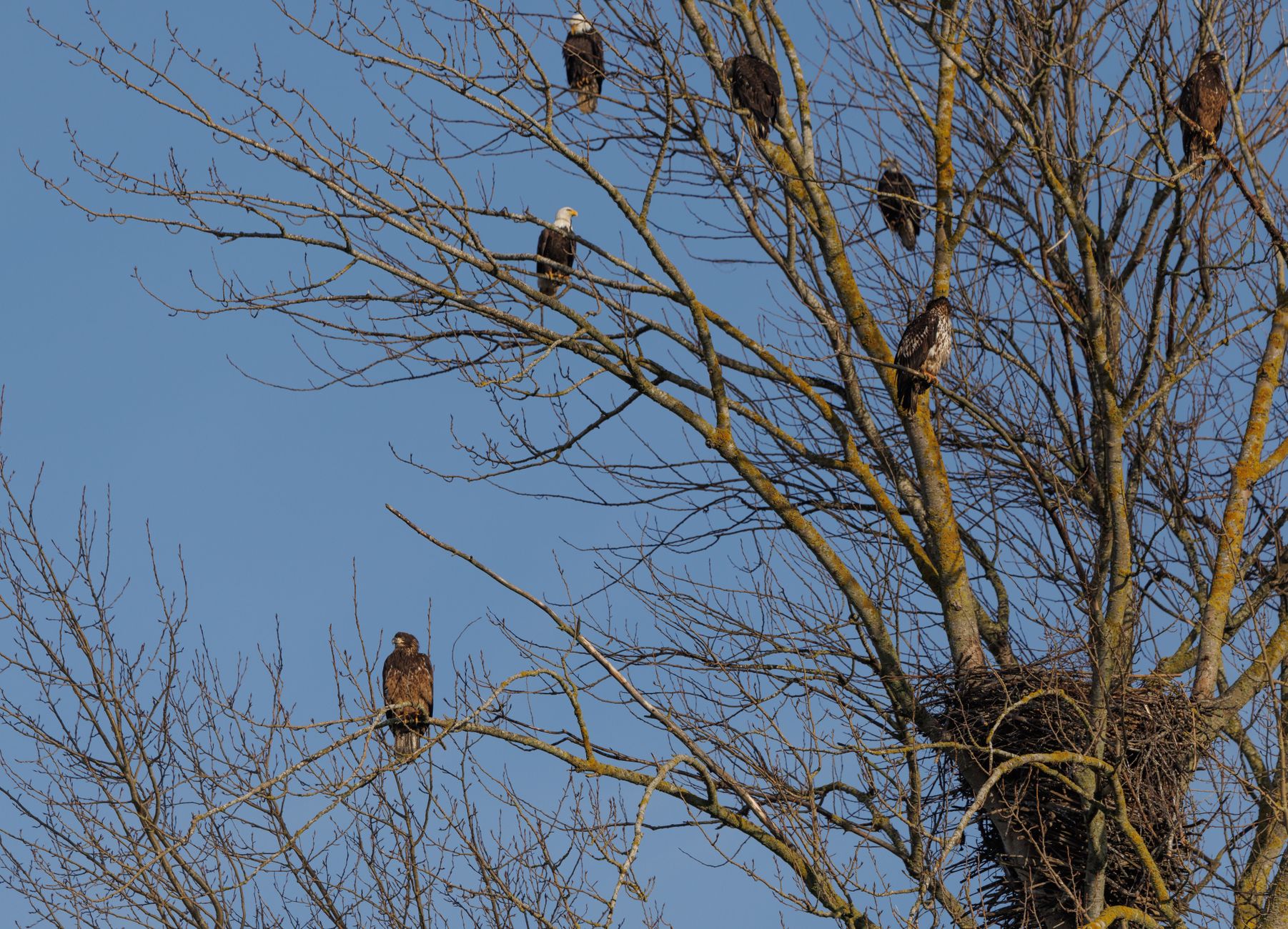
Bald Eagles are no longer hard to find. That is the good news, and it is worth stating first, because it was very nearly the opposite.
But a winter concentration is a different thing from seeing an eagle. In the right place in the right week you can have fifty or a hundred birds in view at once, and those places are predictable, because they are produced by a specific combination of conditions.
What makes a winter eagle concentration
Three things have to coincide. The first is open water, because eagles need to fish and in a hard winter most water is frozen, so anywhere that stays open becomes disproportionately valuable: a fast river, a tailwater below a dam, a spring-fed reach. The second is a food pulse, usually spawned-out salmon carcasses on a Pacific river, fish stunned or killed passing through dam turbines on an interior river, or a large waterfowl concentration supplying both crippled birds and carrion.
The third is the one people forget. Eagles roost communally in winter, in mature conifers or large hardwoods on a slope sheltered from wind, often a mile or more from where they feed. The roost matters as much as the food, and it is the reason some rivers hold eagles while an equally fishy river next door does not.
Get all three and you get a concentration. That is the whole model, and it lets you predict sites rather than memorize them.
How to Watch the Eagle Migration on the Skagit RiverThe Pacific salmon rivers
The Skagit River in Washington, between roughly Rockport and Marblemount, is the classic lower-48 salmon-river gathering. Eagles arrive on the late chum run and are present from about December through February, with the Skagit River Bald Eagle Interpretive Center at Rockport operating in season, viewing areas along Highway 20, and float trips run by local outfitters. The etiquette there is worth respecting: stay in the designated viewing areas, keep off the gravel bars where birds are feeding, and if you float, use an outfitter who knows the voluntary no-stopping reaches. The Nooksack and several other north-west Washington rivers hold smaller versions of the same thing.
The Chilkat River in Alaska, near Haines, is the largest gathering in the world, on a late chum run kept accessible by warm groundwater upwelling that holds the river open after everything else has frozen. Peak is late October through December. It is worth knowing that survey counts there have fallen substantially over three decades and run far below the figures usually advertised.
The interior and the refuges
-
The Klamath Basin, on the Oregon and California border, holds the largest concentration of wintering Bald Eagles in the contiguous United States, drawn by enormous waterfowl numbers rather than by salmon. Birds are present from early December through mid-March and peak in mid-February, and the tradition is the dawn fly-out from the Bear Valley roost, watched from the public road below.
-
The upper Mississippi lock and dams, from Minnesota down through Iowa and Illinois, produce reliable concentrations wherever the tailwater stays open. Lock and Dam 14 at LeClaire, Lock and Dam 15 at the Quad Cities and the reach around Keokuk are long-standing sites, and Starved Rock State Park in Illinois runs a winter eagle program.
-
Conowingo Dam on the Susquehanna in Maryland is the best-known eastern site, with eagles concentrating on fish passing the turbines. Numbers peak around November and December, and the site is famous enough that the photographer density is itself notable.
-
Reelfoot Lake in Tennessee holds wintering eagles and runs guided tours in January and February.
-
Blackwater National Wildlife Refuge in Maryland holds one of the largest breeding and wintering concentrations on the east coast outside Florida.
What they eat, and where to look
The romantic image is an eagle plucking a fish from the surface. The reality is more interesting and it tells you where to stand.
Carrion is a large part of the winter diet: spawned-out salmon on Pacific rivers, winter-killed deer, road kill and gut piles left by hunters. Eagles are opportunists and scavenge readily. They do take fish live from open water, particularly below dams where the turbines stun or kill them, and they take waterfowl, which is precisely why the Klamath concentration exists, hunting crippled and weakened birds and occasionally healthy ones cooperatively. And a great deal of what looks like hunting at a winter gathering is actually theft, since eagles rob Ospreys, gulls and each other constantly.
The practical consequence is to look where the food is rather than where the scenery is. A shingle bar with carcasses on it beats a beautiful stretch of river with nothing dead in it.
The carrion habit is also the lead problem. An eagle feeding on a gut pile or an unrecovered carcass shot with lead ammunition ingests fragments, and studies have found lead exposure widespread across the population. That is the direct link between how a deer is shot in November and how an eagle does in January, and non-lead ammunition is the fix.
Timing
November and December cover the Chilkat, Conowingo and the first arrivals elsewhere. December through February is the Pacific salmon river window. January and February suit the interior rivers and the Klamath peak, and in general the coldest weeks are the best, because a hard freeze concentrates birds onto whatever open water remains.
Go early everywhere. Eagles leave communal roosts at first light and are most active in the first hours of the day.
And watch the forecast rather than the calendar, because a thaw disperses them. If the ice breaks up, birds spread out and the concentration evaporates within days, which is the usual reason a well-planned eagle trip underdelivers.
Skagit County Draws Photographers and Birders for Bald Eagle ViewingWatching without pushing them
Winter is the hardest season an eagle faces, and disturbance carries a real energetic cost. Stay in the vehicle or the designated viewing area, since eagles tolerate cars far better than people on foot. Do not approach a feeding bird, because one pushed off a carcass may not get it back and in February that matters. Never approach a roost at any time; roost sites are the most sensitive part of the system and several are formally closed. Leave the drone at home, which is the fastest way to clear a river of eagles and is prohibited at most managed sites anyway. And give them a hundred yards or more, which is the standard guidance and roughly where most birds stop reacting to you.
Learn to read the reaction, because eagles telegraph it. A bird that stops feeding and raises its head is aware of you. One that shifts its feet, turns to face you or begins calling has decided you are a problem. If it opens its wings, you have already pushed it too far and the next thing it does is leave. The useful discipline is to stop moving at the first head-up and let the bird settle rather than pressing on to see what happens, which is how most people end up watching an empty gravel bar.
The gear
Winter eagle watching is stationary, cold and done at distance, and the gear is the same whether you are on a salmon river or at a refuge roost.
A spotting scope, because the productive way to watch eagles is to find a perch tree or a gravel bar with a dozen birds on it and study them, rather than to walk a riverbank pushing them ahead of you.
Layers for standing still in the cold, which is the actual activity. A January morning on the Skagit or the Chilkat spent moving is warm; spent watching, it is not.
A window mount, since many of the best interior sites are refuge auto tours where the vehicle is the hide and getting out is what ends the sighting.
A camera with reach, used from where you already are. Eagle photography is the single most common cause of disturbance at these sites, and reach is the substitute for approach.
A thermos, for the same reason as the layers.
A weather and river-condition check before you go, because these concentrations follow the salmon and the salmon follow flow. A blown-out river scatters the birds, and a late run moves the peak by two weeks.
And non-lead ammunition, if you also hunt the same country. Lead fragments in gut piles and unrecovered carcasses remain a leading cause of eagle poisoning, and switching is the single most useful thing a hunting birder can do for the species they came to watch.
Ageing them, and not missing a Golden
A winter concentration is a mixed-age gathering, and reading that turns a flock of eagles into something more informative. Bald Eagles take about five years to reach full adult plumage of white head and tail with a yellow bill. First-year birds are dark chocolate brown with a dark bill and eye and variable white mottling in the wing linings and belly. Second-year birds show a messy white belly patch and a disheveled look, with a ragged trailing edge from mixed old and new feathers. Third-year birds start showing a paler head with a dark eye-line, giving an osprey-like face, and the bill begins to yellow. Fourth-year birds look nearly adult but carry dark flecking in the white head and tail and often a dark terminal tail band.
Learning that has two payoffs. The proportion of immatures in a winter flock tells you something about recent productivity. And picking a Golden Eagle out of a Bald Eagle concentration depends entirely on knowing what a juvenile Bald looks like, because juvenile Balds are the birds most often called Goldens by mistake.
Golden Eagle is a bird of open country rather than fish, so where the two overlap in winter it is usually over grassland, sagebrush, a canyon rim or a carcass on open ground rather than on a river bar. An adult Golden is uniformly dark brown with a golden nape, no white anywhere, and a small-headed long-tailed silhouette. A juvenile Golden has clean-cut white patches at the base of the primaries and a white tail base with a sharp dark terminal band, and the key word is clean-cut, because a juvenile Bald's white is messy, blotchy and irregular with nothing crisply defined.
Structure separates them at any distance. Bald Eagles have a large head and heavy bill projecting nearly as far forward as the tail projects behind, where Goldens have a smaller head and a proportionately longer tail. Flight differs too, with Goldens soaring on a slight dihedral and noticeably more agile, and Balds soaring on flat wings like a plank. At a mixed site, check every dark eagle rather than assuming, and read head projection first, because it works at ranges where plumage does not.
The recovery, and the threat that remains
The reason you can plan a trip like this at all is recent. By 1963 the lower 48 held roughly 417 known nesting pairs of Bald Eagles, reduced by shooting, habitat loss and above all DDT, which thinned eggshells so severely that reproduction essentially failed.
DDT was banned in the United States in 1972. The species was federally listed in 1978 and delisted in 2007. A 2019 assessment put the lower-48 population at roughly 71,400 nesting pairs and around 316,700 individuals. That is a change of more than two orders of magnitude in nesting pairs inside a working lifetime, produced by a chemical ban, a law with teeth, and decades of enforcement and reintroduction.
Lead is the threat that persists and gets the least attention, and it is the one an individual can do something about. If you hunt the same country you watch eagles in, switching to non-lead ammunition is the single most direct contribution available.
The plan
Pick one site and go in the coldest week you can manage: Skagit in January, Klamath in mid-February, Conowingo in late November, Chilkat in November.
Be there at first light. Watch from the vehicle or the platform. Bring a scope and more clothing than you think you need. Check who owns the bank before you stand on it, because a gravel bar may be public below the ordinary high water mark and private above it, the boat launch may be state, the road county, the far bank a ranch, and the roost above it a closed refuge unit. That layer is what Guidepole Bird is for.
And when a hundred eagles are in view at once, remember it was 417 pairs.
For the specific sites, Klamath Basin refuges covers the Bear Valley fly-out, southeast Alaska covers the Chilkat in detail, and the Skagit Flats covers the goose fields the same eagles hunt.
The largest of these concentrations, at the northern end of the range, is in southeast Alaska birding. The interior refuge version, which looks nothing like a salmon river, is in the Klamath Basin refuges. The eagles that put a goose flock into the air are the same story from the other side, in Skagit flats snow geese. Sorting them from other large raptors is easier after reading hawk watches explained, and the shared-ground etiquette is in birding during hunting season.