Fish
Fish Fire
Fire Hike
Hike Bird
Bird

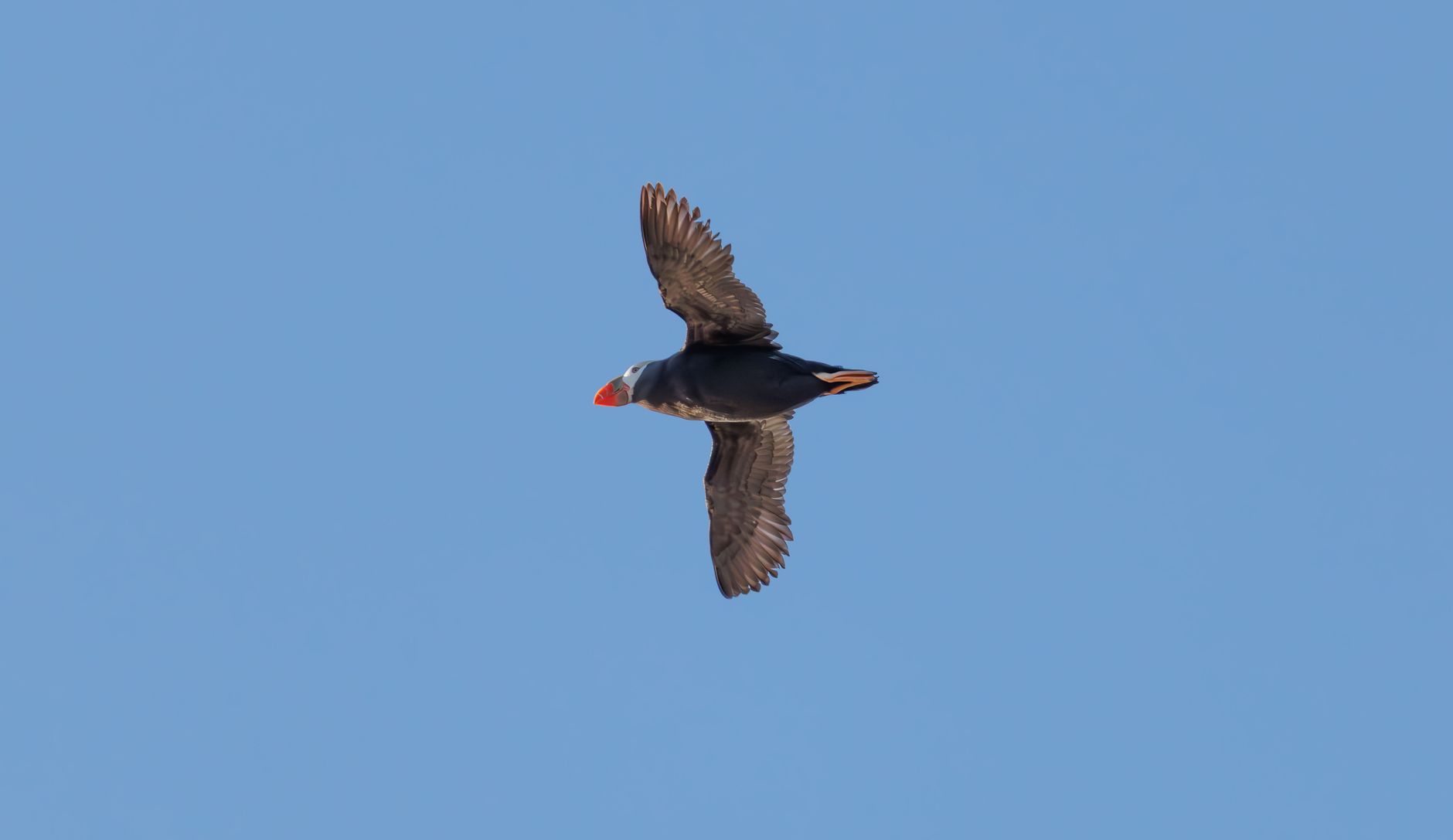

The honest opening: Tufted Puffin is a hard bird in Washington now, and it did not used to be.
The species is listed as endangered at the state level, and the regional decline is severe. Across Oregon and Washington, populations have fallen roughly 90 percent since the mid-1990s, and the colonies remaining in the inner waters are down to a handful. This is a species to go and see, and to go and see soon.
Protection Island, and the 200-yard rule
Protection Island National Wildlife Refuge, in the eastern Strait of Juan de Fuca off Discovery Bay, is the most important seabird site in the inner waters of Washington. Roughly 70 percent of the nesting seabird population of Puget Sound and the Strait nests on that one island, which holds one of the largest Rhinoceros Auklet colonies in the world along with Pigeon Guillemot, Pelagic Cormorant, Glaucous-winged Gull, nesting Bald Eagles and a harbor seal haul-out. It is also one of the last two Tufted Puffin colonies in the Puget Sound area.
The access rules are unambiguous. The refuge is closed to all public access, with no permit, no arrangement and no exception for birders. The surrounding waters within 200 yards are closed to all watercraft, and that buffer is enforced, because it exists specifically so adults are not flushed off nests. You view the island from outside the buffer, by boat, and that is both the intended and the legal way to do it. A scope from the mainland will not get you there; the distance is too great.
Since a boat is the realistic route, it helps to know what the day involves. Trips run from Port Townsend and nearby ports in season, usually as half-day wildlife cruises rather than dedicated birding charters, though some operators run birder-specific departures and those are worth seeking out. The route generally crosses Discovery Bay, circles the island outside the buffer, and works the surrounding water where feeding birds gather. Expect distance, and expect the birds on the water between you and the island to give the better views. Expect a mixed audience too, since most passengers are there for seals, eagles and scenery, though a good skipper will still work the birds if asked.
Two practical points make a real difference. Bring stabilized optics if you own them, because a tripod is useless and a heavy scope is a liability on deck. And take the earliest departure available, since wind builds through the day in the strait and a choppy afternoon crossing is both less comfortable and much harder for picking small alcids off the water. Ask the operator about the puffin situation before booking, because the people running the route weekly know whether birds are being seen this month, and that beats any guidebook.
The Tufted Puffins of Destruction IslandThe other colonies
Smith and Minor Islands, further out in the strait, form another refuge unit and are similarly closed. Tatoosh Island, off Cape Flattery at the north-west corner of the state, historically held a substantial puffin colony; it is Makah tribal land and is not open. Destruction Island, off the Olympic coast, sits within the outer-coast refuge system and is closed. And the outer coast rocks generally, from the Olympic coast south, fall within Washington Islands National Wildlife Refuges and are closed to landing on the same principle as the Oregon rocks.
The pattern is consistent and it is not an accident. Every remaining colony is on ground you cannot set foot on, and that is a large part of why any of them remain.
Where you can stand
There are land-based options, and they are honest long shots rather than reliable plans.
Cape Flattery, the north-westernmost point of the contiguous United States, gives a boardwalked trail to viewpoints over the strait and Tatoosh Island, with puffins possible from the overlooks in season alongside murres, auklets and cormorants on the rocks below. One access note matters more than the rest: Cape Flattery is on the Makah Reservation and requires a Makah Recreation Pass, bought in Neah Bay. It is inexpensive, it is required, and it is checked, so buy it before you drive out to the trailhead.
Beyond that, Point Wilson at Fort Worden in Port Townsend gives a strait vantage where puffins occasionally pass, and Salt Creek Recreation Area and the north Olympic headlands offer more of the same. The Anacortes to Sidney and Port Townsend to Coupeville ferries cross productive water and make cheap seawatching, though neither is dependable for this particular bird.
The wider alcid cast
A puffin trip in Washington shows you a family more interesting than the single target species, and knowing the cast makes the trip worthwhile even on a puffin-less day.
Rhinoceros Auklet is the abundant one, and it is also the identification problem. It is a close relative of the puffin: dark gray-brown, much plainer, with a smaller orange bill carrying a pale horn at the base and two thin white facial plumes, and at distance it is similar in shape and size. Because auklets are abundant at Protection Island and puffins are not, the default identification for a dark alcid there is auklet, and the puffin has to be argued for. A breeding Tufted Puffin is unmistakable when you do get one: all-dark body, white face mask, huge orange-red bill and long pale golden head plumes trailing back. Horned Puffin is a rare visitor worth being alert for, white-breasted with a yellow-and-red bill and a dark horn above the eye.
The supporting cast is genuinely good. Pigeon Guillemot breeds in cavities on bluffs and jetties throughout the inner waters, black with a white wing patch and startling red feet and gape. Common Murre occurs in numbers, particularly in late summer when males lead flightless chicks out to sea calling to each other constantly, which at dusk from a headland is one of the better sounds on this coast. Marbled Murrelet is the listed one, small and fast and low over the water, nesting inland in old growth, present year-round in the inner waters and arguably a better find than a puffin. Ancient Murrelet appears in late autumn and winter, sometimes in good numbers in the San Juans, and Cassin's Auklet is largely offshore but turns up in the strait occasionally.
The useful reframing is that the alcids are the point and the puffin is the prize. A trip producing five alcid species and no puffin is still an excellent day.
Timing
Late April through August is the window, when adults are ashore at colonies, with May through July the core when birds are most consistently around the island and most visible on the water nearby. Outside that period puffins are pelagic, disperse well offshore, and are effectively unfindable from land or from inner-water boats.
So unlike most target species this one has a hard seasonal gate. A trip to Protection Island in October will show you a lovely island with no puffins on it.
Glimpsing the Future Through Washington's PuffinsWhy they are declining, and what is being done
The drivers are the ones affecting cold-water seabirds generally: warming ocean temperatures shifting the distribution and abundance of forage fish, reduced forage fish overall and particularly the lipid-rich species that make a chick grow, plastic ingestion both direct and passed to chicks, gill-net entanglement in some fisheries, and introduced predators at some colonies. The southern edge of the species' range has retracted noticeably, and Washington's inner waters sit right at that edge.
The situation is not being ignored, which is worth knowing given how bleak the trajectory reads. State listing triggered a recovery planning process and a monitoring commitment, which is the mechanism by which a species gets attention and money. Colony monitoring by state agencies, universities and volunteers tracks the remaining sites, which is harder than it sounds when all of them are closed islands requiring boat surveys. Buffer enforcement around Protection Island and the other refuge islands is the most direct measure available and it demonstrably works, since colonies with enforced buffers do better than those without. Predator removal, principally of introduced rats, has been effective at seabird colonies worldwide and is a live tool where it applies.
The highest-leverage intervention is also the hardest. Forage fish protection, particularly for the herring, sand lance and surf smelt that puffins provision chicks with, means managing a fishery and a nearshore habitat rather than a single island. Federal listing has been petitioned for and considered, but the underlying driver is ocean condition, which no single agency controls.
The realistic assessment is that Washington's inner-water colonies sit at the retreating southern edge of the range, and the honest reason to go is that the window is not indefinite.
The gear
Washington puffins are seen from boats, from headlands, and mostly at distance, and the gear reflects a species you are lucky to get close to.
Binoculars you can use on a moving deck, which means eight power rather than ten. On a boat, the extra magnification costs you more in shake than it buys in detail.
A Makah Recreation Pass, if you are birding Cape Flattery or Neah Bay, which is required, inexpensive, sold in town, and frequently overlooked by visitors who assume the headland is a park.
A booked wildlife cruise, because the reliable way to see Tufted Puffins in Washington is from a boat around Protection Island or out of Westport, and the good trips run on a schedule and fill.
A camera with reach for documentation, since Tufted Puffin sightings in Washington are worth reporting properly and the birds are usually far off.
Layers for cold on the water, which is colder than the same air temperature on land by a wide margin.
Motion sickness preparation taken before you board rather than after you feel it, since by the time it is needed it is too late for it to work.
And a seabird reference covering alcids, because the useful skill here is separating Tufted Puffin from Rhinoceros Auklet, Common Murre, Pigeon Guillemot and the two murrelets, all of which share the same water and several of which are far more numerous.
If you want a surer thing
Worth being direct: if the goal is simply to see a Tufted Puffin, Washington is not the efficient choice.
Oregon's Haystack Rock at Cannon Beach is the most accessible mainland-viewable colony on the west coast, with birds present April into July and interpreters with scopes on the beach, and while the colony is much reduced it is watchable from the sand. Oregon's central coast headlands, including Cape Meares and Yaquina Head, offer further chances. California's Farallon Islands trips out of the Bay Area reach a small remnant colony, and British Columbia holds larger colonies north of the border.
Alaska is the genuine stronghold. Day boats out of Seward into Kenai Fjords produce Tufted and Horned Puffin routinely and at close range, alongside murres, kittiwakes and auklets, and for a birder who simply wants good views of puffins that is the answer.
None of which makes the Washington attempt pointless. It makes it a different thing: going to see a state-endangered population at the retreating edge of its range, which is worth doing on its own terms and is a meaningfully different experience from a boatload of puffins in Alaska.
The practical plan
This species is an access problem before it is an identification problem. The colonies are closed, the buffers are legally enforced, the best land viewpoint requires a tribal recreation pass, and the outer coast rocks are all refuge. Guidepole Bird carries the ownership, closure and buffer layer under the birds, so a refuge boundary that runs 200 yards out into the water reads as what it is rather than as open sea, which for anyone taking a boat out is the difference between good birding and a violation.
Book a Protection Island cruise from Port Townsend in June. Take binoculars you can use on a moving deck, and expect the birds to be distant. If you want a land attempt, buy a Makah Recreation Pass in Neah Bay and give Cape Flattery a long morning with a scope.
And if you see one, sit with it for a while. The Washington population a birder in 1990 took for granted is largely gone, and the honest way to enjoy what remains is to know that.
For the wider coast, the Oregon coast has the more accessible colony at Haystack Rock, and your first pelagic trip covers going offshore to find the rest of the alcids.
The Oregon colony that most people actually visit, and the population trend behind it, is in birding the Oregon coast. Getting properly offshore, where the rest of the seabirds are, is in your first pelagic trip. The colony closures and the distance rules that govern approach are in nesting and seasonal closures explained and a wildlife refuge is not a park. The nearest city birding is in birding Seattle.
One last note on why the Washington population matters out of proportion to its size. Tufted Puffins are abundant in Alaska and the species as a whole is not in trouble, which is why it has no federal listing. What is collapsing is the southern end of the range, and a range contracting from its warm edge is the signature of a warming ocean rather than of a local problem. Washington listed the bird as endangered at the state level in 2015 for exactly that reason.