Fish
Fish Fire
Fire Hike
Hike Bird
Bird

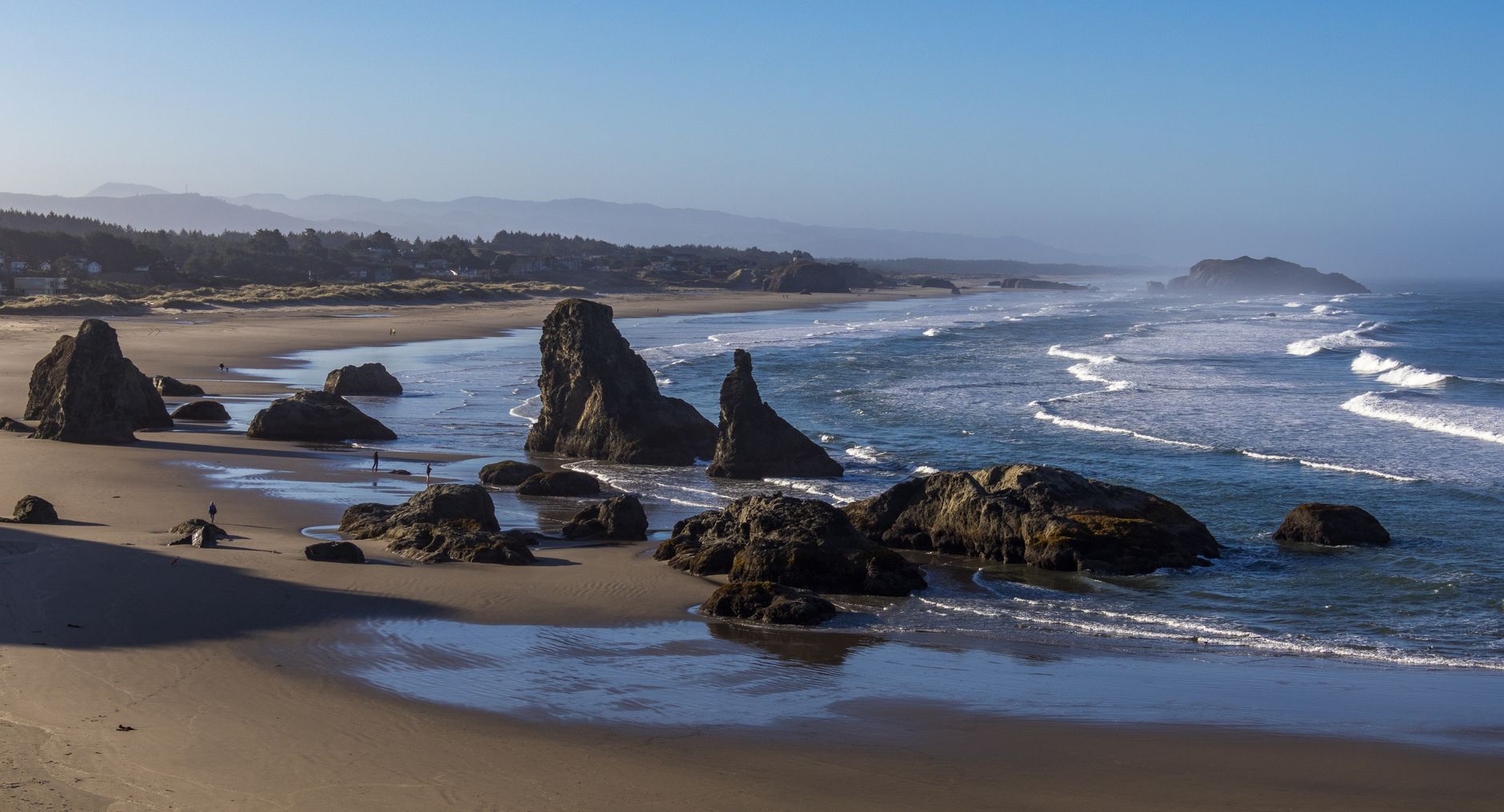
Stand on the beach at Cannon Beach in May and look at Haystack Rock. There are birds all over it, there is a marked area you should not walk into at low tide, and there is no legal way for you to set foot on the rock itself.
That pattern repeats for three hundred and sixty miles. Nearly every offshore rock, reef and island along the Oregon coast is part of Oregon Islands National Wildlife Refuge, and essentially all of it is closed to public landing. Which sounds restrictive until you understand what it produces: a coastline where seabird colonies sit a few hundred yards offshore, undisturbed, in full view of a public beach.
The puffins, and the number nobody wants to say
Tufted Puffin is the bird most people come for, and Haystack Rock is the most accessible colony in the state. Birds return in April and are present into July, with the best viewing in the morning when they are moving between the burrows and the sea, and the Haystack Rock Awareness Program and the Friends of Haystack Rock run interpretive sessions with scopes and binoculars, including a welcome event in mid-April when the birds arrive.
Here is the number. Counts at Haystack Rock have fallen from 312 birds in 1988 to 106 in 2023, and across Oregon and Washington as a whole Tufted Puffin populations have declined more than 95 percent since the mid-1990s. The drivers are the usual coastal set: warming ocean temperatures, reduced forage fish, plastic ingestion, gill-net drowning, and introduced predators at some colonies.
That is worth carrying with you rather than skipping past. You are still very likely to see puffins at Haystack Rock. You are seeing a third of what a birder standing in the same spot saw in the late 1980s.
The Puffins of Haystack RockThe offshore refuge, explained
This is the thing that shapes the whole coast and almost nobody explains it. Oregon Islands National Wildlife Refuge covers the rocks, reefs and islands off the Oregon coast, essentially all of them, and they are closed to public landing, with many also inside designated wilderness. Three Arch Rocks, off Oceanside, was established in 1907 by Theodore Roosevelt and was the first national wildlife refuge west of the Mississippi, carrying seabird colonies and a Steller sea lion haul-out.
The rocks are closed for a straightforward reason: seabird colonies do not tolerate people. A single visit to a murre colony can cause a mass flush, and a mass flush leaves eggs and chicks exposed to gulls and eagles for as long as the adults stay off. The same logic governs the 500-foot rule you will see posted for boats and aircraft near colonies, and increasingly for drones, since flying a drone at a seabird colony is among the most damaging things a visitor can do on this coast and is prohibited.
What that means practically is that the mainland viewpoints are the product rather than a compromise. The refuge exists so that you can stand on a public bluff and watch an undisturbed colony.
The headlands, and the seawatch
The Oregon coast has a strong seawatching tradition and the geography is why. Boiler Bay State Scenic Viewpoint near Depoe Bay is the classic, a small headland with parking essentially at the viewpoint, deep water close in, and a reputation for producing shearwaters, jaegers, alcids, loons and the occasional real rarity in the right conditions. Yaquina Head at Newport gives elevation, a lighthouse and a Common Murre colony you can look down onto in summer, which is one of the great close-range seabird experiences on the west coast. Cape Meares, Cape Lookout and Cape Perpetua all give elevation onto open water and each has its adherents, while Bandon and Coquille Point put sea stacks close to a public bluff with breeding colonies visible from the path.
The seawatching rules are the same everywhere. Wind matters more than the date, onshore or northwest winds after a blow push birds in close, and the productive hours are usually early. A scope is not optional.
The estuaries, which are the other half
The rock-and-headland coast gets the attention, and the bays are where the shorebird numbers are. Tillamook Bay and Netarts Bay in the north, Yaquina Bay at Newport, Coos Bay in the south and Bandon Marsh National Wildlife Refuge on the Coquille are the principal ones.
The pattern is the standard estuary pattern and it is entirely tide-driven. Falling and low tides expose flats and spread the birds out to feed, while rising tides push them into roosts where they are countable. Southbound passage from late July through September is the peak, with a smaller northbound movement in April and May.
Bandon Marsh is the one to know if you have to pick. It is a restored estuarine refuge, it produces the best shorebird lists on the southern coast, and it has a rarity record out of proportion to its size.
The gear
The Oregon coast is a scope-and-weather problem, and the gear list is mostly about staying comfortable enough to keep looking.
A spotting scope is not optional here. The headland seawatch is the best birding on this coast and everything in it is distant: shearwaters in a line half a mile out, jaegers harassing terns, a Black-footed Albatross that is a speck until it turns. Binoculars will show you that something is out there.
Genuinely waterproof outer layers, which for this coast means a hard shell rather than a resistant jacket. Oregon coast rain arrives horizontally.
A tide table, because the estuary half of the trip is entirely tide-driven and a mudflat at high water holds nothing at all.
A windproof scope setup, which mostly means a heavier tripod than you would otherwise carry. A light tripod on a headland in a twenty-knot wind is a vibrating tripod, and the difference between a usable image and an unusable one at sixty power is small.
Layers for cold you did not expect in July, since the summer upwelling that makes this coast productive also makes it cold, and August mornings at Boiler Bay run in the low fifties with wind.
A seabird identification reference, ideally one organized by flight style rather than by plumage, since that is what you get to work with.
And a car you do not mind parking on gravel, because most of the good pullouts are not paved.
The coastal migrant traps
The rocks and the bays get the attention, and there is a third habit that produces the surprises. The Oregon coast has a set of isolated tree and shrub patches in an otherwise open landscape of dune, marsh and grass, and they concentrate migrants for exactly the same reason the ranch groves do at Point Reyes.
Coastal cemeteries and town parks are the classic: small, wooded, isolated, and checked repeatedly by local birders in autumn. The dune-backed shore pine patches along the central coast hold birds in the right conditions. Sewage ponds and settling lagoons near coastal towns are frequently the best shorebird and duck habitat available at a high tide. And the jetties at the river mouths concentrate gulls, alcids close inshore, Rock Sandpiper and Wandering Tattler in season, making them the most accessible seawatching on the coast.
The autumn technique is the same as anywhere: work the small isolated cover slowly, go back, and pay attention to the days following a weather system rather than the calendar. Oregon produces a steady trickle of eastern warblers and vagrants each autumn, and almost all of it comes out of habitat patches you could walk across in two minutes.
Marbled Murrelet, and the bird that explains the forest
This one connects the coast to the mountains behind it. Marbled Murrelet is a small alcid that feeds at sea and nests inland in old-growth conifer forest, sometimes tens of miles from the coast, on a wide moss-covered branch high in a mature tree. Nobody found a nest in North America until 1974, which is remarkable for a bird that common. It is listed as threatened in Oregon, Washington and California for a straightforward reason: the branches it needs take centuries to grow, and most of the forest that had them was cut.
Two practical consequences follow. At sea, murrelets are among the easier alcids to find close inshore, often in pairs on calm water off the headlands and in the bays, with winter and early spring giving the best views. Inland, they fly to and from nest sites in the dark, at speed, calling, in the hour around dawn, and hearing one over old growth in the Coast Range at first light is a strange experience and a good reason to be up early somewhere unexpected.
It is also the clearest illustration on this coast that a marine bird can be a forest conservation problem, which is not intuitive until you know it.
Brown Pelican, a recovery you can watch
One cheerful story on a coast that has several sad ones. Brown Pelican was effectively wiped out along much of the west coast by DDT, which thinned eggshells to the point that colonies failed almost entirely. The species was federally listed in 1970, DDT was banned in 1972, and the population recovered to the point of delisting in 2009.
What that means for a birder on the Oregon coast is that from roughly May through October, after breeding further south, thousands of pelicans move north and are abundant along the whole coastline, with lines of them along a wave face or a plunge-diving flock over a bait ball among the more reliable spectacles of the summer coast. East Sand Island, in the Columbia estuary, hosts one of the largest night roosts on the west coast in late summer and can hold very large numbers.
It is worth pausing on. A birder standing at Boiler Bay in 1975 would have seen essentially none. The recovery happened because a chemical was banned and a law was enforced, which is a useful thing to remember on the days when conservation feels futile.
Chasing Tufted Puffins at Haystack RockTiming the coast
April to July gives breeding seabirds, with puffins, murres, cormorants, guillemots and oystercatchers on the rocks at their most visible and photogenic. Late July to September brings shorebird passage in the estuaries and the start of the productive seawatching. October and November give the best seawatching of the year in the right weather, plus vagrant potential at the coastal migrant traps. December to February holds loons, grebes, scoters and alcids close inshore, Brant on the bays, and wintering raptors over the dunes and marsh. And March starts the northbound push, brings Brown Pelicans back, and overlaps with the gray whale migration.
Where to sleep, and a four-day run
The coast is long and the driving adds up, so a base matters. Cannon Beach and Seaside put you on the puffins and the northern rocks with Tillamook within reach. Newport is the practical center of the coast, with the most accommodation and food, Yaquina Head and Yaquina Bay on the doorstep and Boiler Bay twenty minutes north. Florence covers the central dunes and the Siuslaw estuary. Bandon is the base for the southern rocks, Bandon Marsh and the Coquille. And Brookings at the far south is a different climate entirely and the most reliable sun on the coast. Book ahead in summer, because this is a heavily visited coastline in July and August and birders are competing with everyone else.
For four days, start at Cannon Beach for the puffins at Haystack Rock in the morning, then work Tillamook and Netarts bays on the falling tide. Day two, Cape Meares and Oceanside for the rocks, and Boiler Bay if the wind is right. Day three, Yaquina Head for the murre colony and Yaquina Bay for the flats. Day four, run south to Bandon and Bandon Marsh, which will justify the drive. Bring a scope, waterproofs you trust, and no expectations about the weather.
The ownership map underneath all of this is more complicated than it looks: federal refuge on the rocks, state parks on the headlands, state-owned beach below the vegetation line, federal and state marine reserves offshore, county and city ground at the access points, and private land immediately behind much of it. Oregon is unusual in that the beach itself is public under the 1967 Beach Bill, which gives far more access than most coastlines, but that does not tell you where the dry-sand boundary sits, which headland trail crosses private ground, or which intertidal area is a protected Marine Garden with restrictions on where you may walk. Guidepole Bird carries that layer, which here is the difference between a viewpoint you can use and a pull-off that belongs to somebody.
For the offshore half of this, your first pelagic trip covers going out to meet the seabirds rather than waiting for them, and shorebirding is a tide problem covers the estuary timing.
The declining seabird that gives this coast its emblem is covered in more detail in where to see puffins in Washington, and the way to get properly offshore is in your first pelagic trip. The estuary half of the trip runs on the same logic as shorebirds and tides. Inland, the other great Oregon birding destination is Malheur National Wildlife Refuge, and the city at the north end of the state is in birding Portland.