Fish
Fish Fire
Fire Hike
Hike Bird
Bird

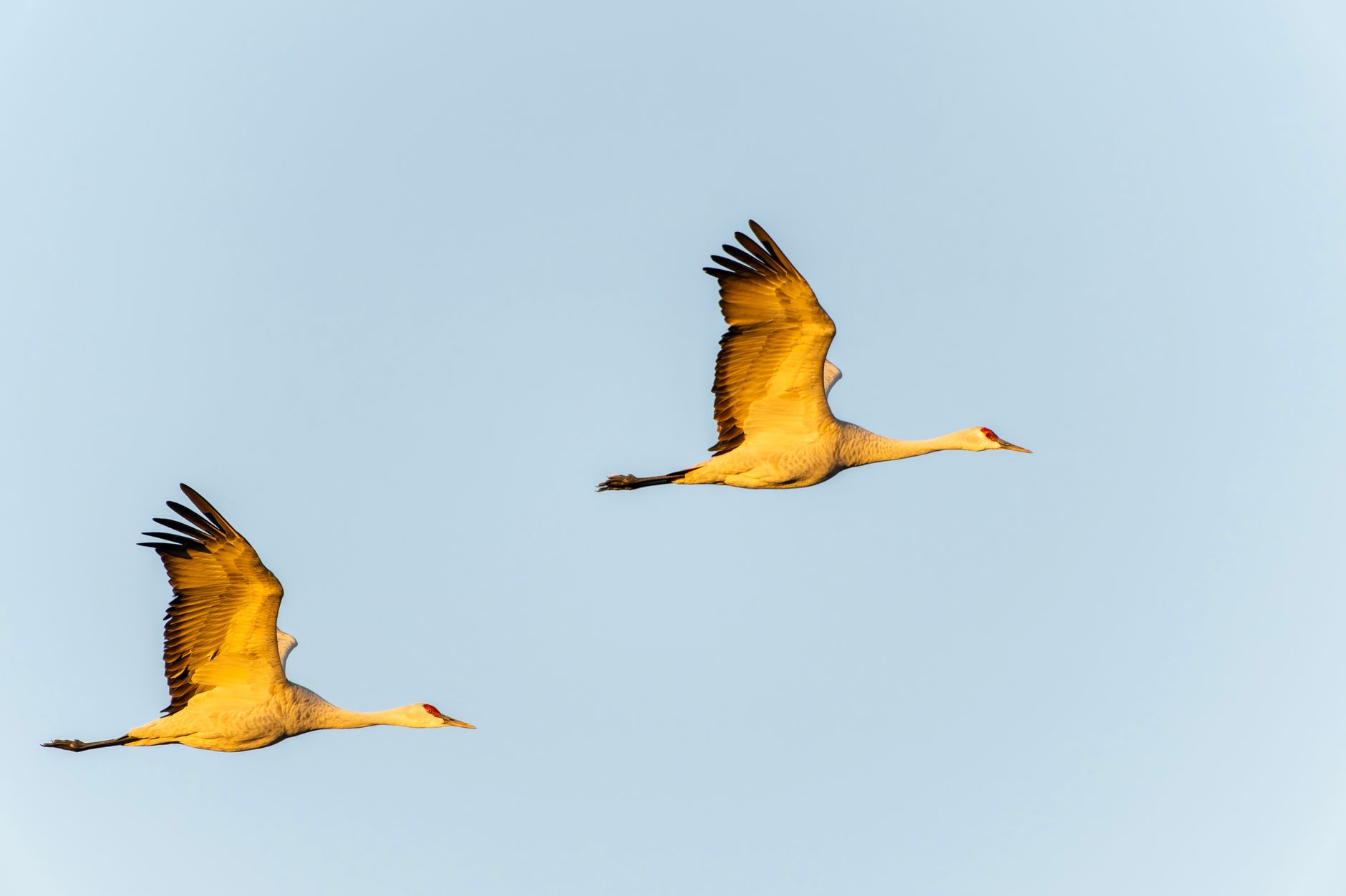

There is a sound that carries several miles across flat country before you see anything, a rolling wooden rattle from thousands of throats at once. Then the light comes up and the river in front of you is gray with birds standing in shallow water, and then all of them leave at the same time.
Sandhill Crane staging is one of the largest wildlife gatherings left in North America, and unlike most of them it happens on a predictable schedule at a small number of known places.
The daily rhythm, which is the whole thing
Every crane staging ground works the same way, and understanding it is what saves you from planning the trip wrong.
Cranes roost on shallow water at night, standing in a few inches of river or wetland, in the open, where nothing can approach without splashing. It is a predator-avoidance behavior and it is not negotiable for them. Shortly after first light they leave the roost in waves and fly out to feed, spending the day in agricultural fields eating waste grain and invertebrates, spread thin and often several miles away. Then at dusk they return, in a fly-in that can last an hour.
So the two events are dawn and dusk, at the roost, and the middle of the day is for finding feeding flocks in fields, which is pleasant but is not the spectacle. That single fact determines everything about the trip. Arrive at a famous crane site at eleven in the morning, look at the river, and you will see almost nothing and conclude the reports were exaggerated.
Riverfront Blind Tour: Migration, Conservation and Viewing EtiquetteThe Platte River, which is the big one
The central Platte in Nebraska, between Grand Island and Kearney, hosts the largest concentration. The spring population in the Central Flyway is commonly estimated at 600,000 to 800,000 birds, with numbers on the Platte peaking around 500,000 or more, and recent record springs topping 700,000. The migration runs from late February through early April, and the third week of March tends to be the peak.
The reason they stop here is specific. The Platte is a wide, shallow, braided river with sandbars, which is exactly the roosting substrate cranes need, and it sits at the point on the journey where birds must lay down fat for the remaining flight to the Arctic, with the surrounding cornfields supplying the calories. Cranes gain a significant proportion of their body weight during the stopover.
The Iain Nicolson Audubon Center at Rowe Sanctuary is the standard way in, running guided two-hour tours at sunrise and sunset from blinds on the river, with reservations opening months in advance; the 2026 season opened for booking in early January and these sell out. Crane Trust near Alda runs a similar blind program. If you would rather not book anything, public bridges and viewing decks along the river give free options, and the hike-bike bridge at Fort Kearny State Recreation Area is the classic no-cost dusk vantage.
Kearney is the usual base, with the largest choice of accommodation and the annual crane festival in March, sitting at the western end of the core stretch. Grand Island is the eastern anchor, similarly equipped and closer to the Crane Trust blinds, while Gibbon, Alda and the smaller towns between them put you nearest the river with very limited rooms. Book months ahead for the third week of March, because the peak week fills the whole corridor, and budget for a twenty or thirty minute drive to a blind in the dark on top of an already early start.
The other staging grounds
The Platte is the largest and it is not the only one worth traveling for.
-
Bosque del Apache, New Mexico. Wintering cranes alongside Snow Geese from November through February, where the combined dawn blast-off of both is the reason the place is famous.
-
Hiwassee Refuge, Tennessee. The Eastern Population from mid-October through February with a January peak. The refuge itself closes for the season and viewing is from a year-round observation platform.
-
Jasper-Pulaski, Indiana. The Eastern Population's autumn staging ground, peaking in November, with an observation mound built for the purpose.
-
Grays Lake, Idaho. A major Greater Sandhill Crane breeding and staging area in a high mountain basin.
-
Malheur, Oregon. Breeding and staging birds through the Blitzen Valley.
-
Sauvie Island, Oregon. Wintering cranes from September through March, within half an hour of Portland.
-
The Central Valley, California. Both Greater and Lesser Sandhill Cranes wintering, with Woodbridge Ecological Reserve, Cosumnes River Preserve and Merced National Wildlife Refuge the main sites.
-
Monte Vista, Colorado. A spring stopover in the San Luis Valley in March.
Whooping Cranes among them
Worth watching for wherever you are, because Sandhill flocks are how most people encounter the rarer bird.
Whooping Crane is North America's tallest bird and one of its rarest, with a total population in the hundreds after a low point of around fifteen birds in the 1940s. The Aransas-Wood Buffalo population, the only self-sustaining wild flock, migrates between northern Canada and the Texas coast and passes through the Central Flyway including the Platte in spring and autumn, so sightings there are possible. The eastern reintroduced population winters partly at Hiwassee in Tennessee and elsewhere in the south-east among Sandhills, and a smaller Louisiana population is non-migratory.
Adults are white with black primaries and a red crown, unmistakable in flight. The field difficulty is immature birds, which are extensively washed rusty-brown and can be genuinely hard to pick out among thousands of gray Sandhills in poor light.
If you find one, do not approach; watch from wherever you already are. Photograph the legs if you can, because color band combinations identify individual birds and the data matters. Report it through the appropriate state or federal channel as well as eBird. And expect the record to be obscured, since eBird treats the species as sensitive and hides it from public output, which is a feature rather than a failure.
The subspecies question
This explains why cranes in different places look like different sizes. Sandhill Cranes are divided into several subspecies: Lesser Sandhill Cranes breed in the Arctic including Siberia and are noticeably smaller and shorter-billed, Greater Sandhill Cranes breed in the temperate interior and are substantially larger, and Canadian Sandhill Cranes sit between the two. The Platte flock is predominantly Lessers with a mix of the others, which is why the birds there look smaller than a Greater standing in an Oregon meadow.
There are also non-migratory populations in Florida, Mississippi and Cuba, the latter two endangered and numbering in the low hundreds.
Why the Platte matters more than its size
A short piece of history changes how the river reads. The Platte was historically a mile wide and an inch deep, a braided, shifting, sandy river scoured every spring by snowmelt floods that swept away vegetation and kept the sandbars open.
Upstream dams and irrigation diversions cut the flows dramatically, and the channel narrowed as trees and shrubs colonized the bars that floods used to clear. Something like seventy percent of the historic flow has been diverted, and the roosting channel cranes require has contracted to a fraction of its former extent. What keeps it functioning now is active management, with conservation organizations mechanically clearing vegetation from sandbars, maintaining wet meadows and negotiating for flows.
So the half million cranes are not compressed onto eighty miles because they prefer it. They are compressed because that is what is left, and it is maintained by hand. That concentration is also the risk, because a single disease outbreak, chemical spill or catastrophic weather event could affect a very large proportion of a continental population in one place. It is the standard argument for why habitat elsewhere in the flyway matters even in the years the birds are not using it.
Sandhill Cranes Arriving at Roost on the Platte RiverWatching without doing damage
Cranes at a roost are vulnerable and easily displaced, and the etiquette matters more here than at most sites.
Be in position before the birds are, which means arriving at a blind or viewpoint well before first light and well before dusk, because walking in while cranes are on the roost puts them up. Stay in the blind or the vehicle, since cranes tolerate a static structure or a car and do not tolerate a person on the skyline. Use no lights, no flash and no drones, because a drone over a roost causes a mass flush at the worst possible moment. Keep quiet and keep still, as sound carries across water at dawn far better than you expect. And do not approach feeding flocks in fields, which are usually private farmland anyway and where pushing birds costs feeding time in the exact weeks they cannot spare it.
A flushed roost is not a minor event. Birds that abandon a roost site use worse ones, and repeated disturbance shifts the whole staging pattern.
The gear
Crane viewing is done from a blind, before dawn, in March, on a Nebraska river. Every item follows from that sentence.
A booking made months in advance, which is the item that decides whether the trip happens at all. The Rowe Sanctuary and Crane Trust blinds sell out for the peak weeks by January, sometimes earlier, and there is no walk-up option. Book in autumn for the following spring.
Genuine cold-weather layers, because you are sitting still in an unheated blind from before first light, over open water, in a month when central Nebraska routinely runs below freezing at dawn. Nothing about this is strenuous, which is exactly why the cold gets in.
A spotting scope, since the roost is out on the channel and the birds are not coming to you.
A camera with high-ISO capability, because the two best moments, the arrival at dusk and the lift-off at dawn, both happen in light that a slow lens cannot handle. This is the one situation where sensor performance matters more than reach.
A red-filtered headlamp for walking in and out, which is required by the blinds rather than suggested. White light at a roost puts the whole river up.
A thermos and something to sit on, since the blind benches are hard and the wait is two hours.
And a land ownership map, if you plan to look at fields away from the sanctuaries, because almost all of the surrounding cornfield feeding habitat is private.
The dancing
One behavior people travel for, and worth watching properly. Cranes dance: bowing, leaping vertically several feet with wings spread, tossing vegetation or sticks into the air, and running with wings half open.
It is easy to assume this is courtship, and it is more than that. Cranes of all ages dance, including juveniles, and it appears to function in pair bonding, in reinforcing an existing bond, in reducing aggression, and simply as something young birds do because they are young. On a staging ground it is contagious, and one pair starting can set off several nearby until a whole area of a field is leaping. It also becomes more frequent late in the staging period, as birds on the Platte in the third and fourth weeks of March get closer to the breeding grounds and the season.
Look for it in feeding fields during the day rather than at the roost, most often in the late morning and afternoon when birds are settled and fed. It is also the answer to what to do with the long gap between the two roost events: find a feeding flock from a road, park, and wait.
The plan
For the maximum, go to the central Platte in the third week of March, book a Rowe Sanctuary blind months ahead, and give it two dawns and two dusks, because the weather will take one of them. For a smaller, quieter and much cheaper version, go to Hiwassee in January, Bosque del Apache in December, or Jasper-Pulaski in November.
Whichever you pick, be there before the light. That is the entire technique.
One thing to sort before you go: crane viewing is an access problem in a specific way, because the birds spend the night on public or protected water and the day on private farmland. The roost has managed viewing and the feeding flocks do not, so the question you face at ten in the morning with a flock four hundred yards out is whether the roadside you are standing on is a legal vantage. Guidepole Bird carries that layer, meaning which river access is public, which reserve needs a booking, and where the road right of way ends.
For the specific sites, Hiwassee covers the eastern option in detail, Central Valley waterfowl covers the California roosts, and Malheur covers the Oregon high desert.
The largest wintering concentration in the Southeast, watched from a single platform, is in the Hiwassee sandhill cranes. The California end of the same continental system is in Central Valley waterfowl. The disturbance question that governs every rule at a roost is in nesting and seasonal closures explained, the autumn season on the same flyway is in birding during hunting season, and the other great spring spectacle of white birds on farmland is in Skagit flats snow geese.