Fish
Fish Fire
Fire Hike
Hike Bird
Bird

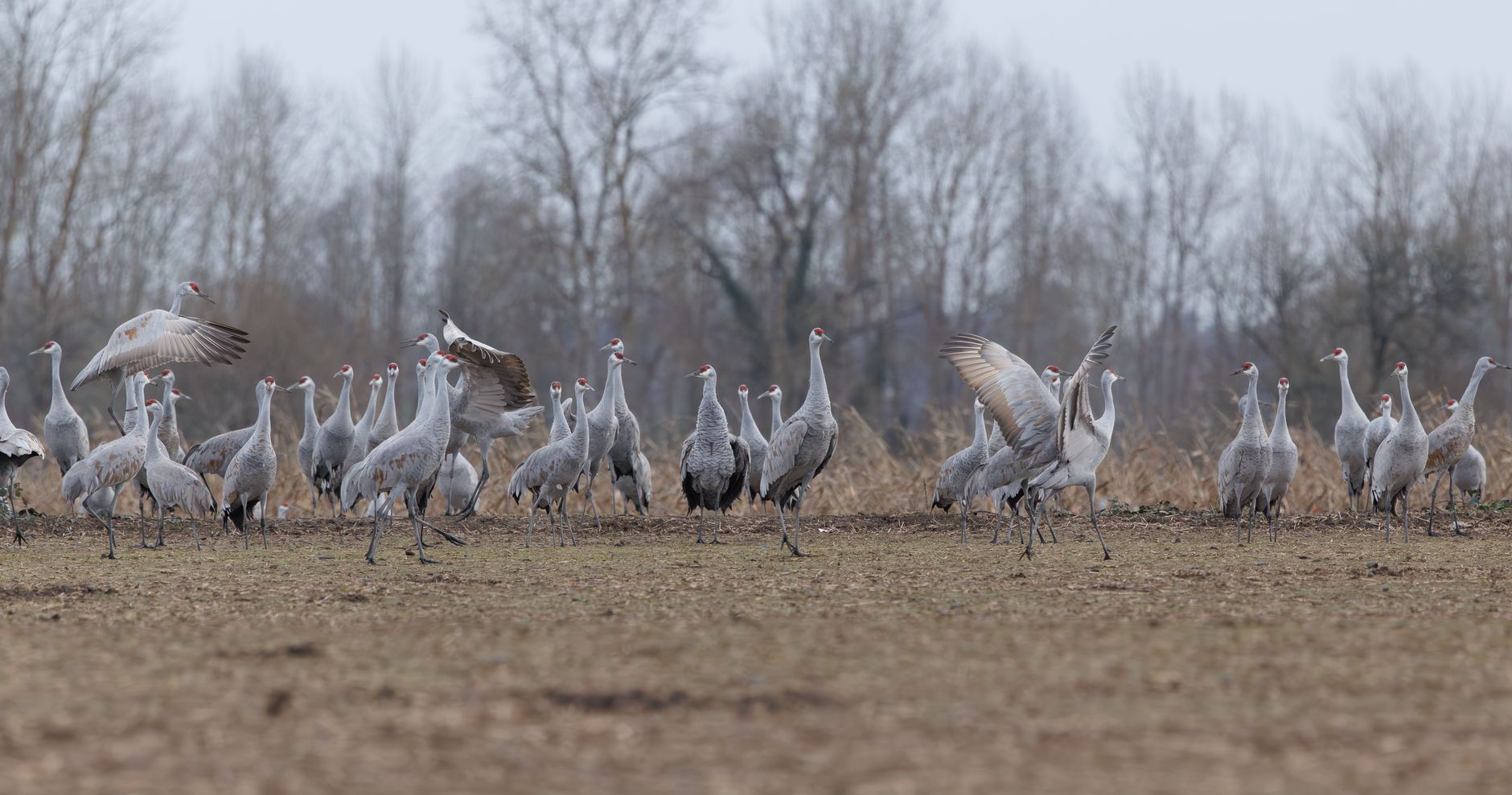

You hear them a long time before you see them. Sandhill Cranes have a rolling, rattling call that carries for miles across open water, and on a still January morning at Blythe Ferry it arrives from every direction at once.
Then the light comes up over the Tennessee River and there are thousands of gray birds on the far bank, and a few of them are, if you are having a very good day, white.
The closure is the point
Here is the thing that confuses first-time visitors, and it is worth stating before anything else. Hiwassee Refuge is closed to the public from November 15 to the last day of February, which covers the heart of the period the cranes are there.
That is not a scheduling error. The Tennessee Wildlife Resources Agency closes the refuge in winter precisely because the birds need somewhere they are not walked through, and a wintering flock pushed off its roost repeatedly burns energy it needs and eventually leaves for somewhere worse.
The Observation Platform is open year-round during daylight hours with no fee, and that is the designed answer: the refuge is the birds' and the platform is yours. From it, November through February, you can watch Sandhill Cranes and occasionally an endangered Whooping Crane, with peak numbers in January. The arrangement is a small masterclass in how wildlife viewing is supposed to work, and it is why the birds are still there.
Where to stand, and how to get there
Two places matter and they complement each other. The Hiwassee Refuge Observation Platform looks out over the wintering ground. Cherokee Removal Memorial Park at Blythe Ferry, at 6800 Blythe Ferry Lane, gives a second overlook from higher ground with a different angle across the water and a visitor center. It is also a site of real historical weight, marking the departure point where thousands of Cherokee people crossed the Tennessee River on the Trail of Tears, and it is worth arriving with that in mind rather than treating it purely as a birding overlook. Between the two you can generally find the flock, because the birds shift between roost water and feeding fields through the day.
The directions matter because the turns are unmarked enough to catch people out in the dark. From I-75, take exit 25 at Cleveland, Tennessee, and head north on Highway 60 through Birchwood. Roughly 1.7 miles north of the town, turn right on Shadden Road, go a mile, turn right on Blythe Ferry Road, then take the next left onto Priddy Lane and follow the signs.
Drive the route in daylight the first time if you possibly can, or at least once before committing to a pre-dawn arrival. The last stretch is rural and narrow, so park in the provided area rather than on the shoulder. Chattanooga is about forty minutes away, which makes this an easy morning trip from a comfortable base rather than an expedition. And during the January festival, do not drive to the platform at all; use one of the three designated parking areas and take the free shuttle, which exists precisely because the lane cannot absorb festival traffic.
Hiwassee Refuge Management and Wildlife ViewingTiming a visit
-
Cranes are present from mid-October through February, sometimes into March.
-
January is the peak. If you are making one trip, make it then.
-
Dawn and late afternoon are the events. Cranes roost on water and feed in fields, and the movement between the two at either end of the day is when you get flight and noise and numbers overhead rather than distant birds standing still.
-
Midday is the quiet stretch, and a reasonable time to visit the Cherokee Removal Memorial Park visitor center or drive the surrounding country.
-
Cold snaps concentrate birds, so a run of hard weather up-flyway is worth watching for.
Watch the weather up-flyway as much as the calendar, because that is what moves the numbers. A hard freeze around the western Great Lakes pushes birds south in a wave, and a flock that was three thousand at the weekend can be twice that by midweek. The reverse holds too: a mild December can leave a good proportion of the population sitting well north of Tennessee into January, which is the usual reason an early-season visit disappoints.
Telling the two cranes apart
This is the whole reason to keep scanning, so it is worth being specific. Sandhill Crane is gray overall, often stained rusty on the back and wings from iron-rich mud the birds preen into their feathers, with a bare red crown and a dark bill, and in flight gray with a slightly darker trailing edge. Whooping Crane is white with black primaries, taller, with a red crown and face patch and a heavier pale bill, and in flight the black wingtips against white are unmistakable at considerable distance.
The practical field problem is not confusing the two adults. It is that immature Whooping Cranes are extensively washed rusty-brown, which at range in poor light among thousands of gray birds is genuinely difficult, and it is why the platform regulars keep scanning long after everyone else has decided the flock is uniform. A useful shortcut is to look for the bird that is too tall, because height difference reads at distance more reliably than color does in flat winter light.
A small number of Whooping Cranes winter in the eastern flyway and some pass through or stay here among the Sandhills. This is a species with a population in the hundreds, so treat a sighting accordingly: do not approach, watch from the platform with a scope like everything else, and report it properly, since sightings are tracked and color band combinations matter. Photograph the legs if you can do it from where you already are, and expect eBird to obscure the record, because sensitive species are hidden from public output and that is a feature. Finding one is a real privilege, and the correct response is to make yourself less relevant to the bird rather than more.
Winter Birding and Sandhill Cranes at Hiwassee Wildlife RefugeWhy the cranes are here at all
This is a relatively recent phenomenon, and knowing it changes how the flock reads. The cranes wintering here belong to the Eastern Population, which breeds around the western Great Lakes and in Ontario, and which collapsed to very low numbers in the early twentieth century through hunting and wetland drainage. Its recovery over the following decades is one of the substantial conservation successes of the continent.
As numbers rebuilt, the wintering distribution shifted, and Hiwassee became a major stopover and then a wintering site within living memory, helped by the combination of protected roost water at the river confluence and abundant waste grain in the surrounding farmland. Both halves are required. The refuge provides the safe roost and the farms provide the food, so a crane flying out to a field in the morning and back to the water at night is moving between two different land ownerships, which is a neat illustration of why access maps and bird maps are the same map.
The festival, and the hunting question
The Tennessee Sandhill Crane Festival is held at Birchwood each January and is well into its fourth decade, marking its 35th year in 2026. It runs over a weekend with spotting scopes set up and staff on hand at both the refuge platform and the Cherokee Removal Memorial overlook, with parking distributed across the memorial park, Birchwood Baptist Church on Highway 60 and the Birchwood Community Center, and free shuttles running a loop between them. If you want scopes, expertise and company, go to the festival. If you want quiet, go on an ordinary weekday in January. Both are correct and they are different trips.
The hunting question comes up here more than at most crane sites and is worth addressing rather than avoiding. Tennessee established a limited Sandhill Crane season following the recovery of the Eastern Population, after considerable public debate in which birders and hunters were frequently on opposite sides. The practical facts for a visitor are that the refuge is closed through the crane season and the observation platform area is a viewing site rather than a hunting one, so what you are watching is a protected concentration. The wider point is worth carrying: the Eastern Population recovered from near-collapse largely through habitat protection and hunting regulation funded substantially by hunters, and it recovered to the point where a limited season became a live question. Those two facts sit together whether or not you like the conclusion.
The gear
Hiwassee is watched from one place, at distance, in cold weather, for a long time. Every item here follows from that.
A spotting scope is the difference between a good visit and a frustrating one. The cranes are across water from the observation platform and they are not coming closer, which is the whole design of the site. Twenty or thirty power turns a distant gray mass into individual birds you can age, sex by behavior, and search for the odd Whooping Crane among.
Far more layers than the forecast suggests. A Tennessee January afternoon reading forty degrees on a screen behind a windbreak reads considerably colder standing still on an exposed platform over water for three hours, which is what you are going to do.
A thermos, for the same reason.
Binoculars with good low-light performance, because the best hour is the last one, when birds are coming in to roost and the light is going.
A camera with reach, used from the platform rather than from closer. The entire refuge is closed to entry during the crane season and the platform is the intended vantage point. A longer lens is the legitimate way to get a closer picture.
Ear protection from the wind rather than from the cranes, which is a real consideration on a river platform and is the sort of thing nobody thinks about until their ears ache.
And the refuge calendar checked in advance, since the festival weekend, the sandhill crane hunting season and the general seasonal closure all move independently and all change what a visit looks like.
Photographing from the platform
The constraints here are unusual enough to need their own adjustments. You are fixed, with one vantage and no way to reposition, so composition is a matter of waiting for the birds to move rather than moving yourself. The good light is marginal light, since dawn and dusk are when the birds fly, which means high ISO and accepting noise. Shoot the flight rather than the standing bird, because a distant gray crane on a far bank is a poor photograph at any focal length while a skein coming overhead at dawn is a good one at almost any. Bring a long lens and expect still to be short, because the far bank is far. And use the platform rail as a rest, which is more stable than a tripod on a windy platform and considerably faster to redirect.
A first visit
The crane spectacle overshadows a good general winter site. Bald Eagles are reliable, drawn by the same open water and waterfowl concentrations, waterfowl numbers on the river and the refuge impoundments are substantial through the winter, and raptors over the surrounding farmland including harriers and wintering hawks make the drive in productive. Once the refuge reopens on March 1 it becomes an ordinary, pleasant, walkable wildlife area for the other eight months of the year, which almost nobody visits.
Arrive at the observation platform before sunrise in January, in more clothing than you think you need, with a scope. Listen first, then watch the roost lift. Move to the Cherokee Removal Memorial overlook when the light gets high, and give the place its due as a historical site while you are there. Come back for the evening return.
And do not try to get closer than the platform. The reason there are thousands of cranes in front of you is that for a hundred days a year, nobody does. That question, which unit is closed and from when and what the one piece of ground you can legally stand on is, is what Guidepole Bird answers, and it matters far more at the hundreds of unsigned state wildlife areas than it does at a well-marked site like this one.
For the wider picture, sandhill crane migration viewing covers the other staging grounds and the timing that governs all of them, and a wildlife refuge is not a park explains why a state refuge closure like this one works the way it does.
The national picture for this species, including the vastly larger Platte River staging, is in sandhill crane migration viewing. The reason the whole refuge is shut while you watch from one platform is in a wildlife refuge is not a park and nesting and seasonal closures explained. The hunting season that runs alongside the viewing season is covered in birding during hunting season, and the nearest city birding is in birding Nashville.