Fish
Fish Fire
Fire Hike
Hike Bird
Bird

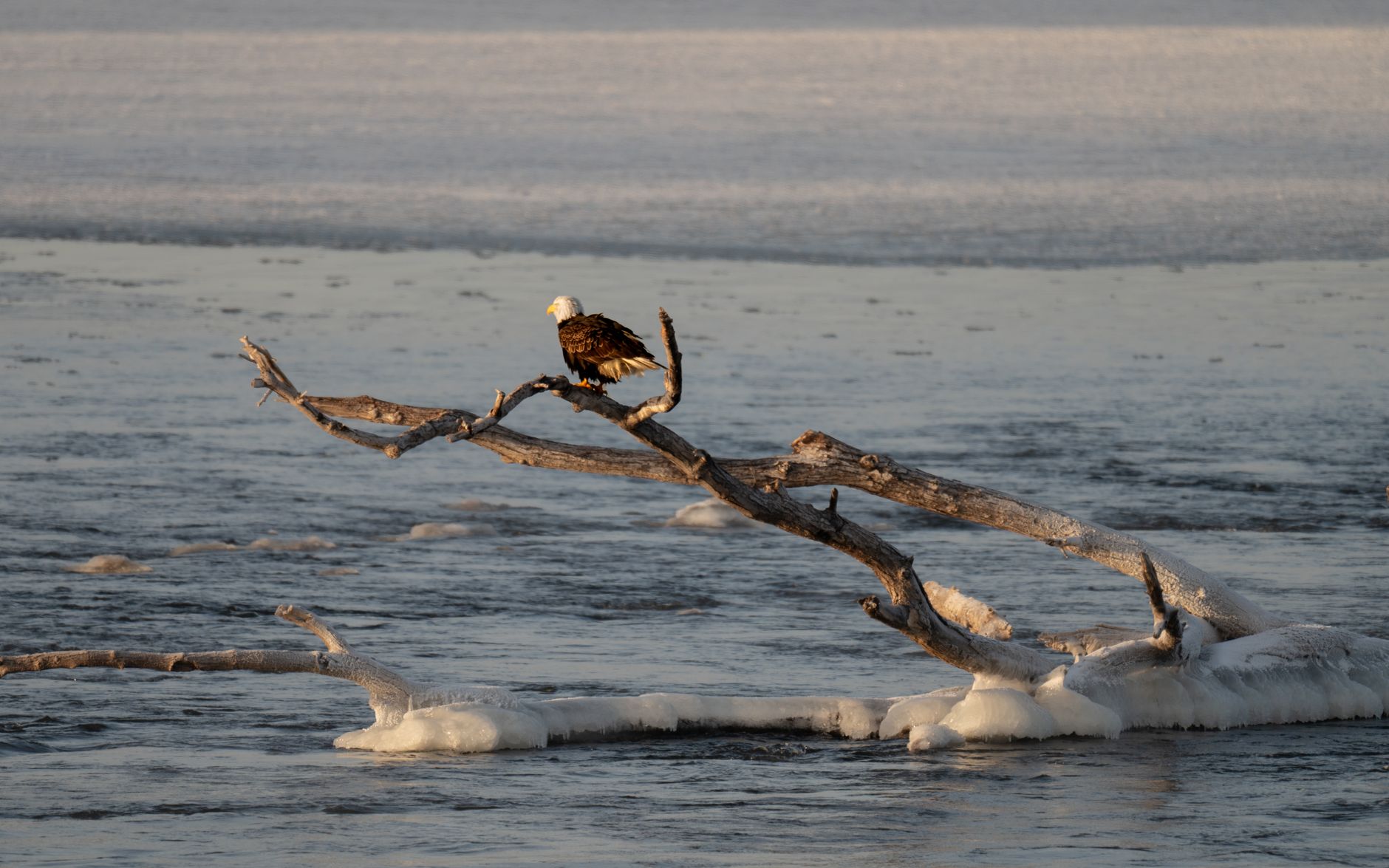

The Alaska Chilkat Bald Eagle Preserve protects 48,000 acres along the Chilkat River near Haines, and it is billed, accurately, as the site of the world's largest gathering of Bald Eagles.
The question is how large, and the honest answer is more interesting than the brochure.
The numbers, properly
You will see figures of three or four thousand birds, and occasionally much higher, attached to this place. The survey record tells a different story. From 1988 to 2000, peak counts consistently exceeded 1,000 eagles. Since 2011, counts have passed 1,000 only four times. A survey in late November 2025 documented over 1,400 birds, described by the Takshanuk Watershed Council as the highest count since 2000. Two hundred to four hundred eagles are resident year-round.
So the good news is that 2025 was an unusually strong year. The context is that it was strong relative to a baseline that has fallen substantially over three decades.
Biologists point to two things. Chum salmon availability is the main driver, and strong runs correlate with higher counts, with the 2025 peak chum count exceeding 20,000 fish, which is what produced the eagles. Warmer autumns are the other factor, since southeast Alaska has warmed roughly four degrees since 1988, and in a warm year eagles spread across a wider area away from the road, which makes them both harder to count and harder to see.
It is also worth knowing that monitoring here is chronically underfunded. Aerial surveys, the most comprehensive method, have not been flown for at least twenty years, and road surveys are the only current tracking mechanism with obvious limits. One biologist quoted on the subject put it plainly: he is not sure what the eagles are doing in the valley.
None of this means do not go. It means go, understand what you are looking at, and treat the round numbers on the tourism material with appropriate suspicion.
Where to stand
The viewing is straightforward and does not require a boat or a guide. Miles 18 to 24 of the Haines Highway run along the preserve, with the eagles concentrated on the river flats where warm groundwater upwelling keeps sections ice-free late into the season, holding the chum run that draws them. The Council Grounds pullout at Mile 19 is the main facility, with pit toilets, interpretive displays, a boardwalk and viewing scopes. Peak is late October through December, with November generally the center.
The rules are the same as anywhere with concentrated wildlife: stay on the boardwalk and the pullouts, do not walk out onto the flats, and do not push a bird for a photograph. A displaced eagle is one that stops feeding, in the season when it most needs to.
Eagles of the Alaska Chilkat Bald Eagle PreserveReading a salmon stream
Since salmon drive so much of the bird life here, a little fluency helps. Different species run at different times and each supports a different peak, with king and sockeye through early summer, pink and chum through mid to late summer, and coho and late chum into the autumn and early winter. It is that late chum run that produces the Chilkat gathering when everything else has frozen.
The carcasses are the point. After spawning the adults die, and the resulting biomass supports eagles, gulls, ravens, corvids and bears, and fertilizes the forest itself, with studies tracing marine-derived nitrogen from salmon into streamside trees. Dippers work the same streams, feeding on invertebrates including salmon eggs. Gull flocks are the signal worth using, because if you are looking for eagles from a road you should find the gulls first, since they are more visible and they are on the same food. And bears are on it too, which is the safety half of this, because a stream with fish and carcasses in it during the run is the highest-risk place in the region to walk without spray and noise.
The habit worth building is to check the run timing for the river you are visiting, because a stream between runs is quiet and the same stream two weeks later can be covered in birds.
Bald Eagles Feeding at a Salmon Stream near JuneauThe ferry, which is an underrated birding platform
The Alaska Marine Highway runs vessels through the Inside Passage, and for a birder it functions as a very cheap, very long pelagic trip. From the deck you can expect Marbled and Kittlitz's Murrelet, Pigeon Guillemot, Rhinoceros Auklet, Ancient Murrelet, three scoter species, Pacific Loon, Black-legged Kittiwake, and in summer Sooty and Short-tailed Shearwater on the more open crossings, with humpback and orca routine.
A few practical points make the difference. Sit on the outside deck rather than behind glass, and dress for the wind rather than the air temperature. The crossings across open water, particularly around Cross Sound and the exposed stretches, produce more than the sheltered narrows. And bring a scope only if you can brace it, because ship movement defeats a tripod, so binoculars and a beanbag on the rail work better. Note also that the schedule is the schedule: ferries run on their own logic and are subject to cancellation and vessel changes.
The gear
Southeast Alaska is a temperate rainforest with bears in it, and the gear list is dominated by those two facts.
The best rain gear you own, and then a spare. This is a place that receives its rainfall in feet rather than inches, the rain is frequently all day rather than in bursts, and there is no waiting it out because the alternative is a week indoors.
Bear spray, carried accessibly rather than in a pack. Salmon streams are where the eagles are and salmon streams are where the bears are, and those are the same places for the same reason. Know how to deploy it before you are standing in alders.
Binoculars you can use one-handed on a moving deck, which in practice means eight power rather than ten. The ferry is one of the best birding platforms in the region and it does not hold still.
A scope for the Chilkat pullouts, where the eagles are across the river and the count is the point.
Serious cold-weather layers for November, when the Chilkat congregation peaks and the temperature does not.
A headlamp for December, because the days are genuinely short at this latitude and the useful light is a narrow band.
And a land ownership map, since Southeast is a mosaic of Tongass National Forest, state land, Alaska Native corporation land and private inholdings, and the boundaries are not marked in the woods.
Old growth, and why it matters to birds
The forest here is not scenery, it is habitat with specific structure, and understanding that changes what you look for.
Marbled Murrelet nests on wide moss-covered branches in old-growth conifers, sometimes many miles inland, and flies to sea to feed. It needs branches thick enough to hold a nest cup, which takes centuries to grow, and that is the reason the species is listed in the lower 48 and the reason logging in the Tongass is a bird conservation issue rather than only a landscape one. Kittlitz's Murrelet, by contrast, nests on bare ground on scree near glaciers, which ties it to receding ice in a way that is not going to end well. Northern Goshawk of the distinctive coastal subspecies is an old-growth bird here. Cavity nesters including Chestnut-backed Chickadee, Red-breasted Sapsucker and Hairy Woodpecker depend on the large dead standing wood that mature forest supplies and young plantations do not. And Sooty Grouse hoot from high in the canopy in spring, which is a difficult sound to locate and one of the more entertaining challenges available.
The practical version for a birder is that a two-hundred-year-old stand and a forty-year-old clearcut regrowth look superficially similar from a road and hold completely different birds. Learning to tell them apart is the most useful field skill in the region.
The other seasons
Eagles are the winter story and the region is not a one-season destination. Late April and early May bring the Stikine River delta shorebird passage near Wrangell, one of the largest concentrations on the Pacific coast, with Western Sandpiper in enormous numbers plus a substantial eagle gathering on the eulachon run. May and June are the breeding season, with Varied Thrush, Pacific Wren, Townsend's and Wilson's Warbler, Rufous Hummingbird, Sooty Grouse hooting from the hemlocks, and Marbled Murrelet flying inland at dawn to nest on old-growth branches. Summer puts seabird colonies at their peak and gives the long light, along with Glacier Bay and the tidewater glacier front where Kittlitz's Murrelet and Black-legged Kittiwake concentrate. And August and September bring southbound shorebirds to the estuaries and the start of the salmon-driven eagle build-up.
Glacier Bay and the tidewater fronts
If the trip allows it, this is the other thing southeast Alaska does that nowhere else does as well. Glacier Bay National Park is reached by boat or plane rather than road, and the bay functions as a corridor from mature forest at the mouth to bare recently deglaciated ground at the head, compressing a century of ecological succession into a day's travel.
For birds the tidewater glacier fronts are the draw. Black-legged Kittiwakes nest on the cliffs and feed in the plumes of upwelling meltwater at the ice face, which concentrates prey. Kittlitz's Murrelet, one of the least known seabirds in North America and closely tied to glacial habitat, is most reliably found here. Arctic Tern, Pigeon Guillemot, Harlequin Duck and large numbers of scoters use the bay, and South Marble Island holds a seabird colony and sea lion haul-out that is a standard stop on the day boat.
The park day boat is the usual way in for a birder without a kayak, private vessels need permits in the peak season, and the weather governs everything. It is not a cheap addition to a trip, and it is the sort of place that justifies itself.
Practical reality
It rains. Southeast Alaska is temperate rainforest and several communities record extraordinary annual rainfall, so plan for wet rather than for a break in the wet. Getting around is by boat or plane, since most communities here have no road connection to anywhere, with Haines and Skagway the exceptions, connected via Canada. Bears are everywhere, both brown and black, and salmon streams in season are the highest-risk places to be on foot. Daylight is extreme in both directions, with June giving nearly endless working light and December giving very little, which matters a great deal for a winter eagle trip. And costs are high, with accommodation in Haines during the eagle season booking out well ahead.
The ownership map is its own hazard. Southeast Alaska is mostly Tongass National Forest, the largest national forest in the country, interleaved with state land, Alaska Native corporation land under the Alaska Native Claims Settlement Act, municipal ground, private parcels and a national park. Native corporation land in particular is private property, frequently unposted and often indistinguishable from surrounding forest, and birders arriving from the lower 48 routinely assume that unfenced forest in Alaska is public when a great deal of it is not. Guidepole Bird carries that layer, which here is the difference between national forest you may walk and corporation land you may not.
The towns, and a first trip
Because almost none of this is connected by road, choosing where to stay decides what you can see. Haines is the eagle base, road-connected via Canada, small, and the natural center for the Chilkat preserve, also giving access to Chilkat and Chilkoot lakes and the Chilkat State Park shoreline. Juneau has the most flights, the most accommodation and good birding within reach, with the Mendenhall Wetlands State Game Refuge on the edge of town excellent for shorebirds and waterfowl and the Mendenhall Glacier area adding forest species. Sitka faces the open Pacific, which makes it the best base for seabirds and the outer coast, with the Sitka Sound crossings productive from the ferry. Wrangell and Petersburg are the bases for the Stikine delta in spring and are small enough that accommodation needs booking early for the shorebird week. And Gustavus is the gateway to Glacier Bay, with a small number of lodges plus its own good birding on the flats.
The route that works for many visitors is to fly into Juneau, take the ferry one or two legs, and fly out of somewhere else, which turns the transport into part of the birding rather than a cost.
For eagles, fly or drive to Haines in November, stay several days because the weather will take some of them, and work Miles 18 to 24 in the morning light. For everything else, come in late May, take the ferry at least one leg with a full day on deck, and give yourself a morning in old growth listening for murrelets going inland.
Bring the best rain gear you own. Bring bear spray. Bring low expectations about the schedule and high ones about the birds.
For the wider context, where to see bald eagles in winter covers the other great salmon-river concentrations, and your first pelagic trip covers seabirding from a deck.
The wintering eagle concentrations here are the largest example of a pattern that repeats down the coast, covered in where to see bald eagles in winter. The ferry deck is the cheapest seawatch in North America, and the dedicated version of that is in your first pelagic trip. The nearest city with a comparable set of birds is in birding Anchorage, and the seabird colonies further south are in where to see puffins in Washington. Access on the mosaic of ownership here works much like state trust lands and access.