Fish
Fish Fire
Fire Hike
Hike Bird
Bird

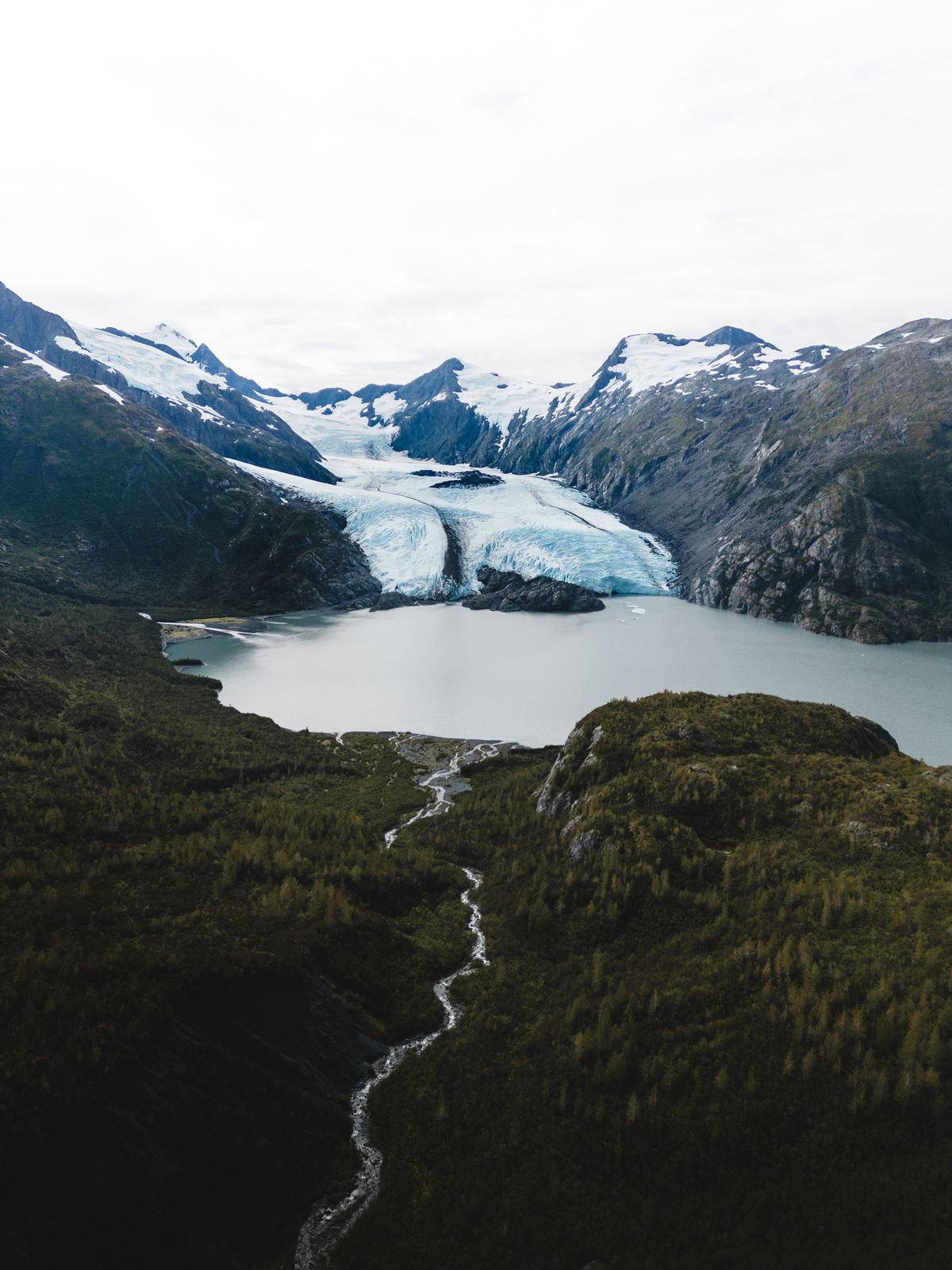

Seward, Alaska sits at the head of Resurrection Bay, wedged between mountains that still hold glaciers and a fjord system so deep the halibut have never seen sunlight. The town is 2,600 people, one main drag, a small boat harbor packed with charter vessels, and a relationship with fish that predates statehood. Seward is a fishing town. It has been a fishing town since the railroad arrived in 1903. The national park came later, Kenai Fjords was established in 1980, and the park is magnificent, but nobody in Seward confuses the park with the fishing.
That's because the park itself is mostly ice. The Harding Icefield, 700 square miles of ice up to a mile thick, covers the interior. Forty glaciers flow from it, including tidewater glaciers that calve directly into the fjords along the coast. Exit Glacier, the park's one road-accessible feature, spills down from the icefield toward the Resurrection River valley. The rest of the park is rock, ice, and ocean, accessible only by boat or floatplane. It is spectacularly beautiful and almost entirely devoid of fishable water.

The fishing happens at the edges. Exit Creek, a small stream near the Exit Glacier road, holds silver salmon and Dolly Varden. Resurrection Bay, the deep fjord that Seward sits on, produces halibut, salmon, rockfish, and lingcod from charter boats. And 90 miles northwest, the Kenai River, arguably the most famous salmon river in the world, runs through the same peninsula, drawing the same anglers, creating the same ecosystem of guides, lodges, and tackle shops that makes the Kenai Peninsula Alaska's most accessible fishing region.
This is a guide to fishing at, near, and around Kenai Fjords National Park, with honesty about what's actually in the park versus what's in the fishing town that serves as its front door.
Seward, A Fishing Town That Happens to Have a National Park

Seward's identity is the harbor. Walk the small boat harbor on any summer morning and you'll see charter captains prepping boats for halibut trips, commercial seiners loading gear, sport fishermen checking tackle, and a line at the fish-cleaning station that tells you yesterday was a good day. The harbor faces Resurrection Bay, a fjord that runs 24 miles to the Gulf of Alaska, with mountains on both sides reaching 5,000 feet. It's one of the most dramatic harbor settings in North America.
The town is accessible by road, the Seward Highway runs 127 miles from Anchorage through the Chugach Mountains and along Turnagain Arm, one of the most scenic drives in the state. That road access makes Seward the easiest gateway to saltwater fishing in Southcentral Alaska. You don't need a bush plane. You don't need a floatplane. You drive your truck to the harbor, walk down to the charter dock, and you're fishing in Resurrection Bay within 20 minutes.
This accessibility defines the fishing culture. Seward isn't a remote lodge operation where you spend $1,200 a night for guided fly-outs. It's a working port where a halibut-and-salmon combo charter runs $350-450 per person, and you can walk to the harbor from your hotel. A Seward charter captain isn't flying you to a remote lodge, they're meeting you at the dock and putting you on fish the same day. The fishing is democratic in a way that most Alaska destinations aren't, families, first-timers, serious anglers, and cruise ship passengers all fish the same water.
Exit Creek, The Fly Fishing Gem Inside the Park Boundary
Exit Creek flows from the area near Exit Glacier down through the Resurrection River valley. It's a small stream, intimate water by Alaska standards, running through cottonwood and spruce forest with gravel bars and shallow pools. It joins the Resurrection River, which flows through Seward into Resurrection Bay.
This is the park's legitimate freshwater fly-fishing opportunity, and in character it has more in common with the small streams of Glacier Bay or Denali than with the big water of the Kenai River. Silver salmon (coho) enter Exit Creek beginning in August, with the run building through September. These are ocean-bright fish pushing into a small stream, 8 to 12 pounds of chrome-sided, aggressive salmon that will chase a fly with the kind of violence that makes coho the fly angler's favorite Pacific salmon species.
The fishing is wade-and-cast on a stream small enough to cover with a 30-foot roll cast. The coho hold in the deeper pools and behind structure, stacking up where the current slows. You're not sight-fishing to individual fish the way you would on a spring creek, you're reading the water, identifying the holding lies, and swinging flies through runs where you know the fish are holding.
The Coho Fly Box, What Actually Works on the Kenai Peninsula
Silver salmon on the Kenai Peninsula eat aggressively, and the fly patterns that produce here are distinctly Alaskan. Forget the trout-centric patterns you'd fish on a Lower 48 stream. These fish want movement, flash, and color, particularly pink, purple, and chartreuse.
The essentials:
The Starlight Leech in pink is the standard by which all Alaska silver salmon flies are measured. Sparse, flashy, with marabou that pulses in the current, it has arguably caught more coho across Alaska than any other single pattern. Carry it in purple too, because some days the fish prefer it. The Popsicle, a pink-and-orange marabou streamer with flash, is another Kenai Peninsula staple that draws strikes from coho that have refused everything else. Egg-Sucking Leeches in black and purple (#2-6) are the all-purpose subsurface pattern, fished on a dead-drift or slow swing through the deeper pools. A Muddler Minnow (#4-8) swung through the head of a pool can also move coho, especially in lower, clearer water.
The Alaskabou is worth mentioning because it swings beautifully on a spey rod, if you're swinging flies through the longer runs, the Alaskabou's marabou and flash construction gives it a pulsing action that coho find irresistible. Pink Pollywogs and other surface patterns will draw explosive topwater strikes from fresh silvers holding in shallow pools, watching a coho blow up on a waking fly is one of Alaska fishing's great thrills. For subsurface stripping, a Clouser Minnow in chartreuse-and-white or pink-and-white (#2-4) is a proven producer, and a Woolly Bugger in pink or purple (#4-6) remains the fly that everyone carries and nobody brags about.
For Dolly Varden in Exit Creek and the Resurrection River system: egg patterns are the primary weapon during the salmon spawn, Glo Bugs in peach, Oregon cheese, and chartreuse (#8-12), along with 8mm-10mm beads in peach and orange. Beads are arguably the single most effective Dolly Varden technique in Alaska, though opinions on their sporting merit vary. Small flesh flies in pale pink (#6-10) imitate the decomposing salmon tissue that Dollies gorge on through the fall. The Dolly Llama, a large articulated streamer, is the pattern when you want to target the biggest char in the system. Standard nymphs, Pheasant Tail (#14-18), Hare's Ear (#12-16), Prince Nymph (#12-16), will pick up Dollies and the occasional rainbow trout between salmon runs. A San Juan Worm in red or pink (#10-14) is another reliable option for Dollies holding behind spawning salmon, it imitates the tissue debris that drifts through the water column during the spawn. If the Dollies are feeding selectively on the surface during an evening caddis hatch (which happens in late summer), an Elk Hair Caddis (#14-16) or a Parachute Adams (#14-18) will produce rises from char that normally ignore the surface entirely.
For pink salmon (which run in the Resurrection River system in July and August, heavy in even years): small pink and chartreuse flies are the ticket. Pink Sparkle Shrimp, Hot Pink Clousers, and sparse pink marabou streamers in #6-10 all produce. Pinks are the most willing salmon species, they'll eat almost anything pink thrown in their direction.
Gear for Exit Creek
Rod: An 8-weight, 9-foot, handles the coho. Bring a 6-weight for Dolly Varden and pink salmon if you want the lighter-rod experience, the Dollies don't require heavy tackle, and pinks on a 6-weight are genuinely fun.
Line: Weight-forward floating for most of the stream work. A sink-tip or short sinking leader for the deeper pools where coho hold tight to the bottom early in the run.
Leader: Short and stout for coho, 7.5 feet tapered to 0X or 1X. These fish aren't leader-shy, and you need the strength for a hot coho in current. For Dolly Varden on nymphs and eggs, go to 3X or 4X.
Wading: Chest waders and studded boots. The water is cold, glacier-fed streams on the Kenai Peninsula run 40-50°F even in August. You are not wet-wading this water.
Resurrection Bay, The Charter Fishery

The saltwater fishing out of Seward is the main event for most anglers visiting the area. Resurrection Bay and the waters of the Gulf of Alaska beyond it produce halibut, all five species of Pacific salmon, lingcod, and over 30 species of rockfish. This is charter-boat fishing, not fly fishing, but it's the fishing that defines Seward, and any honest guide to the area has to cover it.
Halibut
Halibut are the bread and butter of the Seward charter fleet. Most boats fish the deeper water outside Resurrection Bay, running 30 to 60 minutes to the halibut grounds in 150 to 400 feet of water. The fishing is conventional, heavy rods, braided line, large jigs or circle hooks baited with herring, dropped to the bottom and worked with short lifts.
Halibut catches in Seward commonly run 20 to 80 pounds, with fish over 100 pounds coming in regularly. The occasional 200-pound-plus barn door turns an expensive charter day into a story and a freezer full of the best white fish in the ocean. Halibut season runs May through September, with June and July typically the most consistent months.
This is not fly-rod territory. Nobody is fly fishing for halibut in 300 feet of water. But a halibut trip is part of the Seward fishing experience, and the combination of a halibut charter one day and fly fishing for silvers the next is how many anglers structure a Kenai Peninsula trip.
Salmon in Saltwater
Charter boats target silver salmon in Resurrection Bay from mid-July through September. The silvers stage in the bay before pushing into the rivers and creeks, and they're taken by trolling or mooching (slow-trolling cut herring). Fresh silvers in saltwater are chrome-bright and fight hard, they're acrobatic fish that jump repeatedly and make long runs.
King salmon are available from mid-May through July, though regulations have increasingly restricted the king fishery across Southcentral Alaska. Check current Alaska Department of Fish and Game regulations before planning a king trip, seasons, bag limits, and emergency closures change year to year based on run strength.
Pink salmon flood the bay in July and August (peak in even years), and while they're not a charter target, they provide near-constant action when the charters are focused on halibut or silvers. Chum salmon overlap with the pinks in late summer.
The Seward Silver Salmon Derby
The Seward Silver Salmon Derby is one of Alaska's oldest and most celebrated fishing events, running since 1956. Held annually in August when the coho runs peak in Resurrection Bay, the derby draws anglers from across Alaska and the Lower 48 for a week of competitive silver salmon fishing.
The format is straightforward: buy a derby ticket, catch the biggest silver salmon by weight, win cash. The grand prize is $10,000, with daily prizes, specialty categories, and tagged-fish bounties (catch one of the 10 specially tagged silvers and win up to $20,000). The derby is open to all gear types, so fly anglers compete alongside the trollers and moochers.
The derby is a Seward institution, it defines the town's August character. The harbor is packed, the restaurants are full, the fish-cleaning station runs nonstop, and the weigh-in at the harbor pavilion draws crowds every evening. If your visit coincides with the derby, fish it. If it doesn't, the silvers are still there, just without the prize money.
The Kenai River, The Elephant in the Room
Any guide to fishing the Kenai Fjords area has to address the Kenai River, because the Kenai River is the reason half the anglers on the peninsula are here in the first place. The river is roughly 90 miles northwest of Seward, about a 90-minute drive via the Seward and Sterling Highways, and it is, by most measures, the most famous salmon river in the world.
The Kenai produces king salmon over 90 pounds (the world record, 97 pounds 4 ounces, was caught here in 1985), massive runs of sockeye salmon that pack the Russian River confluence in July, silver salmon through September, and trophy rainbow trout that gorge on salmon eggs in the fall. The river is accessible, road-paralleled, heavily guided, and intensely managed. It is the opposite of wilderness fishing, combat fishing on the sockeye banks during the July run is a uniquely Alaskan experience that involves hundreds of anglers standing elbow-to-elbow, flipping weighted flies through schools of salmon so thick the water boils.
The Kenai is not in the park. It's not near the park. But many anglers combine a few days of Kenai River fishing (guided drift-boat trips for kings or silvers, or wading the Russian River for sockeye) with a day or two in Seward for halibut charters and the glacier tour boats. The peninsula is compact enough to make this work, you can fish the Kenai in the morning and be back in Seward for dinner.
For fly fishing specifically: the Kenai's upper river (above Skilak Lake) is the better fly water, smaller, wadeable, holding rainbow trout and Dolly Varden that eat standard nymph patterns (Pheasant Tail, Hare's Ear), egg patterns during the salmon spawn, and Woolly Buggers stripped through the deeper runs. The rainbow trout on the upper Kenai are genuine trophies, fish over 20 inches that gorge on salmon eggs in the fall and fight like nothing you've encountered on a 6-weight in the Lower 48. The trout fishing rivals what you'll find at Lake Clark or Katmai, but with road access instead of a floatplane. The lower Kenai, the big, powerful stretch below Soldotna, is primarily drift-boat water for kings and silvers, fished with heavy gear by guides who know the exact drifts.
The Glacier Connection, Exit Glacier and the Harding Icefield

Most visitors to Kenai Fjords come for the glaciers, not the fishing. Exit Glacier, the park's one drive-to attraction, 13 miles from Seward on a paved road, is where you walk up to a glacier without chartering a plane or a boat. The retreat of Exit Glacier is documented by signs along the trail marking where the glacier's terminus stood in various years, 1961, 1998, 2010, a quiet, devastating timeline of climate change rendered in concrete markers and bare rock.
The Harding Icefield Trail, which climbs 3,500 feet in four miles from the Exit Glacier nature center to the edge of the icefield itself, is one of the great day hikes in the national park system. You start in rainforest, climb through alpine meadow, and end standing at the edge of a 700-square-mile expanse of ice that stretches to every horizon. On a clear day, it redefines your understanding of scale.
The glacier boat tours from Seward, full-day trips into Aialik Bay and Northwestern Fjord to see tidewater glaciers calving into the ocean, humpback whales, orcas, sea otters, puffins, and Steller sea lions, are the other marquee park experience. These tours don't involve fishing, but they're the reason many anglers' non-fishing companions agree to the trip. A day on the glacier tour, a day on the halibut charter, a day wading Exit Creek for silvers, that's a Kenai Fjords trip.
The Calendar, When to Fish What
May: Halibut season opens. Charter boats are running. The weather is cold and unpredictable, 40s and 50s, rain. Freshwater streams are still running high from snowmelt. Not much happening for the fly angler specifically, but the halibut fishing is excellent.
June: King salmon appear in saltwater (check regulations, increasingly restricted). Halibut fishing peaks. Dolly Varden are active in the Resurrection River system. Long days, 19+ hours of light around the solstice. The glacier tours are running.
July: Pink salmon enter the Resurrection River and tributaries (heavy in even years). Silver salmon begin staging in Resurrection Bay. Halibut and rockfish remain strong from charters. The Seward highway is at its busiest. Exit Glacier is fully accessible.
August: Silver salmon peak in Resurrection Bay and begin entering Exit Creek and the Resurrection River. The Seward Silver Salmon Derby runs mid-month. This is the prime month for fly fishing for coho, fresh fish in the creeks, aggressive takes, chrome sides. Dolly Varden are transitioning to egg-feeding behind spawning pinks. The best overall month for an angler visiting the area.
September: Silver salmon continue in the creeks. Dolly Varden gorge on salmon eggs. The crowds thin dramatically. Weather turns, shorter days, colder temperatures, more rain. The fishing is still excellent but the town is quieter. This is the local's favorite month.
Regulations and Practicalities
All anglers 16 and older need an Alaska sport fishing license, available online through the Alaska Department of Fish and Game or at sporting goods shops in Seward and Anchorage. Non-residents need the standard non-resident license plus a king salmon stamp if targeting kings.
Key freshwater regulations for the Seward area: Except for the Resurrection River drainage, all freshwater drainages into Resurrection Bay are closed year-round to salmon fishing. The Resurrection River drainage downstream of the Seward Highway and Nash Road opens to fishing for silver salmon on August 1, with a daily bag limit of three salmon, of which two may be silvers. Dolly Varden, rainbow trout, and Arctic grayling are open in most fresh waters year-round.
Saltwater: Inside Resurrection Bay, all six of your daily salmon bag limit may be silver salmon. Outside the bay, only three of the six may be silvers. Halibut regulations (bag limits, size limits) change annually under IPHC management, your charter captain will have current rules.
Important: Regulations change year to year based on run strength, especially for king salmon. Always check current ADF&G regulations before fishing. Emergency orders can open or close fisheries with little notice.
What to Expect, The Honest Assessment
Kenai Fjords National Park is not a fishing destination in the way that Katmai is a fishing destination. The park itself offers limited freshwater fishing, Exit Creek and a handful of backcountry streams holding salmon and Dolly Varden. If you want big rainbow trout eating eggs behind spawning salmon in a wilderness stream, go to Katmai or Lake Clark. If you want the scale and remoteness of a true Alaska bush fishing experience, Wrangell-St. Elias delivers that on a scale that dwarfs everything else in the system, and Denali offers grayling and char fishing in genuine wilderness that Seward, which has a Safeway and cell service, cannot match.
But if you want to combine legitimate fly fishing for silver salmon with world-class saltwater charter fishing, spectacular glacier scenery, and the easy accessibility of a town you can drive to from Anchorage in three hours, Seward and Kenai Fjords deliver a combination that no other Alaska national park can match. Glacier Bay requires a flight to Gustavus. Glacier National Park in Montana is a different universe entirely. Seward is the Alaska fishing experience you can actually pull off in a long weekend.
The silver salmon in Exit Creek are real fish, aggressive, ocean-bright coho that will chase a pink Starlight Leech with the kind of commitment that makes you forget you're on a creek you can cast across. The halibut from the charter boats are real fish, 50-pounders that bend a heavy rod double and fill a cooler with the best eating fish in the Pacific. And the Kenai River, 90 minutes away, is the Kenai River, which needs no further explanation to anyone who has fished Alaska or dreamed about it.
Pack an 8-weight for the silvers. Book a halibut charter for the day your casting arm needs rest. Drive up to Exit Glacier and stand where the ice used to be. And if you have an extra day, drive the Sterling Highway to the Kenai and see what all the fuss is about. You'll understand immediately.