Fish
Fish Fire
Fire Hike
Hike Bird
Bird

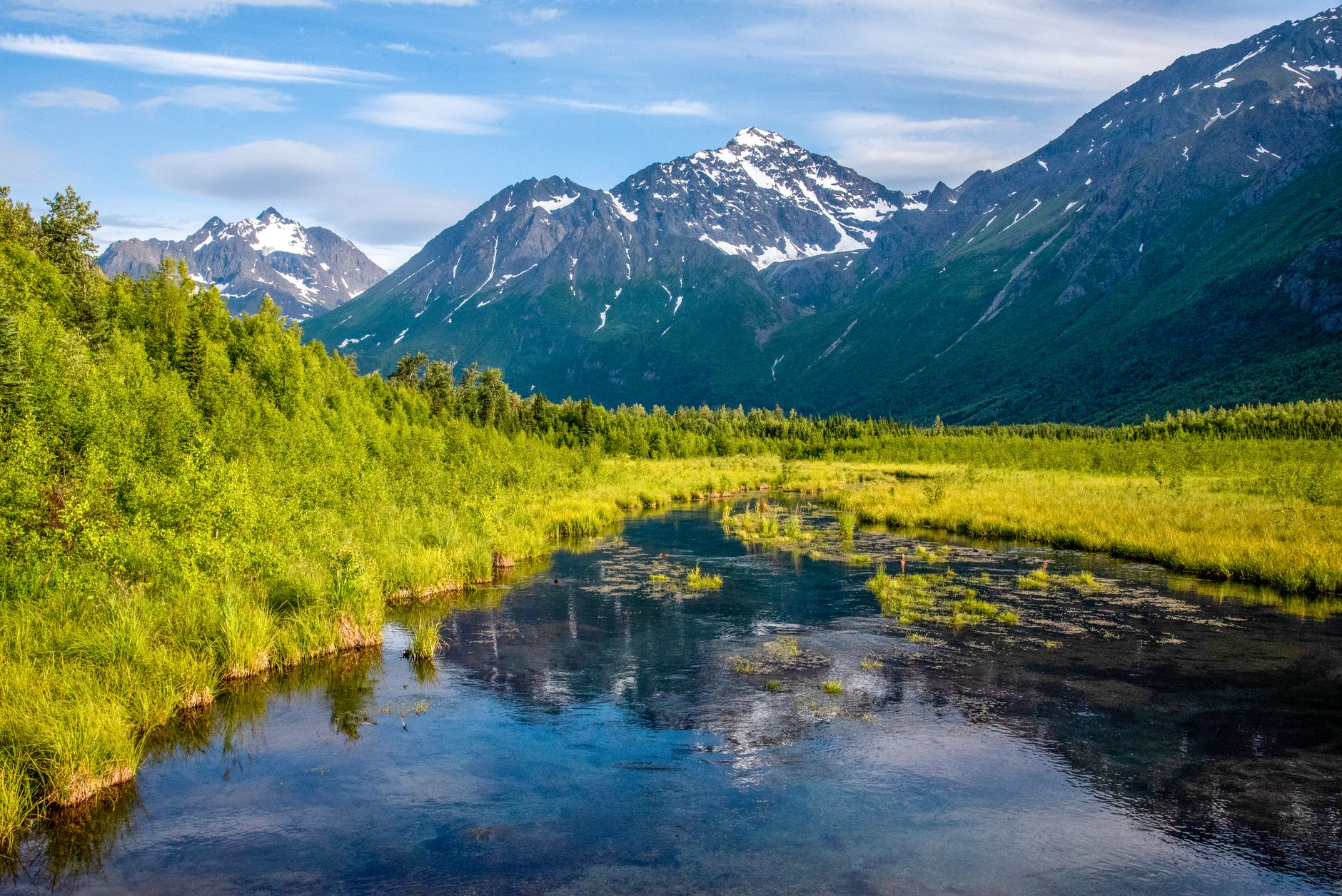

Potter Marsh is a 564-acre freshwater marsh that stretches nearly two miles between the New Seward Highway and the base of the Chugach Mountains, with 1,550 feet of boardwalk running out over it.
You park, you walk fifty yards, and a Trumpeter Swan is on the water with mountains behind it and traffic behind you. It is arguably the most accessible wildlife viewing in Alaska, and it is inside the city limits of the state's largest city.
Getting oriented
Anchorage is easy to bird once you understand its shape. The city sits on a triangle of land between Cook Inlet to the west, Turnagain Arm to the south and the wall of the Chugach Mountains to the east, and almost everything is within twenty minutes of everything else.
The Seward Highway runs south along Turnagain Arm and is the artery, with Potter Marsh at its northern end and the pull-offs along the arm serving as the mudflat viewpoints. The Tony Knowles Coastal Trail runs eleven miles along the inlet from downtown to Kincaid Park, linking Westchester Lagoon, the coastal bluff and the forest at the far end, and it is flat, paved and one of the better urban birding walks in the country. The Hillside rises east of the city into Chugach State Park, where gaining elevation happens fast. And the greenbelts follow the creeks through the city and connect the parks to each other.
The practical version is that you can be on tidal mudflat, freshwater marsh, boreal forest and alpine tundra in a single day without driving more than an hour.
Potter Marsh
The marsh forms the southern end of the Anchorage Coastal Wildlife Refuge, and it concentrates at least 130 species of migratory and nesting birds. The boardwalk is the whole facility and it is enough, being flat, accessible, and placed over the water rather than beside it.
Trumpeter Swans and Arctic Terns are the headline birds, both frequently at very close range after green-up, alongside a long list of ducks and geese, Red-necked and Horned Grebe, Bald Eagle, and passerines in the willow and alder edges. The marsh also holds moose, beaver, muskrat and spawning salmon, which makes it an unusually productive fifty yards of boardwalk.
Timing matters more than at most sites:
-
Late April through mid-May is spring migration, with large concentrations of waterfowl stopping on the way to breeding grounds further north.
-
Mid-May through late June is the most active period, with new chicks hatching and birds at their most visible, and it is the best window for photography.
-
Late July and August brings shorebirds flocking up before southbound migration.
-
Winter freezes the marsh and the birding moves elsewhere entirely.
The Arctic Terns are the point
Worth pausing on, because most visitors walk past without knowing. The Arctic Terns screaming at you from the marsh have one of the longest migrations of any animal on Earth, breeding in the Arctic and wintering in Antarctic waters, following the sun, which over a lifetime can run to millions of miles of travel. The bird hovering over a boardwalk in south-central Alaska in June was, four months ago, somewhere near the edge of the Antarctic pack ice.
They are also aggressive nest defenders and will strike at your head if you get close to a nest. Stay on the boardwalk, which is where you should be anyway.
Potter Marsh Bird Sanctuary and Coastal Wildlife Refuge: A Travel GuideThe mudflat shorebird show
The flats you must not walk on are where a good deal of the interest is, and they are watchable from solid ground. Cook Inlet has one of the largest tidal ranges in North America, and the exposed silt flats around Turnagain Arm and the Anchorage coastal refuge support very large numbers of shorebirds on passage.
Late April and early May bring the northbound movement, with Western Sandpiper, Dunlin, Least Sandpiper, Hudsonian Godwit, Whimbrel and Short-billed Dowitcher among the regulars, sometimes in flocks of thousands. July and August bring the southbound return, more protracted, with adults first and juveniles later.
Watch from the Potter Marsh boardwalk, the pull-offs along the Seward Highway on Turnagain Arm, or the Tony Knowles Coastal Trail on the city side, and time it with the tide, because a rising tide pushes birds off the flats toward the shore and is far better than dead low water when everything is a mile out and unidentifiable.
And once more, because it matters: the flats themselves are lethal. Watch from the trail, the boardwalk or the highway pull-off.
The rest of the city
Westchester Lagoon near downtown is the other essential site, a freshwater lagoon on the Coastal Trail with waterfowl at close range, breeding grebes, terns and gulls in summer, and one of the easiest urban birding walks anywhere. Ship Creek, in the middle of the city, has a salmon run that draws gulls, eagles and at times bears, in a setting of railroad yards and industrial buildings, which is an extremely Alaskan piece of urban wildlife viewing. Kincaid Park on the western point gives boreal forest, coastal bluff and views over Cook Inlet, with spruce and birch forest species and a good chance of moose. Campbell Creek and the greenbelt system run through the city holding dipper, waterfowl and forest birds. And the Hillside and the edge of Chugach State Park put you into subalpine and alpine within a short drive, which is where the ptarmigan, Golden-crowned Sparrow and Northern Wheatear are.
Anchorage Audubon runs field trips and maintains the local rare bird information, which is the fastest way in for a visitor.
The gear
Anchorage is the only city in this library where the gear list has to account for bears and for tidal mudflats that kill people, and both belong on it.
Bear spray, carried where you can reach it rather than in a pack. Anchorage has both black and brown bears inside the municipality, the greenbelt trails that hold the best birding are also bear travel corridors, and Campbell Creek in July is a salmon stream running through a city.
Serious mosquito protection, because the marsh and the boreal edge are exactly where the birds are and exactly where the mosquitoes are, and a June evening at Potter Marsh without it is not birding.
A sleep mask, which sounds like a joke and is not. In June the sun barely sets, birds sing through what should be the night, and visitors who do not sleep do not bird well on day three.
A spotting scope for the Turnagain Arm mudflats and for the marsh, both of which are wide.
Layers for a cold June morning, since fifty degrees with wind off the inlet at six in the morning is the normal case.
Waterproof boots, for the boggy edges everywhere.
And the Anchorage Audubon rare bird information, because this is a city where Asian strays turn up with some regularity and the local network is how you hear about them.
The hazards, stated plainly
Anchorage is the only major American city where this section is necessary.
Moose are the main risk. They are numerous inside the city, dangerous in spring when cows have calves and in autumn during the rut, and they cause more injuries in Alaska than bears do, so give them a wide berth, put something solid between you and them, and never get between a cow and a calf. Both brown and black bears are present within the municipality, particularly along the creek corridors during the salmon runs, with Ship Creek, Campbell Creek and the Hillside trails all seeing bear activity, so carry spray, make noise on the greenbelt trails, and do not use headphones.
The Cook Inlet mudflats are lethal. The fine glacial silt behaves like quicksand, tides come in fast and with an enormous range, and people have died on them. Do not walk out onto the flats. This is not an abundance of caution.
The seasons, and the light
May and June are the season. Migration overlaps with breeding, the light is extraordinary, and the birds are singing round the clock, so if you are coming once, come then. July and August bring southbound shorebirds to the mudflats plus salmon and the birds and bears that follow them. September is raptor movement and the last of the passage.
October through April is a different city, with short days, frozen water and a bird list dominated by residents, and it has a specific appeal for anyone chasing boreal species. Common and Hoary Redpoll flocks work the birches, and picking a Hoary out of a Common flock is a genuine and much-argued identification challenge. White-winged Crossbill irrupts in spruce cone years and can be abundant. Boreal Chickadee occurs alongside Black-capped in the spruce, and separating them by call is a satisfying skill. Pine Grosbeak and Bohemian Waxwing flocks move through the city stripping ornamental fruit. Northern Hawk Owl and Great Gray Owl appear in some winters, generally at forest edges and on the Hillside. And Common Raven is everywhere and worth watching rather than dismissing, because the aerial play in winter is remarkable.
The winter constraints are real: daylight runs roughly five and a half hours around the solstice with functional birding light shorter than that, cold is a hazard rather than a discomfort, and roads and trails ice hard enough that traction devices are basic equipment. But the birds are findable within the city, the crowds are nil, and the light in the few hours you get is extraordinary.
Summer light changes how you plan a day rather than simply extending it. Anchorage in June has roughly nineteen hours between sunrise and sunset and never gets properly dark. Dawn chorus is not at dawn, because birds sing through a long dim period rather than a sharp sunrise and peak activity spreads across a wide window in the early hours. Midday is not dead, since at this latitude the sun stays low enough that the harsh overhead light of a temperate summer never really arrives. Evening is excellent, with nine and ten at night giving warm low light and active birds, and it is the best photography window of the day.
Two warnings follow from that. You will overdo it, because visitors routinely bird for sixteen hours when it never gets dark and then have a poor second day, so set an end time and keep to it. And take the sleep seriously, with blackout curtains or a mask, because nothing else about an Alaskan summer trip is as consistently underestimated.
Day trips, and a June day
Anchorage is a good base and the best birding within a few hours is worth planning for. Turnagain Arm and Portage, south on the Seward Highway, give the mudflats, Dall sheep on the cliffs, beluga whales on the right tide and access to the Chugach forest. The Kenai Peninsula puts you within reach of Seward and the Kenai Fjords day boats, the accessible pelagic option in south-central Alaska, producing puffins, murres, kittiwakes, Marbled and Kittlitz's Murrelet and Parakeet Auklet plus whales. Hatcher Pass, northeast of the city, gives alpine tundra by road with ptarmigan, Northern Wheatear, American Pipit and Golden-crowned Sparrow, and is the easiest alpine access in the region. And the Matanuska-Susitna valley adds farmland and wetland with a different set again, including cranes staging in autumn. All four are day trips, and a week based here covering marsh, alpine, pelagic and boreal forest is a strong Alaskan itinerary without ever taking a bush plane.
For a single June day, start at Potter Marsh early, walk the boardwalk twice, and give the terns and swans proper time. Mid-morning, take Westchester Lagoon and a stretch of the Coastal Trail. In the afternoon drive up onto the Hillside into Chugach State Park for the subalpine species. Then in the evening go back to Potter Marsh or Ship Creek, depending on whether you want quiet or salmon.
One planning note. Anchorage sits inside a mosaic of municipal parkland, state park, state refuge, federal ground, military installations, Alaska Native corporation land and private property, and the boundaries are frequently not obvious. Joint Base Elmendorf-Richardson occupies a large area on the city's north side with excellent habitat and access rules that are specific and enforced, while Native corporation land under the Alaska Native Claims Settlement Act is private property, often unposted, and looks identical to the public land beside it. Guidepole Bird carries that layer, which here is the difference between a greenbelt you may walk and ground you may not.
The light will still be good at ten at night, which is the thing nobody adequately prepares you for.
For the wider region, southeast Alaska covers the panhandle and the Chilkat eagles, which is a completely different trip.
The wider region, its rain and its eagles, is in southeast Alaska birding. The mudflat shorebird spectacle here runs on the same logic described in shorebirds and tides. The wildlife refuge that Potter Marsh belongs to behaves like the ones described in a wildlife refuge is not a park, the hunting seasons on the surrounding ground are in birding during hunting season, and finding the productive spots in an unfamiliar city is in reading eBird hotspots.