Fish
Fish Fire
Fire Hike
Hike Bird
Bird

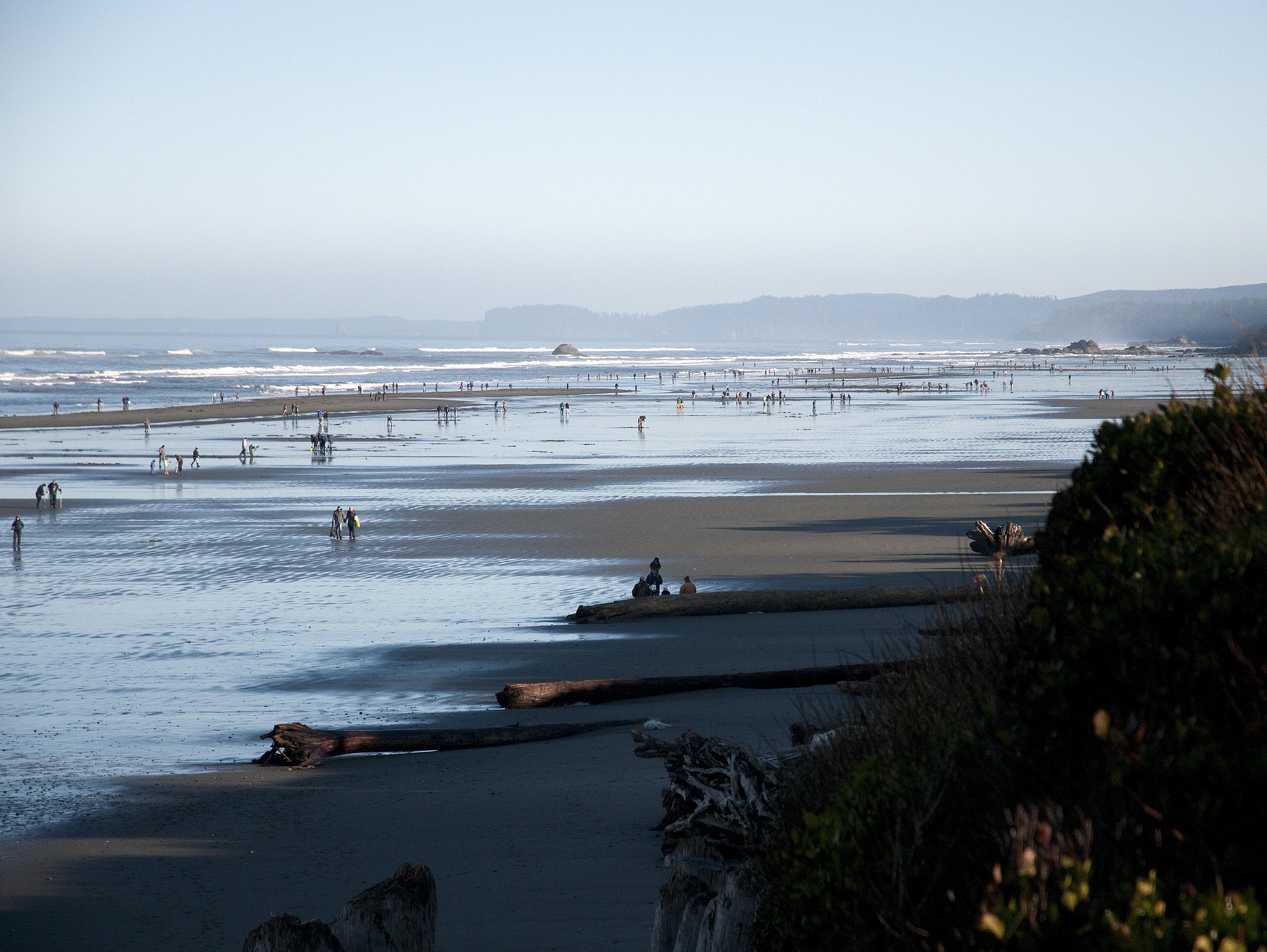

There is a rule on Washington's coastal razor clam beaches that catches every newcomer, and it is the most instructive rule in American recreational shellfishing.
You must keep the first fifteen clams you dig. Not the best fifteen. Not fifteen you are happy with. The first fifteen, whatever comes out of the sand, regardless of size or condition.
Once you understand why that rule exists, you understand razor clamming. This guide covers what the animal is, when the digs actually open, which beaches are worth driving to, the gear that matters, how to read a show and get the clam out of the sand, the rules that get enforced, and how to clean a limit at the end of a cold night.
What you are catching
Siliqua patula, the Pacific razor clam, is built entirely around burrowing, and every technique below follows from that.
The shell is thin, smooth, elongated and slightly open at both ends, which offers almost no resistance moving through wet sand. The muscular foot works by pushing down, inflating to anchor, then hauling the shell after it. A healthy clam repeats that cycle fast enough to outpace a person with a shovel, which is why a committed dig beats a careful one every time.
They live a handful of years and grow quickly, and the population on any given beach swings widely between years depending on how well the larvae settled. That variability is why the state surveys each beach and sets seasons against those numbers rather than running a fixed calendar. It is also why the number of digging days differs so much between beaches in the same year.
They sit relatively high in the surf zone compared with most clams, which is why razor beaches work on tides that would be useless for geoducks, and why the limiting factor here is surf rather than tidal extremity.
When to go
Washington's razor season runs from autumn through spring, and it does not work like a season you can book against.
The Department of Fish and Wildlife publishes a list of tentative dates, sometimes dozens of them, and then approves them in blocks of a few days, usually a week or two ahead, once marine toxin results come back. A given beach might be approved for three days in a row and then not again for a fortnight. So a razor clam trip is planned around a tide and confirmed against an announcement.
That conditionality is not a formality. Domoic acid closes these beaches regularly, sometimes for an entire autumn, and reopening requires two clean samples spaced seven to ten days apart with a declining trend. The whole mechanism is in shellfish biotoxin closures, and it is worth reading before you book anything.
Most of the season happens on evening tides in autumn and winter, which means digging after sunset in the cold and the rain. That is not a hardship added to the activity, it is the activity. The lowest tides of the winter fall in the dark on the Pacific coast, and the digs are announced around them. Spring digs run into April and early May and are the pleasant end of the season, with daytime tides and better weather.
You want a low tide, ideally a minus, and the arithmetic is in minus tides for clamming. Surf matters as much as the number, because this is an open Pacific beach with no shelter, and a heavy swell on a low tide gives you less workable sand than the tide table promises.
Where to go
Four beaches carry the recreational fishery, and they are managed as separate units rather than as one coast.
Long Beach runs from the Columbia River north to the mouth of Willapa Bay, and it is the longest and most forgiving, with room for a great many people. Twin Harbors covers Willapa Bay north to the south jetty of Grays Harbor and tends to be the most consistent. Copalis runs from the north jetty of Grays Harbor to the Copalis River. Mocrocks continues from the Copalis River to the southern boundary of the Quinault Indian Reservation, and it is generally the quietest of the four.
Kalaloch, further north on the Olympic Peninsula coast, is the fifth beach the department manages and it is handled differently. It is worked to a fixed harvest rate of 25.4 percent where the other beaches use a variable rate between 30 and 40 percent, and it has been closed in recent seasons because the clams there remain small and low in numbers. Do not plan a trip around Kalaloch without checking that it is open at all.
The towns are set up for this. Ocean Shores, Westport, Long Beach and Moclips all fill on announced weekends, so motels book out as soon as digs are approved, which is a good argument for weeknight tides.
Choosing between the four
They fish differently and the choice is worth making deliberately rather than by drive time.
Long Beach is the one to pick for a first trip. It is long enough to absorb a crowd, the access points are numerous, the sand is forgiving, and if the clams are thin in one stretch you can walk. Twin Harbors is the most consistent producer and the one experienced diggers default to, with good access from Westport and Grayland.
Copalis and Mocrocks run smaller and quieter, and they are frequently opened on different days from the southern beaches, which is the useful part: when Long Beach and Twin Harbors are shut, the northern two are sometimes open. Mocrocks is reached through Moclips and is the least crowded of the four on almost any given dig.
Access matters as much as clams. Several of these beaches are driven on, and the approaches back up long before the tide is low, so arriving early to park is more important than arriving early to dig.
The gear
Razor clamming needs very little, and the few things it does need are not substitutable.
The digging tool is either a clam gun or a clam shovel. A gun is a tube with a handle and a vent hole, pushed straight down over the show and pulled up with a thumb over the vent so suction lifts the core out. It is easier to learn, cleaner, faster on soft wet sand, and it breaks fewer clams in inexperienced hands. A clam shovel is a narrow curved blade worked in vertically on the seaward side of the show, angled to lift a wedge away from the clam rather than through it. It is faster in good hands and it breaks a lot of clams while you are learning. Most first-timers should use a gun.
A headlamp with genuine spare batteries is not optional, because most of the season is dug after dark and the cold flattens batteries faster than people expect. A phone light will not survive the conditions or the duration.
Waders or serious waterproof boots matter because you work the waterline in surf, in winter. Wet and cold ends more digs than anything else. And every digger needs their own net or container, because clams must be kept separately by person, which is checked routinely.
The last item is a cleaning setup in the car: scissors, a hot water source and a rinse tub. Fifteen clams per person is real work at the end of a cold night, and doing it in a motel sink is worse than doing it in a parking lot.
The technique
The clam tells you where it is, and learning to read that is the whole skill.
What you are looking for is a show: a small hole, a dimple, or a doughnut-shaped depression in the wet sand where the clam's siphon has withdrawn. Fresh shows appear as the water sheets back off the sand, which is why diggers walk the edge of the retreating waves rather than the dry beach. You can also make clams show themselves by pounding the sand with a shovel handle or stamping alongside a suspected spot, which is the standard way to prospect a stretch that looks empty.
Then commit. With a gun, place it slightly off-center from the show with room on the ocean side, because a razor clam show usually sits at a slight angle seaward of the animal. Drive the tube straight down with the vent open, cover the vent with a thumb, and lift the core with your legs rather than your back. With a shovel, go in vertically on the seaward side and lift a wedge away from the clam.
Either way, your hand goes into the hole at the end. Nobody digs a razor clam entirely with a tool: you dig until you see it or feel it and then you reach.
How to Use a Razor Clam GunThe thing to internalize is that hesitation loses clams. A startled clam moves down through wet sand at a rate a person with a shovel can only just match, and a clean committed dig gets more of them than a careful one.
Pay attention to the surf while you do it. You are working the waterline, in the dark, facing away from the ocean. Sneaker waves on this coast are a real hazard rather than a warning label, and the standard advice is to keep somebody in the group facing the water.
Rules, license and limits
They are simple, they are checked, and the checking is routine rather than exceptional.
Fifteen clams is the daily limit on all open beaches, and the first fifteen you dig are the fifteen you keep. All diggers fifteen or older need an applicable fishing license, and the license year turns over in spring, which is the single most common failure on an April dig. Each digger's clams go in a separate container, so that a group cannot pool a limit and an officer can see whose is whose.
And you dig your own. There is no helping somebody else fill their limit, and a parent digging a child's limit is exactly the scenario the rule is written about.
The first-fifteen rule deserves its own explanation, because it is the one people argue with. A razor clam that has been dug is usually a razor clam that is going to die: the shell is thin and brittle, the siphon is easily severed, and the animal cannot reliably rebury itself once handled. A digger who keeps only the large ones is not practicing catch and release, they are killing a great many clams and taking home fifteen. The rule converts an invisible mortality into a visible limit, which is the only way to manage a fishery where the animal you release does not survive.
The practical consequence is that your limit is decided by your first fifteen holes, so accuracy matters far more than speed. Learn to read the show before you dig rather than digging every dimple you see.
Rules are revised annually, so confirm the current season, limit and license requirements with the Department of Fish and Wildlife before you travel. The wider state-by-state picture is in shellfish licenses by state.
Cleaning and eating
Fifteen clams per person is a substantial amount of work at the end of a cold night, and razor clams are more involved than most shellfish.
The standard method is a brief dip in very hot water to loosen the shell, then a cold rinse, then opening the clam and cutting away the gills, the palps and the dark digestive tract, leaving the digger, the mantle and the neck. Most beach towns provide cleaning stations for exactly this reason, and doing it there rather than at home is the right call.
How To Clean and Cook Razor ClamsSand is the enemy and rinsing is the answer. Razor clams do not purge well in a bucket the way manila clams do, so the cleaning has to remove the grit mechanically.
Cook them fast and hot. A razor clam is a two-minute animal and overcooking turns it to rubber, which is the most common way a hard-won limit gets wasted. Dredged in seasoned flour and fried briefly is the regional standard, and chopped into chowder is what happens to the rest.
Putting it together
Watch the tentative list, book around a tide series that suits you, and confirm the dig is approved before you drive. The tide is fixed years in advance, the approval is not, and the two together decide whether the trip happens.
Bring a gun rather than a shovel for a first trip, a headlamp with spares, waders, and a separate container per person. Walk the waterline as the water sheets back, read the shows, and commit to the dig. Keep the first fifteen. Clean them at the beach and cook them fast.
If the coast is closed, Puget Sound is a different fishery under different rules and frequently open when the coast is not, covered in digging Manila clams in Puget Sound, with the species that stays toxic longest explained in butter clams and PSP. The Oregon version of this fishery, with its fixed July closure, is in razor clamming the Oregon coast. And whether the beach you are standing on is public at all, which matters far more on Puget Sound than on the open coast, is in public tidelands and private beaches.