Fish
Fish Fire
Fire Hike
Hike Bird
Bird

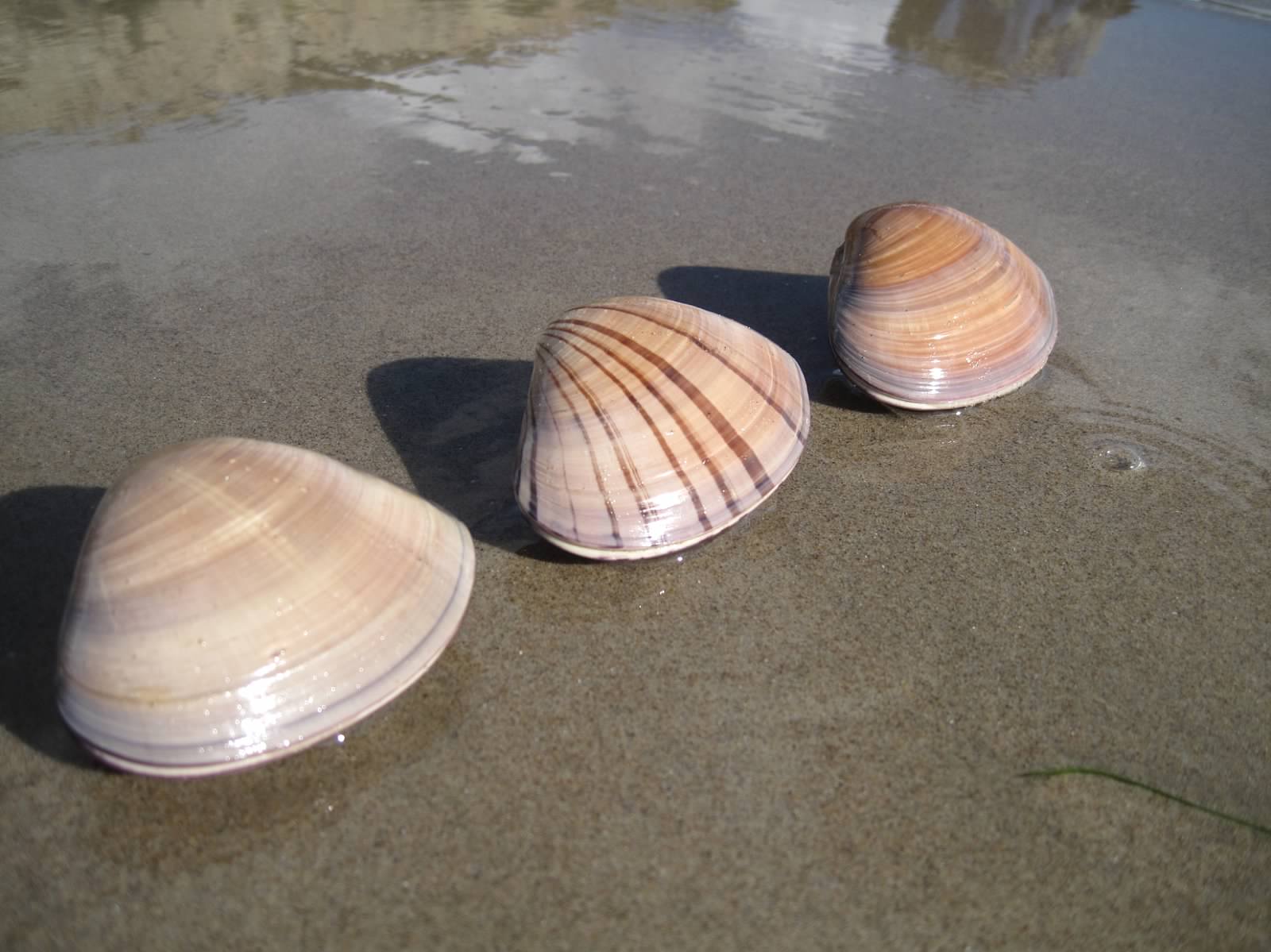
You may legally dig Pismo clams in California, on a beach named after them, and you will almost certainly not find a legal one.
The minimum size is five inches north of the Monterey and San Luis Obispo county line and four and a half inches south of it. The daily limit is ten. And the population, which once supported a commercial fishery and a beach so productive that cars drove onto it to load clams, has been reduced to the point where a legal-size animal is a genuine find.
This is the honest article about a fishery that collapsed, which is a different thing from a guide to catching them.
What was here
The Pismo clam, Tivela stultorum, is a large, heavy, thick-shelled surf clam of the open sandy beaches of central and southern California and Baja.
They grow slowly and live a long time, which is how they reach the size the limits contemplate, and they live in the surf zone on exposed sand beaches, buried shallow. Historically they occurred in extraordinary density along the central coast, and the beach at Pismo took its reputation from it.
The early twentieth-century accounts are the ones that give the scale away. Clams were harvested commercially, plowed from the sand in quantity, and there are photographs of horse-drawn and later motor equipment working the beach. A recreational limit of ten clams is a modern number applied to a fishery that once operated by the ton.
What happened to them
Several things, and disentangling them is difficult.
Sustained heavy harvest, commercial and then recreational, removed a great many large animals over decades. The species is slow-growing, so replacing a five-inch clam takes years, and a population fished down does not bounce back quickly.
Sea otters returned. Otters were hunted to near-extinction in California and their recovery along the central coast restored a highly effective predator of exactly this animal. Otters eat Pismo clams efficiently and the correlation between otter range expansion and Pismo clam decline in particular areas is not subtle. This is an uncomfortable fact for people who like both otters and clams, and it is a real part of the picture.
Beach conditions changed too, with coastal armoring, sand supply changes and heavy recreational use of the beaches all affecting habitat. And El Nino events and storms periodically hammer surf-zone populations.
The result is a population that persists, in places at reasonable density in small sizes, and produces very few animals that reach legal size.
The rules as they stand
They are specific and they vary by where you are on the coast.
Minimum size is five inches north of the Monterey and San Luis Obispo county line, and four and a half inches south of it. The daily limit is ten clams.
Season varies too. In Santa Cruz and Monterey counties, Pismo clams may be taken from September 1 through April 30. In San Luis Obispo County and south, including Pismo Beach itself, there is no closed season.
A California fishing license is required, and there are rules about measuring devices: you must carry a measuring device and measure every clam you dig.
Undersized clams must be reburied, and there is a correct way to do it. They go back into the wet sand, at depth, siphon end up, in the same area they came from, and they are given a chance to dig themselves in. Leaving an undersized clam on the surface kills it, and given how few clams reach legal size, that mortality matters more here than almost anywhere.
How to Rebury a Pismo Clam (California Department of Fish and Wildlife)The gear
California's Pismo clam rules produce a gear list where the most important item is a measuring device you will use far more often than a bucket.
A measuring device, and the state requires you to have one in your possession while clamming rather than merely to know the number. The minimum is four and a half inches at Pismo Beach and south of it, and four and a half inches is a very large clam. You will measure many and keep few.
A California fishing license, which covers invertebrates and is required for anyone sixteen or older.
A clam rake, or bare feet, since treading works here the same way it works in Rhode Island and a fair number of people prefer it.
Realistic expectations, which belongs on the list. The beds that produced the historic harvests are gone, the population has been recovering slowly, and a trip that finds one legal clam is a good trip by current standards.
The knowledge of how to rebury an undersize clam, which is the item that matters most for the resource. A clam left on the surface dies, to a gull or to the sun. It goes back siphon-end up, in wet sand, at the depth it came from, immediately.
A tide table, since the working band is a low tide band.
And something else to do afterward, because the honest framing of a Pismo clamming trip in 2026 is a walk on a good beach with a small chance of dinner attached.
Why the article is not a how-to
Most writing about Pismo clamming is a nostalgic guide with a technique section. That is misleading, and a piece of honest writing about this fishery has to say so.
You dig them the way you dig any surf clam: at low tide, in the wet sand in the surf zone, feeling for them with your feet or a rake, working the area where the waves are running back. It is not difficult. The technique is not what is stopping you.
What is stopping you is that there are very few legal-size clams. People fish a full low tide, find many clams, measure every one, and keep nothing. That is the normal outcome and it is worth expecting rather than discovering.
If you want to do it anyway, and there are reasons to, then go with the understanding that measuring and reburying is the activity and taking clams home is the exception. That is an enjoyable morning if you have framed it correctly and a frustrating one if you have not.
The monitoring, and a reason for slight optimism
There is active work on this species and it is worth knowing about.
California surveys Pismo clam populations, and there has been organized monitoring effort including work involving volunteers and citizen scientists measuring clams on the central coast beaches. The point of that effort is to establish whether size structure is shifting, which is the signal that would indicate recovery.
Some surveys in recent years have found substantial numbers of clams in the smaller size classes on certain beaches, which is at least the raw material for a recovery. Whether those animals survive to legal size, given predation and conditions, is the open question.
Reburying undersized clams properly is the one thing an individual recreational digger contributes to that. It is not a token: on a population where legal-size animals are scarce and sublegal ones are abundant, the survival of the sublegal ones is the whole question.
How the beach used to work
The scale of what was here is difficult to convey without the specifics, and the specifics are startling.
Pismo clams supported a commercial fishery in the early twentieth century in which clams were plowed from the sand mechanically, and photographs survive of horse teams and later trucks working the beach in a way that looks more like agriculture than fishing. Individual daily bag limits for recreational diggers were once in the dozens rather than at ten.
A beach that supported that is a beach with an extraordinary density of large, old animals, built up over a long period without much predation, because the sea otter had been hunted out of the region entirely by the fur trade.
That last point is the uncomfortable one and it explains a great deal. The Pismo clam abundance the fishery grew up on was itself partly artificial: it reflected a coast with its principal invertebrate predator removed. What has happened since is partly a collapse and partly a return toward what the beach looked like before the otters were killed.
Holding both of those ideas at once is the honest position. The fishery was overharvested, and the baseline it was measured against was never natural.
Driving on the beach
Pismo State Beach and the adjacent Oceano Dunes are among the very few places in California where vehicles are permitted on the sand, and it interacts with the clams.
Vehicle access makes the beach reachable in a way most are not, which is part of why it stayed a popular clamming destination long after the clams became scarce. It also compacts sand, and there has been long-running argument about the effects of vehicle traffic on intertidal invertebrates and on the beach as habitat, alongside separate arguments about dust and air quality.
Access arrangements at Oceano Dunes have changed over recent years and continue to be litigated and revised, so anyone planning to drive onto the sand should check the current status rather than assume. It is one more reason the practical answer for a clamming trip is to check what is actually permitted this season before committing to it.
Where else to dig in California
If the goal is clams rather than specifically Pismo clams, California has better options and they are worth naming.
Razor clams occur on some northern California beaches under their own rules, though the fishery there is far smaller than Washington's or Oregon's. Gaper, littleneck and Washington clams occur in bays and estuaries, notably around Humboldt Bay and Tomales Bay, and those are more reliable diggers.
Mussels are abundant on the rocky coast under a recreational limit, subject to the annual quarantine that California imposes over the warmer months for paralytic shellfish poisoning, which is a state-wide seasonal closure rather than a beach-by-beach one and is a different regulatory model from the north.
That quarantine is the thing most likely to catch out a visitor from Washington or Oregon, and the general closure framework is in shellfish biotoxin closures.
The other thing that eats them
Otters get the attention and they are not the only predator that increased.
Pismo clams are eaten by a range of animals including shorebirds, rays and various fish, and by the moon snail, which drills a neat beveled hole through the shell and rasps out the animal. Any beach with clams has drilled shells on it, and finding one is a good illustration of how much mortality happens without any human involvement at all.
The point is not to spread the blame around. It is that a slow-growing, long-lived animal in a heavily used surf zone is under pressure from several directions at once, and a recovery requires enough clams to survive all of them long enough to reach five inches.
That is why the reburial rule matters more here than the size limit does. The size limit protects clams you found. Reburial protects the ones you found and did not keep, which on this beach is nearly all of them.
How to Find and Harvest Pismo Clams, and the RegulationsWhat a trip looks like
For anyone going anyway, the practical shape is straightforward.
Pick a negative or low tide on an open sand beach in the historical range, with Pismo State Beach the obvious and legal option in San Luis Obispo County where there is no closed season. Bring a license, a measuring gauge, and a rake or your feet.
Work the wet sand in the surf zone as the water runs back. Measure everything. Rebury everything that is short, properly, siphon up and dug in.
And treat a legal clam as an event rather than an expectation, which is both realistic and, honestly, more satisfying than the alternative framing.
The short version
Pismo clams are legal to take at five inches north of the Monterey and San Luis Obispo county line and four and a half inches south, with a daily limit of ten.
Santa Cruz and Monterey counties have a September 1 to April 30 season. San Luis Obispo County and south have no closed season.
The population collapsed under sustained harvest and has not recovered, with returning sea otters a significant and genuine additional factor. Legal-size clams are scarce.
You must carry a measuring device and measure every clam, and undersized clams must be reburied properly, siphon up, at depth, in the same area.
Expect to dig, measure and rebury without keeping anything. That is the normal outcome, and going with that expectation is the difference between a good morning and a disappointing one.
The tide arithmetic that governs a Pismo trip is in minus tides for clamming, and the Pacific coast clam that still supports the kind of fishery Pismo Beach used to have is in razor clamming the Washington coast, which is worth reading as a picture of what a healthy surf clam fishery looks like. The California licensing rules sit alongside every other state's in shellfish licenses by state, and the beach access question, which is comparatively easy in California and difficult further north, is in public tidelands and private beaches. If the clams are not there, the surf fishing bait under the same sand is in pumping ghost shrimp for bait.