Fish
Fish Fire
Fire Hike
Hike Bird
Bird

California closes mussel harvest for six months of every year, on a fixed calendar, before anybody has tested anything.
Not in response to a bloom. Not when a sample comes back hot. Every year, the same window, whether the water is clean or not.
No other shellfish on that coast is treated this way, and understanding why is most of what a person needs to know before picking mussels anywhere on the Pacific.
Why mussels specifically
Mussels are filter feeders sitting in the most exposed part of the intertidal, pumping large volumes of water through themselves in the surf zone where blooms concentrate.
The California Department of Public Health puts the reason plainly: mussels are a particularly high risk because they can concentrate these toxins very quickly. That is the whole distinction. A clam in a sheltered bay accumulates toxin gradually and sheds it gradually. A mussel on an open coast rock can go from safe to dangerous inside a short bloom, and it does not look, smell or taste any different afterward.
That speed is also why mussels are used as the sentinel species in biotoxin monitoring. Agencies hang mussels at fixed stations and test them precisely because they respond first, which makes them an early warning for everything else. The animal that warns you about the other shellfish is the animal you should be most careful about eating.
The California quarantine
The annual quarantine is normally in effect from May 1 through October 31, along the entire California coast from the Oregon border to the Mexican border.
It applies only to sport-harvested mussels. Commercially harvested product comes from operations under a separate testing regime and is not covered.
It exists to protect against two different problems: paralytic shellfish poisoning, caused by saxitoxin, and domoic acid poisoning, also called amnesic shellfish poisoning. Different organisms, different toxins, one closure.
The dates are not arbitrary. CDPH states that the May through October period encompasses more than ninety-nine percent of all PSP illnesses and deaths reported in California since 1927. That is close to a century of case data pointing at one half of the year.
And the window moves when it needs to. CDPH may begin the quarantine early, or extend it, if monitoring finds dangerous toxin levels outside the normal period.
The part people get backwards
Here is the sentence from CDPH that matters most, and it is the one most likely to be misread.
You should never assume that sport-harvested mussels are safe to eat when the annual quarantine is not in effect.
The quarantine is not a safety certificate for the other six months. It is a blanket closure over the period when the risk is highest, and outside it the ordinary rule applies: check current advisories for the specific stretch of coast before you eat anything. If dangerous levels turn up outside the quarantine, CDPH issues a health advisory for the affected area.
So November through April is not open season. It is the period when the decision goes back to you and the monitoring data, rather than being made for you by the calendar.
California Mussels Under QuarantineWashington, where the limit is a weight
Washington does not run an annual calendar quarantine. It closes by beach and by species as monitoring requires, which is the system described in shellfish biotoxin closures.
The limit there is unusual in a different way: mussels are ten pounds in the shell per day, with no minimum size.
Almost every other shellfish limit in this library is a count. Oysters in Washington are eighteen a day at two and a half inches. Clams are forty, not to exceed ten pounds. Mussels are simply a weight, because counting them is absurd and sizing them is pointless: they grow in dense clumps of mixed ages fused to rock, and you take a handful of the bed rather than selecting individuals.
Ten pounds in the shell is also less mussel than it sounds. Shell is most of the weight.
Oregon, where the limit is a count
Oregon takes a third approach again, and between the three states you can watch regulators solve the same problem in three incompatible ways.
Oregon's published sport regulations give a daily limit of seventy-two mussels, with no minimum size, in a marine zone listed as open all year and around the clock. Confirm that against ODFW before you go, because it is a single published figure and this article has not been able to corroborate it elsewhere.
Taken at face value, that puts three different instruments on one coast: California shuts the whole thing for six months by calendar, Washington sets a weight and closes by beach, and Oregon counts individual animals. Same species, same ocean, three regulatory philosophies inside eight hundred miles.
Two things a statewide number does not tell you, and they apply in every state on this list. Tribal harvest is governed by treaty right and by tribal regulation rather than by the state number, and on ground where those rights apply the state figure is not the operative rule. And a marine reserve, a marine protected area, a refuge or a local ordinance can forbid mussel harvest outright on a specific stretch of shore while the statewide limit stays exactly where it is. A published limit is a ceiling, not a permission.
The Oregon catch is where the closure information lives. ODFW sets the limits, but the Oregon Department of Agriculture closes beaches for biotoxins, and those are different agencies with different pages. That split is the same trap described in oystering on the Oregon coast. Two bookmarks, not one.
What the two toxins actually do
They are different problems and they are worth telling apart.
Saxitoxin causes paralytic shellfish poisoning. It blocks nerve conduction, the first symptom is usually tingling or numbness in the lips and tongue within minutes to a couple of hours, and in severe cases it progresses to respiratory paralysis. It is the one that kills people. Cooking does not destroy it.
Domoic acid causes amnesic shellfish poisoning. It produces gastrointestinal symptoms first and, in severe cases, neurological effects including the permanent short-term memory loss that gives the syndrome its name. Cooking does not destroy this one either.
Neither changes the appearance, smell or taste of the animal. There is no field test, no rule of thumb, and no traditional check that works. The only thing that works is the monitoring data.
Which mussel you are actually picking
There is more than one animal in a Pacific mussel bed and it is worth knowing which is which.
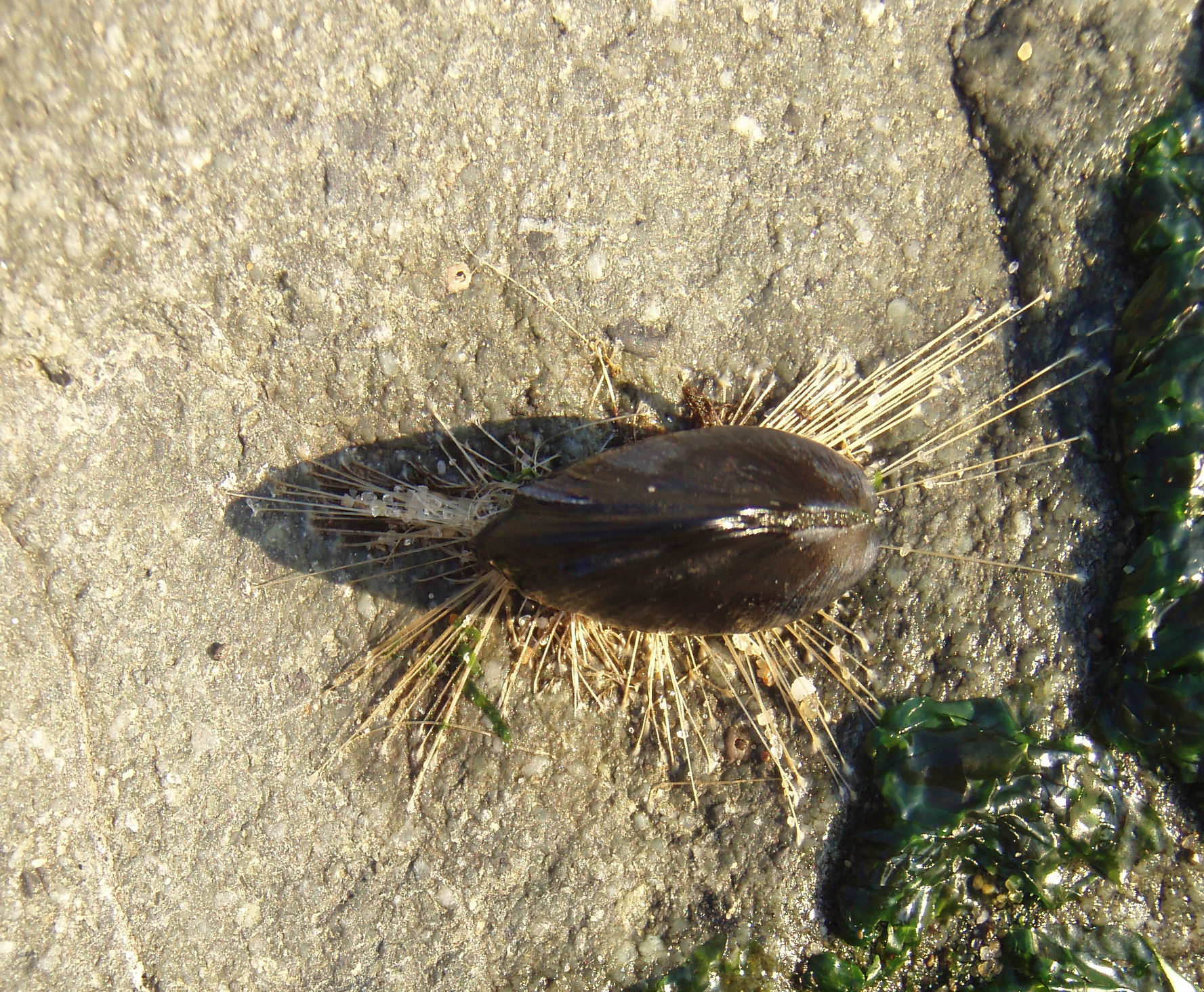
The California mussel, Mytilus californianus, is the big one. Thick-shelled, ribbed, blue-black weathering to brown, and it dominates the wave-exposed outer coast. It grows large, it is the species most people picture, and it is the one the California quarantine is written around.
The bay mussel is smaller, smoother and thinner-shelled, without the heavy radiating ribs, and it favors sheltered water: bays, inlets, pilings, floats. In the Salish Sea it is what you will mostly find, and it is closer to the mussel sold in restaurants.
Both are edible and both accumulate the same toxins. The distinction matters less for eating than for where you look: the exposed rock that holds Californias is a different and considerably more dangerous place to stand than the sheltered piling that holds bay mussels.
There are also farmed mussels growing on suspended lines in several bays, and those are somebody's crop. A rope of mussels hanging from a float is not wild harvest, and the rule there is the same as for any oyster lease.
The gear
Mussels need less equipment than anything else in this library, which is part of why people get casual about them.
The current closure status for your specific stretch of coast, checked the morning you go. In California that means whether the annual quarantine is running and whether any advisory is in effect. Everywhere else it means the state's shellfish safety map.
A shellfish license for the state you are standing in, which is required for mussels the same as for clams. The cross-state picture is in shellfish licenses by state.
Sturdy gloves, because mussel beds are sharp, the shells break into edges, and barnacles grow through the bed.
A short blunt tool, a putty knife or a paint scraper, for breaking clumps free of rock. You are levering the byssal attachment rather than cutting individual animals.
Boots with real grip. Mussel beds sit on wave-exposed rock in the mid intertidal, they are permanently wet, and they are among the most slippery surfaces you will stand on.
A mesh bag, so the catch drains and the animals stay alive.
And a tide table, because the productive band is uncovered briefly and the same waves that make a mussel bed productive make it dangerous. The arithmetic is in minus tides for clamming.
Coastal Foraging: Where, When and How to Harvest MusselsPicking them
The technique is simple and the judgment is not.
Take from the middle of a bed rather than the edges, and take clumps rather than individuals. Pulling a single mussel out of dense cover tears the byssal threads of its neighbors; taking a clump from a thick patch does less damage and is faster.
Take the larger animals and leave the small ones attached. Mussels recruit onto each other, so a bed stripped to bare rock recovers far more slowly than one thinned from the middle.
Never turn your back on the water. This is the genuinely dangerous part of mussel picking and it has nothing to do with toxins. You are on wave-exposed rock, facing the rock, concentrating downward, at low water on a coast that produces sneaker waves. People are swept off mussel beds.
Leave anything gaping that does not close when handled, and leave anything already broken.
Cleaning and cooking
Mussels are the least forgiving shellfish to hold and the easiest to cook.
Debeard them at the last moment, not when you get home. The byssus is the bundle of threads anchoring the animal to rock, and pulling it out kills the mussel. Debearded mussels have hours, not days.
Keep them cold and breathing, in a bowl under a damp cloth in the refrigerator, never sealed in a bag and never in fresh water.
Discard anything that stays open after a sharp tap, and after cooking discard anything that stayed shut.
Steam them briefly in a little liquid, four to six minutes, until they open. Overcooked mussels go to rubber quickly and there is no recovering them.
And none of that addresses biotoxins, which is the point worth ending on. Cleaning, cooking, purging and sorting are all food handling. They do nothing whatsoever about saxitoxin or domoic acid, which is why the check happens before the trip rather than in the kitchen.
Where the sentinel programs came from
The reason a state can tell you anything at all about a mussel bed is a monitoring network that has been running longer than most people realize.
California's dataset behind the quarantine dates back to 1927, which is why CDPH can say the May to October window covers more than ninety-nine percent of recorded PSP illnesses and deaths. That is not a modeled estimate; it is a very long case series.
The mechanism is the same everywhere on this coast. Agencies place mussels at fixed stations, pull them on a schedule, and test the tissue. Because mussels take up toxin faster than clams or oysters, a rising mussel result is the early warning that triggers a closer look at everything else in that water. When you read that a beach is shut for butter clams but open for oysters, the number that started the conversation very likely came from a mussel.
Which produces a small irony worth sitting with. The animal doing the warning is the animal least safe to eat, and the reason the rest of the shellfish rules can be as precise as they are is that somebody is testing mussels every week on your behalf.
When to go, if it is open
Assuming harvest is permitted where you are, the timing of a mussel trip is simpler than a clam trip and the constraints are different.
You want a low tide, but not the extreme one a geoduck demands. Mussels sit in the mid intertidal, higher than most clams, so an ordinary low of zero to plus one exposes plenty of bed. That means far more workable days in a year than the species lower down allow.
You want calm water more than you want a big minus. The limiting factor on an exposed mussel bed is surf, not tide height, and a modest low on a flat day is safer and more productive than a big low with swell running. Check the marine forecast rather than only the tide book.
And in Washington and Oregon, winter is the better season for a reason that has nothing to do with tides. Biotoxin risk is generally lower in cold water, and the closures that shut mussel harvest tend to cluster in the warm months, which is the same logic California formalized into a calendar. Cold, calm, and a moderate low is the combination.
The short version
California closes sport mussel harvest coast-wide from May 1 to October 31 every year, on the calendar, because that window covers more than ninety-nine percent of the state's recorded PSP illnesses and deaths since 1927.
That quarantine can start early or run late, and its absence is not a guarantee of safety in the other six months.
Washington limits mussels by weight, ten pounds in the shell, with no minimum size, and closes by beach and species rather than by calendar. Oregon's published figure is a count of seventy-two a day with no size limit, with closures coming from the Department of Agriculture rather than ODFW, and it is worth confirming with the department rather than taking from here.
Mussels concentrate toxins faster than other shellfish, which is why they are the sentinel species in monitoring programs and why they get their own rules.
Neither saxitoxin nor domoic acid can be seen, smelled, tasted or cooked out.
Check the status for your specific beach on the day, take clumps from the middle of a bed, and keep your eyes on the water.
The species that holds toxin longest rather than fastest is in butter clams and PSP. The warm-water problem that cooking does solve is in the R rule is right for the wrong reason, and the beach-picking version of all this is in picking oysters on Puget Sound.