Fish
Fish Fire
Fire Hike
Hike Bird
Bird

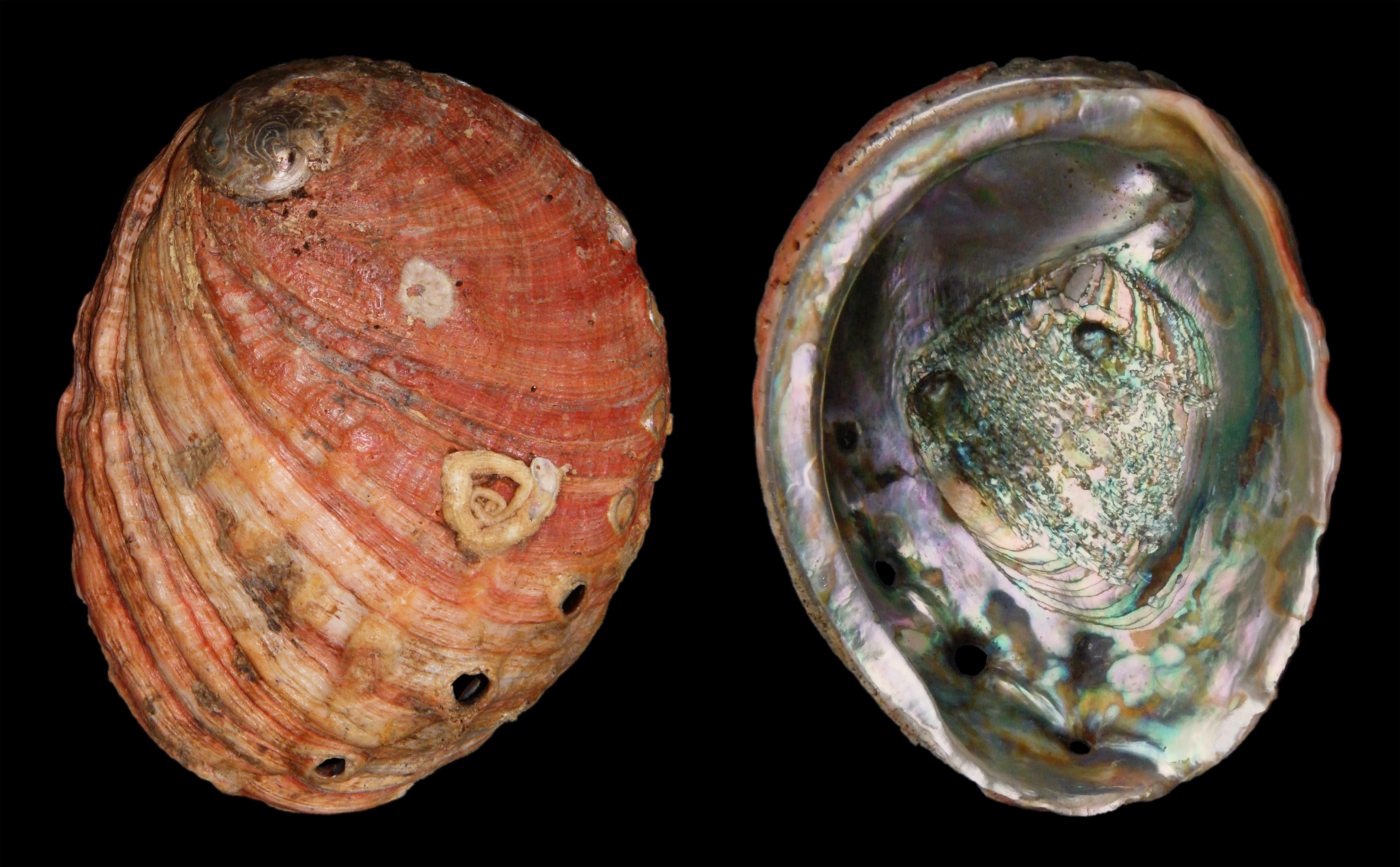
California's recreational red abalone fishery has been closed since April 2018. At the December 2025 Fish and Game Commission meeting it was extended again, to 2036.
That is not a pause. A closure written to run eighteen years past the last open season is a statement that the thing being managed is not expected back inside a career.
What the fishery was
It is worth setting out what closed, because it was unlike anything else on the American coast.
Red abalone could be taken only north of San Francisco Bay, and Fort Ross in Sonoma County was shut inside that. The season ran May 1 to June 30 and August 1 to October 31, closed through July and from November to April. Hours were 8 a.m. to half an hour after sunset.
The annual limit was twelve, reduced from eighteen, with a daily limit of three. Only nine of the twelve could come from Sonoma or Marin. Everyone sixteen and over needed a sport fishing license and an abalone report card, and the card carried twelve tags, one per animal, of which only nine were valid south of Mendocino. A tag had to stay attached to the card until used.
The minimum size was seven inches along the longest shell diameter, checked with a fixed-caliper gauge you were required to carry. The tool was specified too: an abalone iron, smooth with no sharp edges, under thirty-six inches long, at least three-quarters of an inch wide and a sixteenth of an inch thick.
And there was no scuba. Not merely no diving on scuba, but no abalone aboard any boat, kayak or floating device with scuba gear present. Red abalone were taken on a breath hold, or picked off rocks at low water, and nothing else.
The rest of the rulebook was about honesty. No high grading, meaning you could not detach a legal abalone and swap it for a bigger one. No dry sacking, meaning you could not take somebody else's limit for them. Abalone had to stay in their tagged shell until they were being prepared to eat.
It was also dangerous
This is the part that gets left out of the elegies.
Between 1993 and 2012, more than fifty-four people died taking abalone in northern California. Free-diving in cold, rough water off an exposed coast, frequently alone, frequently by people who were fit but not divers, on a coast where the spring wind that opens the season is also what makes it rough.
The fishery had a genuine culture and a genuine body count, and both are true at once.
Three things happened, in order
The collapse was not one event. It was a sequence, and the order matters.
In 2013 a sea star die-off swept the west coast. Sea star wasting disease removed the predator that had been eating urchins, and it removed it across thousands of miles at once.
From 2014 to 2016 an ocean heat wave sat on the North Pacific. Warm water is poor for bull kelp, which is an annual and has to re-establish from spores every year, so the forest came back thinner each season.
From 2015 onward, purple sea urchins boomed. With their predator gone and nothing checking them, they grazed what kelp remained down to bare rock, producing what ecologists call an urchin barren: a seafloor of urchins and coralline crust with no canopy over it.
Abalone eat drifting kelp. Urchins eat kelp too, and there were suddenly vastly more of them. The abalone did not get eaten; they starved.
Bull Kelp to BarrensWhat the numbers looked like
The figures are worth stating precisely, with their dates, because they are snapshots rather than standing facts.
By 2019, only seven percent of the bull kelp canopy documented in 2014 remained along more than two hundred miles of northern California coastline.
The worst of it was in Sonoma and Mendocino counties, where bull kelp canopy declined by about ninety-five percent between 2014 and 2020 measured against the 1984 to 2013 historical average. Del Norte and Humboldt, further north, were spared the worst and kept enough canopy that the state allowed continued but capped bull kelp harvest there.
For Sonoma and Mendocino counties combined, red abalone densities fell by seventy-five percent from 2014.
Surveys in 2018 found lower densities and numerous freshly emptied shells, which is the signature of animals dying in place rather than being fished out. Limited survey work in 2019 found no improvement. The state notes that abalone and fresh shells still wash ashore during winter storm waves, which indicates mortality is continuing rather than having stopped.
Why a population like this does not bounce back
Abalone reproduce in a way that makes recovery from low density unusually hard, and it is the reason a closure alone does not fix this.
They are broadcast spawners. Males and females release sperm and eggs into the water and fertilization happens outside the body, which works when animals are close together and fails when they are not. Past a certain point, thinning a population does not just reduce the number of breeders, it reduces the odds that any given spawning event produces anything at all. Two abalone twenty yards apart on a reef are, reproductively, not really a pair.
That is why the emptied shells matter as much as the counts. A reef that has lost most of its animals has not simply lost that fraction of its output; it has lost the density that made spawning work.
Growth is the other half. Red abalone are slow, and a seven-inch animal, which was the legal minimum, is old. Even in a good scenario where kelp returned and settlement resumed, the size classes the fishery was built on would be many years behind the recovery of the habitat.
Put those together and an eighteen-year closure stops looking cautious and starts looking arithmetical.
The closure, and why it keeps getting longer
The fishery closed in April 2018. That December the Commission extended it to 2021. At the December 2020 meeting it was extended again, to 2026. Surveys in the years that followed found the population still in poor condition, and in December 2025 the Commission extended it to 2036.
The logic of an eighteen-year closure is not that abalone take eighteen years to recover from fishing. It is that the habitat they need does not exist, and rebuilding a kelp forest is not something a fishery closure accomplishes.
There is also no sign of the constraint lifting. The kelp has not come back at scale, the urchins are still there, and the Commission has now three times looked at fresh survey data and concluded the population is no better than it was.
Fish and Game Commission Red Abalone Fishery Closure Extension, December 11, 2025The gear
This is a closure article, so the honest list starts with an admission.
Nothing, because you cannot legally take one. There is no permitted recreational red abalone harvest anywhere in California and there has not been since April 2018. Anything you read that describes a season is describing the past.
The abalone iron in your garage, which is worth keeping. The specification has not changed and the fishery may eventually reopen, and irons of the legal pattern are not sold in quantity any more.
A mask and a dive light, for looking rather than taking. Abalone are still there in reduced numbers and they are visible at low water on the north coast, and looking at one is legal.
A tidepool guide, since the north coast intertidal is worth the trip on its own and abalone are a small part of what is in it.
The CDFW closure page bookmarked, because the date will move again in one direction or the other and it is the only source that will say so first.
An appetite for farmed abalone, which is the legal way to eat one. California has a small aquaculture industry producing red abalone, sold live, and buying one supports the sector doing the captive-rearing work rather than the wild population.
And restraint, which is the real item. Poaching is the pressure a closed fishery still faces, wardens work this coast specifically for it, and a closed fishery that gets quietly fished anyway never reopens.
What an urchin barren looks like
If you swim the north coast now, the change is not subtle, and it is worth knowing what you are looking at.
A healthy bull kelp forest is a canopy. Stipes rise from holdfasts on the rock to floats at the surface, the light underneath is green and shifting, and the understory is full of drifting kelp fragments, which is what abalone actually eat. They do not graze the standing plant so much as catch what breaks loose and drifts past.
A barren is the same rock with none of that. Purple urchins cover it at densities that look implausible, the rock between them is pink coralline crust, and there is no canopy and no drift. Urchins in a barren persist in a starved state for years, which is the cruel part: they do not die off and let the kelp return, they sit there and keep eating anything that tries to establish.
For an abalone the difference is simply that the food stopped arriving. They do not migrate to better ground. They sit where they settled, and on a barren they slowly starve in place, which is why survey divers were finding whole animals and freshly emptied shells rather than an absence.
Where this happened
The fishery was a north coast institution, and the geography is worth knowing because it is where the survey work still goes on.
Sonoma and Mendocino counties were the heart of it, which is why those two are the ones the density figures are reported for. Fort Ross, in Sonoma, was already closed to take before the fishery shut, an early sign that the state was managing a resource under strain rather than an abundant one.
Van Damme, on the Mendocino coast, is a state marine conservation area and one of the sites where volunteer scuba divers have run repeat underwater surveys since 2007, which is a large part of why the before-and-after picture here is as well documented as it is. Caspar Cove, also in Mendocino, is another of the survey sites where divers worked the 2018 season that found mass starvation.
Further north, Del Norte and Humboldt were spared the worst of the kelp collapse. Canopy loss there was far less severe than off Sonoma and Mendocino, enough that the state kept a capped bull kelp harvest open in those northern counties. They were never the center of the recreational fishery, and the starkest habitat story is south of them, off Sonoma and Mendocino.
The other abalone, briefly
Red is not the only species, and the others are further along the same road.
Black abalone were hit hard by withering syndrome, a bacterial disease that significantly reduced populations in southern California through the 1980s and 1990s. They are federally endangered.
White abalone are endangered too, and are the subject of a federal and state recovery program that is breeding them in captivity and out-planting them, which is currently the thing standing between the species and extinction.
Neither has been open to recreational take in living memory for most people, and neither is close to it.
What would have to change
Recovery here is a kelp problem before it is an abalone problem, and the work being done reflects that.
Urchin removal is the most direct intervention: divers clearing purple urchins from selected reefs to give kelp a chance to re-establish. It works at the scale of a cove and is enormously labor-intensive at the scale of a coast.
Urchin ranching is the attempt to make that pay for itself, taking starved barren urchins, feeding them until the roe is worth selling, and creating a commercial reason to remove them.
Kelp out-planting and restoration research is the slower half, working out which methods actually take.
And the thing nobody controls is water temperature. The mechanism that started this was a marine heat wave, and a warmer North Pacific makes bull kelp's annual re-establishment harder every year it happens.
The short version
The fishery is closed until at least 2036, extended at the December 2025 Commission meeting, and closed continuously since April 2018.
It was a free-dive and rock-pick fishery north of San Francisco Bay, twelve animals a year on a tagged card, seven-inch minimum, no scuba. It was also responsible for more than fifty-four deaths between 1993 and 2012.
It collapsed because a sea star die-off in 2013, a marine heat wave from 2014 to 2016 and an urchin boom from 2015 removed the kelp. The abalone starved rather than being fished out.
Seventy-five percent of the red abalone density in Sonoma and Mendocino was gone by 2019, and only seven percent of the 2014 bull kelp canopy remained across two hundred miles of coast.
You can look at them, photograph them, and eat a farmed one. You cannot take one, and the honest reading of an eighteen-year closure is that nobody managing it expects you to soon.
The other California shellfishery that collapsed and is recovering slowly under a heavy size limit is in Pismo clams in California. The east coast equivalent, a fishery closed by warming water rather than by fishing, is in the Maine shrimp moratorium. The restoration model that a recovering shellfish population actually follows is in the Olympia oyster, the other way warming water reaches shellfish is in ocean acidification and the oyster hatcheries, and the licensing landscape you would need if it ever reopens is in shellfish licenses by state.