Fish
Fish Fire
Fire Hike
Hike Bird
Bird

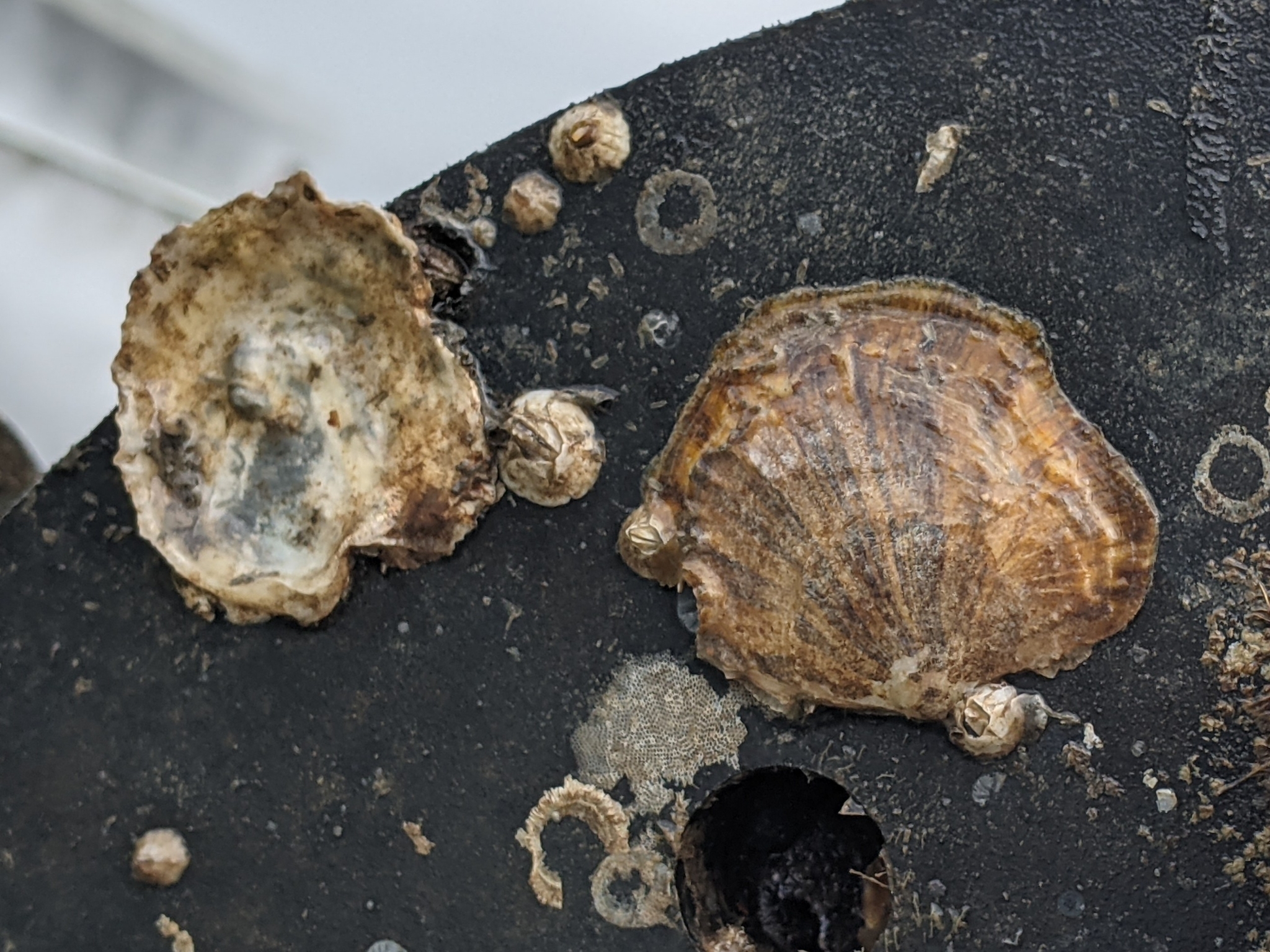

The oyster that Washington is named for, in the sense that the state capital took its name from the beds in the bay beside it, is now so scarce that finding one on a public beach is an event.
Puget Sound may have held something like twenty thousand acres of native Olympia oyster beds. By 2010 the estimate for what remained of the historic core populations was under four percent.
This is the story of how that happened, and of a restoration effort that has been running for over twenty years and is one of the more quietly hopeful things happening on this coast.
What an Olympia is
Ostrea lurida is small, and the size is the first thing to understand because it explains the economics that destroyed it.
A market-sized Olympia is about the diameter of a fifty-cent piece, flat, round and thin, with a shell that is greenish gray outside and often faintly iridescent within. Historical accounts put roughly twenty-four hundred shucked Olympias in a gallon, which gives a sense of the labor involved in producing any quantity at all.
The taste is what people wrote about. Olympias are described as sweet, metallic and distinctly coppery, with a finish nothing like a Pacific oyster, and the descriptions are consistent enough across a century and a half that they are clearly describing something real rather than nostalgia.
Biologically they differ from Pacific oysters in a way that matters enormously for restoration. Olympias are brooders: the female retains her eggs inside the shell, the larvae develop there for a period before release, and the number of offspring is far lower than the broadcast-spawning Pacific oyster produces. It is a strategy that works beautifully in a stable population and recovers very slowly from a crash.
The Gold Rush ate them
The collapse begins in California, which is not where the oysters were.
San Francisco went from a hamlet to a city of tens of thousands almost overnight after 1849, and oysters were the status food of the moment. The city's own beds could not supply the demand and were quickly worked out. So the trade went looking north.
In 1851 the first sacks of Olympia oysters from Shoalwater Bay, now Willapa Bay, reached San Francisco's shellfish merchants. What followed was one of the more intense extraction episodes on this coast. A flotilla of schooners ran between the Washington bays and San Francisco, and the Shoalwater trade dominated the California oyster market from 1850 through the end of the 1860s. One company alone is recorded as shipping fifty thousand bushels a year through the 1850s and 60s.
Consider what fifty thousand bushels of an oyster the size of a coin represents in animals, and in the labor of getting them off the tideflats by hand, and the scale of what was removed becomes clear.
The wild beds in Willapa were worked out within a couple of decades. The industry moved to south Puget Sound, to Oakland Bay and Totten and Eld and Little Skookum, where growers developed diked tideland ponds to hold water over the beds at low tide and worked the Olympia as a cultivated crop rather than a wild harvest. That system was sophisticated and it kept the species commercially alive into the twentieth century.
Then the mills finished the job
What harvest had reduced, pollution nearly ended.
Pulp mills came to south Puget Sound in the first decades of the twentieth century, and the sulfite process they used produced waste liquor that was discharged into the same shallow, poorly flushed inlets where the Olympia beds were. The effect on oyster larvae was catastrophic, and the beds in the affected inlets collapsed in a period of years rather than decades.
The timing is the cruel part. The industry had survived the wild-harvest era by inventing a cultivation system, had found the one part of the Sound where the species reliably reproduced, and had built an economy around it. Then the mills arrived in exactly those inlets, for the same reasons the oyster growers had chosen them: sheltered water, deep enough access, a town.
Growers who had lost their beds turned to the Pacific oyster, which had been arriving from Japan since the early 1900s and was hardier, larger, faster growing and far more tolerant of the conditions. The industry survived by changing species. The Olympia did not get that option.
What is left, and where
The remaining populations are scattered, small and mostly not where the historic core beds were.
Olympias were never entirely eliminated. Pockets persisted in inlets that escaped the worst pollution, in places where the substrate held, and in a few beds maintained deliberately. But the estimate of under four to five percent of historic core populations by around 2010 is the number that frames every restoration conversation, and the species is a state candidate for listing.
They are still found in south Puget Sound, in Hood Canal, in parts of the San Juans and Padilla and Similk bays, and in scattered spots along the coast from British Columbia to Baja. Almost nowhere are they at anything like historic density.
For a recreational harvester the practical instruction is simple: if you find one, leave it. They are small, they are slow to reproduce, and the eighteen-oyster limit on Washington beaches is not aimed at them. A person picking Olympias off a public beach is doing measurable harm for a mouthful.
Restoring the Olympia, Washington's Only Native OysterWhy bringing them back is hard
Restoration is not simply a matter of putting oysters back, and understanding why is the most interesting part of the story.
The first problem is substrate. Olympia larvae, like all oyster larvae, need clean hard surface to settle on, and specifically they favor shell. A bed that has been dredged, silted over or buried in fine sediment has nothing for larvae to attach to, so even a healthy adult population nearby cannot recolonize it. Much of the restoration work is therefore shell work: barging in cured shell and spreading it to rebuild the settlement surface.
The second is reproduction. Because Olympias brood their larvae and produce far fewer of them, a population needs adults close enough together to fertilize each other successfully, and a thinly scattered remnant may be functionally sterile even though every individual is alive and healthy. Restoration has to build density, not just numbers.
The third is genetics. Populations from different parts of Puget Sound are not identical, and moving animals around indiscriminately risks swamping local adaptation. Work on larval shell chemistry has been used to trace which populations connect to which, which is the kind of research that sounds academic and directly determines where seed should come from.
And the fourth is water. Sediment, low oxygen, altered salinity from stormwater, and the general condition of the nearshore all bear on whether a restored bed persists. Putting oysters back into water that killed them does not work.
How the work is done
Twenty years of effort have settled into a fairly clear method, run largely by the Puget Sound Restoration Fund with tribes, state agencies, universities and volunteers.
Broodstock is collected from the local population at a site, spawned in a hatchery, and the resulting larvae are set on cured Pacific oyster shell, which becomes the seed. That seed shell is then placed on prepared ground at the restoration site, sometimes alongside bare shell laid to catch wild set from the adults already there.
Sites are chosen for the things above: existing remnant populations, suitable substrate or the ability to create it, adequate water quality, and enough tidal exposure at the right height. Then they are monitored for years, because the question is not whether the seed survives its first winter, it is whether the bed becomes self-sustaining and starts producing its own recruits.
Some sites have. The spatial extent and abundance of Olympia oysters in Puget Sound has measurably increased over the past two decades, which for a species at four percent of its historic range is a good outcome even though it is a long way from recovery.
The gear
This is the one article in the library where the gear list is deliberately close to empty, and that is the point rather than an omission.
Nothing, because you are not harvesting these. Olympia oysters are not what a recreational limit is for anywhere in their range, the remaining beds are a small fraction of what was here, and a picked Olympia is a bed that recruits less next year. If you find one, the correct equipment is your hands, put back where you found it.
A hand lens, if you want to actually see what you have found. An Olympia is small, flat, round and roughly the size of a fifty-cent piece, and the interior is olive to greenish rather than the chalky white of a Pacific. Under a lens it is a different animal, not a small version of the same one.
Boots with grip and a willingness to kneel, because the beds sit low and you are looking at something the size of a coin among a great deal of gravel and old shell.
A tide table, since the low intertidal band where Olympias survive is exposed on relatively few tides.
Gloves, for a volunteer day, which is the best way to see them. Restoration groups around Puget Sound run shell-bagging and bed-monitoring days and they are open to anyone.
A camera rather than a bucket.
And a raw bar reservation, because a handful of growers produce farmed Olympias legitimately, and eating a cultivated one is how you taste the species without touching a wild bed.
Why it matters beyond the oyster
The case for spending public money and volunteer weekends on a small, commercially marginal oyster is not sentimental.
Oyster beds are structure. A dense bed creates hard habitat in an environment that is mostly soft, which shelters juvenile fish and invertebrates, and the oysters themselves filter enormous volumes of water, removing particulate and improving clarity. A restored bed is a functioning piece of nearshore infrastructure rather than a collection of animals.
There is also the straightforward argument that this is the only oyster native to this coast, that it was here for thousands of years, that Coast Salish peoples harvested and managed these beds long before any of the above, and that losing it entirely because of a nineteenth-century export boom and a twentieth-century industrial process would be a poor outcome for a region that likes to think of itself as good at this.
Project Aims to Restore Olympia Oysters to Samish BayWhere you can see them
You can encounter Olympias without harvesting any, and it is worth doing.
Restoration sites in south Puget Sound and Hood Canal are the likeliest, and several are on public tidelands where you can walk the beach at low water and find them among the Pacific oysters if you know what you are looking at. They sit lower and flatter than a Pacific, they are round rather than elongated, and they are frequently in clusters cemented to shell.
Some growers produce Olympias commercially in small quantities, and they turn up on raw bars in Seattle, Olympia and Portland at a price that reflects how much work twenty-four hundred oysters to the gallon actually is. Eating a farmed one is a good way to understand what the fuss was about without touching a wild population.
Volunteer shell-bagging and site work days run through restoration groups, and they are the most direct way to be useful.
The short version
The Olympia is the only oyster native to this coast and it is at something under four percent of its historic core range, from a Puget Sound that may once have held twenty thousand acres of it.
The Gold Rush did the first damage, with schooners running Shoalwater Bay oysters to San Francisco from 1851 and the trade dominating the California market for two decades. Pulp mill waste in south Puget Sound finished the job in the early twentieth century. The industry survived by switching to the Pacific oyster from Japan.
It is hard to bring back because Olympias brood their young and reproduce slowly, because larvae need clean shell to settle on and most of it is gone, and because a scattered remnant can be too thin to fertilize itself.
Restoration has run over twenty years, it uses hatchery-set seed on cured shell placed at chosen sites, and it is working slowly.
And if you find one on a beach, leave it there.
The practical rules for picking the oysters you may take are in picking oysters in Puget Sound, the ownership question behind every Washington beach is in public tidelands and private beaches, and the closures that govern any harvest are in shellfish biotoxin closures.
The species that replaced this one commercially, and where it came from, is in the oyster on your plate came over on a steamship. The chemistry problem that now threatens both is in ocean acidification and the oyster hatcheries. And the state that has taken the most restrictive position on wild oyster harvest, largely to protect its own remnant Olympia beds, is covered in oystering on the Oregon coast.