Fish
Fish Fire
Fire Hike
Hike Bird
Bird


In 1852, a hunter named Augustus Dowd chased a wounded bear into a grove of trees in the Sierra Nevada foothills and found himself looking at something he could not account for.
The giant sequoias of the Calaveras Grove were not the first known to Europeans, but they were the ones that got the publicity, and within a year the grove was a tourist attraction, with a hotel, a bowling alley, and a dance floor built on a tree stump.
That stump is the reason this park matters more than its size suggests.
The Discovery Tree
In 1853, a group of entrepreneurs stripped the bark from the largest tree in the grove to a height of about 50 feet, in numbered sections, and shipped it east. The bark was reassembled as a walk-in exhibit and displayed in San Francisco and then New York, where audiences largely assumed it was a hoax, because no tree could be that large.
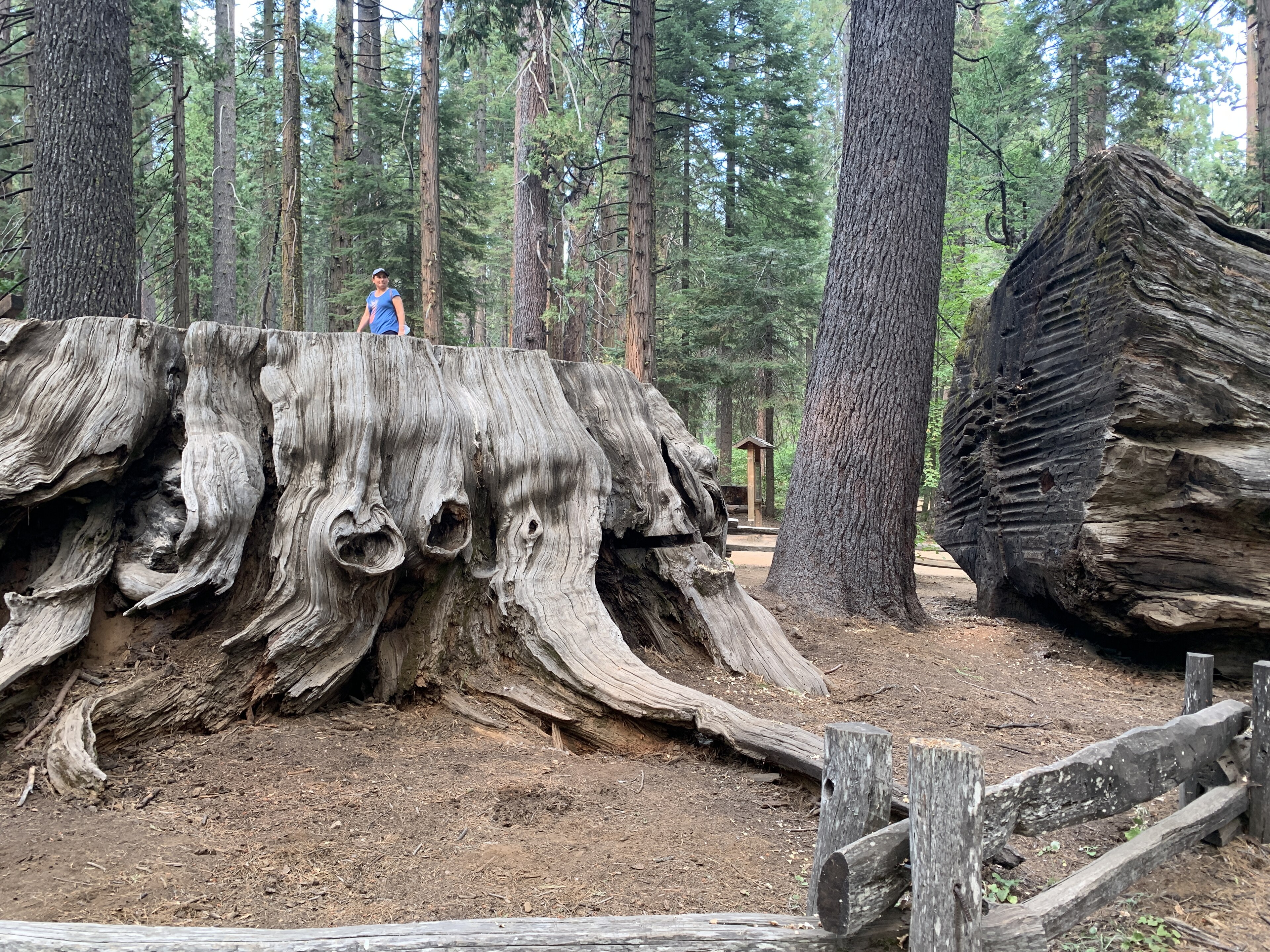
Removing the bark killed the tree. It was then felled, which took five men 22 days using augers rather than saws, because no saw was long enough. The stump was planed flat and used as a dance floor, and the fallen trunk became a bowling alley. Both are still there, on a short flat trail in the North Grove, and standing on that stump is an uncomfortable experience.
It is worth picturing what grew up around it, because the modern park is a restoration of sorts. Within a couple of years of 1852 the North Grove had a hotel, that bowling alley on the fallen trunk, the dance pavilion on the stump, and a stagecoach route bringing paying visitors from the Gold Country. The trees were named after politicians, generals and celebrities, and carved with initials. That operation continued in various forms into the twentieth century, which is why the North Grove has the layout it does: a loop trail through what was essentially a Victorian pleasure ground. The stump is still flat, the bowling alley is gone, and the hotel burned.
The other tree that went east
The Discovery Tree was not the only one taken apart for exhibition, and the second episode is arguably worse. In 1854 a party stripped the bark from the Mother of the Forest, a tree in the same grove estimated at over 300 feet, to a height of around 116 feet, using scaffolding. That bark also went east and was exhibited, at the Crystal Palace among other places, where it burned in a fire in 1866.
The tree, stripped of its protective bark, died standing and remained as a bare snag for decades before finally falling. Photographs from the period show it surrounded by scaffolding, and the images are difficult to look at. The remains are still in the North Grove and identified.
Why it matters
The destruction of the Discovery Tree produced a public reaction that was, for 1853, remarkable. Newspapers condemned it, the naturalist James Mason Hutchings and others wrote against it, and John Muir later described the exhibition of the bark as vandalism. It was these two episodes together, the Discovery Tree felled and the Mother of the Forest skinned and left to die, that generated the press coverage and the moral argument, with Horace Greeley writing about it along with the editors of several eastern papers and the emerging natural history establishment.
The argument they made is one that had not been made loudly before in America: that some things are worth more standing than sold, and that the appropriate response to a two-thousand-year-old organism is not to convert it into an admission-charging exhibit.
It took decades to become policy. Yosemite was granted to California in 1864 and became a national park in 1890, Sequoia National Park was created in 1890, and Calaveras became a state park only in 1931, well after the parks its own destruction had helped argue into being. The grove was privately owned and commercially operated for most of that time, and the South Grove was protected only in the 1950s after another logging threat and another public campaign.
The two groves
They are very different and most visitors only see one. The North Grove is the historic one beside the entrance, with the North Grove Trail, a 1.5-mile flat loop past the Discovery Tree stump, the Big Stump, the fallen Father of the Forest and the Pioneer Cabin Tree. That last was a drive-through tree, tunneled in the 1880s to compete with a similar attraction in Yosemite, and it fell in a storm in January 2017, which caused widespread public grief and a certain amount of quiet acknowledgement that cutting a hole through the base of a tree is not a survival strategy. The North Grove is busy, accessible, and full of history.
The South Grove is the reason to stay. It holds roughly a thousand giant sequoias in a much larger, wilder setting, reached by a nine-mile drive on the park road and then a 3.5 to 5 mile loop on foot, with no interpretation to speak of, far fewer people, and trees including the Agassiz Tree, the largest in the park.
Walking into the South Grove after doing the North Grove is the whole point of the park. One is a museum. The other is a forest, and it shows you what the North Grove looked like before any of it happened.
The trees
Giant sequoia, Sequoiadendron giganteum, is not the tallest tree, which is the coast redwood, nor the oldest, which is the bristlecone pine. It is the largest by volume, and standing next to one makes the distinction obvious. They grow only on the western slope of the Sierra Nevada, in about seventy-five scattered groves between roughly 4,000 and 8,000 feet, and Calaveras is the northernmost significant grove.
They need fire, because cones open with heat and seedlings need bare mineral soil and light, and a century of fire suppression left the groves with far more understory fuel than they evolved with, which is why prescribed burning is now standard. Bark up to two feet thick and low in resin is why they survive fire that kills everything else. And they rarely die of old age, because most fall, since the root system is shallow relative to the mass.
The other things growing here
The sequoias dominate attention and the surrounding forest is a good example of mid-elevation Sierra mixed conifer, with ponderosa pine, sugar pine, incense cedar, white fir and Douglas fir making up the canopy around the groves.
Sugar pine is worth spotting, being the largest pine species in the world, with cones up to eighteen inches long that hang from the branch tips like pendants, and John Muir considered it the finest tree in the Sierra. Pacific dogwood flowers white in the understory in spring and turns deep red in autumn, which is the main reason to come in October, azalea blooms along the creeks in early summer, and bracken, thimbleberry and hazel fill the damp ground. The Stanislaus River canyon below the groves holds a different community again, warmer and drier.
One visible problem: bark beetle mortality during and after the 2012 to 2016 drought killed enormous numbers of pines across the Sierra, and standing dead trees are common. Sequoias were far less affected than the pines around them, which is one more entry in the list of things they survive.
Exploring the Giant Sequoias of Calaveras Big Trees State ParkWalking beyond the groves
The park covers about 6,500 acres and there is more than sequoias. The Stanislaus River runs through it, and the Bradley Trail and river access give swimming holes in summer, while the Lava Bluff Trail and Bumblebee Trail offer mixed-conifer forest walking away from the crowds.
The gear
Calaveras protects the northernmost giant sequoia groves and sits at forty-seven hundred feet in the Sierra foothills, which sets the seasons.
Time for the South Grove, which is the actual recommendation. The North Grove is beside the parking lot and receives almost all the visitors; the South Grove is a five-mile loop, holds larger trees, and is quiet on the same afternoon.
Layers for forty-seven hundred feet, since the groves hold cold air and mornings here are considerably colder than in the Gold Country below.
Swimming things in summer, for the Stanislaus River, which runs through the park and which is the reason a lot of locals come.
Snowshoes in winter, because the park stays open, the groves in snow are the best version of them, and the road is plowed to the North Grove while the trails are not.
A wide lens and low expectations, which is the honest note about photographing sequoias: they do not fit in a frame and no picture has ever conveyed one.
A Golden Poppy pass if you use California state parks regularly.
And bug repellent in early summer, since the meadows here produce mosquitoes for a few weeks after the snow goes.
Winter here, and the seasons generally
The park at 4,700 feet gets real snow and the case for a winter visit is strong. The park road closes past the North Grove, which removes vehicle access to the South Grove but opens the road itself to skiers and snowshoers, and marked winter trails run through the North Grove and along the closed road. Snowshoeing among giant sequoias is one of the better winter experiences in California and is almost entirely uncrowded, with the visual being the point: enormous cinnamon-colored trunks against snow, with the canopy holding drifts far above. Rentals are available in Arnold, the park runs occasional guided snowshoe walks, and chains may be required on Highway 4, which is the usual limiting factor.
The rest of the year: summer is busy and warm with the river as the draw, autumn is superb with the dogwood turning and thin crowds, and spring brings high water and wildflowers.
That seasonal road closure is the practical thing to check, because which half of this park you can reach depends on it, and the South Grove road runs on its own schedule rather than the park's front gate. Guidepole Hike carries road and trailhead access status against the routes they serve, which here decides whether the better grove is a three-hour walk or a nine-mile ski.
Giant Sequoia Ecology at Calaveras Big Trees State ParkThe Gold Country below
The park sits above Highway 4 in Calaveras County, and the towns on the way up are worth the detour. Murphys is the nearest of the historic Gold Rush towns, with a preserved main street, a substantial number of tasting rooms for the surrounding wine region, and the Murphys Historic Hotel, where Mark Twain and Ulysses S. Grant both stayed. Angels Camp is where Twain set The Celebrated Jumping Frog of Calaveras County, and the town has leaned into it ever since with an annual frog jumping competition.
Further south, Columbia State Historic Park is a preserved Gold Rush town operated as a living-history site with original buildings and a working stagecoach, while Moaning Caverns and Mercer Caverns are commercial show caves in the limestone below, and the Stanislaus and Mokelumne rivers offer whitewater and swimming. The combination makes a good weekend: sequoias in the morning, a Gold Rush town in the afternoon.
What to do with a day
A day-use parking fee applies, and a Golden Poppy annual pass at $125 covers most California day use. Camping at North Grove and Oak Hollow books six months ahead. Dogs are restricted to paved areas and campgrounds rather than the grove trails. It is about two and a half hours from Sacramento and four from San Francisco, on Highway 4 above Arnold, at around 4,700 feet.
Walk the North Grove loop first, an hour and a half, and stand on the Discovery Tree stump. Then drive to the South Grove and walk the loop, three to five hours, among a thousand trees with no plaques on them. Swim in the Stanislaus afterward if it is warm.
And the thing to hold in mind, walking the South Grove: the reason it is standing is that somebody skinned a tree to death in 1853 and enough people were angry about it.
The other sequoia country is in one day in Sequoia National Park, and the coast redwoods at Humboldt Redwoods and Jedediah Smith. California's fee and dog rules are in six states, six ways to charge you for a trailhead.
The larger sequoia groves two hundred miles south are in one day in Sequoia National Park, and the coast redwood parks are in Humboldt Redwoods and Jedediah Smith Redwoods. The Sierra parks above are in one day in Yosemite and Emerald Bay. The pass structure is in state park passes by state.
A note on the two stumps in the North Grove, which are the reason this park exists at all. The Discovery Tree was felled in 1853 by men who stripped its bark to exhibit in New York and left a stump they built a dance floor on. Nearby, the Mother of the Forest was stripped of bark a hundred and sixteen feet up and died. The public reaction to both, particularly in the English press, is generally credited as one of the first conservation campaigns in America, and it fed directly into the argument that produced Yosemite's protection a decade later.