Fish
Fish Fire
Fire Hike
Hike Bird
Bird


The single biggest mistake people make with one day in Yosemite is treating it like a driving tour.
It is an understandable instinct. The famous things are spread out, the map looks manageable, and every itinerary online promises Tunnel View plus Glacier Point plus the Valley floor plus a waterfall. In practice, in summer, that day consists of circling for parking at four separate locations, sitting in a line of cars on a one-way loop road, and walking about two miles total.
Yosemite Valley is roughly seven square miles. It absorbs the overwhelming majority of the park's visitors. The people who have a good day there are almost always the people who did one thing properly instead of five things badly.
First, the admin nobody checks
In 2026 no timed-entry reservation is required to enter Yosemite, because the Park Service announced in February 2026 that it would not run a reservation system for the year. That is a genuine change from several recent seasons, and it means that this year arriving early is about parking rather than permission. Do confirm it before you travel, because Yosemite's entry rules have changed repeatedly from year to year and a guide written in a reservation year reads exactly like one written in a non-reservation year. The park's own planning pages are the authority.
The other piece of admin matters more day-to-day. From July 27 through October, a section of the Mist Trail is closed on weekdays: the stretch from its junction with the John Muir Trail above the Vernal Fall footbridge to the top of Vernal Fall shuts Monday through Thursday between 7:00 am and 3:30 pm, staying open Fridays through Sundays and on holidays, and reopening on those weekday evenings from 3:30 pm through 7:00 am.
If your one day is a summer Tuesday, that single fact reshapes it. It is also the kind of closure that is almost impossible to stumble on, because it is not seasonal, not permanent, and applies to one segment of one trail on four days out of seven. Guidepole Hike carries closures at that level of granularity alongside the route, which is the difference between planning around it and finding out at the footbridge with the morning gone.
Leave the car
Yosemite runs a free shuttle around the eastern half of the Valley. Park once, anywhere in that eastern half, and ride it. This is the highest-leverage decision of the day and most visitors skip it, because moving the car feels faster than waiting for a bus. It is not. On a summer afternoon the Valley loop road is a line and every trailhead lot you drive to is already full, whereas the shuttle goes to Happy Isles for the Mist Trail and to the other Valley stops, and it does not need a parking space.
Get into the Valley before 8:00 am. That is the whole trick. Before eight you park where you like; by ten you are hunting.
One Day in YosemitePick one climb
Here is the honest framing: with one day you get one substantial hike plus some walking around. Choose based on what you want.
The Mist Trail to Vernal Fall: 3 miles round trip
The most rewarding short option in the park. Granite staircases climb alongside Vernal Fall, and in spring the spray soaks you, which is where the name comes from. Three miles round trip from Happy Isles, steep enough to feel like a hike and short enough to leave the afternoon free. If you walk from Curry Village rather than taking the shuttle, add about a mile and a half round trip.
Continuing to Nevada Fall: 7 miles round trip
The fuller version, and the better one if you have the legs. Above Vernal Fall the trail climbs to Nevada Fall, a taller and more dramatic drop, and the standard loop returns via the John Muir Trail, which is longer and much better graded than the Mist Trail steps. Going up the Mist Trail and down the John Muir is the right way round. Seven miles with real climbing is a full day for most people, and that is fine, because this is the day.
Upper Yosemite Falls: 7.2 miles round trip
The other serious option, and the one with the view rather than the water in your face. Roughly 7.2 miles and six to eight hours, climbing relentlessly out of the Valley floor to the top of one of North America's tallest waterfalls, with the Valley opening up behind you the whole way. It is unshaded for long stretches and it is a genuine grind, so in midsummer heat you start it at dawn or not at all.
Moderate Yosemite Valley Day HikesWhat to do with the rest of the day
Once your hike is done, the remaining hours are better spent on two or three deliberate stops than on a lap of everything.
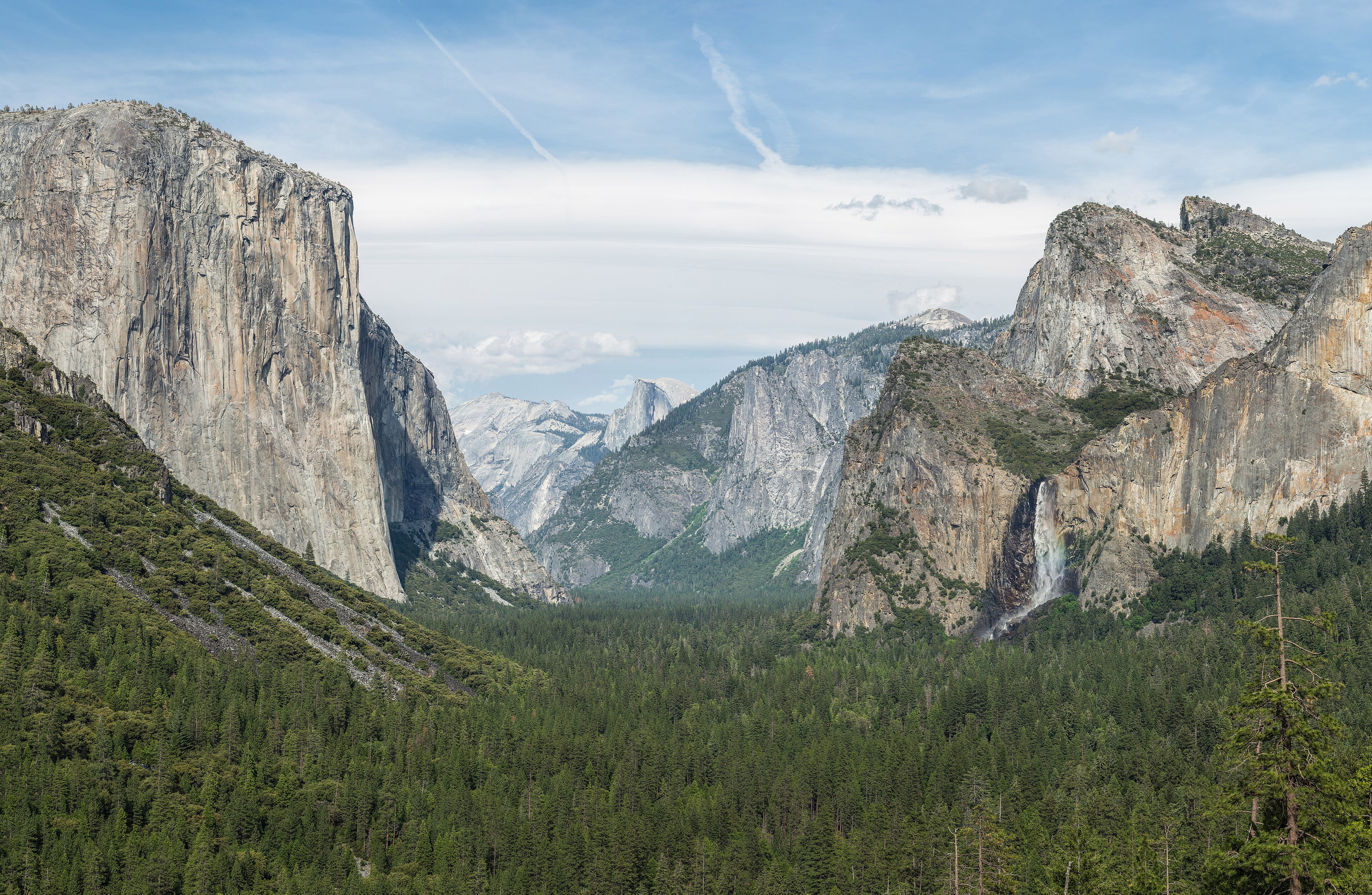
Tunnel View is worth the drive out on Highway 41 and it is the one classic viewpoint that delivers, with El Capitan on the left, Bridalveil Fall on the right and Half Dome in the distance up the Valley. It is also busy, and it is better in evening light than at midday.
Glacier Point puts you level with Half Dome looking down into the Valley, and the road to it is a long detour of roughly an hour each way from the Valley floor, which on a one-day trip is a real cost. Take it only if you have skipped a big hike, or if you are content with the short walk from the parking area as your main event.
The Valley floor itself rewards slow walking, whether at Cook's Meadow at dusk, the base of Yosemite Falls, or the Merced. This is where an early start pays a second dividend, because you are wandering at golden hour instead of driving.
If the Valley feels like too much
There is a case for skipping Yosemite Valley entirely on a single day, and in high summer it is a strong one.
Tuolumne Meadows, up Tioga Road, is Yosemite at 8,600 feet: open subalpine meadow, granite domes, the Tuolumne River, and a fraction of the Valley's crowd. Lembert Dome is a short steep climb with an enormous view and no scrambling, and Cathedral Lakes is a longer classic. The catch is that Tioga Road is closed by snow for much of the year, typically opening in late May or June and closing with the first serious storms in autumn, but when it is open it is arguably the better one-day Yosemite.
Hetch Hetchy, in the park's northwest, is quieter still. The reservoir there drowned a valley that John Muir argued was Yosemite's equal, and the trail along its north shore to Wapama Falls is spectacular in spring, opening earlier in the year than the high country and making a good answer in April and May. Wawona and Mariposa Grove are the sequoia option in the south of the park, and they are worth a day of their own rather than a corner of this one.
None of these are consolation prizes. On a July Saturday they are better than the Valley.
The gear
A day in Yosemite Valley is a short list, because the Valley is a road with services on it and what you need is what makes one climb comfortable.
Trekking poles, which matter more here than the elevation suggests. Every Valley climb is an out-and-back that gives back every foot it took, the Mist Trail steps and the Four Mile switchbacks are both hard on knees, and the descent is where a one-day trip goes wrong.
A rain shell you do not mind wearing in sunshine, because the Mist Trail earns its name. In spring the spray off Vernal Fall soaks you thoroughly, and a shell is the difference between an enjoyable climb and a cold one.
Two liters of water plus electrolytes, since the Valley in summer runs into the nineties and the climbs are all in the sun by ten.
Shoes with real grip, for the granite steps, which are polished by two centuries of boots and are genuinely slick when wet.
A sun hat and high-SPF sunscreen, because the Valley walls reflect and the trails have less shade than the photographs suggest.
A headlamp, which is the item people skip on a day trip and regret. Coming off a Valley rim climb an hour later than planned is normal, and the last mile in the dark without one is unpleasant.
And an America the Beautiful annual pass, which pays for itself in three Yosemite visits, or two at a higher-fee park.
Bears, food, and the things rangers enforce
Yosemite has a serious and long-running black bear problem, and it is entirely a human food problem. Bears in the Valley have learned that cars contain food and they will break into one to get it, so use the food storage lockers where they are provided at trailheads and in campgrounds, and do not leave food, coolers, scented toiletries or empty wrappers visible in a vehicle. This is enforced, and a citation is the least of the consequences.
On the trail, keep food with you rather than leaving a pack unattended at a viewpoint, where the squirrels are the more likely thief and will chew through pack fabric to get in. And do not plan on seeing bears from the car: you might, but driving slowly hoping to is how the loop road becomes a line.
The park is also strict about staying on trail near the falls. The granite above Vernal and Nevada Falls is polished and the water is far more powerful than it looks, and the fatalities here are overwhelmingly people who stepped past a railing for a photograph.
The seasonal reality
Spring, April to June, is the best time for one day and it is not close. The waterfalls are at full volume, everything is green, the Mist Trail earns its name, and the high-country roads are still closed, which conveniently removes the temptation to drive somewhere far.
Summer, July to August, is hot on the Valley floor, crowded everywhere, and the waterfalls are dropping fast, which is when the early start and the shuttle stop being advice and start being the difference between a good day and a bad one. It is also when the Mist Trail weekday closure applies.
Autumn, September to October, is the underrated window: cooler, quieter, better light, and Tioga Road still open if you want the high country, though the falls are at their weakest so pick a view hike over a water hike. In winter the Valley is quiet, sometimes snowy and beautiful, with many trails icy and some roads closed, and traction devices worth having.
Where the day goes wrong
It is worth being specific about how a Yosemite day gets eaten, because the failure is rarely dramatic.
The classic version: arrive at the entrance station at 10:00 am, line twenty minutes to get in, drive forty-five minutes to the Valley, spend half an hour finding parking, walk to a shuttle stop, ride to Happy Isles, start climbing at 12:30 in full heat, turn around at the Vernal Fall footbridge because you are out of time and water, and drive out. That is a real day that happens to thousands of people, and every single failure in it was decided before 9:00 am.
The corrected version costs nothing extra. Leave your accommodation at 5:30 or 6:00, be through the entrance and parked by eight, be climbing by 8:30 in cool air with the falls to yourself for the first hour, and be back at the Valley floor by one with the whole afternoon and evening still ahead of you. The difference between those two days is two and a half hours of sleep.
Three smaller errors compound it. Trying to add Mariposa Grove, which is a long drive south and its own day. Underestimating the granite steps, because the Mist Trail is stone stairs, wet in spring and hard on knees going down, so poles help and so does taking the John Muir Trail back. And bringing too little water, since Sierra summer heat plus continuous climbing empties a bottle faster than people expect, and while there is water at Happy Isles there is none up the trail.
Getting there, and where to sleep
Yosemite is big and the drive in is longer than the map suggests. From the west, Highway 140 through Mariposa and Highway 120 through Groveland are the main routes, while Highway 41 from the south comes in past Wawona and delivers you to Tunnel View, and from the east Tioga Road crosses the crest and is closed by snow much of the year.
Staying inside the park is what makes an eight-o'clock start easy, and it books up months ahead, with Curry Village and the Valley lodges putting you walking distance from the shuttle. Staying outside in El Portal, Mariposa, Groveland or Oakhurst is far easier to arrange and adds an hour or more each way, and if that is your situation the early alarm stops being optional and becomes the entire plan.
One thing properly
Be in the Valley by eight, park once, take the shuttle. Do one hike properly: Vernal Fall if you want the classic short one, the Nevada Fall loop if you want a full day, Upper Yosemite Falls if you want the view and can handle the climb. Check the Mist Trail's weekday closure if you are there Monday through Thursday between late June and October. Spend the evening at Tunnel View or in a meadow rather than in a line.
You will not see Yosemite in a day. You can absolutely have a great day in Yosemite, which is a different and more achievable thing.
If your one day turns into a plan to come back, three days in Yosemite covers the version that includes the high country, and the cables up the back of that dome in the distance are their own undertaking: the Half Dome cables.
And the Merced you walked beside all the way up the Mist Trail is a trout river. Most people climbing past Vernal Fall never register that the water beneath them is fishable, and the high country holds wild trout in the Tuolumne and the park's alpine lakes. Fly fishing Yosemite covers where and when, and it pairs unusually well with a Tuolumne Meadows day.
The version with time to do it properly is in three days in Yosemite. The two big-ticket climbs, both of which need permits, are in the Half Dome cables and Clouds Rest. The high country on the far side of Tioga Road is a different park, described in Eastern Sierra day hikes, and the other big-tree park two hours south is in one day in Sequoia National Park.