Fish
Fish Fire
Fire Hike
Hike Bird
Bird

Everybody plans the way up Half Dome. Almost nobody plans the way down.
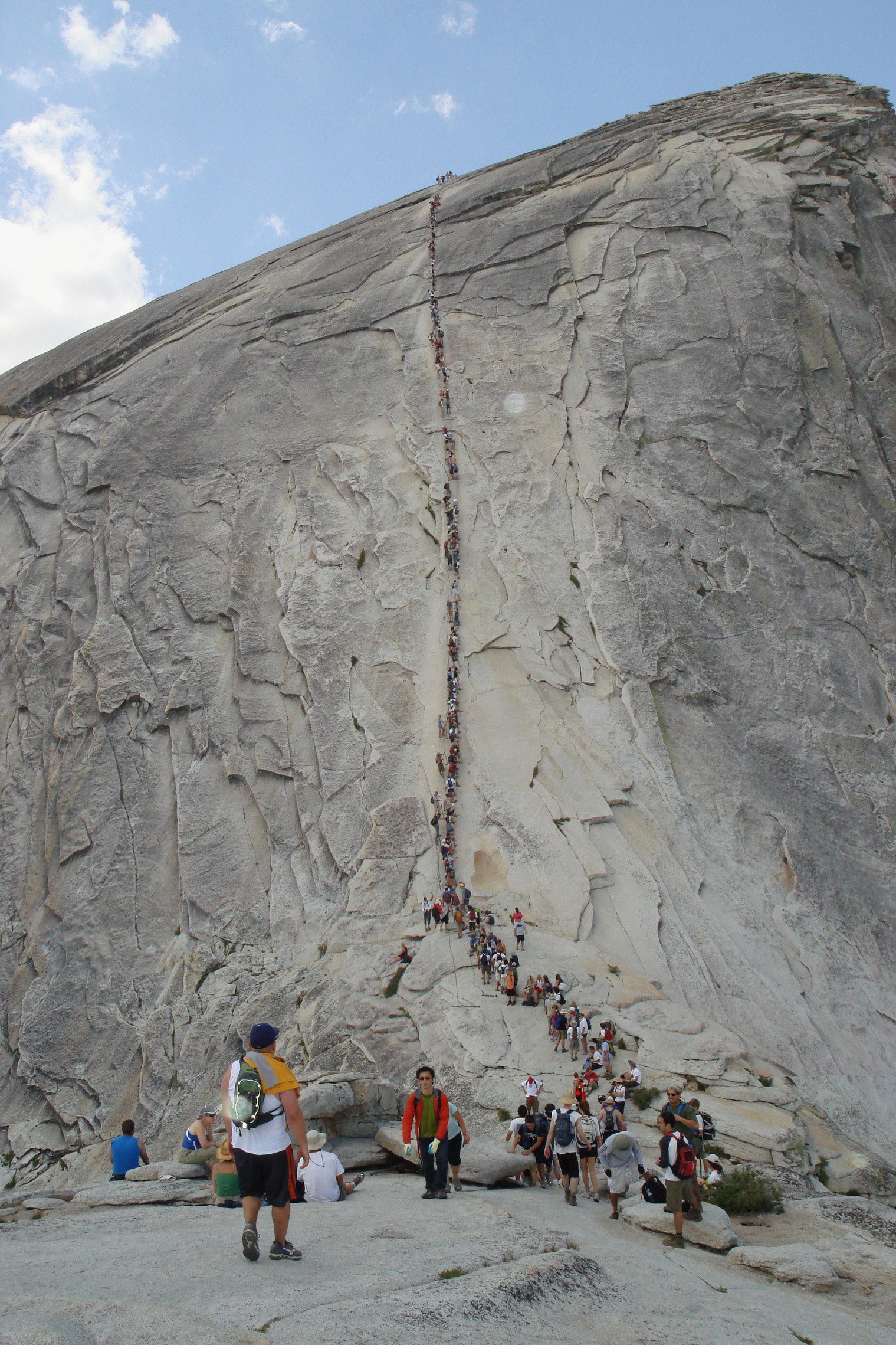
That is the single most useful thing to know about this hike, and it explains most of what goes wrong on it. The cables are a 400-foot pitch of bare granite at something close to 45 degrees, equipped with two steel cables strung through metal poles with a wooden slat every ten feet. Going up, adrenaline and the person behind you carry you along. Coming down, you are facing outward over Yosemite Valley, your forearms are finished, and there is no one pushing you. That is where people freeze.
This piece is about the whole day, but it is weighted toward that half of it.
Getting a permit, without the mythology
The cables are open to 300 people per day beyond the base of the subdome, split roughly 225 day hikers and 75 backpackers, and two lotteries hand those out, both on Recreation.gov.
The preseason lottery takes applications March 1 through 31 and returns results in mid-April, distributing 225 permits per day. The daily lottery runs during the season for the remainder and for cancellations, so you apply two days before your intended date, between midnight and 4:00 pm Pacific, with results that evening.
The fee structure catches people out. There is a $10 non-refundable application fee per application whether or not you win, plus $10 per person once a permit is awarded, and that second charge is refundable if you cancel by 11:59 pm Pacific the day before your hike, which is worth doing rather than no-showing because cancellations feed the daily lottery.
The daily lottery is winnable. It gets a fraction of the attention the March lottery does and it exists precisely because plans fall apart, so if you are already in the park with flexible days it is a far better bet than most people assume.
One thing to be clear about: the Half Dome permit is not the only piece of paper in play. Park entry is separate, and Yosemite is not running a timed-entry reservation system in 2026 though it has in several recent seasons, and if you split the hike across two days the wilderness permit for Little Yosemite Valley is a third system again with its own allocation. Guidepole Hike carries all of the requirements that attach to a route rather than only the headline one, which on this mountain is the difference between holding a permit and holding all of them.
When the cables are up
The Park Service targets raising the cables on the Friday before Memorial Day and dropping them the day after the second Monday in October. Those are targets rather than promises, and a heavy snow year pushes installation back by weeks.
Outside that window the cables lie flat on the rock. People do climb them then, and it is a technical proposition on slick granite with no poles, well outside the scope of a hiking day. Treat the posted season as the season, and confirm current status on the Yosemite National Park site before you commit, because conditions move those dates every year.
The Half Dome Hike: A Complete Guide to the CablesThe day itself
From Yosemite Valley it is roughly 14 to 16 miles round trip depending on your route, with about 4,800 feet of elevation gain, to a summit at 8,844 feet.
The Mist Trail is the shorter, steeper, more spectacular option, with granite staircases beside Vernal and Nevada Falls, soaked in spring and a knee-punisher on the way down, while the John Muir Trail is longer and better graded. The standard play is up the Mist Trail while your legs are fresh and down the John Muir Trail while they are not, and it is standard because it is right. Above Nevada Fall the trail runs through Little Yosemite Valley, then climbs steadily through forest before breaking out onto the shoulder.
Start absurdly early, with most people leaving the Valley between 4:00 and 6:00 am. That is not machismo. It is about being off the cables before afternoon thunderstorms build, which they do with real regularity in summer, and about not descending 4,800 feet in the dark on tired legs.
The subdome is the real filter
Before the cables there is the subdome: a steep set of granite steps and slabs, switchbacking up open rock with serious exposure and no cables at all.
The subdome is where a meaningful number of people discover that they do not want to do this, and that discovery is a good outcome rather than a failure. If the subdome makes you feel sick, the cables will be substantially worse. Turning around there is the cheapest good decision available on the entire route, and rangers check permits at its base for exactly this reason.
The cables, and the descent
At the base of the cables there is usually a pile of gloves left by previous hikers. Bring your own, meaning leather or rubber-palmed work gloves, and do not rely on the pile, because relying on it is how you end up gripping bare steel.
The technique is straightforward and unglamorous. Hands on both cables, feet flat on the granite for friction, move up between the slats one section at a time, and rest with your feet braced on a slat rather than hanging off your arms. The rock is polished from a century of boots and it is much slicker than it looks.
Then the part to plan for. Coming down, face outward: it feels wrong and it is correct, because you can see your feet and the slats and your soles get real contact with the rock, whereas facing in you are climbing blind down a ladder that is not a ladder. Budget your forearms for that descent, since most people arrive at the top with nothing left to grip with, and going up slower than you can leaves you the strength to come down safely.
Congestion is the other thing to plan around. Even with a permit capping the day at 300 people the cables bunch up badly, because everybody who left the Valley at 5:00 am arrives at the base within the same ninety-minute window, which produces a line on a 45-degree slab with hikers going up and coming down sharing two cables. Wait it out at the base rather than passing, because passing means unclipping your grip on a 45-degree slab with hundreds of feet of air below. Neither waiting nor a slow stop-start ascent is dangerous by itself, and both are much worse in the rain.
Which is the last rule: get off if the weather turns. Wet granite between the cables goes from grippy to frictionless very quickly, and the cables are steel on the most exposed high point for miles during a lightning storm. If a storm is building, do not start up, and if you are up and it arrives, get down and off the dome.
People have died on this route, both from falls on the cables and from lightning on the summit. That is not a reason to skip Half Dome. It is the reason the sequencing above matters.
Why Visitors Keep Dying on Half Dome's CablesThe cables are a historic structure
The cable route dates to 1919 and it was added to the National Register of Historic Places in 2012, which is a useful frame. You are not on an engineered via ferrata with modern fall protection. You are on a 1919 solution to getting tourists up a granite dome, maintained and inspected but fundamentally unchanged in concept. Nobody is clipped in, and your grip is the system.
If that description makes you uneasy, listen to it. Plenty of people have a wonderful day in Yosemite that tops out at Nevada Fall or Little Yosemite Valley.
Splitting it over two days
The 75 backpacker permits are the most under-considered option on this mountain. A wilderness permit for Little Yosemite Valley lets you walk in the first afternoon, camp at about 6,100 feet roughly four miles up, and hit the cables early the following morning with fresh legs and an empty rock face.
The advantages are real. You break 4,800 feet of climbing across two days. You are on the cables before the day-hiker wave arrives from the Valley, which is the single biggest factor in how pleasant or unpleasant the cables feel. And you spend a night in one of the better backcountry camps in the park, with a bear-proof food storage locker and a seasonal ranger station.
The cost is that you carry overnight weight up the Mist Trail, and Little Yosemite Valley books up, so check Yosemite's current wilderness permit system rather than assuming your Half Dome permit covers it.
The gear
Half Dome is a sixteen-mile day with forty-eight hundred feet of gain and four hundred feet of cable at the end, and the gear list is short and specific.
Leather-palm work gloves, which is the item everyone asks about. Buy a cheap pair, use them, and pack them out. The pile of abandoned gloves at the base of the cables is a park problem, and the gloves matter because the cable is steel, it is hot, and your grip fails long before your legs do.
Approach shoes with sticky rubber, which are better here than boots. The cable route is bare granite slab at low forty-five degree angles and the friction of the sole is what is holding you on it.
A headlamp, because the standard start for this hike is before four in the morning.
Three liters of water capacity plus a filter, since the last reliable water is at the top of Nevada Fall and the rest of the route is exposed granite in the sun.
Trekking poles that stow on your pack, which is the important qualifier. They are useful for fourteen of the sixteen miles and actively dangerous on the cables, so they need to go away.
A lightweight rain shell, for the afternoon thunderstorms that build over the Sierra crest through summer. Wet cables and lightning on an exposed dome are the two conditions that make this route genuinely lethal.
And a park entrance reservation if the season requires one, checked before you drive.
Water, heat, and altitude
The practical failures on Half Dome are rarely dramatic. They are dehydration and heat. There is water to filter along the Merced below Little Yosemite Valley and nothing at all above it, while the dome is bare granite in full sun and the last few miles from Little Yosemite Valley upward are the hottest, driest and most exposed part of the day, taken on at 8,000-plus feet after ten miles of walking.
Carry capacity for three liters and a filter to refill low down. Start with salt as well as water, because people drinking heavily in Sierra heat without replacing electrolytes get into trouble surprisingly fast. And treat the altitude as real, since 8,844 feet is enough to shorten the breath of anyone who flew in yesterday from sea level.
If you have any flexibility on dates, midweek is transformatively better than a weekend, and September is better than July on every axis: cooler, drier, fewer thunderstorms, thinner crowds, and the cables still up.
If you do not get a permit
Losing both lotteries is the common outcome, and the consolation options here are unusually good.
Clouds Rest is the one to know about. It is higher than Half Dome at about 9,930 feet, it needs no permit for a day hike, and a strong argument says the view is better, because it looks down on Half Dome rather than out from it. The final stretch is a narrow granite fin with drop-offs on both sides, so it asks for a head for heights of its own.
Nevada Fall via the Mist Trail is a superb half-day in its own right, and in spring the Mist Trail soaks you. And the Panorama Trail from Glacier Point down to the Valley gives you Half Dome in profile the entire way with a fraction of the climbing, as long as you can sort the shuttle. None of these require winning anything.
The summit is not the achievement
Apply in March, apply to the daily lottery two days out if March does not work, and go early. Take the Mist Trail up and the John Muir Trail down. Bring your own gloves. Treat the subdome as a decision point rather than a formality. Save your arms for the descent and come down facing out.
The summit is not the achievement. The parking lot is.
The permit-free alternative that looks down on it is Clouds Rest. If permit lotteries are becoming a theme in your hiking, Washington runs the other famously brutal one, and the odds there are considerably worse: the Enchantments.
And if you lose the lottery entirely, there is a quieter way to spend a Yosemite day: the Merced runs right past the bottom of the Mist Trail and the park's high country holds wild trout. Fly fishing Yosemite is a very different way to use a permit-free day in the same park.
The permitless alternative with a comparable view, from higher up, is in Clouds Rest. The park around it is in one day in Yosemite and three days in Yosemite. The other great permitted Sierra day hike is Mount Whitney, and the east side approach to the same range is in Eastern Sierra day hikes.