Fish
Fish Fire
Fire Hike
Hike Bird
Bird

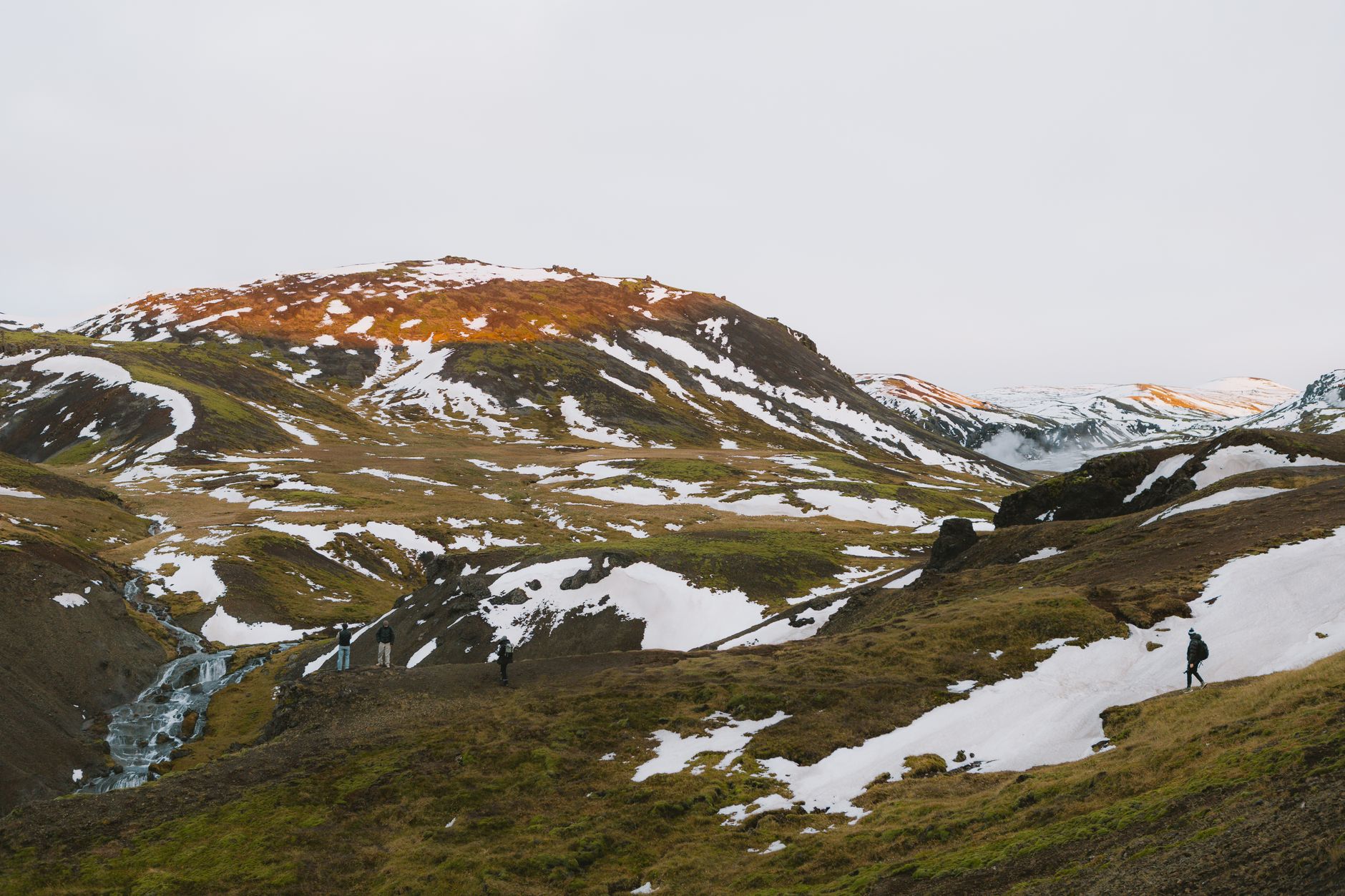

Every spring, in every mountain range in America, the same accident happens repeatedly.
Someone checks the forecast: warm, clear, no rain. They drive to a trailhead that is bare dirt. They start up a well-graded trail in a t-shirt. Two hours later they are standing on a firm snow slope, in trail runners, with a long way down if they slip, and no obvious way forward or back.
Nothing in the first two hours of that day suggested it was coming. That is the defining feature of shoulder-season hiking, and it is why this window produces such a disproportionate share of mountain rescues.
The snowline moves and nothing tells you where it is
Snow does not melt evenly. It melts as a function of elevation, aspect, tree cover and how much fell in the first place, which means the boundary between bare trail and continuous snow can sit anywhere and shifts week to week.
Elevation is the obvious driver and it is not a clean line, because snow persists in gullies and on benches hundreds of feet below where an open slope has cleared. Aspect matters enormously: north-facing slopes hold snow weeks longer than south-facing ones at the same elevation, and a trail that switchbacks from a south face to a north face can go from bare to knee-deep in a single turn. Tree cover cuts both ways, since dense forest shades snow and preserves it while open slopes melt out faster but also slide.
Underneath all of that sits the previous winter, which governs everything. A heavy snow year can push the melt-out four to six weeks later than a light one, so a route that was clear on June 1 last year can be under three feet on the same date this year. The consequence is that you cannot infer the snowline from the calendar, from the trailhead, or from a guidebook. The only reliable source is a recent, specific, dated observation.
Reading trip reports properly
This is the core skill of shoulder-season hiking, and most people do it badly.
-
Check the date, not the season. A report from three weeks ago in a melting spring is nearly useless, and in May a report from five days ago is old.
-
Look for elevation numbers. A useful report says "continuous snow from about 4,200 feet." A useless one says "a bit of snow up top." Learn to write the useful kind yourself.
-
Note the time of day. Someone who summited at 8am walked on frozen snow and someone who came down at 2pm postholed through slush. Both are accurate and they describe different hikes.
-
Note the gear they used. "Microspikes were plenty" and "we turned around without an axe" are the two most informative sentences in any spring trip report.
-
Weight recent snowfall heavily. A single warm week transforms conditions, and so does a late-season storm.
Washington Trails Association, regional forums and agency condition pages all carry dated reports. Use them the way you would use a weather forecast, as perishable information rather than reference material.
Morning snow and afternoon snow are different substances
This is the single most useful physical fact about spring snow, and it explains most of what goes wrong. Overnight, snow refreezes, so by early morning it is hard and supportive and you walk on top of it, which is pleasant until you notice it is also slippery enough that a slip becomes a slide. By late morning the sun softens it into something grippy and forgiving, and that is the good window. By afternoon it is slush, and you break through with every step, sometimes to the knee or hip. That is postholing, and it is exhausting, slow, and a real injury risk when a leg goes into a hole and the body keeps moving.
So the same slope requires traction at 8am, is easy at 11am, and is punishing at 3pm. The implication for planning is that you go early and get off the snow by early afternoon, which is the opposite of the instinct to wait for things to warm up, and it is why spring starts are earlier than summer ones rather than later.
Kahtoola Traction ComparisonWhat traction can and cannot do
This is the gear question people get wrong in both directions. Microspikes are chains with small spikes that stretch over a boot, and they are excellent on firm snow and ice on moderate ground, weigh very little, and are the right answer for the overwhelming majority of shoulder-season hiking. Carry them from roughly November through June in any western range, and take them even when you are confident you will not need them.
What they are not is crampons. They do not bite into hard steep snow and they will not hold you on a slope where a fall would accelerate. Crampons and an ice axe are the tools for steep hard snow, and they only work if you can self-arrest, which is a skill requiring practice on a safe slope well before you need it. Carrying an axe you cannot use is worse than carrying nothing, because it talks you into continuing. Snowshoes solve a different problem again, deep soft snow rather than ice, and they are the wrong tool for a firm morning slope.
The honest test is simple. If the slope is steep enough that a slip would not stop, and you do not have an axe and the training to use it, that is your turnaround. Not the summit, not the lake, not the pass. There.
The specific hazards of this season
-
Postholing, exhausting and a leg-injury risk, particularly where snow bridges old logs and boulders.
-
Tree wells. Around the base of a conifer the canopy keeps snow shallow and unconsolidated, creating a void, and falling into one head-first makes self-rescue difficult. They are a documented cause of death, most often in deep-snow conditions.
-
Snow bridges over creeks. Spring meltwater runs high under snow that looks continuous, punching through into moving water is a serious situation, and crossings that are trivial in August are dangerous in May.
-
Rockfall and icefall as things thaw, particularly below cliffs in the afternoon.
-
Avalanche. This gets less discussion in a hiking context than a skiing one, but wet slides in the afternoon heat are real and hikers cross avalanche paths without recognizing them. If your route crosses open steep slopes below a headwall, that is avalanche terrain and it deserves a check of the regional forecast.
-
Losing the trail. Under continuous snow the tread disappears and so do the switchbacks, so people follow boot tracks made by someone who was also lost, or take a direct line up a slope the trail deliberately avoided.
-
High water on the descent. Creek crossings rise through the day with melt, so a crossing you made easily in the morning can be substantially harder on the way back.
Turning around well
The hardest thing in shoulder-season hiking is not the snow. It is that the day up to the snowline was easy, so stopping feels absurd.
A few things make it easier. Decide the criterion in advance, because "we turn around at continuous snow on a slope" is a decision made in the car rather than on the mountain. Treat the snowline as the objective rather than an obstacle in front of the objective, since walking to the snow and back is a good spring day in its own right. Remember that you have to come down, because ascending firm snow is far easier than descending it and people routinely commit upward past the point where they can reverse safely. And watch for the trap of following tracks: someone else's boot prints prove that a person went that way, not that they came back, and not that they were equipped as you are.
Microspikes, Crampons and Snowshoes: Winter Hiking TractionWhere this bites hardest
The pattern is universal but the timing varies enormously by range. The Cascades are the classic case, with trailheads at 1,500 to 3,000 feet melting out in March while the passes and summits hold snow into July and, in a heavy year, well beyond. The gap between a green trailhead and a snowbound ridge is larger here than almost anywhere.
The Sierra melts later than people expect, and in a big winter the high country is not reliably clear until July, which is also where creek crossings become the dominant hazard rather than the snow itself. The Northern Rockies, meaning Glacier, the Bitterroots and the Beartooths, have a short season and high trails often do not clear until mid-July regardless of what the valleys are doing.
The Southern Appalachians are the exception that catches southern hikers out. Elevations are lower, but the Smokies and the Roan Highlands hold snow and rime ice into spring, and winter conditions above 5,000 feet are real. Desert ranges invert the problem entirely, since the valleys become too hot before the high country melts out, leaving a narrow band that works.
One access wrinkle rides along with all of this. A great many shoulder-season trailheads sit behind seasonal gates on forest and park roads that do not open until the road crew clears them, which can be weeks after the trail itself is walkable, and the closure point is often miles below the trailhead you planned on. Guidepole Hike carries road and trailhead access status alongside the ownership layer, which in April is frequently the difference between the hike you planned and a long walk up a plowed road to reach the start of it.
The gear
Shoulder season is the hardest hiking season to pack for, because you are dressing for two seasons that will both happen to you on the same afternoon.
Kahtoola MICROspikes, which are the default tool for this season and the one whose limits matter. They work on packed snow and on ice on a moderate grade. They do not work on steep firm snow above a runout, and mistaking one situation for the other is the classic shoulder-season accident.
Waterproof boots plus gaiters, since the trail is running water at the bottom and postholed snow at the top.
Trekking poles with snow baskets, which is a small detail that matters: without baskets the poles sink to the grip and give you nothing.
An ice axe, and only if you have practiced self-arrest with it. An axe carried without the skill is weight and false confidence, and this is worth saying plainly rather than softening.
An offline map with the route loaded, because the trail disappears under snow and the tread you are following at that point is somebody else's guess.
An extra warm layer and dry socks, kept dry, since wet feet plus a cold ridge is how a good day turns bad.
And a headlamp, because the season is bracketed by short days and the postholing takes twice as long as the ascent suggested.
Dressing for two seasons in one day
The clothing problem is awkward, because you leave a warm trailhead and arrive in winter. Start colder than is comfortable, since you will warm within ten minutes of climbing and sweat that soaks a base layer becomes a problem the moment you stop at the snowline. Carry a warm layer you have not used, dry and reserved for stopping, because spring hikers routinely have everything damp by the time they need insulation.
Waterproof footwear and gaiters matter here more than in summer, because the wet comes from below rather than above, and trail runners that are ideal in August make a postholing day miserable. Bring sunglasses and sunscreen, since snow reflects hard and spring sunburn on a bright snowfield catches people who dressed for a forest walk. And carry spare dry socks in a bag, which is the single highest-value luxury item in shoulder season.
What the season is good for
None of this means avoid spring. It is one of the best times to be out, provided you aim correctly. Low-elevation trails are at their best, green and running with water and empty while everyone else waits for the high country. Waterfalls peak with snowmelt. Wildflowers work up the mountain over weeks, so there is always a band in bloom somewhere between the valley and the snow. Deserts and canyons are in their prime window before summer heat arrives. And the high country is spectacular from below, carrying more snow on the peaks than you will see all summer.
So find a dated trip report with an elevation number in it, start early, and plan to be off any snow before the afternoon softening. Carry microspikes from November through June whether or not you expect to need them, and know that microspikes are not crampons and that an ice axe without self-arrest practice is not equipment. Set your turnaround criterion in the parking lot, and treat the snowline itself as a fine place to have lunch and go home from.
The six weeks when the trailhead is dry and the summit is not are the six weeks that catch out experienced people. The mountain gives you no warning, so the planning has to.
What snow does to a published difficulty rating is in trail difficulty and elevation gain, and the navigation half of the problem is in navigation without signal. The season's other hazard, moving water, is in river and creek crossings. Places in this library where the snowline question decides the trip include North Cascades day hikes, one day at Mount Rainier and the Enchantments permit lottery.