Fish
Fish Fire
Fire Hike
Hike Bird
Bird


There is a crab in Puget Sound that you may keep in either sex, at a smaller size, when the Dungeness season is shut, and almost nobody takes it.
Red rock crab are abundant, they come up in the same gear, they are perfectly good eating, and most recreational crabbers throw them back to make room for a Dungeness that never arrives.
That is a mistake, and understanding why people make it is most of what is interesting about this animal.
The rules, which are more generous than people assume
Washington's red rock limits differ from Dungeness in two ways that matter enormously.
The daily limit is six red rock crab, and unlike Dungeness they may be male or female. The minimum size is five inches across the shell, against six and a quarter for Dungeness in Puget Sound. Hard shell only, as with everything.
That combination is the point. Taking females is permitted, which doubles the proportion of any given catch that is legal, and the smaller minimum means crab that would be short as Dungeness are keepers as red rock.
Seasons differ by marine area and red rock is frequently open when Dungeness is closed, which is the situation that produces the article's whole argument: a day when the pot is coming up full of legal crab that most people are returning.
Oregon is even more generous, at twenty-four a day of any size or sex, year-round in the estuaries. That is covered in Dungeness crabbing on the Oregon coast.
Telling them apart
Confusing the two is the practical risk, because keeping an undersized Dungeness that you believed was a red rock is still an undersized Dungeness.
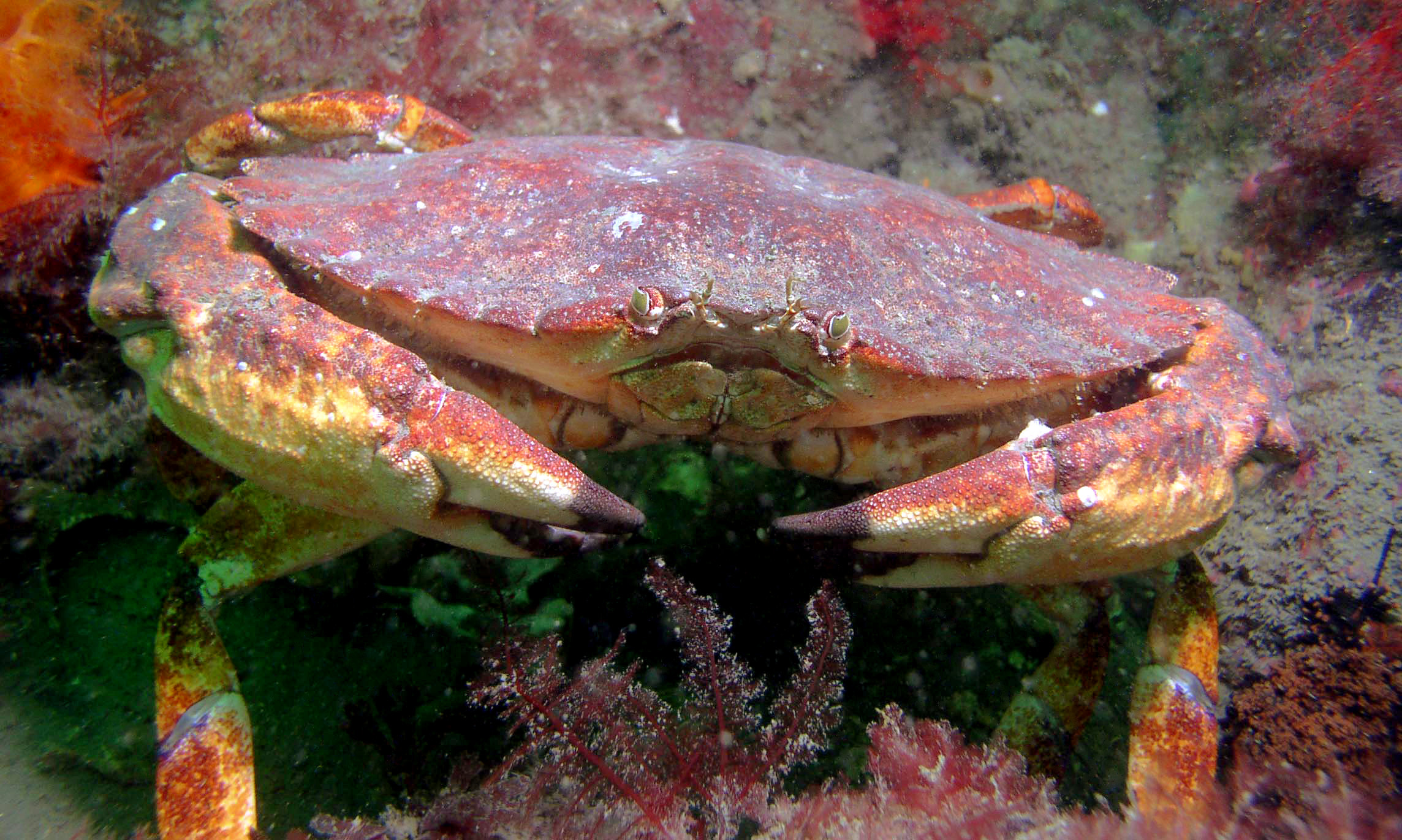
A red rock crab is Cancer productus, and the adult is unmistakable once you have seen one: a broad, heavy, brick-red to dark red shell, considerably thicker and more solid than a Dungeness, with large black-tipped claws. The shell edge has a series of blunt, low teeth rather than the sharper points of a Dungeness.
A Dungeness is lighter in color, purplish to tan-brown, with a wider more oval shell, a distinct pattern of points along the edge, and proportionally smaller claws with white tips.
The reliable check is the claw tips. Black on a red rock, white on a Dungeness. Juvenile red rock crab can be patterned and confusing in other respects, so the claw is what to look at.
Why people ignore them
Three reasons, and only one of them is a good reason.
The first is meat yield, and this one is legitimate. A red rock has a heavier shell and less body meat than a Dungeness of similar size, so a crab that looks comparable produces noticeably less. Filling a limit of six takes more picking for less return.
The second is the claws, and this is a real practical consideration rather than an excuse. A red rock crab's claws are proportionally much larger and considerably more powerful than a Dungeness of the same size, and they will draw blood through a careless grip. Handling them requires more care, which puts people off.
The third is cultural, and it is not a good reason. Dungeness is the prestige crab on this coast and red rock is treated as what you catch when you fail. That framing means a great many perfectly good crab go back over the side.
Why they are worth keeping
The counter-argument comes down to the claws, which is also the reason people avoid them.
Those oversized claws are packed with dense, sweet meat, and a great many people who have eaten both prefer red rock claw meat to Dungeness. It is firmer, sweeter and holds up better in cooking. The body meat is less impressive; the claws are the prize, and a limit of six red rock crab is a substantial quantity of very good claw meat.
They are also available when nothing else is. Red rock seasons are longer and the animal is abundant in rocky and mixed ground where Dungeness are thin, so a bay that is disappointing for one may be full of the other.
And they are easier to catch. Red rock crab are aggressive feeders and go into gear readily, which means the frustration of an empty pot is much less common.
Crab Fishing Multiple Areas in Washington Puget Sound for Dungeness Crab and Rock CrabWhere they are
Red rock crab want harder ground than Dungeness, and knowing that changes where you set.
Dungeness favor sand and mud. Red rock crab prefer rock, cobble, gravel, rip-rap and structure, and they are common around jetties, breakwaters, pilings and rocky shorelines. In practice a pot set on mixed or rocky ground catches red rock and a pot on clean sand catches Dungeness, and a pot on the transition catches both.
That makes them the accessible crab from shore. Public piers, jetties and breakwaters are frequently good red rock ground precisely because they are structure, and a ring fished from a jetty in Puget Sound is a reasonable way to get crab with no boat at all.
Depth is less critical than for Dungeness and they are frequently taken shallow, which further reduces the equipment threshold.
The gear and the rules that come with it
Everything about gear is the same as for Dungeness, because you are using the same gear and frequently the same pot on the same day.
Two escape rings of at least four and a quarter inches in the upper half of the pot, biodegradable rot cord, and a half red, half white buoy with your name and permanent address. The reasoning is in crab pot rules explained, and it is the same reasoning: a lost pot keeps fishing.
The catch record card requirement applies to Dungeness rather than red rock, which is a detail worth checking against current rules because it changes what you must carry and record.
And marine area boundaries govern here as everywhere in Puget Sound. Red rock seasons differ between adjacent areas, they differ from Dungeness seasons in the same area, and the boundaries are chart lines with nothing visible on the water. Guidepole carries the area boundary and its current rules against the water you are on, which on a fishery where two species in the same pot have different seasons and different limits is more use than a memory of last summer.
The rest of the Cancer crabs
Red rock is one of several similar crabs on this coast, and knowing the others prevents both wasted effort and accidental violations.
The graceful or slender crab is smaller and lighter with a more delicate shell and considerably less meat, and it comes up in gear constantly. Hairy crabs and helmet crabs turn up too, and none of these are worth keeping. Juvenile Dungeness are the ones that matter, because they are legal-looking to an inattentive eye and are exactly what you must not keep.
The one crab in this group you need to be able to recognize is European green crab, and the reason is the opposite of the usual one. It is a prohibited invasive in Washington, it is illegal to possess a live one, and the state asks you to photograph, report and release rather than kill it, because natives are misidentified as green crab constantly. That whole situation is in do not kill the green crab you think you found.
So the sorting on a Puget Sound pot pull is: Dungeness by the white claw tips and the size, red rock by the black claw tips and five inches, green crab photographed and released, and everything else back over the side.
Why the seasons run differently
It is worth understanding why red rock stays open when Dungeness closes, because it explains why this article exists.
Dungeness is the species under harvest pressure. It supports a large commercial fishery, a tribal fishery and an enormous recreational one, it is managed to a shared quota, and the summer catch record card returns determine the winter season. Red rock carries a fraction of that pressure, is abundant, and is not the subject of the same allocation arrangements.
So the closures you encounter are usually Dungeness closures, and the red rock season sitting open underneath them is not an oversight. It is a species that can absorb the harvest being left available while the one that cannot is rested.
The practical version is that a closed Dungeness season is not a closed crabbing season, and a crabber who only knows one species loses most of the year.
Working a jetty
Because red rock crab live on structure, the jetty fishery is a genuine option and it deserves its own treatment.
The gear is a ring and enough line to reach bottom plus slack for current, which on most Puget Sound jetties is thirty to sixty feet. You want the ring on the bottom against the rock rather than out on clean sand, so drop it close in and let it settle, and accept that you will occasionally lose one to the rocks.
Check every ten to fifteen minutes. A ring holds nothing, and a red rock that walked in two minutes after your last pull will walk out before your next one if you leave it too long.
Current is the variable. A jetty on a running tide moves your gear and buries your bait in scent, which is good, and it also drags a light ring off the ground you wanted, which is not. Weight the ring more than you think and re-set after each pull rather than assuming it stayed put.
And watch the water rather than the rod. Jetty rocks are slick, swell wraps around the end of a jetty in ways that surprise people, and the two dangerous things about this fishery are both about footing rather than crab.
How to HUMANELY Cook and Clean Dungeness Crab (Step-By-Step)Reading a pull
A pot that comes up full of red rock and empty of Dungeness is telling you something about the ground, and learning to read that saves a season of wasted sets.
Red rock crab hold on structure and Dungeness hold on open sand and mud, so a pull dominated by red rock means the pot landed on or against rock, cobble or rip-rap. If Dungeness is what you want, move the pot fifty yards onto cleaner bottom and try again. If the Dungeness season is shut, that same pot is exactly where you want it.
A mixed pull means you found the transition, which is generally the most productive place to be when both species are open, because you get a shot at two limits from one set.
An empty pot on rocky ground usually means current rather than absence. Red rock feed aggressively and find bait fast, so a pot that soaked an hour on good structure and produced nothing was probably in still water where the scent never traveled, or it was dragged off the rock by a running tide. Weight it more and set it where the water moves.
And a pot full of undersized crab of both species is a nursery, which is worth moving away from rather than working. Handling a great many sublegal crab to find one keeper is hard on the animals and slow for you.
Cooking them
The approach differs from Dungeness in one respect and it follows from the anatomy.
Because the claws are the prize and the body is modest, many people cook and pick red rock crab differently: crack and pick the claws properly, and use the body meat in something rather than serving it whole. Crab cakes, chowder, dip and pasta all take body meat well.
The shell is thick, so cooking runs slightly longer than a Dungeness of the same size, and cracking takes a proper mallet rather than a squeeze.
Otherwise the handling is identical. Cool and damp, never submerged, never fresh water. Cook live or clean immediately after dispatch. And during a domoic acid event, clean the crab and discard the viscera, which is where the toxin concentrates.
The short version
Six red rock crab a day in Puget Sound, either sex, five inch minimum, hard shell. More generous than Dungeness on both sex and size, and frequently open when Dungeness is shut.
Identify by the claw tips: black on a red rock, white on a Dungeness. The shell is brick red, heavier and blunter-toothed.
They yield less body meat than a Dungeness, and the oversized claws hold dense sweet meat that many people prefer.
Set on rock, cobble, rip-rap and structure rather than sand, which makes jetties and piers productive from shore.
Same gear rules as Dungeness, because it is the same gear: escape rings, rot cord, marked buoy.
And handle them carefully, because those claws are the reason to keep them and the reason to respect them.
The species people are actually targeting when red rock come up is in Dungeness crabbing in Puget Sound, and Oregon's far more generous version of both fisheries is in Dungeness crabbing on the Oregon coast. Whether the water is open at all is in shellfish biotoxin closures, and the license picture across states is in shellfish licenses by state.