Fish
Fish Fire
Fire Hike
Hike Bird
Bird


The card in your pocket decides next winter's season.
Puget Sound recreational crabbing runs on a catch record card, and the summer harvest reported on those cards is what the state uses to set the areas and the length of the winter season. Returning it is not paperwork. It is the mechanism by which the fishery gets managed, and a card that never comes back is counted as an unknown that gets resolved conservatively.
That is an unusual amount of leverage to hand a recreational fishery, and it is worth knowing before anything else.
The limit, and the three things that have to be true
Five Dungeness crab a day is the Puget Sound limit, and three separate conditions apply to every one of them.
Male only. The identification is on the underside, where males have a narrow pointed abdominal flap and females a broad rounded one. It is obvious once you have seen both, which is why it is worth looking at a female deliberately on your first outing rather than working it out in the dark later.
At least six and a quarter inches across the carapace, measured in a straight line across the widest part, immediately in front of the points rather than including them. Measuring to the tips is the most common honest error on the water and it is enough to turn a legal crab into a short one.
And hard shell. A crab that has recently molted is legal size but mostly water, with poor meat yield and poor texture, and it is far more likely to die from handling. Press the shell just behind the widest point: a hard crab is rigid and a soft one gives.
Red rock crab are a separate animal with a separate limit, generally open when Dungeness is not, and they are worth knowing as the fallback rather than a consolation.
Marine areas, which are the unit that matters
Puget Sound is not managed as one water. It is divided into marine areas, each with its own season dates, and the boundaries are lines on a chart rather than anything visible from a boat.
Summer seasons typically open in early July and run into early September, area by area, with some areas open only on certain days of the week. Winter seasons open in several areas around the beginning of October and run into the winter, and which areas open and for how long depends on how much of the summer quota was taken, which is where the catch record cards come back in.
A boat can cross from an open area into a closed one in ten minutes with nothing to mark the transition, which is the single most common way an otherwise careful crabber ends up out of compliance. The area boundary, the season dates for that specific area, and the current biotoxin status are three separate pieces of information from two agencies, and Guidepole carries them together against the water you are on rather than leaving you to reconcile a regulation pamphlet with a chart.
The gear
Crabbing Puget Sound is cheap to start and the legal specifications are exact, so the gear list splits into what catches crab and what keeps you compliant.
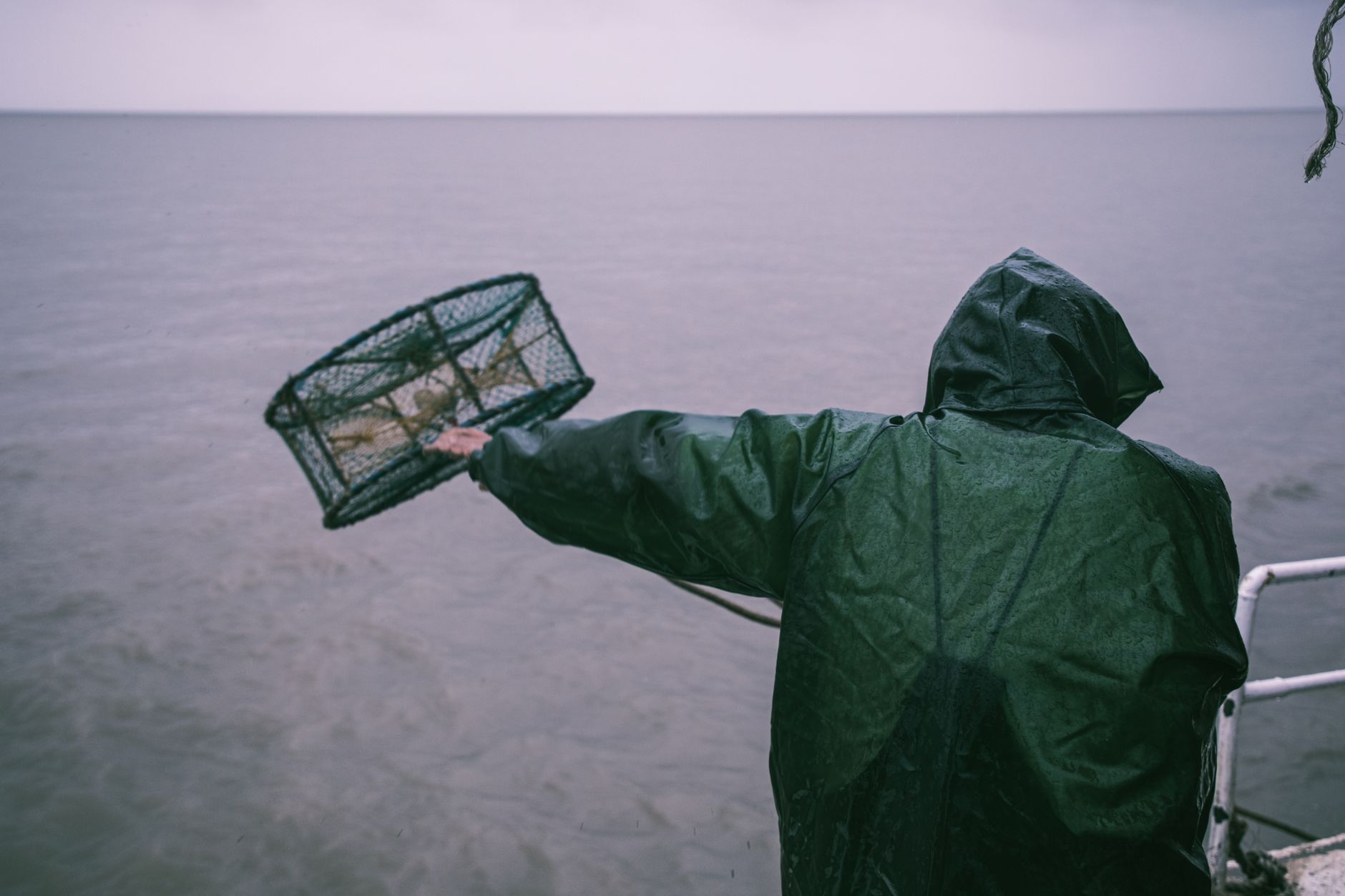
The catching half is a pot or a ring, a hundred feet or so of line depending on your depth, a buoy, and bait. A bait box or cage matters more than the bait itself, because contained bait releases scent through a whole soak instead of being stripped in twenty minutes. Oily fish, salmon carcasses and poultry all work.
The compliance half is not optional and it is checked. Two escape rings of at least four and a quarter inches inside diameter, set in the upper half of the pot. Fresh biodegradable rot cord, untreated cotton or another natural fiber no larger than thread size 120, replaced every season. And a buoy that is half red and half white with both colors visible while fishing, carrying your first and last name and permanent address.
Sinking line, or a weighted section near the buoy, keeps slack off the surface where propellers find it. That is the difference between gear you recover and gear that becomes somebody else's derelict pot.
Then a crab gauge, used on every crab before you decide rather than after, and a cooler with a wet towel and a little ice, drained, because crab kept cool and damp last hours while crab in fresh water or a sealed bucket do not.
Finally, a license with the crab endorsement, which is what produces the catch record card you are required to carry and record on.
Pots and rings do different jobs
The two common gear types suit different situations and most people eventually own both.
A pot is a baited trap that crab enter and mostly do not leave. It can soak for hours, it works unattended, it needs a boat or a dock to set from, and it is the standard for anyone fishing from a vessel. It is also the gear that becomes a derelict hazard when it is lost, which is why the escape ring and rot cord rules exist.
A ring is a collapsible hoop that lies flat on the bottom and closes into a basket as it is pulled. Crab are not trapped, they are simply lifted before they can leave, so a ring has to be checked every ten to twenty minutes. It is cheaper, it is legal in some places and times when pots are not, and it is the standard gear off a pier.
Whichever you use, the gear rules are specific and enforced: two escape rings of at least four and a quarter inches, biodegradable rot cord, and a half red, half white buoy with your name and address on it. The reasoning behind all of that is in crab pot rules explained, and it is worth understanding rather than memorizing.
How to Catch More Dungeness Crab in Puget Sound | Best Bait, Depth & Tides for CrabbingWhere to set
Crab are not evenly distributed and the difference between a good set and a bad one is larger than the difference between good and bad bait.
Depth is the first variable, and the productive band shifts through the season, generally shallower early and deeper later as the water warms. Somewhere between forty and a hundred feet covers most Puget Sound recreational crabbing, and the way to find the working depth on a given day is to spread your pots across a range rather than putting them all on one number.
Bottom type matters more than depth. Crab work sand and mud rather than rock, and they concentrate along edges: the margin of an eelgrass bed, the transition from sand to gravel, the lip of a drop-off, the mouth of a bay. A pot on featureless deep mud catches; a pot on an edge catches more.
Current is the third factor and the one people underestimate. Crab find bait by scent, so a pot in moving water broadcasts a plume and draws from further away, while a pot in still water waits for something to wander past. Setting where a tide runs, and setting before the tide rather than at slack, is worth more than any change of bait.
Bait, and how long to soak
Bait is less critical than people think and there is still a right answer.
Oily fish works: herring, salmon carcasses, mackerel, and the chicken and turkey parts that a great many people swear by and that do catch. What matters more than the species is that the bait is contained. A bait box or cage keeps it working through a full soak instead of being stripped in the first twenty minutes by everything else on the bottom.
An hour is a reasonable minimum soak for a pot and several hours is better, though rules on how long gear may sit unattended vary by area. Rings are the opposite: check them every ten to twenty minutes, because nothing is holding the crab in.
The one universal is that fresh bait beats frozen and both beat bait that has been soaking since yesterday. Rebait every set.
Pulling gear without losing it
More recreational pots are lost to bad retrieval than to theft, and the failures are avoidable.
Come up on the buoy from downcurrent and take the line vertical before you start hauling. Pulling at an angle drags the pot along the bottom, where it snags, and a snagged pot in moving water is how the line parts. If the pot will not lift, do not winch against it from a rocking boat: reposition directly over it and try again on the slack.
Watch the tide before you set, not just before you pull. A strong flood lays a buoy flat and pushes it under, so gear set at slack in forty feet can be invisible three hours later, and a buoy you cannot see is a pot you cannot recover. Note the position on a chartplotter or against a shore transit rather than trusting that the buoy will still be showing when you come back.
How to Properly Clean Dungeness Crab (The PROPER WAY!)Handling, keeping and cleaning
What happens between the pot and the pot of water decides whether it was worth the trip.
Pick a crab up from behind, thumb and fingers on the back edge of the shell behind the rear legs, and it cannot reach you. Measure it, check the sex and the shell, and put back anything that fails before it goes in the box.
Keep them cool and damp, never submerged. A cooler with a wet towel and a little ice, drained so they are not sitting in fresh water, holds live crab for hours. Fresh water kills them, a sealed bucket kills them, and a crab that dies before cooking begins breaking down almost immediately, which is why the standard is to cook them live or clean them immediately after dispatch.
Cleaning before cooking is common on the Pacific coast and worth doing: the crab is dispatched, the shell removed, the gills and viscera rinsed away, and the two halves cooked. It cooks faster, it packs smaller, and during a domoic acid event it is the recommended handling, because domoic acid concentrates in the viscera rather than the meat.
The seasons behind the seasons
Why crabbing opens when it does is not arbitrary and understanding it makes the rules feel less like obstacles.
Dungeness grow by molting, and a crab that has just shed is soft, vulnerable and worthless to eat. Mating happens while the female is soft, immediately after her molt, with the male guarding her through it. So a season set during peak molt would take crab at their worst condition and disrupt the reproductive cycle at the same time.
Setting the fishery for hard-shelled males outside the main molt achieves three things at once: better meat, an untouched female population, and males that have already had the chance to mate. It is why the male-only rule and the seasonal timing are one policy rather than two, and why the answer to a closed area full of visible crab is that the closure is the point.
Getting started without a boat
You do not need a vessel, and the pier fishery is good in places.
Public piers around Puget Sound allow ring and pot fishing, they concentrate around the areas where crab move through in the summer, and they need nothing but a ring, a line, bait and a license with the crab endorsement. The catch rate is lower than from a boat working good bottom, and the barrier to entry is a fraction of it.
The other entry point is a shore set from a beach at low tide, walking gear out and retrieving it on the next low, which is legal in some places and not others and is very much worth checking before trying. Whether the beach you are walking across is public at all is a separate question in Washington, and it is covered in public tidelands and private beaches.
The short version
Five crab, male only, six and a quarter inches measured in front of the points, hard shell. Marine areas each have their own season and the boundaries are invisible, so know which one you are in.
Get a license with the crab endorsement, carry the catch record card, record as you go, and return it, because the summer cards set the winter season and a missing card is counted conservatively.
Pots soak and need a boat or a dock; rings need checking every fifteen minutes and work from a pier. Set on edges rather than open bottom, in moving water, with contained bait. Keep the catch cool and damp, never in fresh water, and clean it before cooking if a domoic acid advisory is running.
The gear rules and the reasoning behind them are in crab pot rules explained, and whether the water is open at all is in shellfish biotoxin closures.
If the Dungeness season in your marine area is shut, red rock crab is frequently open under a more generous rule and comes up in the same pot, covered in red rock crab in Puget Sound. The Oregon version of this fishery is year-round and twice as generous, in Dungeness crabbing on the Oregon coast. And whether the beach you launch from is public at all is in public tidelands and private beaches.