Fish
Fish Fire
Fire Hike
Hike Bird
Bird


In late September, a birder walks slowly around a small stand of cypress in a hollow on a windswept headland, looking at each tree from every angle, for the fourth time that day. To a passer-by this looks like extremely poor use of a beautiful place.
What they are doing is working a migrant trap, and Point Reyes National Seashore has some of the most productive ones on the continent.
The geography does all the work
There is nothing mystical about why Point Reyes produces rare birds. Three things stack up. It sticks out, projecting roughly ten miles into the Pacific and well west of the general run of the California coast, so a bird drifting offshore that makes landfall anywhere in this stretch is disproportionately likely to make it here. It is nearly treeless, since the outer point is grassland, coastal scrub and wind, which leaves the few stands of cypress and pine, most of them planted around historic ranch buildings, functioning as islands where a tired migrant has no choice about where to drop. And the coast runs the wrong way, so birds moving south along the coastline hit a headland that pushes west and the geometry funnels them.
Then there is the least romantic and most important factor, which almost nobody says out loud. Point Reyes produces rarities partly because rarities land there and largely because an unusual number of very good birders check the same small stands, repeatedly, for decades. A vagrant that lands on an equally suitable headland with nobody on it is not a record; it is just a bird having a bad autumn.
That has two consequences worth internalizing. The site is not as far ahead of its neighbors as the list suggests, because comparable habitat up and down the coast is under-watched and some of it would produce similarly if anyone worked it. And your own odds are better than the raw numbers imply if you are willing to be thorough, because the birders who find things here are not luckier, they simply walk the same eight stands four times a day and look at every bird. It is also why the eBird bar charts for this location are so dramatic, and why they should be read as a map of effort as much as of birds.
Birding Point ReyesThe tree stands, and how to work them
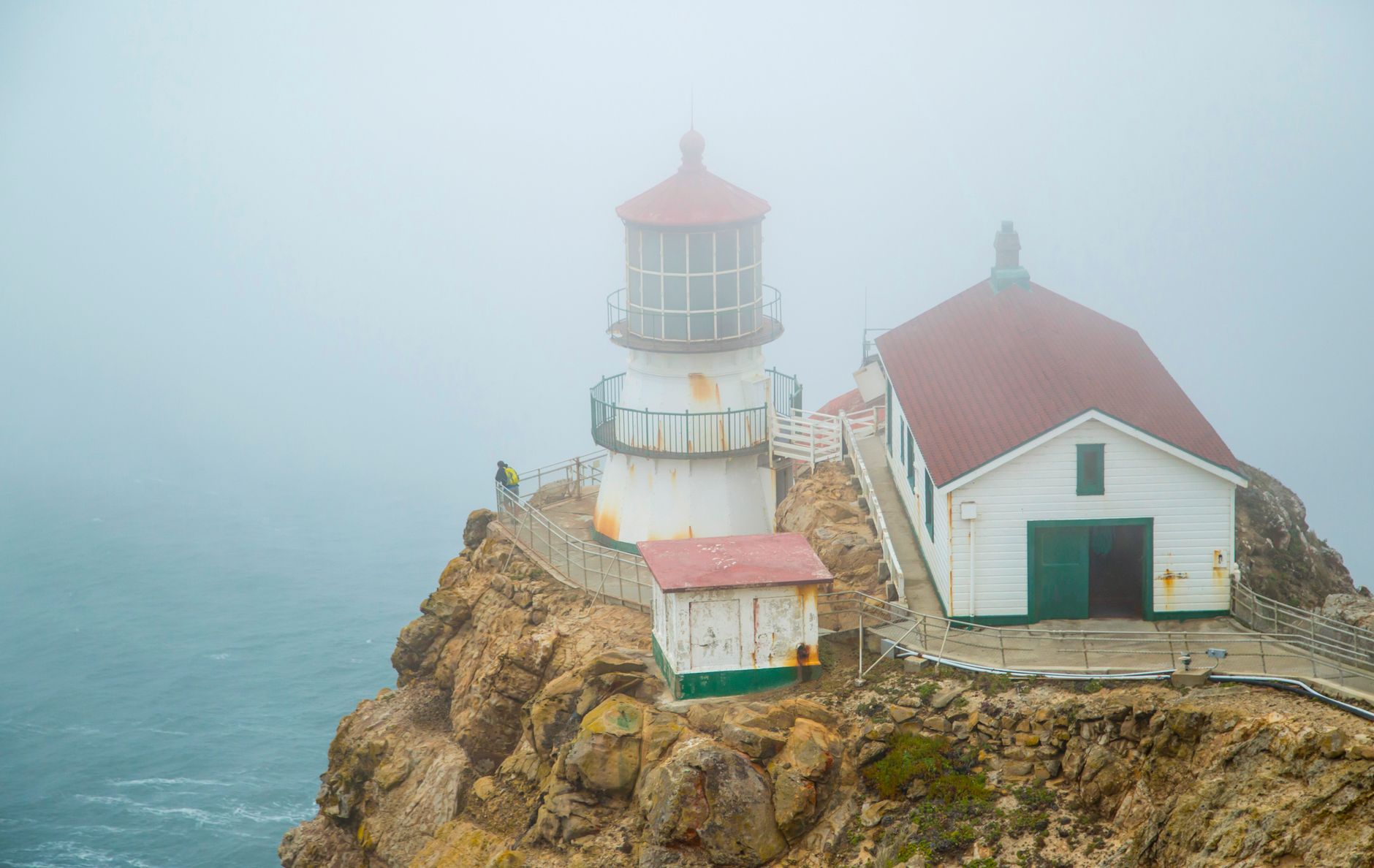
The outer point holds a small number of isolated stands, and in autumn they are checked repeatedly by a lot of people. The classic circuit takes in the cypress and pine plantings around the historic ranch sites out toward the lighthouse, along with the Fish Docks at Chimney Rock, the Nunes and Mendoza ranch groves, and the willows and cover at Drakes Beach and around Abbotts Lagoon.
The technique is unglamorous and it is the whole skill:
-
Walk slowly and circle each stand, because a bird on the lee side is invisible from the windward side.
-
Watch the edges and the tops. Most vagrants here are in the outer foliage or dropping to the ground at the drip line.
-
Come back. A stand that held nothing at nine can hold a rarity at eleven, since birds arrive and move through all day.
-
Do not thrash the trees. Repeatedly flushing a tired vagrant that has just crossed a great deal of ocean is harmful, and on a heavily birded headland the cumulative effect of forty people doing it is worse than any one person imagines.
-
Read the weather. Productive conditions generally follow a system that has pushed birds off course, and the days after a front are worth more than the calendar date.
What turns up
It is worth being concrete about what a vagrant here means, because the word covers a wide range. Eastern warblers are the classic, with Blackpoll, Black-and-white, American Redstart, Northern Parula, Chestnut-sided and Magnolia among a long tail of scarcer species, and most autumns produce a good number across the outer point. Eastern vireos, flycatchers and orioles appear with some regularity, and eastern sparrows and buntings turn up in the weedy edges and around the ranch buildings. Asian strays are the headline birds and the reason people keep coming back, arriving rarely but often enough to matter.
The underlying mechanism is straightforward. A small proportion of young birds on their first migration orient wrongly, and a coastline that projects west collects a disproportionate share of them. It is a numbers game played across a continent, and Point Reyes is where a slice of it becomes visible.
What the ranch settlement changed
This is the significant recent development and it is worth stating carefully. In January 2025 the National Park Service issued a revised Record of Decision alongside a settlement agreement over the long-running dispute about ranching on park lands. Under private, voluntary agreements brokered by The Nature Conservancy, the operators of six dairy ranches and six beef ranches agreed to cease operations and surrender their leases in exchange for compensation, and ranchers and workers had largely exited by spring 2026, a transition affecting around ninety tenants. The closing ranch lands are to be managed within a Scenic Landscape zone that prioritizes resource conservation, and the settlement is framed around increased public access and restoration.
For birders, the honest summary is that this is a live transition and the access picture is still settling. Several of the historic tree stands that have produced the headland's rarities for decades sit on or beside former ranch ground, and what that ground looks like in five years, how it is managed and precisely where the public may walk are all being worked out now rather than settled. The practical advice is to check current conditions before each visit rather than relying on a trip report from three years ago.
The seawatch, and the other half of the site
Point Reyes is not only a passerine trap. From the headland you can seawatch, with shearwaters, jaegers, alcids and loons moving past in numbers depending on wind and season, and the lighthouse area and Chimney Rock give the elevation to do it from.
Elephant seals haul out at Chimney Rock and Drakes Beach in winter, and that is the thing which most changes your logistics, because during the peak winter season the park runs restricted access arrangements to the outer point on busy weekends, historically including a mandatory shuttle. Check the current arrangement before planning a winter dawn start, since it is the single most common way a Point Reyes trip goes wrong.
Tomales Bay on the eastern side is a completely different habitat, holding waterfowl, grebes and loons in winter and shorebird roosts at the appropriate tides.
The gear
Point Reyes in autumn is a long day on an exposed peninsula looking at small birds in small trees, and the gear list is built around wind, distance and documentation.
Wind-proof outer layers, which matter more here than warm ones. The Outer Point is one of the windiest places on the California coast and the wind is what makes the day cold rather than the temperature.
A spotting scope for the seawatch half of the site, where the point produces shearwaters, jaegers and the occasional albatross, and where everything is far out.
Close-focusing binoculars for the tree stands, because vagrant passerines in a cypress row are frequently at fifteen feet and a pair that will not focus inside eight is a real handicap.
A camera you can document with. This is not about photography as an end in itself. A genuine vagrant needs documentation for the records committee, the bird is usually seen briefly by few people, and a mediocre photograph settles a question that a good description may not.
Layers for fog that arrives without warning, since the Outer Point can go from clear to fifty yards of visibility in twenty minutes and back again.
Food and water for the whole day, because the Outer Point is a long way from anywhere selling either.
And current conditions checked that morning, since the road to the lighthouse closes to private vehicles on busy weekends and runs a shuttle instead.
The etiquette of a crowd
A good bird here draws people quickly, and the site has developed reasonably strong norms. Park properly, because the roads out to the point are narrow with limited pull-offs and a badly parked line of cars is the fastest route to formal restrictions. Do not surround a stand, since working a tree from all sides simultaneously with fifteen people leaves the bird nowhere to go. Share information, because the culture here is unusually open and it is a large part of why the site produces so much. Give the bird gaps, as rotating people through with quiet periods produces better views for everyone and a bird that stays for a second day. And respect the closures, which exist for nesting and hauled-out species, and which a birder ignoring looks considerably worse than a tourist doing the same.
Finding Vagrant Birds on eBirdTiming
Late August through October is the vagrant season, with the last week of September and the first half of October the traditional core. November still produces, often the best rarities of the year, with far fewer people about. Winter is for the bay, the raptors over the grassland and the seals. Spring is real but much less concentrated, because the geometry that funnels autumn birds does not work the same way in reverse.
And all year, the fog is a factor. The outer point can be socked in when Bear Valley is sunny, and the reverse happens just as often.
The rest of the park, and the access basics
The outer point gets the attention and the rest of the seashore is genuinely good. Bear Valley and the forested inner park hold a completely different community of woodpeckers, nuthatches, creepers, Spotted Owl habitat and breeding warblers in spring. Limantour gives estuary, dune and beach in one walk, with shorebirds at the right tide and a good raptor showing over the marsh. Five Brooks and the ponds inland are reliable for woodland species and a change of pace when the outer point is fogged in. And Olema Marsh and the Giacomini wetlands at the head of Tomales Bay are restored wetland with rails, herons and waterfowl, close enough to the visitor center to be an easy addition.
The practical value of knowing all that is weather. When the outer point is in fog and thirty knots of wind, the inner park frequently is not, and a day that looked wasted becomes a good woodland morning instead.
There is no entrance fee at Point Reyes National Seashore. Annual wildlife closures apply to protect nesting and hauled-out species, they are posted, and they are not negotiable. Three visitor centers operate, with Bear Valley the main one and the right place to get current conditions. And the drive out is long, since Bear Valley to the lighthouse is a slow road and the outer point in autumn is a full day rather than a stop on the way to somewhere else.
A first autumn visit
Give it a full day. Start at the outer point stands early, work them slowly, circle every tree, and go back to the good ones. Break for the seawatch when the passerine activity dies at midday, then return to the stands in the afternoon.
Do not expect a rarity. Most days do not produce one, and the birders who find them are the ones who came back on the days that did not.
This is also a place where the ownership question is not academic: a national seashore with a working ranch history, a live land-management transition, wildlife closures that move between years, and a lot of ground that looks walkable and is not. Guidepole Bird carries the management and ownership layer under the map, so what is open seashore, what is a posted closure and where the transitioning ranch boundaries fall is visible rather than inferred from a fence line that may predate all of it.
If the vagrant hunt appeals, our guide to reading eBird hotspots explains why places like this look so much better than they are on the map, and why observer effort is doing most of the work. For the seabird side, your first pelagic trip covers what happens when you go and meet them offshore instead.
The tool that most vagrant chasing now runs on, along with its blind spots, is in reading eBird hotspots. The seawatch half of the day has a northern equivalent in birding the Oregon coast, and getting properly offshore is in your first pelagic trip. The migrant trap principle is the same one at work at Malheur National Wildlife Refuge. The nearest urban birding is in birding San Francisco Bay, and the access questions that come up when a rarity turns up on private ground are in can you legally bird here.
A last word on why this particular headland works. Vagrancy is not random: most autumn strays here are young birds on their first migration with a navigational error, carried west and then held by the coast. The peninsula reaches far enough out that a bird correcting southward runs into it, and the isolated cypress rows are the only cover for miles. That is the whole mechanism, and it is why the same handful of tree stands produce year after year.