Fish
Fish Fire
Fire Hike
Hike Bird
Bird

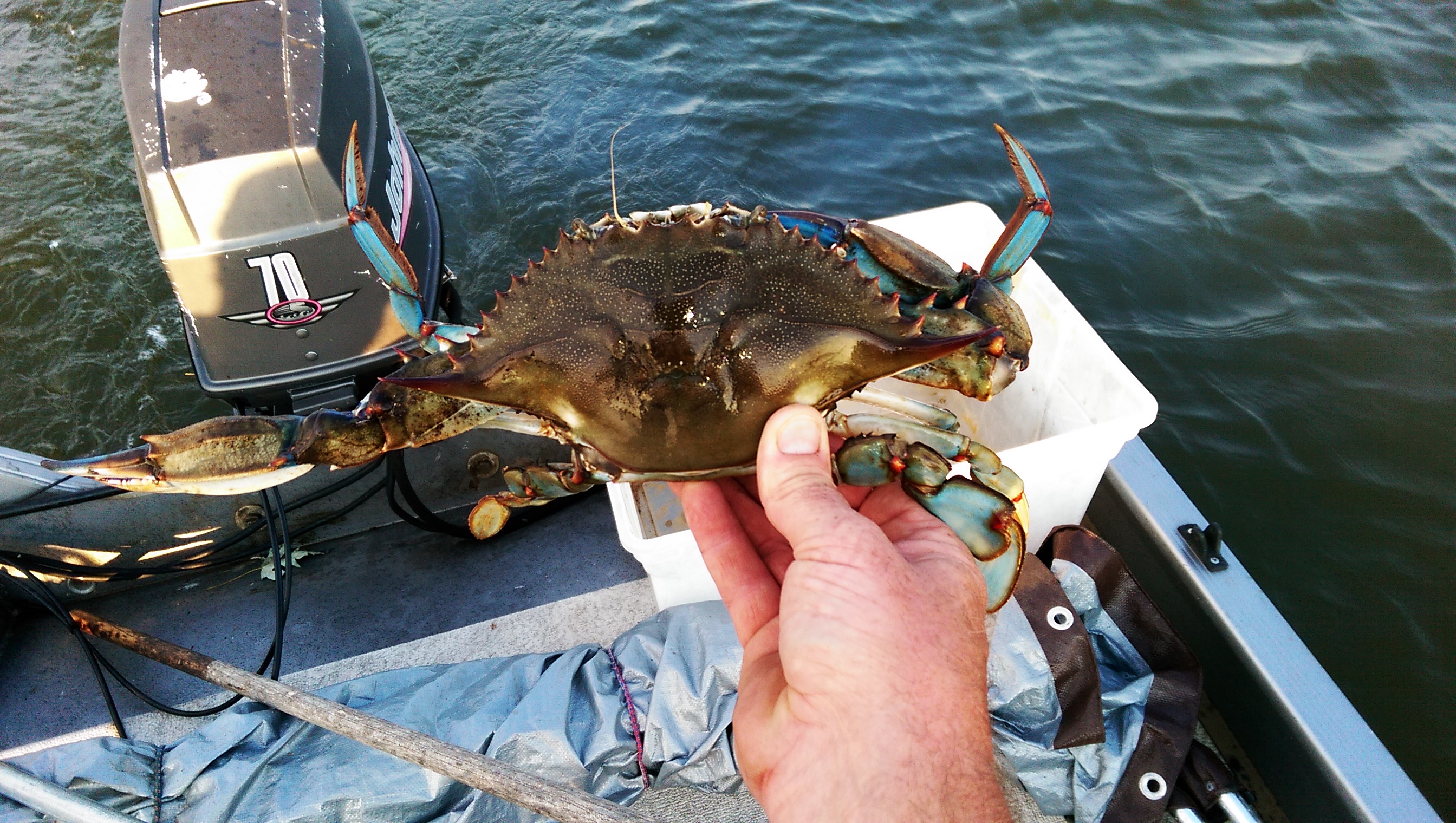

Chesapeake crabbing has a rule that changes in the middle of the season, and it tells you most of what you need to know about how the fishery is managed.
In Maryland, male hard crabs must be at least five inches across in the early season, and at least five and a quarter inches from the middle of July onward. Nothing about the crabs changes on that date. What changes is that the year's crabs have had time to grow, and the state raises the bar to let them.
That, plus an outright ban on keeping egg-bearing females, is the whole management philosophy in two rules.
Measuring, and the two things that disqualify a crab
A blue crab is measured across the shell from point to point, tip to tip, at the widest part. Unlike Dungeness, the spines are included, and a gauge is the only sensible way to do it because the difference between five and five and a quarter inches is not something anyone judges by eye.
The second disqualifier is the sponge. A female carrying eggs has a visible orange or brown mass under her abdomen, and possession of a sponge crab is banned in Maryland outright. This is not a size rule and it is not negotiable: she is carrying somewhere in the hundreds of thousands to the low millions of eggs, and returning her costs you one crab and returns a great deal more than that.
Learning the underside is worth an evening. A male has a narrow flap shaped like the Washington Monument. An immature female has a triangular one. A mature female has a broad domed flap, and a sponge crab has that flap open with the egg mass showing. Watermen call them jimmies, sooks and sallies, and once you know the shapes you sort a bushel without thinking about it.
The trotline, which is the Chesapeake's own invention
Most American crabbing is traps. The Chesapeake runs on a line of bait laid across the bottom, and it is a different activity.
A trotline is a long baited line, weighted at each end and buoyed, laid out along the bottom in shallow water. The boat runs along it slowly with the line lifted over a roller on the gunwale, and as each bait comes up toward the surface the crab riding it lets go at the last moment. Somebody nets it in that instant. Nothing traps the crab, nothing holds it, and the entire method depends on a crab's unwillingness to release a good meal.
Maryland limits a recreational crabber to a trotline, or trotlines, with a baited portion of no more than twelve hundred feet in total aboard the vessel. That is a per-vessel total rather than a per-person allowance, so it does not double when a second person gets in the boat. Bait is usually chicken necks, and turkey necks, bull lips, fish heads and commercial bait all work, with the older and more pungent generally outfishing the fresh.
It is a two-person job done well: one running the boat along the line at a walking pace, one on the net. The rhythm is the skill, and a good netter working a good line is a thing worth watching.
Trotline Crabbing How To: Everything You Need to KnowThe other ways, and who they suit
Trotlining needs a boat, a line and a partner. Most people start with less.
Chicken necking is the entry point and it is exactly what it sounds like: a chicken neck on a string, dropped off a dock or a bulkhead, retrieved slowly with a net waiting underneath. It costs almost nothing, it works, and it is how a large fraction of the Chesapeake learned. The crab is not hooked, so the retrieve has to be slow enough that it does not notice it is being lifted.
Collapsible traps and box traps sit on the bottom baited and are pulled periodically, which suits a dock or a pier and requires no skill in the retrieve. Crab pots are the commercial gear, and recreational pot use is restricted, typically limited in number and tied to waterfront property in Maryland, so check before buying any.
Dip netting in shallow grass at night with a light is the fourth way and the most underrated. Crabs move into the shallows to feed and to molt, and a headlamp, a long-handled net and a slow walk along a grassy shoreline produces crab that no trap will reach.
The gear
Chesapeake crabbing scales cleanly from nothing to a boat, and the gear list reflects where you are on that scale.
A crab gauge is the one item nobody should skip. Maryland and Virginia both work in sixteenths of an inch and both measure point to point across the shell, and the difference between a legal hard crab and a citation is smaller than most people's estimate. Measure on the boat, not in the basket.
A long-handled dip net, which is the whole technique on a trotline and most of the technique from a dock. Longer than feels necessary is correct; a crab that sees the net coming leaves.
Chicken necks, or anything older and worse. Crab bait rewards age rather than quality, and the traditional Chesapeake preference for razor clam and bull lip exists because both stay on the line.
A bushel basket, or a cooler with the drain open so meltwater runs out. Crab sitting in fresh water die.
Trotline, up to twelve hundred feet baited per vessel in Maryland, with the anchors, floats and a roller to run it over. This is the real investment and it is what separates a good day from a fair one.
A headlamp for the grass beds, since the productive hours start early and the legal day frequently begins before light.
And a steamer rack, because Chesapeake crabs are steamed over liquid rather than boiled in it, and a pot without a rack drowns the bottom layer and washes the seasoning off everything above it.
Season, hours, and why the hours exist
Maryland's recreational season runs from the first of April to the fifteenth of December, and it has time-of-day limits that people routinely miss.
From May through September, gear may be set and crabs taken from half an hour before sunrise until sunset. In April and from October through the fifteenth of December, it starts half an hour after sunrise instead. The reason is enforcement rather than biology: an activity that is legal only in daylight is an activity that can be checked.
There is also a closed day, which catches visitors constantly. In the Chesapeake Bay and its tidal tributaries you may not set crabbing gear or take crabs recreationally on Wednesdays, with exceptions for crab pots fished from private property, dipnets and handlines. When a state or federal holiday falls on a Wednesday or Thursday, recreational crabbing is permitted on the Wednesday of that week.
Virginia runs its own rules with different dates and different limits, and the state line runs through the middle of the Bay. Two crabbers a mile apart can be under different limits, different size minimums and different seasons, and nothing on the water marks the boundary, which is the same problem that Puget Sound crabbers have with marine areas and the same reason Guidepole carries the jurisdiction and its current rules against the water you are floating on.
The soft crab, which is the whole point for some people
The Chesapeake is the center of the American soft-shell crab trade, and understanding it explains a great deal about the Bay's rhythm.
A blue crab grows by molting, and for a few hours after shedding it is entirely soft and completely edible, shell and all. Watermen hold crabs that are about to shed in floats, watch them constantly, and pull each one within hours of the molt, because the shell begins hardening almost immediately and a crab left too long is a paper shell rather than a soft.
The signs are readable on the crab and this is learnable. A white line along the edge of the swimming paddle means a molt is a week or two away, a pink line means days, and a red line means hours. Those are called white-signs, pink-signs and red-signs, and anyone catching their own softs is sorting for red-signs and holding them.
A recreational crabber can do this at home with an aerated tank, a great deal of attention, and the acceptance that missing a molt by six hours produces a crab you have to cook hard-shell.
Where the population sits, and why the rules move
Blue crab management is unusually responsive, and it is worth knowing why the limits change.
The Bay runs an annual winter dredge survey that estimates the population before each season, and the resulting number drives the season's rules. When the survey is poor, limits tighten, seasons shorten and size minimums rise. When it is strong, they loosen. That is why last year's regulations are not this year's regulations, and why anybody telling you the limit from memory is telling you something that may be two revisions out of date.
The population itself swings hard, driven by spawning success, water quality, seagrass extent and predation, and by the fact that a blue crab lives only about three years. There is no long-lived reserve of old crabs to buffer a bad year, so a single poor spawn shows up in the fishery quickly and the management has to move quickly too.
The eelgrass and widgeon grass beds matter more than most people realize, because juvenile crabs shelter in them and a decline in submerged grass shows up as a decline in crabs a year or two later. The Bay's grass extent is one of the better leading indicators of what crabbing will be like.
Where to crab, and the access question
The Bay has thousands of miles of shoreline and a surprisingly small fraction of it is somewhere you can legally stand with a net.
Public landings, county piers, state park shorelines and the road-end access points that Maryland and Virginia maintain are the entry points, and they are unevenly distributed and inconsistently signed. A great deal of Chesapeake waterfront is private, and a dock is somebody's dock even when nobody is on it. The water itself is public and navigable, so a boat solves most of the problem, which is part of why the Bay's crabbing culture is so boat-centered.
For anyone working from shore, the practical exercise is finding the access rather than finding the crabs. Public landings tend to be listed by county rather than in one place, some have parking and some have a gravel shoulder, and several of the best ones are unmarked from the road. That is an ownership and access data problem rather than a fishing one, and it is exactly the layer Guidepole carries: which shoreline is public, which landing is real, and which stretch of bulkhead belongs to somebody.
The Bay itself, briefly
Understanding the estuary makes the fishery make sense.
The Chesapeake is a drowned river valley, the flooded lower Susquehanna, which is why it is long, shallow and branched rather than a bay in the usual sense. Average depth is around twenty-one feet, which for a body of water nearly two hundred miles long is remarkably thin, and that shallowness is why it warms fast, why it grows submerged grass, and why it produces crabs in the numbers it does.
Salinity runs from fresh at the head to nearly oceanic at the mouth, and blue crabs use the whole gradient across their lives. Females mate in the middle Bay, then migrate to the high-salinity water near the mouth to spawn, which is why Virginia and Maryland have historically argued about crab management: the two states are harvesting different parts of one population at different stages.
10 Trotline Crabbing Tips and Tricks on the ChesapeakeHandling and cooking
Blue crabs are more fragile than Dungeness and considerably more aggressive, and both facts shape the handling.
Keep them cool, damp and out of standing water, in a bushel basket or a cooler with a wet towel and the drain open. They will fight in the basket and lose claws doing it, which is one argument for not overfilling and for keeping them cool enough to be sluggish. Anything that dies goes in the trash rather than the pot.
Steaming is the regional method and it is the right one: crabs go in a rack above boiling water and vinegar rather than into it, layered and seasoned as they go, and steamed until the shells turn red. Boiling waterlogs them. The seasoning is a settled argument in Maryland and an unsettled one everywhere else.
The short version
Five inches early, five and a quarter from mid-July, measured point to point including the spines, males only if you are keeping hard crabs, and never a sponge crab.
Trotlining is the Chesapeake method and needs a boat, a partner and up to twelve hundred feet of baited line. Chicken necking off a dock costs almost nothing and works. Night dip-netting in the grass beds is the underrated one.
Season runs April through mid-December with daylight-only hours that shift in April and October, and no recreational crabbing on Wednesdays in the Bay and its tidal tributaries. Maryland and Virginia have different rules and the line is invisible.
And the rules move every year, because the winter dredge survey sets them and a blue crab only lives about three years. Check the current season rather than repeating last year's numbers.
Gear rules and the reasoning behind escape rings and rot cord are in crab pot rules explained, the Pacific equivalent of this fishery is Dungeness crabbing in Puget Sound, and the safety half of any shellfish harvest is in shellfish biotoxin closures.
The same species under an entirely different set of rules is in blue crab on the Gulf coast, which is worth reading if you ever crab south of Virginia. The other significant East Coast crab fishery, and the only one where the animal goes back alive, is stone crab claws in Florida. What you need to buy before any of it is in shellfish licenses by state.