Fish
Fish Fire
Fire Hike
Hike Bird
Bird

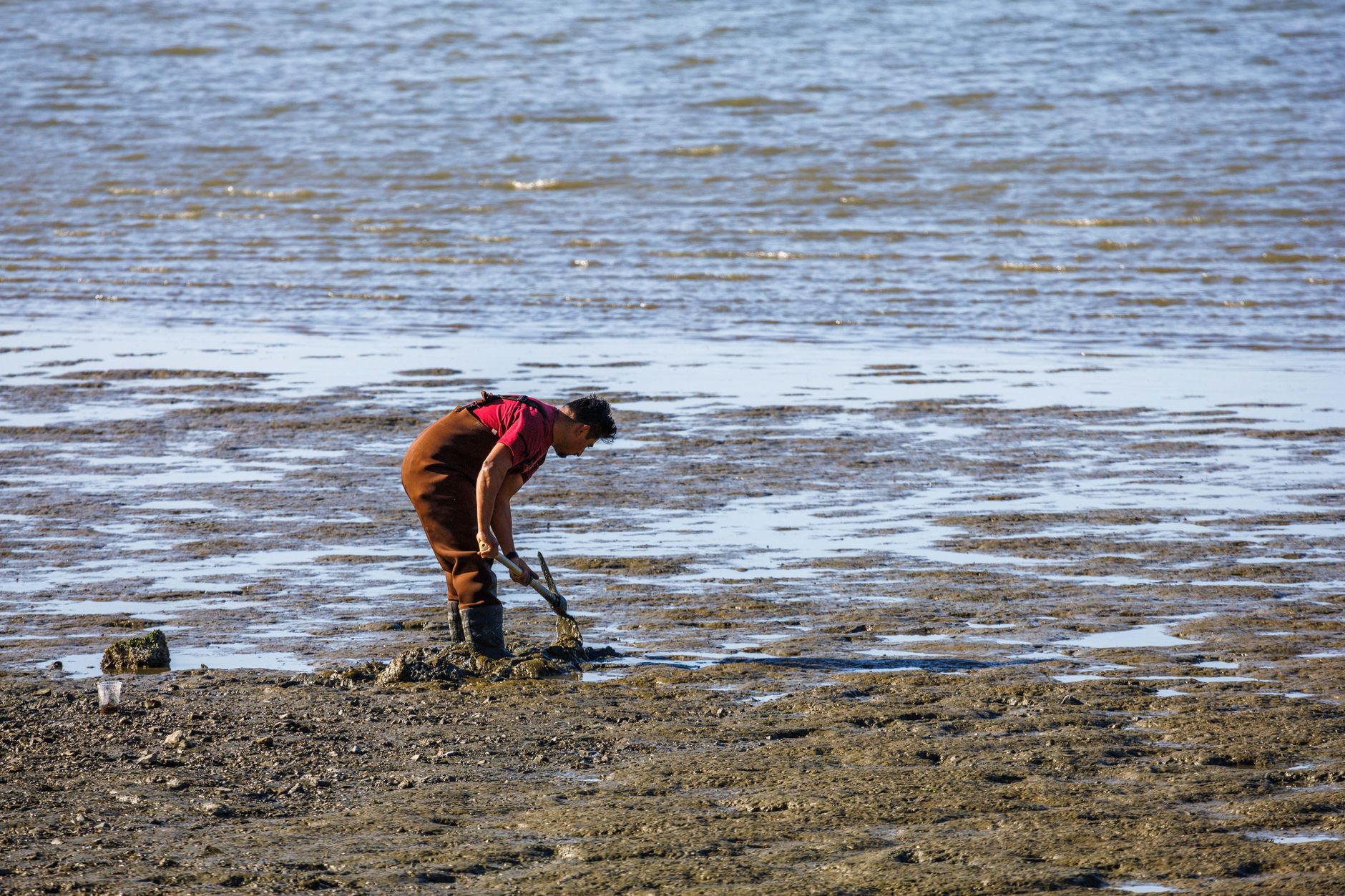

In almost every American fishery, the state decides whether you may harvest. In Maine, the town does.
Soft-shell clam licensing is municipal. A town writes its own shellfish conservation ordinance, decides how many licenses exist, sets the price, sets the season, and can close its own flats. The state sets the framework and tests the water. The town office issues the permit, and if it has none left, you do not dig there.
That single structural fact shapes everything about clamming in Maine.
Why the towns run it
The arrangement is old and it is a genuine piece of local self-government rather than an administrative accident.
Maine's intertidal zone is unusual to begin with. Under a colonial ordinance dating to the 1640s, private ownership on much of the Maine and Massachusetts coast runs down to the low water mark rather than the high, with public rights reserved only for fishing, fowling and navigation. That leaves an enormous amount of productive flat in private hands and a body of law about what the public may do on it.
Layered on top of that, the state delegated shellfish management to municipalities that adopt an approved conservation ordinance. A town that does so gets to control access to its flats and is expected to manage them, which in practice means surveying, closing depleted areas, seeding, and limiting license numbers to what the resource supports.
The result is that Maine has well over a hundred separate shellfish jurisdictions with different rules, different prices, different seasons and different license caps, and no central place that reliably lists them all.
Getting a license, which is the actual obstacle
Assume nothing carries over from the last town you dug in.
Licenses are typically sold in resident and non-resident categories, with the non-resident allocation often small and sometimes issued by lottery. Some towns sell out. Some restrict non-resident licenses to a handful for the whole year. Fees are waived for harvesters under eighteen and over sixty-five in the state's recreational framework, though details vary locally.
Commercial licenses in many towns carry a requirement that is unusual: conservation hours. A commercial digger owes the town a number of hours of work on conservation projects each season, which might mean seeding flats, building brush fences to hold sediment, surveying, or predator control. It is a working obligation attached to a harvesting privilege, and it is one of the more interesting pieces of fisheries governance in the country.
The practical instruction for a visitor is to call the town office of the specific town whose flats you intend to dig, before you travel. Not the state, and not the next town over.
The limit, and the unit
Maine's recreational limit is expressed in a unit most people have never used: one peck per day.
A peck is a quarter of a bushel, about eight dry quarts, and it is a volume rather than a count. That single peck covers soft-shell clams, quahogs, razor clams and American oysters together rather than separately, so a mixed day is still one peck. Hen or surf clams are counted separately, at three bushels a day.
Maine also allows one guest to assist a licensed recreational harvester. The guest helps take that harvester's peck rather than adding a second one, so it is one peck combined between the two of you.
Towns can and do set limits lower than the state framework, along with minimum sizes, so the local ordinance governs. The standard soft-shell minimum is two inches, measured across the longest axis of the shell, and undersized clams go back into the hole they came from rather than onto the surface, because a clam left on top of the mud is eaten.
The gear
Steamer digging in New England is cheap to equip and hard to do, which is roughly the opposite of most of the shellfishing in this library.
A short-tined clam hoe is the tool, and it is not a garden fork. The tines are short, close together and set at a steep angle to the handle, because you are turning heavy mud in a small area rather than breaking ground. A long-tined fork spears more clams than it lifts.
Footwear that cannot come off. This matters more here than anywhere else. New England flats are deep, sticky mud, and a boot pulled off mid-flat by suction is a genuine problem when the tide is coming.
A hod, which is the traditional wire basket, or any wire basket you can rinse the catch in. The point is that it drains and you can wash mud off in a tide pool rather than carrying it home.
A town shellfish license, which is the real obstacle here rather than the gear. Maine licenses through the municipality rather than the state, the number issued is capped, some towns sell nonresident licenses and some do not, and the answer is a phone call to a town office.
A tide table for the specific bay, corrected, since New England tidal ranges are large and the flat you want may be exposed for ninety minutes.
Waterproof gloves, because the mud is cold most of the year.
And a bucket for purging in clean seawater, carried home full, since steamers hold grit and an unpurged one ruins the pot for everybody.
Digging a steamer, which is nothing like digging a razor
The tool is a short-tined hoe, the target is shallower, and the animal is much slower.
Soft-shell clams live a few inches down in mud and mixed mud-and-sand flats, and they show themselves the same way razor clams do, with a hole in the surface and often a squirt as they withdraw their siphon. On a good flat at low water the surface is dimpled with them.
The technique is to work the hoe in beside the show, not through it, and turn a wedge of mud over so the clams roll out. Then you pick by hand. A digger works backward across a patch, turning mud toward themselves, rather than walking over ground they intend to dig.
The soft-shell's shell is brittle, which is where the name comes from, and a hoe driven through a clam is a clam wasted. Speed comes from reading the flat and turning mud efficiently, not from digging hard.
Beginner's Tutorial for Digging Soft Shell ClamsThe mud, which is the real difficulty
Nobody warns first-timers properly about the mud, and it is the thing that ends the day.
Maine clam flats at low water are soft, deep, sucking mud that takes boots off feet and knees out of joints. People get stuck. The standard footwear is not boots at all but something that laces tight or straps, and a good many diggers work in old sneakers or dedicated mud boots with the tops taped.
Move deliberately, keep your weight spread, and do not fight the mud by pulling straight up on a stuck foot, which is how you leave a boot behind. Working near the low water line on firmer ground is easier than the soft upper flat, and the tide gives you a window of a couple of hours either side of low.
And it is cold work in the seasons when the flats fish best. Maine clamming is a spring, autumn and winter activity as much as a summer one.
Closures, which are constant and specific
New England runs the same biotoxin program as everywhere else and it closes flats regularly.
Red tide, meaning Alexandrium blooms producing paralytic shellfish poisoning, is a recurring feature of the Gulf of Maine and closes flats every year, sometimes for extended periods. The state Department of Marine Resources tests and publishes closures, and they are specific to areas rather than statewide.
Pollution closures are the other category and they are separate from biotoxin. Flats near outfalls, marinas, rivers after heavy rain and areas with failing septic systems get closed on bacterial grounds, sometimes permanently, sometimes conditionally after rainfall. A conditional closure that triggers on rainfall is a real thing in Maine and means a flat can be legal on Friday and closed on Saturday because of Thursday's storm.
So there are three separate questions before any dig: is the town issuing a license, is the flat open on biotoxin grounds, and is it open on pollution grounds. Three sources, three different agencies, and the answers change. That combination is exactly what Guidepole carries against the specific flat, alongside the tide that decides whether it is diggable at all, and it is the difference between a planned trip and three phone calls.
The fishery's long trouble
Maine's soft-shell landings have declined substantially over recent decades, and understanding why explains a lot of what a digger sees on the flats.
Green crabs are the largest single factor. An invasive from Europe established on this coast long ago, they eat juvenile clams in enormous numbers, and their populations expand in warm winters because cold is what has historically held them back. Warmer water in the Gulf of Maine, which has warmed faster than most of the world ocean, has removed that brake. Towns fight back with brush fences, netting over seeded flats and trapping, which is a large part of what those conservation hours pay for.
Milky ring worm and other predators add to it, ocean acidification makes shell formation harder for juveniles, and closures for water quality take productive ground out of use. The result is a fishery that is worth considerably less than it was and that towns are actively working to hold together.
For a recreational digger, the practical consequences are visible: netting laid over seeded areas that you must not disturb, flats closed for reseeding, and lower limits in some towns than the state framework allows. None of that is bureaucracy for its own sake.
Digging Steamers on the Coast of MaineWhere to go
Because licensing is municipal, the sensible approach is to pick a town rather than a beach.
Coastal towns from Casco Bay east through the midcoast and Downeast all have flats and most have ordinances. The larger the town's flat acreage the more likely it sells non-resident licenses, and the towns with small popular flats near tourist areas are the ones most likely to have sold out or restricted them.
The town office will tell you what it sells, what the local limit and minimum size are, which flats are open, and frequently where to park, which is not a trivial question on a Maine peninsula. That single phone call replaces a great deal of guessing, and it is the step almost every disappointed visitor skipped.
Cooking them, which is the easy part
The soft-shell clam is arguably the best-eating clam on the American coast and it wants very little done to it.
Purge them first. Soft-shells hold mud, and a few hours in clean cold seawater lets them spit it out. Fresh water kills them and does not purge them, so use seawater or salted water, and change it once.
Then steam them, in a small amount of water or beer, until they open, which takes minutes. They are served with the broth and with melted butter: you dip the clam in the broth to rinse any remaining grit, then in butter. The siphon has a tough sheath that most people slip off, and the belly is eaten with everything in it.
Fried clams are the other institution, whole-belly rather than strips, and the difference between a whole-belly clam and a strip is the whole argument about clam shacks in New England.
A note on what happens after the tide. New England flats are worked by commercial diggers who make their living on them, and a recreational digger who fills holes, takes only legal clams and stays out of a working digger's line is participating in a fishery rather than intruding on one. The relationship between towns, commercial diggers and recreational licenses is a real local politics, and the reason nonresident licenses are capped in many towns is that the resource is finite and somebody's income depends on it.
The short version
The town issues the license, not the state, and licenses can be capped, sold out or restricted to residents. Call the specific town office before you travel.
The limit is one peck a day covering soft-shells, quahogs, razor clams and oysters together, with a two inch minimum on soft-shells and local rules that can be stricter. Hen and surf clams are separate, at three bushels. One guest may assist a licensed harvester, sharing that one peck rather than adding another.
Dig with a short hoe beside the show, turn the mud rather than driving through the clam, and work backward across a patch. Wear something that will not come off in the mud.
Check three things before you go: the town's license, the biotoxin closure and the pollution closure. In Maine the third one can turn on yesterday's rainfall.
The mechanism behind biotoxin closures is in shellfish biotoxin closures, the tide window is in minus tides for clamming, and the ownership question that makes New England unusual is covered in public tidelands and private beaches.
The other New England clam, dug differently, cooked differently and licensed under a different arrangement, is in quahogging in Rhode Island. The licensing question that governs both, and which is more complicated here than anywhere else in the country, is in shellfish licenses by state. And the fishery that used to give this coast a winter season and no longer does is in the Maine shrimp moratorium.