Fish
Fish Fire
Fire Hike
Hike Bird
Bird


There is no fishing in the Pacific Northwest quite like standing on a rain-slicked Puget Sound pier at 10 PM in December, hood up against the drizzle, dropping a glowing jig into a pool of dock light and watching a translucent market squid materialize out of the black water to grab it. Squid jigging is Seattle's great democratic fishery, no boat, almost no cost, no exotic skill, and the payoff is a bucket of the freshest calamari you'll ever eat. It's a fall-and-winter city tradition that packs the piers from West Seattle to Edmonds to Tacoma, and once you've done it a few times, you'll understand why the same faces come back night after night from October clear through the holidays.
This guide covers exactly how to do it: what you're catching, when and where to go, the gear that works, the drop-and-lift cadence that puts squid in the bucket, the Washington rules you need to follow, and how to clean and cook your catch. It builds on the squid section in our Seattle fishing guide and the broader Puget Sound fishing guide, read those for the salmon, crab, and bottomfish that round out a Sound angler's year.
What You're Catching: Pacific Market Squid
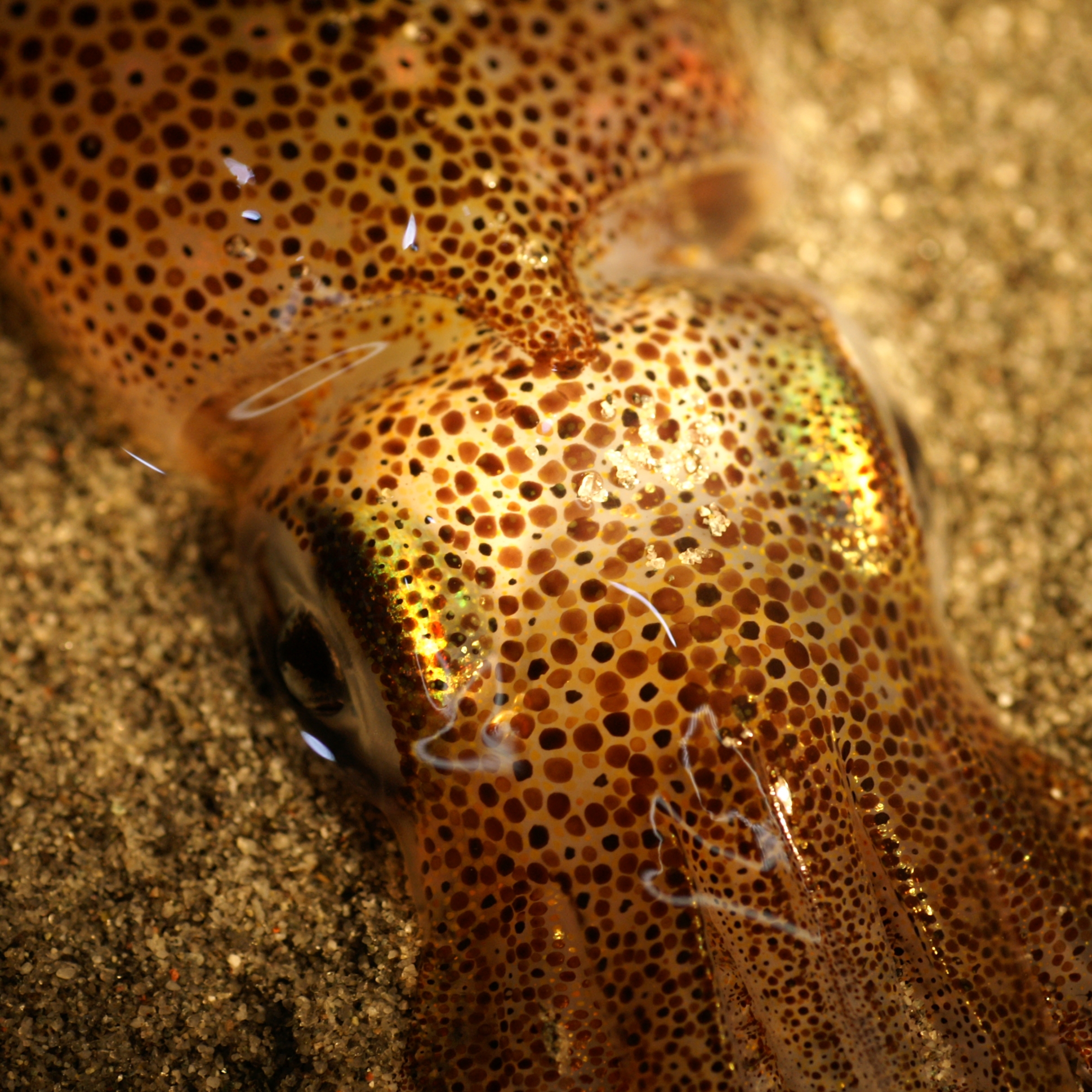
The target is the Pacific (or California) market squid, Doryteuthis opalescens, long known to generations of Northwest anglers as Loligo opalescens. These are small, elegant cephalopods, usually 6 to 10 inches long including the tentacles, semi-transparent with shimmering iridescent skin that flickers red, brown, and gold when they're excited. They're the same squid you eat as calamari in restaurants, which is a big part of the appeal: you are catching dinner.
Market squid live most of their short, roughly one-year lives out in deeper, open water. But from fall into winter they move through Puget Sound in enormous schools, following the baitfish, and, critically for a shore angler, they push into shallower nearshore water to feed and eventually to spawn. That's what brings them within reach of a pier. They are voracious, visual predators that hunt small fish and are strongly drawn to light, which is the entire foundation of the pier fishery: the lights on and around a dock concentrate baitfish, the baitfish and the glow pull in the squid, and you drop a jig into the middle of it.
When to Go: The October–February Window
Squid jigging is a cold-weather fishery, and that catches a lot of newcomers by surprise. The action ramps up in October, and the classic prime time runs from late November through December, with good fishing often continuing into January and February depending on the year. Huge numbers of larger squid typically flood most of the Sound in that late-November-through-December stretch, if you can only pick a few weeks, that's the window.
Two more timing factors matter as much as the calendar:
Night. This is a nocturnal game. Squid feed after dark, and the pier lights only work once it's actually dark, so you fish after sunset, which, in a Northwest winter, is delightfully civilized (it's fully dark by 5 PM in December). Squid usually start biting shortly after dark, sometimes taper off around midnight, and can turn back on later. Plan for the first few hours after full dark.
Tide. Your odds are best on a high tide, which brings deeper water in against the pier, squid prefer that depth near shore, and on cloudy or rainy nights, when there's no moonlight competing with the dock lights and the artificial glow stands out most. A high tide that lands a couple of hours after dark on a drizzly Tuesday is a Puget Sound squidder's dream. Check a local tide table before you commit to a night.
Where to Go: The Best Puget Sound Piers
The beauty of this fishery is that the best spots are free public piers, most of them lit, spread all around the Sound. Here are the classics:
West Seattle, Seacrest Park Pier and Cove 2. The Seacrest fishing pier and the nearby "Cove 2" shoreline are Seattle's most famous squid grounds, minutes from downtown with the city skyline across Elliott Bay. It gets busy on a good night, come early to claim rail space.
Edmonds Fishing Pier. A big, well-lit, purpose-built public fishing pier north of Seattle, and one of the most reliable and beginner-friendly squid spots on the Sound. It's ADA-accessible, has good lighting, and WDFW itself lists it among the top squid piers.
Des Moines Marina Pier and Redondo. Both south of Seattle along the water, both lit, both dependable squid producers and easy to reach. Redondo in particular has a devoted following.
Tacoma, Les Davis Pier and Point Defiance. Down in the South Sound, the Les Davis Pier on Ruston Way and the Point Defiance area are the go-to Tacoma spots. For the full local rundown, see our Puget Sound guide.
Kitsap side, Bremerton, Illahee, and Waterman's. Across the water, Bremerton's boardwalk piers, Illahee State Park's dock, and the Waterman's Wall area near Port Orchard all hold squid, often with smaller crowds than the Seattle-side piers.
Dash Point and beyond. Dash Point Pier between Federal Way and Tacoma rounds out the well-known list, and WDFW also points anglers toward Port Angeles City Pier out on the Strait.
A quick note on access: many of these piers are open into the night, but hours vary, some parks and municipal piers close or restrict access at a set time, and a few have gates. Check the specific pier's posted hours before you plan a midnight session, because rules differ from city to city and change from year to year.
The Gear: Simple and Cheap
One of the joys of squidding is how little you need. A complete setup costs less than a single trip to a restaurant for calamari.
Rod and reel. A light-to-medium spinning rod around 7 to 8 feet, paired with a 2500–3000 size reel, is perfect. You want a sensitive tip, squid bites are subtle, often just a faint extra weight, and enough backbone to swing a jig and a squid up over the rail. Spool with 10- to 15-pound braid for sensitivity, or light mono is fine for a first outing.
Squid jigs (egi and glow). These are the heart of the rig, barbless-looking, torpedo-shaped lures ringed at the tail with a crown of upward-facing prongs (not hooks) that the squid's tentacles catch on. Two families work: egi-style jigs (the Japanese "eging" lures, like Yamashita and Yo-Zuri EGI and the classic small squid jigs) that mimic a shrimp or baitfish, and small glow squid jigs that you charge under a light so they shine in the dark water. Sizes in the roughly 1.5- to 3-inch range are standard. Bring a mix of colors, glow/white, green, pink, and natural, because squid can be weirdly picky night to night.
Multi-jig (umbrella) rigs. Many anglers fish two or more jigs at once on a vertical dropper leader, a small weight at the bottom and jigs spaced above it, to cover more of the water column and double your chances. Washington allows up to four squid lures per line, so a two- to four-jig "umbrella" or daisy-chain setup is legal and popular. If the squid are stacked at one depth, a multi-jig rig finds them fast.
A light. Squid come to light, so a light is arguably your most important piece of tackle. On lit piers the fixtures do the work, but a bright green or white submersible/clamp LED light lowered into the water, or even a strong lantern or headlamp shined onto the surface, will draw squid to your spot and give you a glowing zone to jig in. A headlamp also keeps your hands free for handling squid and re-charging glow jigs. Green light is a longtime favorite for pulling in bait and squid.
A bucket, a net, and a rag. A 5-gallon bucket holds your catch (and doubles as a seat). A long-handled dip net or aquarium net helps land squid you don't want to swing up by the jig alone, and is essential if you're up high over the water. And wear dark clothes you don't mind ruining, market squid ink, enthusiastically, and it stains. Bring a rag.
How to Catch Squid in Puget Sound, Beginner's Guide to Jigs & Pier EtiquetteThe Technique: Drop, Lift, Feel for Weight
The mechanics are simple, which is why kids and first-timers catch squid on their very first night.
Position yourself near a light, ideally where the lit water meets the shadow line, because squid stage in the dark and dart into the light to ambush prey. Drop your jig (or jig rig) down toward the bottom, or to whatever depth you're marking squid. Then work a slow, rhythmic drop-and-lift cadence: raise the rod tip a foot or two with a smooth lift, then let the jig flutter and sink back down on a semi-tight line. Squid almost always grab the jig on the fall or when it's sitting still, so pay attention as it drops.
The "bite" is not a bite in the fish sense. There's no thump. Instead the jig suddenly feels heavier, or you feel a soft, mushy resistance, or your line just stops sinking. That's a squid wrapping its tentacles around the jig. The moment you feel that extra weight, begin a slow, steady, continuous retrieve, no jerking, no pumping, no slack. Squid hold on with tentacles, not a hooked jaw, so any slack or sudden yank lets them release and swim off. Keep smooth, even pressure all the way to the surface, then swing or net the squid into your bucket. Expect to get inked in the process.
Vary your depth until you find the squid, then stay in that zone. When one person on a pier starts catching, the whole rail often lights up as the school moves through, squidding is a social, contagious kind of fishing. Bare jigs work fine; some anglers tip or scent them, but it's rarely necessary. Cadence and being on a light at the right tide matter far more than any secret bait.
Learn from the King: Capt. Paul Kim of Fish PNW
Squid jigging is, at heart, a do-it-yourself pier fishery, that's its charm. But there's a reason Seattle anglers speak one name with real reverence when the subject comes up: Capt. Paul Kim of Fish PNW, widely regarded as the king of squid fishing on Puget Sound. If you ever want to watch a specialist read the bite and fish squid the way locals only dream about, his is the name to know.
Paul has made squid his signature. He runs dedicated Seattle Waterfront squid trips out of Shilshole Bay in Ballard aboard a custom welded catamaran rigged with the lights, working schools that pier anglers never reach, fishing boat-mounted lighting over open water, dialing in the exact depth, and coaching first-timers through the subtle drop-and-lift feel until the bucket fills. It's a genuinely fun, high-volume night of fishing, and because he runs a full-service Puget Sound operation, squid can be paired with salmon and bottomfish combos when the seasons line up. A night like that is one way to fast-forward past the trial-and-error, and even seasoned pier squidders go out to learn how the pros read the bite. His track record is right there on the water, this is a squid fishing video from Paul's own outfit:
Winter Squid Jigging in Downtown Seattle, Fish PNW Guide Service, Capt. Paul KimWashington Rules: License, Limits, and Legal Gear
Squidding is squarely a shellfish activity in Washington, so the rules differ a little from finfishing. Here's what to know, and always confirm the current regulations with WDFW before you go, because limits and seasons can change.
License. You need a valid Washington shellfish/seaweed license (or a combination license that includes shellfish). This is different from a basic freshwater fishing license, so make sure your license covers shellfish. Licenses are available online at wdfw.wa.gov and at the usual dealers, Fred Meyer, Walmart, and local tackle shops. Anyone 15 and older needs one.
Daily limit. WDFW's stated recreational daily limit for squid is 5 quarts or 10 pounds, whichever you reach first, a generous limit that's really a bucket cap, and a full night on a good bite can genuinely fill it. Because these numbers can be updated, verify the current limit on the WDFW website rather than treating any figure as permanent.
Legal gear. Regulations allow one line per person, and up to four squid lures on that line, which is exactly why the multi-jig umbrella rigs described above are legal. Forage-fish jigs and handheld dip nets are also permitted. Night fishing from public piers is legal and expected; this is a fishery the state actively promotes.
For more on Washington's marine areas, seasons, and shellfish rules, our Puget Sound guide breaks down how the numbered Marine Areas work, and the Seattle guide covers the city's crab and salmon seasons that overlap with squid season.
Cleaning and Eating Your Catch
Here's the reward. Fresh-caught market squid is dramatically better than anything frozen, and cleaning them is quick once you've done a few.
Pinch or pull the head and tentacles away from the body tube, the guts come with the head. Reach into the tube and pull out the clear, plastic-looking "quill" (the internal pen) and discard it. Peel off the thin spotted skin if you like a cleaner look (optional). Cut the tentacles off just below the eyes, keeping the ring of tentacles and squeezing out the small hard beak in the center. Rinse the tube and tentacles, and you've got clean calamari, tubes for rings or strips, tentacles for frying whole. A night's catch freezes beautifully if you can't eat it all at once.
Cooking squid follows one iron rule: fast and hot, or low and slow, never in between. Sauté or pan-fry the rings for no more than about 3 minutes for tender calamari; go longer than that in a hot pan and it turns to rubber. Alternatively, braise or stew it for 20 minutes or more and it comes back tender again. Classic preparations include quick pan-fried or breaded fried calamari, squid in a garlicky sauté, and Greek- or Mediterranean-style stews. Freshly jigged, cleaned within the hour, and cooked simply, this is the best calamari money can't buy.
Putting It All Together
Squid jigging is the perfect entry point to Puget Sound fishing: cheap, accessible, forgiving, and genuinely delicious. Grab a shellfish license, a light spinning rod, a handful of glow jigs, a good light, and a bucket. Pick a lit pier, Seacrest, Edmonds, Des Moines, Les Davis, on a high-tide, cloudy November or December night. Drop your jig into the glow, work a patient drop-and-lift, feel for that telltale extra weight, and reel up smooth and slow. Wear dark clothes, expect to get inked, and bring a friend, because the bite is contagious and the calamari is best shared.
When you're ready for more, the Sound has plenty: chase salmon and coho through the summer and fall, drop for lingcod and rockfish on the reefs in season, and pull Dungeness crab from the same piers you squid from. Or, if you'd rather skip the trial-and-error, spend a night out with a squid specialist like Capt. Paul Kim and let the king of Puget Sound squid show you how it's done. Either way, welcome to the pier. Save some rail space for the rest of us.