Fish
Fish Fire
Fire Hike
Hike Bird
Bird

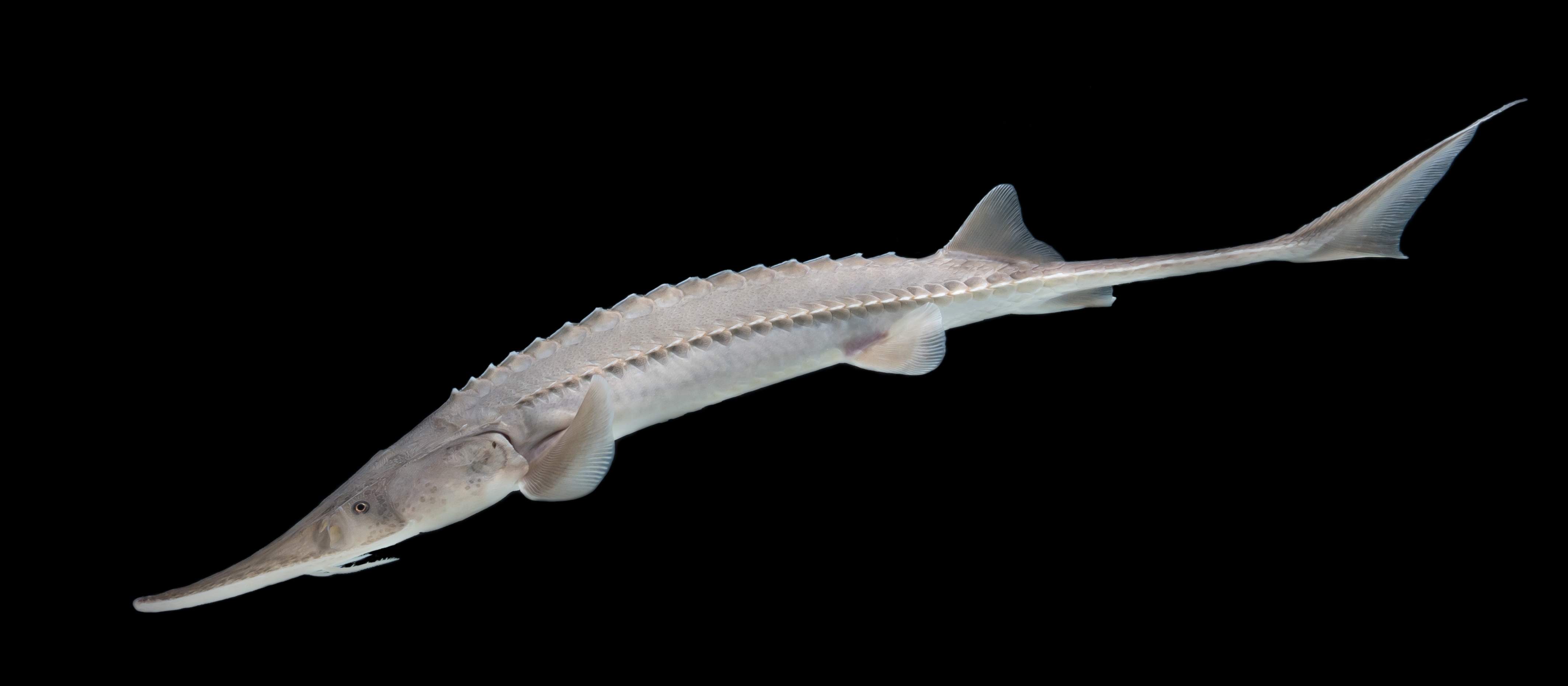

The pallid sturgeon is one of the most remarkable, and most imperiled, fish in North America. A pale, armored, shark-tailed relic that has survived essentially unchanged for tens of millions of years, it swims the murky bottom of the Missouri and lower Mississippi rivers as a genuine living dinosaur. It is also federally endangered, which means the honest answer to "how do you catch a pallid sturgeon?" is: you don't, on purpose, and you can't legally keep one.
This guide is written differently than our others for that reason. There is real angler interest in this ancient fish, and good information is scarce, so this is the straight story: what a pallid sturgeon is, why it is protected, how to tell one from the legal shovelnose sturgeon that shares its water, and, most importantly, exactly what to do if you hook one by accident so the fish swims away healthy. Learning this fish is a conservation act, not a catching one.
Pallid Sturgeon - Dinosaur FishWhy You Can't Legally Target Pallid Sturgeon
The pallid sturgeon (Scaphirhynchus albus) has been listed as endangered under the U.S. Endangered Species Act since 1990. Under that listing it is illegal to "take" a pallid sturgeon, and "take" legally includes harassing, harming, pursuing, capturing, or killing it. In plain terms:
- You cannot deliberately fish for pallid sturgeon.
- You cannot keep, possess, transport, or sell one.
- If you catch one incidentally (by accident, while fishing for something else), you must release it immediately and unharmed.
These protections apply throughout the fish's range, and states layer their own rules on top. Because the pallid is nearly identical to the legal-to-harvest shovelnose sturgeon and the two live in the same rivers, many states have special "sturgeon-restricted" zones, long stretches of the Missouri and Mississippi where shovelnose harvest is closed entirely or where any sturgeon showing pallid characteristics must be released, precisely to keep anglers from accidentally killing a pallid. This is why identification (below) matters so much.
The takeaway is simple: there is no legal, ethical way to "catch pallid sturgeon" as a target species. What you can do is learn the fish, fish responsibly for legal species in its waters, and handle any accidental catch perfectly.
Amazing Adaptations of Pallid SturgeonsMeet the Fish: An Ancient River Survivor
Pallid sturgeon are true living fossils, part of a lineage that predates the dinosaurs' extinction. Everything about them is built for a life spent on the bottom of big, turbid, fast rivers:
- Color: pale grayish-white to sandy tan, the "pallid" (pale) look that names them, and a key difference from the darker shovelnose.
- Body: long and slender, armored with rows of bony plates called scutes instead of normal scales, tapering to a long, shark-like (heterocercal) tail, often with a thread-like filament on the upper lobe.
- Snout: a broad, flattened, shovel-shaped snout they drag along the bottom.
- Mouth: a toothless, tube-like mouth on the underside of the head that extends downward to vacuum food off the riverbed, fronted by four sensory barbels.
- Skeleton: cartilaginous, like a shark's, not bony.
- Size: large, pallids can exceed 5 feet and 80 pounds, dwarfing the smaller shovelnose, though most fish encountered are smaller.
- Age: extraordinarily long-lived. Pallid sturgeon can live 50 years or more, and females may not spawn until they are 15 years old, and then only every few years. That slow life history is central to why the species is in trouble.
They feed by cruising the bottom and using their barbels and keen chemosensory ability to detect prey in near-zero visibility, then extending that tube mouth to suck up aquatic insect larvae, small fish, and other invertebrates.
Pallid Sturgeon: A Dinosaur Fish of the MissouriWhy the Pallid Sturgeon Is Endangered
For millions of years the pallid thrived in wild, free-flowing, sediment-laden rivers. Then, in a single human lifetime, we rebuilt those rivers. The causes of its decline are a case study in what dams and channelization do to a big-river fish:
- Dams block the long spawning migrations pallids need, and they fragment populations into isolated pools. Below dams, cold "tailwater" releases and altered flows disrupt the natural cues that trigger spawning and larval drift.
- Loss of natural flow and sediment. Pallids evolved for a muddy, dynamic, seasonally flooding river. Channelization and flow control turned much of the Missouri and Mississippi into a stable, clearer, faster navigation channel, the wrong habitat for their eggs and drifting larvae.
- Lost spawning and rearing habitat. The braided channels, sandbars, backwaters, and side channels young pallids need were engineered away.
- Hybridization with shovelnose sturgeon, worsened by habitat change, further muddies the genetic picture in some reaches.
The result: for decades, biologists found almost no naturally produced young pallids in the wild. The adults swimming today are largely long-lived survivors, and much of the current population is sustained by hatcheries. That is why every single fish matters, and why the "release it perfectly" instructions below are not a formality.
In Murky Waters: The Plight of the Pallid SturgeonPallid vs. Shovelnose: The Identification That Matters Most
This is the single most important skill for any angler fishing the Missouri or Mississippi systems. The shovelnose sturgeon is legal to harvest in many places; the pallid is federally protected; they look nearly identical, share the same water, and even hybridize. If you catch a sturgeon and cannot be certain, treat it as a pallid and release it immediately.
General field differences (no single one is foolproof, use several together):
- Size and color: pallids grow much larger and are noticeably paler/grayish-white; shovelnose stay small (usually 1.5–3 ft) and are tan to brownish.
- Belly: the pallid's belly is scaleless (smooth); the shovelnose has small scale-like plates on its belly. This is one of the most reliable tells.
- Barbels: on a pallid the inner pair of barbels is set noticeably forward of the outer pair and the inner barbels are smaller; on a shovelnose the four barbels are more even, in a rough row.
- Body proportions and scutes: pallids have differences in belly plate counts and a bare area at the base of the tail; the shovelnose has more complete belly armor.
Because positive identification is genuinely hard, regulators do not rely on anglers getting it right every time, instead, in the reaches where pallids live, they often close or restrict all sturgeon harvest. Know your local regulations for the exact stretch you're fishing before you keep any sturgeon at all. When in doubt, the fish goes back.
What to Do If You Hook One by Accident
Incidental catches happen, usually to catfish anglers fishing cut bait or nightcrawlers on the bottom in the same channels and tailwaters pallids use. If you land a sturgeon and suspect it's a pallid (or you simply aren't sure), your job is to get it back in the water fast and unharmed. This is a legal requirement, not a courtesy:
- Keep it in the water as much as possible. Don't drag it up a rocky bank or drop it in the boat.
- Never lift a big sturgeon vertically by the tail or by the gills, support its body horizontally with wet hands or a rubberized net. Their cartilaginous frame and internal organs are easily damaged by their own weight in the air.
- Minimize air exposure. If you want a photo, get the fish ready in the water, lift it just above the surface briefly and horizontally, then return it.
- Use barbless or de-barbed hooks and pinch-down circle hooks where you can, they make release faster. If a fish is hooked deep, cut the line at the hook rather than digging around inside it.
- Revive it by holding it upright in gentle current, facing upstream, until it swims off under its own power.
- Report it if asked to. Some states and the U.S. Fish and Wildlife Service want reports of pallid encounters (many hatchery-raised fish carry tags), reporting a tagged fish is genuinely valuable data for recovery.
Handled this way, an accidentally hooked pallid swims away to keep doing its 50-year job.
The Recovery Effort: Fishing's Conservation Story
The pallid sturgeon is also one of the more hopeful endangered-species stories, and anglers are part of it. A large, coordinated recovery program, the U.S. Fish and Wildlife Service, the Army Corps of Engineers, state agencies, and hatcheries across the basin, has been working for decades to keep the species from blinking out:
- Hatcheries spawn wild adults, rear the young, and stock hundreds of thousands of genetically managed pallids back into the rivers, buying time while habitat problems are addressed.
- Habitat restoration projects rebuild side channels, sandbars, and more natural flow and temperature regimes below dams to give wild spawning a chance.
- Telemetry and tagging let biologists track individual fish for years, learning where they spawn and move, which is why a report of your tagged incidental catch matters.
Anglers who learn to identify pallids, release them flawlessly, respect the sturgeon-restricted zones, and report tagged fish are directly contributing to that effort. In a real sense, the most valuable thing a fisherman can do for this species is to not catch it, and to help everyone else avoid it too.
Pallid Sturgeon Recovery on the MissouriThe Pallid's Life on the River Bottom
Part of respecting this fish is understanding how it lives, and how little margin it has. Pallid sturgeon are creatures of near-total darkness, spending their lives on the bottom of rivers so silt-laden that sight is almost useless. They navigate and feed by touch, taste, and electroreception, dragging their sensitive barbels and shovel snout across sand and gravel to find drifting insect larvae and small fish, then vacuuming prey up with that protrusible tube of a mouth. They are not fast, flashy predators; they are slow, deliberate, energy-efficient bottom foragers built to sip a hard living from a big muddy river.
Their movements are tied to the seasons and the river's flow. In spring, mature adults undertake long upstream migrations, historically hundreds of miles, seeking the specific combination of current, temperature, and substrate that triggers spawning. Females broadcast their eggs over firm bottom in strong current; the eggs stick to the substrate, hatch, and the tiny larvae drift downstream for days before settling. That long larval drift is the hidden reason dams are so damaging: a reservoir stills the current the larvae need, and they settle into deep, low-oxygen water and die before they can develop. A fish that spawns only every few years, migrates hundreds of miles to do it, and depends on an unbroken river to raise its young simply cannot absorb the changes we've made. Understanding that fragility is what turns a chance encounter with a pallid from a photo opportunity into a responsibility.
Where Pallid Sturgeon Live
Understanding the range helps you know when you're in "pallid water" and should be extra careful with any sturgeon you land. Pallid sturgeon inhabit the Missouri River from Montana down to its mouth, and the Mississippi River from the Missouri confluence down through the lower river toward the Gulf, plus the lowest reaches of some large tributaries like the Yellowstone. They are fish of the big, turbid, main-channel river, deep runs, channel borders, sandbars, and the tailwaters below the major dams, on firm sand and gravel bottom in current. If you are catfishing those exact spots on the Missouri or Mississippi, you are fishing where an incidental pallid is possible, so keep this guide's ID and release steps in mind.
Fish Responsibly for Legal Species Instead
If it's the sturgeon experience you're after, the ethical path is to target the shovelnose sturgeon where it is legal and open, it's the abundant, harvestable cousin that lives in the same rivers and takes the same bottom-fished nightcrawler rigs, while knowing your ID cold so you can release any pallid. Or chase the other big, hard-fighting river fish that share this water, like blue catfish and flathead catfish, and treat a pallid encounter as the rare privilege of touching a living fossil before you let it go.
Respect an Ancient Survivor
The pallid sturgeon has outlasted the dinosaurs, ice ages, and tens of millions of years of change, but it may not outlast us without help. It cannot be a target or a trophy on the stringer. What it can be is a fish every river angler knows how to recognize, handle, and protect. Learn the ID, respect the closures, release any accidental catch like the endangered animal it is, and you become part of the reason this dinosaur is still swimming the Missouri.
For a closer look at the legal cousin you can pursue, see our guide to the shovelnose sturgeon, and for the giant sturgeon of other watersheds, our guides to the lake sturgeon and Atlantic sturgeon.
If you plan to fish the Missouri or Mississippi, do your homework on the water before you go: know which stretches hold protected pallids and where sturgeon harvest is closed, and check the current sturgeon-restricted zones for the exact reach you're fishing. Going in with that knowledge keeps you on legal, harvestable fish and makes sure any ancient surprise gets released and home safe.