Fish
Fish Fire
Fire Hike
Hike Bird
Bird

As of April 2026 you may take one geoduck a day in Washington, down from three, and it must be the first one you dig.
That change tells you most of what you need to know about this animal. A clam whose recreational limit is a single individual per person per day is a clam that does not tolerate much harvest, and a rule requiring you to keep the first one regardless of size or condition is a rule written because the alternative kills clams for nothing.
It is also the hardest legal dig in the country, and the reason people do it anyway is that a geoduck is an extraordinary thing to get out of a beach.
What you are digging
Panopea generosa is the largest burrowing clam in the world and it is built entirely around one strategy: go deep and stay there.
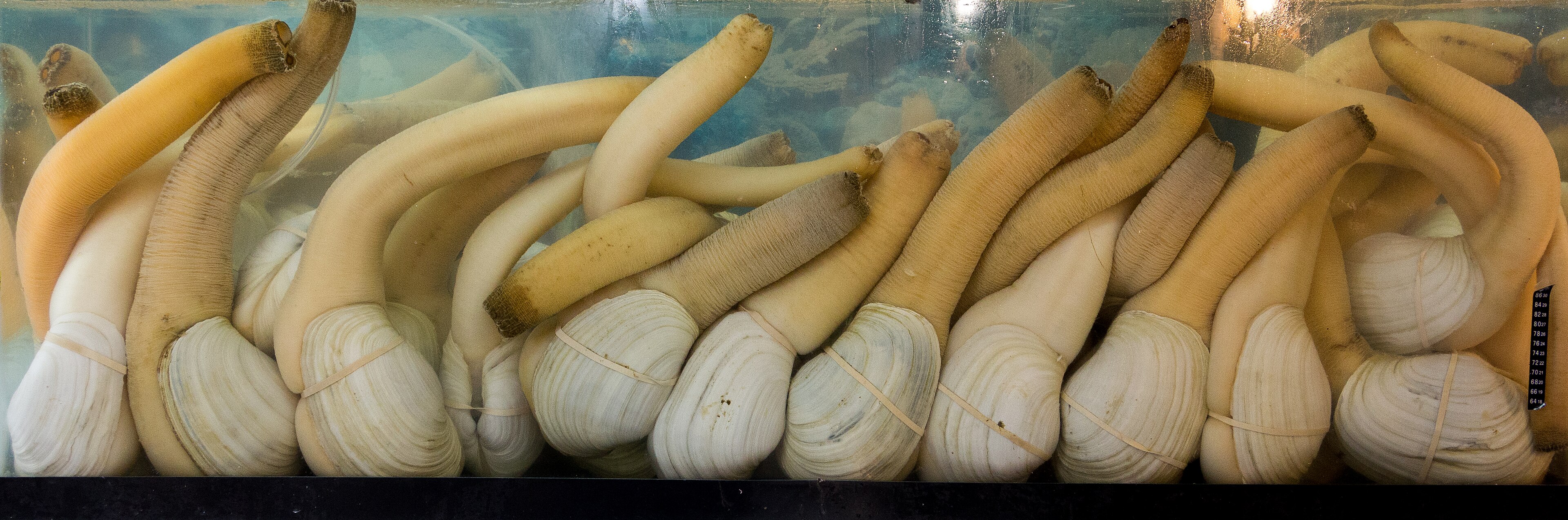
The shell is chalky, oblong and does not close, because the animal inside is far too large to fit. The siphon is the part everybody has seen, and it can extend to three feet or more, reaching from the clam's body up to the sediment surface to feed and breathe. A typical harvested animal weighs one to three pounds and larger ones are common.
They are extremely long-lived. Geoducks routinely reach a hundred years and the documented maximums run well beyond that, which makes the one in your bucket potentially older than everyone you know. That longevity is a large part of the management case: a population of century-old animals does not replace itself quickly.
They live buried two to three feet down, permanently. A geoduck settles once as a juvenile, digs in, and never relocates. Everything above the sediment is siphon.
The limit, and what changed
Washington revised the recreational geoduck rules effective April 1, 2026, and anyone working from older information will be over their limit.
The daily limit is now one geoduck per person per day, reduced from three. It is specifically the first one dug, and any geoduck taken must be retained as part of that limit regardless of size, quality or condition.
The reasoning is the same as for razor clams and horse clams. A geoduck excavated from three feet of sediment does not go back in, and an animal dug and abandoned because it was smaller than hoped is simply a dead hundred-year-old clam. Making the first one count removes the incentive to keep digging until you find a good one.
Horse clams, which people frequently dig by accident while looking for geoducks, are a separate limit at the first seven dug, also retained regardless of condition.
The tide is the real constraint
Geoducks live at the very bottom of the intertidal, and that single fact governs everything about planning a dig.
You realistically need a minus one and a half foot tide or lower to expose ground with geoducks in it, and lower is better. That is a small number of tides a year, they cluster around the new and full moon, and on this coast the biggest ones fall at night in winter.
Then subtract the days when the beach is closed for biotoxin, which is a Department of Health determination you have to look up on the day rather than a seasonal pattern you can plan around, the days when the season is shut for that specific beach under the current Fish and Wildlife rules, the days when weather makes it miserable, and the days you cannot take off work. What remains is frequently a handful of genuine opportunities a year, and they are known years in advance because tides are.
This is why geoduck digging is an occasion rather than an outing, and why serious diggers mark the minus tide series for the whole year and plan around those dates. The arithmetic is in minus tides for clamming.
The gear
Geoduck digging has the shortest gear list in this whole set and the least forgiving one.
The tube is the item that makes the dig possible at all. A stovepipe of steel or heavy plastic, eighteen to twenty-four inches across and a couple of feet deep, worked down over the show to hold the walls open. Without it you excavate a cone of wet sand that refills as fast as you dig, and no amount of effort compensates.
Then a short shovel and something to bail with, because you dig inside the tube by hand and the hole fills with water continuously.
A partner is not equipment and belongs on the list anyway. Nobody should dig a hole they lean into up to the shoulder without somebody else on the beach.
Waders and gloves handle the rest of the physical problem, which is cold water, wet sand and a long time with your arm submerged. This is a winter activity as often as not.
A headlamp follows from the tides, since the minus one and a half or lower that exposes geoduck ground mostly falls after dark on this coast.
The tide table itself is arguably the most important item, because there are only a handful of viable tides a year and they are known years ahead, so the whole activity is planned around a calendar rather than a forecast.
And at home, a pot for blanching ready before you leave. Ten to twenty seconds in boiling water then straight into ice is what lets the siphon skin peel off in one piece.
Finding the show
A geoduck announces itself, and learning to read the announcement is the skill that separates a successful dig from three hours of excavation.
What you are looking for is the siphon show: a hole in the sand, often dimpled, sometimes with the tip of the siphon visible, and frequently larger than a clam show has any right to be. On good ground at a low enough tide the flats are dotted with them.
The size of the show correlates loosely with the size of the animal, and the shape helps distinguish geoduck from horse clam, though the distinction is not reliable enough to bet a dig on. Many diggers find out which they have when they reach the shell.
A geoduck will withdraw its siphon if you stamp nearby, which both confirms it is alive and shows you exactly where it is. Then it retracts down, which does not help you, because it does not go anywhere. Unlike a razor clam, a geoduck cannot outrun you. It lives further down than you want to dig.
How the show tells you what you are about to dig
Reading the flat before committing an hour to a hole is the difference between an efficient dig and a wasted tide.
Geoduck shows are large, often an inch or more across, sometimes oval, and frequently sit in slightly firmer ground than the surrounding flat. Horse clam shows can look similar and the two species overlap, so a certain amount of ambiguity is unavoidable, and it is one reason the horse clam limit exists as a separate line.
Depth of the show is a reasonable signal. A geoduck siphon reaching two to three feet up through sediment tends to produce a hole that looks like it goes somewhere, whereas a shallower clam produces a dimple. Squirting is another: a geoduck disturbed will often expel a jet of water, sometimes impressively, which is both a good confirmation and how a lot of people first notice them.
Ground matters as much as the show. Geoducks favor sand and sandy mud rather than heavy gravel, because a clam that has to dig three feet down does better in material it can move through. A cobbled beach may hold them and it will be considerably harder work.
The honest summary is that experienced diggers still misread shows, and the first-one-dug rule means a misread costs you the day's limit. That is a strong argument for taking time over the choice rather than starting on the first hole you see.
The stovepipe, and the actual work
The tool that makes this possible is a tube, and the method is unlike any other clam digging.
A geoduck tube, sometimes called a stovepipe, is an open cylinder of steel or plastic, typically eighteen to twenty-four inches across and a couple of feet deep, worked down over the show. Its job is to hold the walls of the hole open, because wet sand at that depth collapses continuously and without a tube you are excavating a cone that refills as fast as you dig.
You work the tube down over the show, then dig inside it by hand and with a small shovel, removing sand and water, following the siphon down. As you go deeper you add depth by pushing the tube further. The hole fills with water and you bail it. Your arm goes in to the shoulder.
At the bottom, you find the shell and work it free by hand. Pulling on the siphon is the classic beginner error: it detaches, the clam is killed, and you have neither a geoduck nor a hole worth continuing.
The whole thing takes fifteen minutes to an hour depending on the ground and your competence, in cold water, on a falling and then rising tide, with a clock.
Digging Geoduck in the Puget Sound.Safety, which is not a formality
Collapse is the hazard here, and the mechanism is worth understanding rather than dismissing.
A hole two to three feet deep in saturated sand, with a person leaning into it to the shoulder, can collapse. Sand at that water content behaves more like a fluid than a solid, and a partial collapse that pins an arm while the tide comes in is a dangerous situation, not a theoretical one.
Never dig alone. Fill the hole completely before you leave, which is also a legal requirement and matters just as much for the next person as for the beach. Do not lean fully into a hole that has not been stabilized by a tube. And watch the tide rather than the clam, because the geoduck is not going anywhere and the water is.
Post Hole Geoduck (Puget Sound, Hood Canal)Cleaning one
A geoduck is not difficult to process and the method is specific enough to be worth stating.
Blanch it briefly in boiling water, ten to twenty seconds, which loosens the skin on the siphon. Then plunge into ice water and peel the tough outer skin off the siphon, which comes away in one piece.
Separate the siphon from the body. The siphon is the prize: firm, sweet, faintly crunchy, and traditionally sliced thin and eaten raw as sashimi or crudo, or seared very briefly. It is also excellent pounded and fried.
The body, the mantle and the breast, is softer and less delicate and is generally used for chowder, fritters or stir-fry. Discard the gut.
Overcooking is the standard failure. The siphon becomes rubber in about the time it takes to think about it, which is why raw and brief-sear preparations dominate.
The rest of the fishery
The recreational dig is a small part of what happens to geoducks in Washington, and the context is worth knowing.
There is a substantial commercial subtidal fishery, worked by divers using water jets in deeper water, co-managed by the state and by treaty tribes, and the product is worth a great deal per pound and goes largely to export markets. There is also an aquaculture industry that plants juvenile geoducks in tubes on tidelands, which is visible on many Puget Sound beaches as grids of PVC pipe and netting and is a genuine source of local controversy about shoreline use.
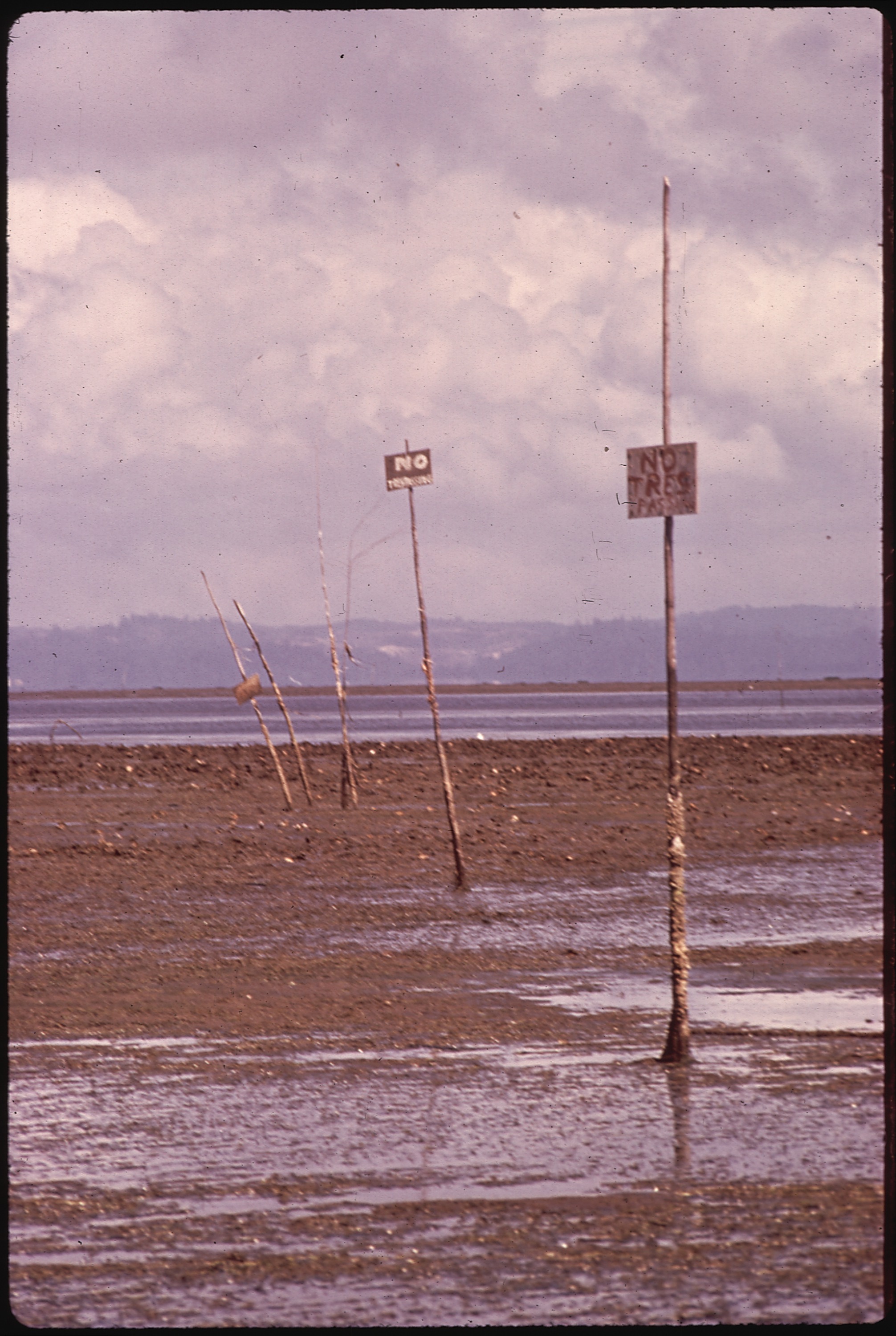
For a recreational digger the practical consequence is that a great deal of geoduck ground is either leased, planted or privately owned, and a bed of tubes on a tideflat is somebody's crop rather than a public opportunity. Whether the ground under you is public is a separate question from whether the season is open, and in Washington it is the harder one, covered in public tidelands and private beaches.
Guidepole carries the ownership boundary and the closure status against the specific beach, which for a fishery with a handful of viable tides a year is the difference between using one of them and wasting it.
The short version
One geoduck per person per day as of April 1, 2026, down from three, and it is the first one you dig, retained regardless of size or condition.
They live two to three feet down, permanently, and routinely reach a hundred years old. You need a minus one and a half tide or lower, which is a handful of days a year, mostly at night in winter.
The tube is what makes it possible, because a hole that deep in wet sand collapses as fast as you dig it. Do not pull the siphon; work the shell free by hand.
Do not dig alone, fill your hole, and watch the tide rather than the clam.
Blanch, peel the siphon, eat it raw or barely seared, and put the body in chowder.
The easier clam on the same beaches is in digging Manila clams, and the species that can be toxic when the others are not is in butter clams and PSP.
The tide series that makes any of this possible is in minus tides for clamming, and the state-by-state rule picture, including the April 2026 limit change, is in shellfish licenses by state.