Fish
Fish Fire
Fire Hike
Hike Bird
Bird


Rocky Mountain National Park is where fly fishing meets conservation in its most direct form. The park straddles the Continental Divide at 7,500 to 14,259 feet, holding over 150 named lakes and hundreds of miles of streams, many of them in alpine terrain above 10,000 feet where the air is thin, the water is cold, and the native trout are fighting for survival.
The greenback cutthroat trout (Oncorhynchus clarkii stomias), Colorado's state fish, was once thought to be extinct. Decades of stocking non-native rainbow, brown, and brook trout had hybridized or displaced the greenback from virtually every stream in its native range. Then biologists found a few pure populations clinging to existence in remote headwater streams. The Poudre Headwaters Project, a 10-12 year partnership between the U.S. Forest Service, Rocky Mountain National Park, and Colorado Parks and Wildlife, is now working to restore the greenback to 40 miles of connected streams and lakes within the park.
When you fish in Rocky Mountain National Park today, you're fishing in the middle of this restoration. The cutthroat you catch may be a greenback, a fish that was declared extinct, rediscovered, and is now being brought back to water it hasn't occupied in a century. Handle it carefully. It's not just a fish, it's a conservation milestone.
The Fish
Greenback Cutthroat Trout (Native, Protected)
The greenback is a high-altitude specialist, adapted to the cold, nutrient-poor headwater streams of the Colorado Front Range. These fish are small (8-12 inches maximum in most streams), slow-growing, and spring-spawning. They eat whatever the stream provides, aquatic insects, terrestrial ants and beetles that fall from the banks, and the occasional small minnow.
Greenback cutthroat are catch-and-release only with barbless hooks required in designated restoration waters. The park is actively expanding greenback habitat by removing non-native trout from select drainages and reintroducing pure greenback populations. Some waters are closed entirely during restoration. Check NPS regulations before fishing, the boundaries change as the restoration progresses.
Colorado River Cutthroat Trout (Native, Protected)
The west-slope waters of the park (the Colorado River headwaters) hold the Colorado River cutthroat, a separate native subspecies also protected under catch-and-release regulations. These fish share the greenback's habitat preferences and behavioral traits: cooperative feeders, willing dry-fly eaters, small but beautifully colored.
Brook, Brown, and Rainbow Trout (Non-Native)
The majority of the fish you'll catch in RMNP are non-native species stocked over the past century: brook trout in the alpine lakes and smaller streams, brown trout in the lower-elevation rivers, and rainbow trout throughout. These fish are not protected, standard Colorado regulations apply. In some restoration zones, anglers are encouraged to harvest non-native trout to reduce competition with recovering greenback populations.
The Waters
Dream Lake

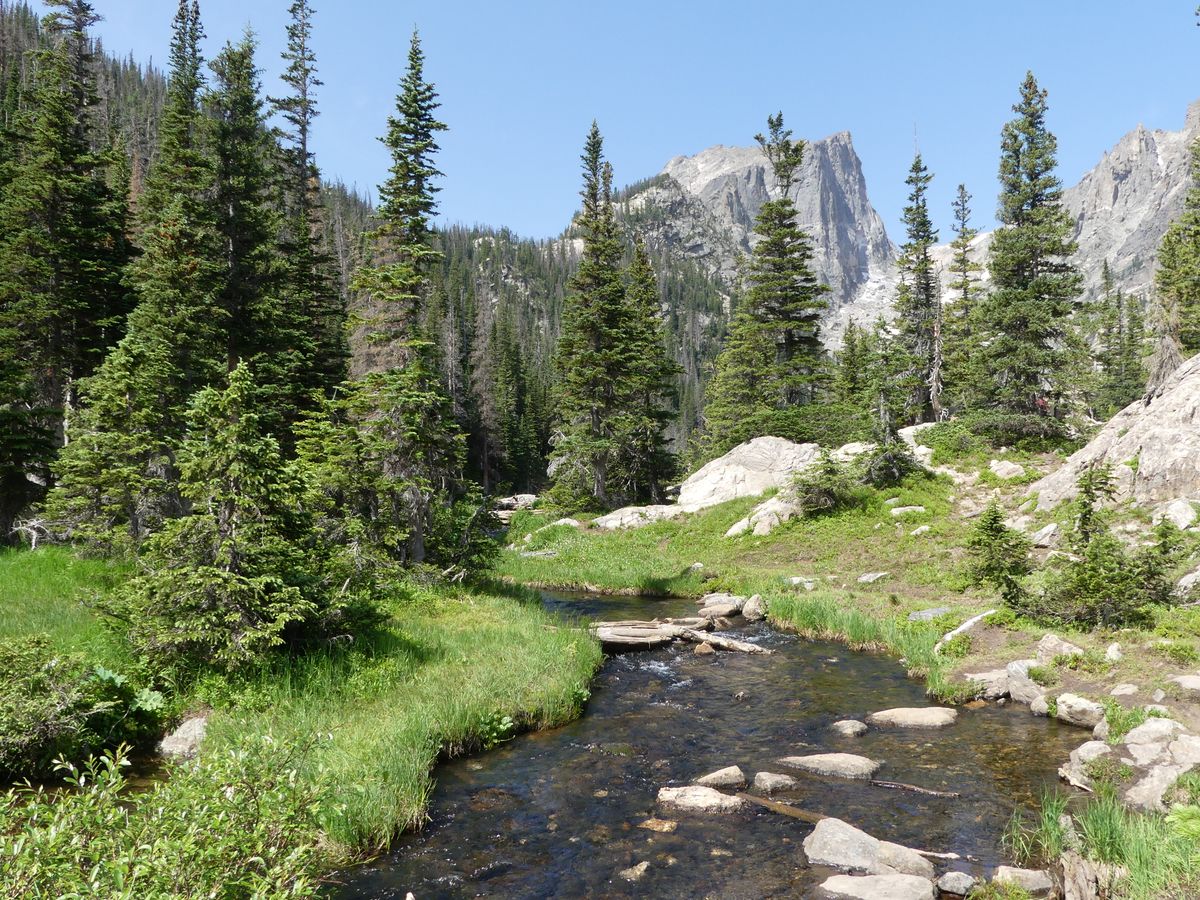
Dream Lake is the park's most photographed alpine lake, and one of its best fishing destinations. A 1.1-mile hike from the Bear Lake trailhead leads to a stunning cirque lake at 9,900 feet, surrounded by Hallett Peak and Flattop Mountain. The lake holds cutthroat and brook trout that respond to small dry flies, Parachute Adams in #16-18, Griffith's Gnats in #20, and small foam ants in #18-20.
Fish early, by mid-morning the trail is crowded with hikers, and the shoreline pressure pushes fish to deeper water. Dawn arrivals have the lake to themselves and the best fishing of the day.
Sprague Lake
The most accessible fishing in the park. Sprague Lake is a 13-acre lake at 8,700 feet with a flat, paved trail around its perimeter, accessible to wheelchair users and families with young children. The lake holds rainbow, brook, and brown trout, and the fishing is straightforward: cast a Woolly Bugger on an intermediate line or fish a dry-dropper rig with a Chubby Chernobyl and Pheasant Tail dropper. This is where you take your kids or non-fishing partners, the scenery is stunning and the fish are cooperative.
The Big Thompson River
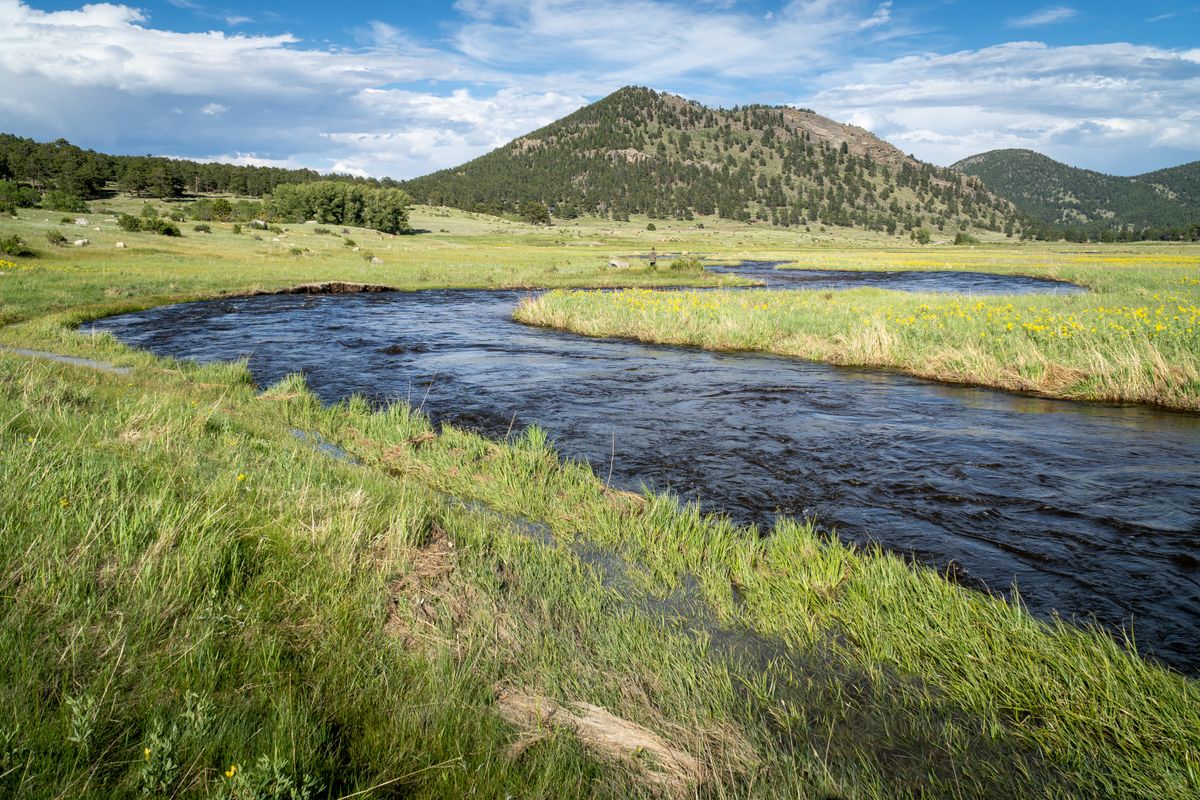
The Big Thompson enters the park from the east and flows through Moraine Park, an open, meadow valley at 8,000 feet. The river here is classic small-stream pocket water: riffles, runs, pools, and undercut banks holding brown and rainbow trout. The fish average 8-12 inches, with occasional browns to 16 inches in the deeper pools.
The Big Thompson fishes like a miniature version of a Montana spring creek, clear water, spooky fish, and precise presentations rewarded. Elk Hair Caddis in #16, Parachute Adams in #16-18, and small Pheasant Tail nymphs in #18 cover the dry-fly and nymph fishing. Stealth matters here, the fish can see you before you see them.
The Colorado River Headwaters (West Side)
The Colorado River, yes, that Colorado River, the one that carved the Grand Canyon, begins as a small stream on the west side of the park in the Kawuneeche Valley. At its headwaters, the Colorado is a 10-foot-wide creek holding Colorado River cutthroat trout and brook trout in cold, clear water surrounded by spruce-fir forest. It's the only place you can cast a fly into the Colorado River and wade across it in three steps.
The west side of the park is less visited than the east (most visitors enter through Estes Park), which means less fishing pressure. The Colorado River headwaters fish best from late July through September when flows stabilize after snowmelt.
Fall River
Fall River winds through Horseshoe Park on the east side, a smaller, more intimate stream than the Big Thompson. Tight casting lanes, overhanging willows, and spooky fish make Fall River a technical challenge. Use a short rod (7-8 feet) and keep your profile low. Small dry flies, #18 Parachute Adams and #20 Griffith's Gnats, are the standard.
Backcountry Lakes, Sky Pond, The Loch, and Beyond
The park's best fishing is in the backcountry, alpine lakes accessible only by trail. Sky Pond (4.7 miles one way, 1,700 feet of elevation gain) holds cutthroat and brook trout in a dramatic cirque beneath the Sharkstooth and Cathedral Wall. The Loch (2.9 miles) holds similar species in a more accessible setting. Fern Lake, Odessa Lake, and Emerald Lake all hold trout.
Pack a 4-piece 3- or 4-weight rod, a small box of dry flies, and 5X tippet. The alpine-lake kit is the same here as in Glacier and Grand Teton, small flies, light tippet, cooperative fish.
The Fly Box
RMNP's trout are altitude-limited feeders, the insect life is sparser than lower-elevation fisheries, and the fish eat opportunistically:
Dry flies:
- Parachute Adams #16-20, the universal high-country dry
- Elk Hair Caddis #16-18, caddis in the lower streams
- Griffith's Gnat #18-22, midge clusters on alpine lakes
- Stimulator #12-14, stoneflies in the larger streams
- Foam ants and beetles #16-20, terrestrials, often the best producers
- Chubby Chernobyl #12, hopper-dropper anchor
Nymphs:
- Pheasant Tail #16-20, the high-country nymph standard
- Hare's Ear #16-18
- Zebra Midge #20-22, cold-water midge pupa
- Copper John #16-18, deep runs in the Big Thompson
Streamers:
- Woolly Bugger #10-12, olive, Sprague Lake and larger pools
The Gear
Rod: 3- or 4-weight, 7.5-8.5 feet for alpine lakes and small streams. 5-weight, 9 feet for the Big Thompson and larger water. A 4-piece pack rod is essential for backcountry hikes, you're not carrying a 9-foot rod up 1,700 feet of switchbacks.
Altitude considerations: RMNP's fishing is at 8,000-12,000 feet. The thin air at altitude makes exertion harder than at sea level. Drink water constantly. Move slowly on the trail. Give yourself a day to acclimate before attempting a 5-mile hike-in lake, the same advice we give for Telluride's high-country lakes.
License: Colorado state fishing license required. Available online or at shops in Estes Park. $11/day for non-residents.
When to Go
- Late June–early July: Snowmelt runoff clearing from lower elevations. Alpine lakes still partially iced. Lower streams (Big Thompson, Fall River) fishable.
- July–August: Prime season. Alpine lakes fully thawed and accessible. Caddis and PMD hatches on the streams. Terrestrials begin. Best overall month: late July.
- September: The local secret, fewer visitors, cooler temperatures, aggressive fish feeding before winter. Fall colors in the aspens. BWO hatches on overcast days.
- October: Season winds down. Early snow at higher elevations. Lower streams still fishable. Cold mornings, stunning autumn light.
The Conservation Story
Fishing in RMNP isn't just recreation, it's participation in one of the most significant native trout restoration efforts in the American West. The greenback cutthroat was listed as threatened under the Endangered Species Act in 1978. In 2012, genetic testing revealed that the fish previously identified as greenbacks in several recovery streams were actually a different subspecies, the true greenback was even rarer than thought, surviving in only a handful of streams.
The current restoration involves removing non-native trout from target drainages (using electrofishing and, in some cases, rotenone treatment), building fish barriers to prevent reinvasion, and stocking pure greenback cutthroat from the surviving source populations. It's controversial (removing fish is never popular), expensive (millions of dollars over a decade), and slow (fish populations take years to establish). But it's working. Greenback cutthroat are swimming in waters they haven't occupied in over a century.
When you catch a greenback in RMNP, small, golden, with that crimson slash under the jaw, you're holding a fish that nearly didn't exist anymore. Release it gently. It's Colorado's state fish, and it's finally coming home.
The High-Country Experience
Fishing in Rocky Mountain National Park is fundamentally different from fishing a Montana tailwater or a Pennsylvania spring creek. The fish are smaller. The water is colder. The hatches are sparser. The access requires hiking, sometimes significant hiking at altitude. None of that is a criticism. It's the point.
The experience of standing at 11,000 feet beside a lake that's been frozen for seven months, casting a #20 Griffith's Gnat to a cutthroat that rises to sip it off the surface film, with the Continental Divide stretching in both directions and no other human in sight, that's not an experience you can have on the San Juan or the Green River. Those are great fisheries. This is something different. This is fishing at the top of the world, for fish that have adapted to conditions that would kill a hatchery trout in a week, in water so pristine that it's the headwaters of rivers that flow to both oceans.
The Telluride / San Miguel guide covers similar high-country fishing at altitude. But RMNP has something Telluride doesn't: the greenback cutthroat, a fish that was dead and is alive again, swimming in the same streams where Lewis and Clark's Corps of Discovery first described it 200 years ago.
Altitude is real. RMNP's fishing starts at 8,000 feet and goes up from there. If you're coming from sea level, give yourself a full day to acclimate before attempting a backcountry lake hike. Drink water constantly, dehydration at altitude is insidious and makes altitude sickness worse. The symptoms (headache, nausea, shortness of breath) are not something you can push through. If you feel them, descend.
Weather changes fast. Afternoon thunderstorms are nearly daily from July through September. The high country generates its own weather, a clear morning at 10,000 feet can become a lightning storm by 2 PM. Plan your backcountry fishing for early morning, and be off exposed ridges and lake shores by noon. Lightning at 12,000 feet with a graphite rod in your hand is not theoretical risk, it's a real one that kills hikers every year.
Bears are here too. Black bears, not grizzlies (unlike Glacier), but still bears. The same precautions apply: carry bear spray, make noise, store food properly if camping.