 Fish
Fish Fire
Fire Hike
Hike Bird
Bird

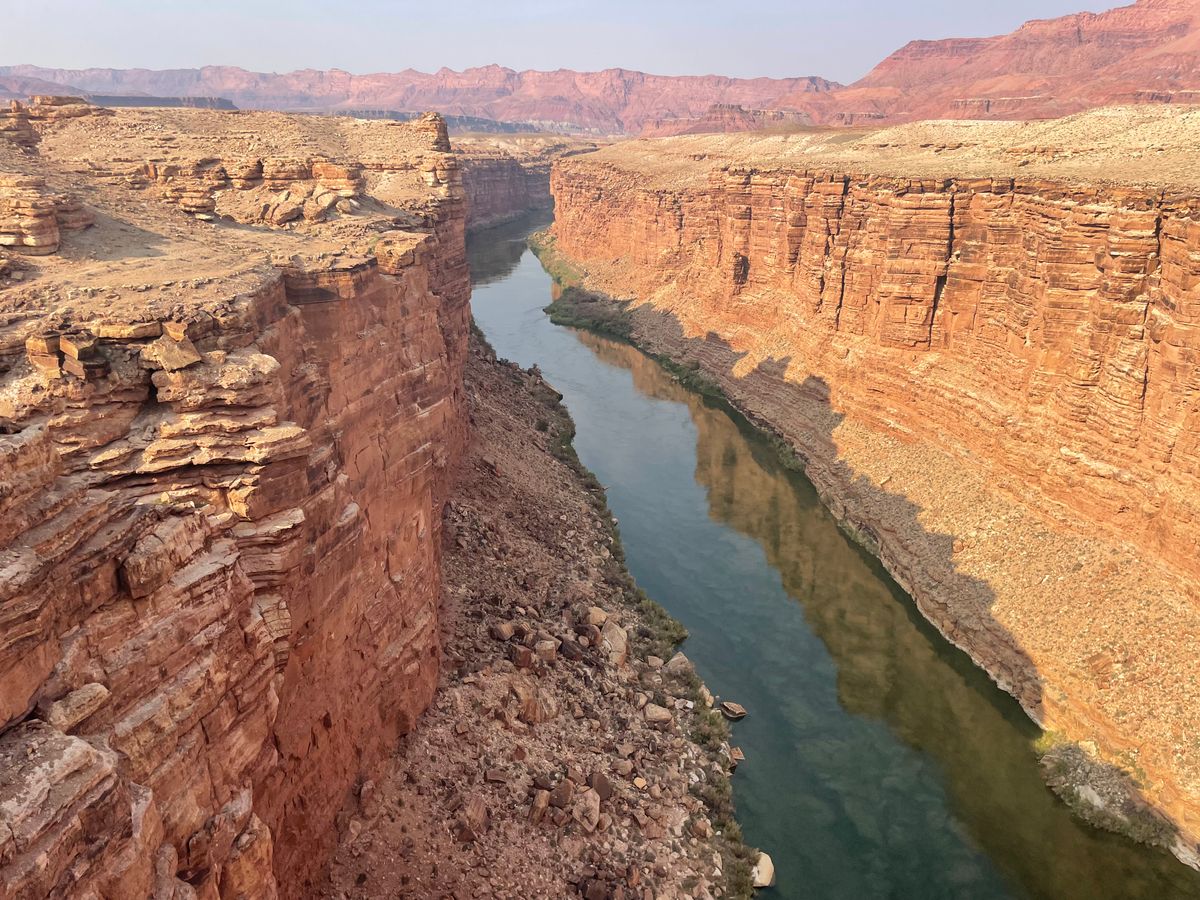

The San Juan River in northwestern New Mexico shouldn't hold trout. The surrounding landscape is high desert, red mesas, sagebrush, and a climate that pushes 100°F in summer. But in 1963, the Bureau of Reclamation completed Navajo Dam on the San Juan, and the cold water released from the bottom of the 402-foot dam transformed a warm desert river into one of the most productive tailwater trout fisheries in the world.
The numbers are staggering: 15,000 trout per mile in the designated Quality Water, the first 3.75 miles below the dam. That's not a peak-year estimate. That's the average. The fish are predominantly rainbow trout averaging 17 inches, with browns mixed in, and fish over 20 inches are routine. Twenty-four-inch rainbows are caught every week. Fish over 30 inches are landed every season.
The San Juan achieves this density because the dam-controlled flows maintain a constant 42-46°F year-round, which supports an extraordinary biomass of midges, Baetis mayflies, scuds, and worms. The trout don't just survive in this water, they grow fat and fast, feeding on an endless supply of tiny insects that hatch every day, in every month, regardless of air temperature or weather.
This is the river that teaches you to fish small. If you can catch a 20-inch rainbow on a #22 midge pupa in the San Juan's clear, flat water, you can catch trout anywhere.
The Quality Water, 3.75 Miles of Protected Trophy Fishing

The first 3.75 miles below Navajo Dam are designated Quality Water by the New Mexico Department of Game and Fish. The regulations are strict and specific:
- Catch and release only, no fish may be kept
- Artificial flies and lures only, no bait
- Single barbless hooks only, no trebles
- Two flies maximum on a single line
These regulations have been in place for decades, and the result is a trout population that's been growing and self-sustaining for generations. The fish are wild, they reproduce in the river's gravel substrate, and they're big because they've never been harvested.
The Quality Water is divided into sections by landmarks and access points. The upper braids, a maze of channels, islands, and side braids directly below the dam, hold the highest fish density and the most technical fishing. The channels are narrow enough to cast across, the water is gin-clear, and the trout hold in feeding lanes between the weed beds, sipping midges with the subtlety of spring creek fish.
Further downstream, the river consolidates into a single channel with defined riffles, runs, and pools. The Texas Hole, the most famous pool on the San Juan, is a large, deep bend where hundreds of trout stack during high-flow events. On a busy Saturday, Texas Hole can look like combat fishing. On a Tuesday morning in January, you might have it to yourself.
The lower Quality Water near the boundary offers more solitude, the walk is farther from the parking areas, which filters the crowds. The fish here see fewer flies, which means they're marginally less educated, a meaningful advantage on a river where the trout have refused every pattern in every fly shop within 100 miles.
The Midge Game, What the San Juan Teaches You

The San Juan is, above all else, a midge fishery. Chironomid midges hatch every day of the year, typically a mid-morning emergence and another in the afternoon, and the trout eat them at every stage: larva on the bottom, pupa ascending through the water column, adult on the surface, and cluster in the film.
Learning to fish midges on the San Juan teaches you subsurface skills that transfer to every other tailwater and spring creek:
Bottom fishing: San Juan Worms (#12-16, red and brown) and scud patterns (#14-18, pink/olive/orange) are fished on the bottom as "anchor flies", heavy patterns that get your rig to the feeding zone. A Zebra Midge or midge larva (#20-24) trails 18 inches behind as the "point fly" that the trout actually eat. The rig drifts along the bottom, ticking the gravel, and the indicator, a small thingamabobber or yarn indicator, pauses, dips, or slides sideways when a trout takes.
Mid-column fishing: As the hatch intensifies, the trout move up in the water column to intercept ascending midge pupae. The indicator depth shortens (from 4-6 feet to 2-3 feet), and the point fly changes to an emerging midge pupa, RS2 (#20-22), Mercury Midge (#20-22), or Barr Emerger (#20-22), that imitates the transitional stage between larva and adult.
Surface fishing: When the adults are on the water and the trout are rising, the game shifts to dry flies, Griffith's Gnat (#18-22) for midge clusters, Parachute Midge (#22-24) for individual adults. The rises are subtle, barely a dimple, and the drift must be dead-perfect in the slow, flat water.
This progression, bottom to mid-column to surface, plays out every day on the San Juan, sometimes over the course of a single morning. The angler who reads the water and adjusts their rig through the progression catches fish all day. The angler who sets up one rig and leaves it catches fish for 20 minutes, then wonders why it stopped.
The Hatch Chart, Midges and More
The San Juan's hatch cycle is simpler than most Western tailwaters, midges dominate, with supporting players:
- Year-round: Midges (#18-26), the constant. Zebra Midge (black, red, olive), Griffith's Gnat, Mercury Midge, RS2. The midge game is the San Juan game.
- Year-round: San Juan Worms (#12-16, red/brown) and Scuds (#14-18, pink/olive/orange), the subsurface staples that produce between hatches.
- March–May: Blue Winged Olives (#18-22), the spring mayfly. Sparkle Dun and Parachute Adams in olive. Overcast days produce the best hatches. The BWO emergence is the San Juan's best dry-fly opportunity outside of midge clusters.
- May–August: Pale Morning Duns (#16-18), limited but exciting when they appear. The PMD hatch on the San Juan isn't as prolific as the Missouri's or Henry's Fork's, but when it's on, the fish eat them eagerly.
- June–September: Caddis (#14-18) and stoneflies (#12-16) appear in the lower Quality Water and below. Elk Hair Caddis and Stimulator provide a welcome change from the midge game.
- September–November: Fall BWOs (#18-22) return. Streamer fishing for browns picks up downstream.
The Fly Box, Small and Specific
The San Juan fly box is the most specialized of any Western tailwater:
Nymphs: Zebra Midge (#20-24, black/red/olive, carry 30+), Mercury Midge (#20-22), RS2 (#20-22), Juju Baetis (#18-20), Pheasant Tail (#18-20), Hare's Ear (#16-18), San Juan Worm (#12-16, red/brown), Scud (#14-18, pink/olive/orange)
Dry flies: Griffith's Gnat (#18-22), Parachute Midge (#22-24), BWO Sparkle Dun (#18-22), Parachute Adams (#18-20)
Streamers: Woolly Bugger (#6-8) for the lower river browns, not for the Quality Water, where nymphing and dry flies dominate
The critical supply: Carry more Zebra Midges than you think you need. The San Juan eats them, lost to rocks, broken off on fish, worn out by trout teeth. A dozen Zebras in each color (black, red, olive) in sizes 20 and 22 is the starting point, not the maximum.
The Gear
Rod: 9-foot 4-weight or 5-weight. The 4-weight is ideal for the midge game, light enough for 6X-7X tippet protection, sensitive enough to detect the subtle takes on small flies. The 5-weight works for windy days and when using heavier indicator rigs.
Leaders: 9 to 12 feet tapered to 5X, 6X, or 7X depending on the fly size and the fish's mood. Fluorocarbon tippet is mandatory, the water is clear enough to see a quarter on the bottom at six feet, and the fish can see mono. Carry every tippet size from 4X (for San Juan Worms) to 7X (for #24 midge pupae).
Indicators: Small and adjustable. The San Juan's relatively shallow Quality Water (2-6 feet in most sections) requires precise depth control. A thingamabobber or New Zealand-style yarn indicator that can be moved quickly is the standard. Some anglers prefer tight-line (Euro) nymphing to eliminate the indicator entirely.
Wading: The San Juan is wadeable throughout the Quality Water. Felt soles are preferred on the slippery bottom. Hip boots suffice in most sections, the water rarely exceeds thigh-deep in the braids.
The Culture, Navajo Dam
The community at Navajo Dam is a cluster of lodges, guide services, and fly shops that exists solely because of the San Juan River. It's remote, an hour from Farmington, three and a half hours from Albuquerque, and an hour from Durango across the Colorado border.
The San Juan guide culture is distinctive: these guides specialize in midge fishing to a degree that guides on other rivers don't. A San Juan guide can tell you the difference between a size 22 Mercury Midge in black and a size 22 Mercury Midge in charcoal, and on certain days, that difference is the difference between a 30-fish day and a blank.
When to Go
The San Juan fishes 365 days a year, the constant 42-46°F water temperature means there is genuinely no off-season:
- November–March: Winter midge fishing, fewer anglers, consistent fishing, the best dry-midge surface activity often happens in winter
- March–May: Spring BWOs add variety to the midge game, the most diverse hatch window
- June–August: Summer, warmer air temperatures make the wading pleasant, PMDs possible, caddis and stoneflies in the lower water
- September–October: Fall BWOs, the transition, excellent fishing with cooler air and lighter crowds