Fish
Fish Fire
Fire Hike
Hike Bird
Bird

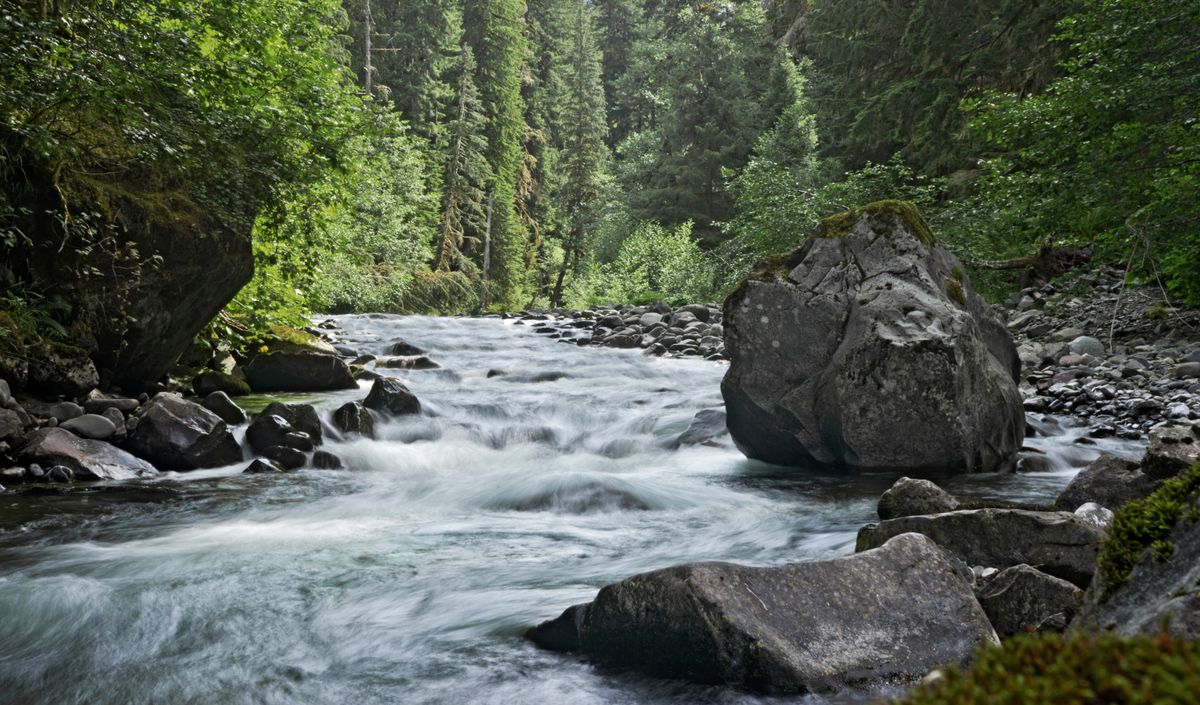

Olympic National Park is three ecosystems stacked on top of each other: temperate rainforest at the base, alpine meadows in the middle, and glaciers at the top, all of it surrounded by rivers that drain into the Pacific Ocean and host some of the last wild salmon and steelhead runs in the contiguous United States. The fishing here spans from 600-foot-deep glacial lakes holding fish that exist nowhere else on earth to rainforest rivers where wild steelhead share the water with Roosevelt elk and the densest stands of old-growth Sitka spruce in the world.
No other national park in the series offers this range. Glacier has native cutthroat. Katmai has monster rainbows. Everglades has saltwater backcountry. Olympic has all of the above, endemic lake trout, wild steelhead, five species of Pacific salmon, sea-run cutthroat, alpine brook trout, compressed into 922,000 acres of the most biologically diverse landscape in the Pacific Northwest.
For the steelhead-specific story, the rivers, the flies, the swing technique, and the conservation crisis, see our dedicated Olympic Peninsula Wild Steelhead guide. This article covers the park's broader fishing picture: Lake Crescent's endemic trout, the Elwha River's historic recovery, the park's regulations, and the experience of fishing in a temperate rainforest.
Lake Crescent, Two Fish Found Nowhere Else on Earth

Lake Crescent is Olympic's most unique fishery, and one of the most unique in the world. The lake is a glacially carved fjord: 5,000 acres, over 600 feet deep, with water so clear you can see the bottom at 60 feet. The lake is cold (rarely above 55°F at the surface), oligotrophic (low nutrients), and isolated, a landslide roughly 8,000 years ago at Indian Creek cut Lake Crescent off from the neighboring Lake Sutherland and the Lyre River drainage, trapping the trout populations inside with no ability to migrate or mix with outside fish.
Eight thousand years of isolation produced two endemic subspecies found nowhere else on earth:
Beardslee Trout (Endemic Rainbow)
The Beardslee trout (Oncorhynchus mykiss irideus, Beardslee form) is a deep-dwelling rainbow trout that has adapted to Lake Crescent's cold, deep water. These fish live in the lake's depths, feeding on kokanee salmon and sculpins, and can reach 20 pounds, massive for a landlocked rainbow. They're called "bluebacks" by locals for their dark blue-green coloring, which is dramatically different from the silver-and-pink of a typical rainbow.
Beardslee trout spawn in the Lyre River (the lake's outlet) from January through May, an unusual winter-spring timing that reflects their isolation from the standard coastal rainbow spawning cycle.
Crescenti Trout (Endemic Cutthroat)
The Crescenti cutthroat is Lake Crescent's endemic coastal cutthroat variant. Smaller than the Beardslee (typically 10-16 inches), these fish feed in the lake's shallows and along the shoreline, eating insects, small fish, and crustaceans. They spawn in Barnes Creek (the lake's primary inlet) from February through June.
Fishing Lake Crescent
Lake Crescent is catch-and-release only with artificial flies and lures, single barbless hook, under 2 ounces. No bait. No treble hooks. These regulations exist to protect fish that cannot be replaced, if this population declines, there's no hatchery backup and no other population to draw from.
The fishing is primarily done from boats and kayaks, the lake's depth and steep shoreline make shore fishing limited. Fly anglers use sinking lines and streamer patterns (small baitfish imitations, Woolly Buggers in olive and black, and sculpin patterns) stripped through the water column for Beardslee. The Crescenti cutthroat can be caught on dry flies along the shoreline, particularly during evening hatches in summer.
Access: Lake Crescent is on Highway 101 between Port Angeles and Forks. Lake Crescent Lodge, a historic 1915 lodge on the south shore, offers boat rentals and is one of the most scenic lodge settings in any national park. Several boat launches provide access around the lake. The Spruce Railroad Trail follows the north shore for 4 miles, offering shoreline access at several points.
The fishing experience. Lake Crescent fishing is patient, contemplative, and deeply connected to place. You're not going to catch 20 fish. You might not catch any. The Beardslee are deep-dwelling and elusive. The Crescenti are present but not abundant. What you will experience is fishing on one of the most pristine lakes in the Pacific Northwest, water so clear that the bottom is visible at depths that seem impossible, surrounded by old-growth forest that has never been logged, with no jet skis, no waterslides, no lakefront condos. Just water, forest, and mountains.
When you do hook a Beardslee, and if you fish with streamers on a full-sinking line, stripping slowly through the 30-50 foot depth zone, you will eventually hook one, you'll know immediately. These are not small fish. A 5-pound Beardslee fights like a steelhead in a bathtub, deep, powerful surges in the cold water, using the lake's depth to its advantage. A 10-pounder is a fish-of-a-lifetime in a lake where the trout are not supposed to exist anywhere else. Releasing it back into the clear, deep water, watching the dark shape descend into the blue until it disappears, is the kind of moment that stays with you permanently.
The science. Researchers from the USGS and NPS have studied Lake Crescent's endemic trout extensively. The genetic isolation that created the Beardslee and Crescenti is a textbook case of allopatric speciation, geographic separation leading to genetic divergence. The trout are genetically distinct enough that some biologists consider them separate species, not just subspecies. This makes Lake Crescent one of the few places in North America where you can catch a fish that is actively evolving into a new species, a process that began when a landslide blocked a creek 8,000 years ago and is still ongoing.
The Elwha River, A River Reborn
The Elwha River is the most important river restoration story in American conservation history. For nearly 100 years, two dams, the Elwha Dam (built 1913) and the Glines Canyon Dam (built 1927), blocked salmon and steelhead from reaching the upper 70 miles of the river within Olympic National Park. The largest dam removal in U.S. history began in 2011 and was completed in 2014.
The result has been extraordinary. All ten species of anadromous fish that historically used the Elwha, spring and summer/fall Chinook, coho, chum, pink, sockeye, summer and winter steelhead, bull trout, and cutthroat trout, have reclaimed the river. Salmon are spawning in habitat that hasn't seen fish in a century. The river is rebuilding itself, sediment that was trapped behind the dams has flushed downstream, creating new gravel bars and rebuilding the estuary.
Fishing the Elwha: The river is currently under special regulations as the ecosystem recovers. Check NPS regulations before fishing, some sections may be closed or catch-and-release only. The long-term vision is a fully restored Elwha with sustainable runs of all native species. When that vision is realized, the Elwha will be one of the great steelhead and salmon rivers in the Pacific Northwest, inside a national park.
The Steelhead Rivers, Inside the Park
The Olympic Peninsula steelhead guide covers the OP steelhead fishery in detail, the Hoh, Sol Duc, Bogachiel, and the techniques, flies, and conservation issues. Within the park boundaries specifically:
The Hoh River, The upper Hoh within the park flows through the Hoh Rain Forest, one of the largest temperate rainforests in the Western Hemisphere. Wild winter steelhead enter from December through March. The park section is accessed via the Hoh Rain Forest Road and trails along the river.
The Sol Duc River, The Sol Duc's headwaters are within the park, accessible from the Sol Duc Hot Springs area. The Sol Duc holds both winter and summer steelhead runs. The Sol Duc Hot Springs, natural hot pools near the trailhead, make the Sol Duc a uniquely civilized steelhead experience: swing flies for wild steelhead in the morning, soak in hot springs in the afternoon.
The Queets and Quinault, Both are currently closed to sport fishing after failing to meet escapement goals. These closures are conservation measures protecting the last wild steelhead populations. See the steelhead guide for the full conservation story.
Alpine Lakes and Small Streams
Olympic's alpine zone, above 5,000 feet, holds mountain lakes and streams with brook trout and cutthroat trout. These are hike-in fisheries accessed from trailheads at Hurricane Ridge, Deer Park, and the high-country trails throughout the park. The fishing is the same alpine experience as Glacier or Rocky Mountain: small fish, big scenery, pack a 3-weight rod and a box of Parachute Adams.
Sea-Run Cutthroat
Olympic's rivers hold sea-run cutthroat trout, the same species we cover in our Puget Sound beach fly fishing guide. These anadromous cutthroat migrate between the Pacific Ocean and the park's rivers, providing excellent fall fishing (September-November) as they return from the salt. The same flies and techniques that work on Puget Sound beaches, Clouser Minnows, small baitfish patterns, Miyawaki Poppers, work on the Olympic rivers when cutthroat are present.
The Fly Box
Olympic's diverse fisheries demand a diverse box, and several of the key patterns are locally developed for these specific waters.
Lake Crescent:
- Kokanee Fry Streamer #4-6, silver/blue, imitating the juvenile kokanee that Beardslee feed on in the deep water. Stripped on full-sinking line through the 30-60 foot zone.
- Woolly Bugger #6-10, olive and black, the universal subsurface option
- Sculpin patterns #4-6, for Beardslee along the rocky bottom
- Parachute Adams #14-18, Crescenti cutthroat on the surface during evening hatches
Steelhead (see full OP guide):
- Hoh Bo Spey #2, pink/purple, THE winter steelhead fly, the #1 pattern on the peninsula
- Egg-Sucking Leech #4-6, black/purple with hot-orange head, deadly in all water conditions, especially stained flows. Uses dark rabbit strip and marabou for maximum movement. The OP guide staple alongside the Hoh Bo.
- Intruder patterns #1/0-2, black/blue (clear water), purple (mid-conditions), pink/orange (colored water), modern intruder-style tube flies dominate OP steelheading
- General Practitioner #4, orange, the classic prawn-style pattern, a proven trophy producer on the Bogachiel
- Classic wet flies, Green Butt Skunk, Purple Peril, Skykomish Sunrise for summer runs on the Sol Duc
- Bunny Leech #2-4, black or purple, when fish are cold, sluggish, or have seen every intruder in the box. The rabbit strip's movement in slow water is unmatched
- Muddler Minnow, skating in warm-water tailouts when temps climb above 50°F
Sea-run cutthroat (rivers and estuaries):
- Delia Conehead Squid #6, THE Olympic Peninsula sea-run cutthroat fly. Created by local guru Jeffrey Delia, this simple conehead squid pattern has caught more sea-run cutthroat on the OP and Hood Canal than any other pattern. Tan tail, white body, deadly when stripped through the estuaries where rivers meet the salt.
- Euphausiid / Krill Pattern #10-12, translucent pink/tan, winter cutthroat feeding on the krill swarms that concentrate in the nearshore zone. Small, sparse, slow-stripped. See our euphausiid tying guide for three pattern variations.
- Clouser Minnow #6, chartreuse/white, the universal baitfish
- foam bass popper, topwater on calm water in the estuaries
- Sand Lance #4-6, when cutthroat are chasing sand lance schools along the beaches
- Chum Fry #8-10, spring outmigration near river mouths
Alpine lakes:
- Elk Hair Caddis #14-16
- Griffith's Gnat #18-20
- Stimulator #14, fast water in the streams
The Sol Duc Hot Springs, Fish and Soak
No other steelhead river in America comes with hot springs. The Sol Duc Hot Springs Resort, inside the park, near the Sol Duc trailhead, has natural mineral hot pools maintained at 99-104°F. The experience of swinging flies for wild winter steelhead in 40°F rain all morning, then walking 10 minutes to soak in a natural hot spring while steam rises around you and old-growth trees tower overhead, is unique in fly fishing. It's the most civilized way to suffer for a steelhead.
The hot springs are open year-round (though the resort has seasonal hours). Day-use soaking is available without a lodge reservation. After a fishless morning in January rain, and most steelhead mornings are fishless, the hot springs are not optional. They're therapy.
Regulations
- Washington state fishing license required for all park waters
- Catch-and-release with barbless hooks on Lake Crescent (mandatory)
- Check current regulations for each river, the Queets and Quinault are closed; other rivers have seasonal restrictions
- Wild steelhead must be released on all park rivers
- No fishing license required for anglers under 15
When to Go
- December–March: Winter steelhead season on the Hoh and Sol Duc. Cold, wet, and spectacular. Lake Crescent is fishable but cold.
- June–September: Summer steelhead on the Sol Duc. Alpine lakes accessible. Lake Crescent fishing at its best. Sea-run cutthroat begin entering rivers in September.
- September–November: Fall cutthroat and salmon watching. The salmon runs up the Sol Duc Salmon Cascades are a park highlight even for non-anglers.
The Rainforest Experience
Fishing in Olympic National Park doesn't feel like fishing anywhere else in the lower 48. The rainforest rivers flow through old-growth Sitka spruce and western red cedar draped in moss, trees 300 feet tall and 20 feet around, growing from a forest floor so thick with ferns and moss that sound is absorbed. Roosevelt elk graze on the gravel bars. Bald eagles perch in the snags. The river is emerald green from glacial melt, and the only sound is the water and the rain.
It rains. A lot. The Hoh Rain Forest receives over 12 feet of precipitation annually, that's not a typo. Twelve feet. Bring rain gear that actually works, not a fashion raincoat, but a real Pacific Northwest rain system: waterproof wading jacket, waterproof hat, neoprene gloves. The rain is part of the experience. It's what makes the rainforest a rainforest, and it's what fills the rivers that the steelhead and salmon need to survive.
The contrast with every other park in this series is total. Glacier is alpine. Grand Canyon is desert. Yosemite is granite and sunshine. Olympic is moss, fern, rain, and the green darkness of a forest so dense that the canopy blocks the sky at noon. The rivers run emerald green. The gravel bars are grey. The elk are the size of horses. And somewhere in the mist, a wild steelhead is holding in a tailout, waiting for a Hoh Bo Spey to swing past its nose.
This is the park where Washington state's fishing identity lives. The steelhead. The salmon. The sea-run cutthroat. The endemic lake trout. The dam removal. The conservation fights. The rain. All of it happens here, in a park that gets less attention than Yellowstone or Yosemite but holds more ecological diversity and more fishing variety than either. If you live in Washington, or if you fish the Puget Sound beaches for cutthroat and want to understand where those fish come from, Olympic National Park is the source.