Fish
Fish Fire
Fire Hike
Hike Bird
Bird

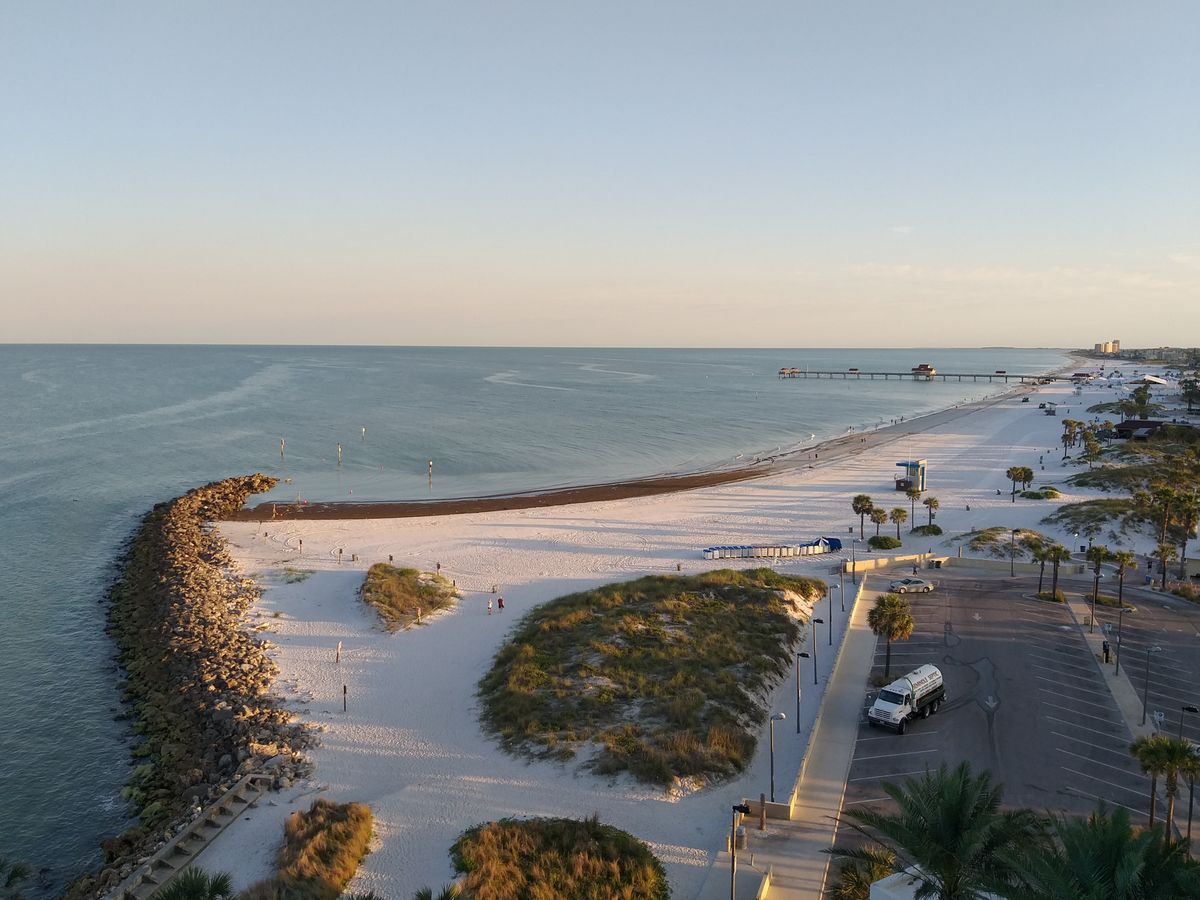

Clearwater Beach faces the open Gulf of Mexico on a barrier island connected to the mainland by the Memorial Causeway. Behind the island, the Intracoastal Waterway winds through a maze of mangrove islands, grass flats, and residential canals. To the south, Clearwater Pass funnels tidal current between the Gulf and the protected water of Clearwater Harbor. To the north, the Dunedin Causeway bridges across to Honeymoon Island, and the shallow grass flats between the two causeways hold some of the best wade fishing on Florida's central Gulf coast.
What makes Clearwater distinct from neighboring Tampa Bay is the direct Gulf access. The offshore grouper and snapper reefs start within ten miles of the beach. Pier 60 extends over a thousand feet into the Gulf and produces species, king mackerel, cobia, tarpon, that you won't find on the bay-side piers. And the combination of Gulf passes, Intracoastal mangroves, and grass flats creates inshore habitat where snook, redfish, spotted seatrout, and juvenile tarpon live year-round.
This guide covers the practical how-to for each fishery: what gear you need, what rigs to tie, what bait or lures to use, and what to expect. For a full destination overview of the broader Tampa Bay area, see our Tampa Bay fishing guide.
Pier 60: The Starting Point for Most Visitors
Pier 60 stretches 1,080 feet into the Gulf of Mexico from the middle of Clearwater Beach. It's a licensed fishing pier, which means you don't need a Florida saltwater fishing license to fish from it, the pier's own license covers everyone. That alone makes it the easiest place in Clearwater to start fishing. You pay the entry fee ($8 for adults, $6.75 for seniors, $5.25 for kids), walk out, and fish.
The pier has a bait shop at the entrance that sells live shrimp, frozen bait, and basic tackle, and rents rod-and-reel combos for $8 if you didn't bring your own. There are fish cleaning stations, restrooms, and a covered observation deck near the end. The sunset celebration that happens on the beach below the pier every evening draws crowds, but most of the fishing action is on the pier itself, away from the noise.
What You'll Catch and When
Spanish mackerel are the pier's bread-and-butter species from March through November. Schools of mackerel chase baitfish along the beach, and when they're running, the action is fast. A Gotcha plug, silver body, red head, cast past the school and retrieved fast produces explosive strikes. A 1/2-ounce silver Clark Spoon on a 3-foot wire leader works too. Use 20-pound fluorocarbon or light wire leader, mackerel teeth will slice through mono in one pass.
Sheepshead stack up around the pier pilings year-round, with the best fishing from December through April during their spawn. These are bait-stealers, they nibble fiddler crabs and small pieces of shrimp off the hook without you feeling a thing. Use a small, sharp hook (size 2 or 1 Owner Mosquito hook) with a fiddler crab or sand flea, fished on a knocker rig (egg sinker directly on the hook's eye, no leader) tight to the pilings. When you feel the tap, set the hook immediately. Sheepshead have a hard, bony mouth and require a firm hookset.
King mackerel cruise past the pier from October through March, and hooking one from a pier is one of the most exciting experiences in Gulf fishing. Kings are big, 10 to 40 pounds, fast, and angry. The standard pier king rig is a live greenback herring (available at the bait shop or caught on a Sabiki rig) free-lined on a stinger rig: a 4/0 circle hook through the bait's nose and a 2/0 treble hook pinned near the tail, connected by 6 inches of #4 wire leader. Let the bait swim out away from the pier. When a king hits, the reel screams and you're in for a 10- to 20-minute fight that may require walking up and down the pier to follow the fish.
Cobia appear from March through May, often swimming alongside large rays that cruise near the pier. They're copper-brown, 20 to 60 pounds, and curious, a cobia will sometimes swim right up to the pier and stare at you. A live pinfish or a white bucktail jig (1 ounce, tipped with a strip of cut bait) presented in their path produces bites. Cobia fight hard and make long, powerful runs. They're also outstanding table fare.
Tarpon show up from May through August, rolling on the surface in silver flashes outside the pier. Landing a tarpon from a pier is a rare achievement, they jump, run, and can spool a reel in seconds, but hooking one is realistic. A large live pinfish, mullet, or crab fished on a 7/0 circle hook with an 80-pound fluorocarbon leader, free-lined past the end of the pier, is the standard approach. Most tarpon hooked from Pier 60 are not landed. That's part of the experience.
Pier 60 Clearwater, Mackerel, Cobia, and SharksPier 60 Gear
If you're bringing your own gear, a 7-foot medium-action spinning rod with a 3000- or 4000-size reel, a Penn Battle III 3000 or Daiwa BG 3000, spooled with 20-pound braided line handles mackerel, sheepshead, and most pier species. For kings and tarpon, you want a heavier setup: a 7-foot medium-heavy rod with a 5000-size reel and 40- to 50-pound braid. Bring a long-handled pier net (the pier has nets available, but having your own guarantees access), you'll need it for anything over a few pounds, since the pier is 25 feet above the water.
A Sabiki rig (size 6 or 8 hooks) dropped near the pilings catches greenbacks, threadfin herring, and pinfish for live bait. Free live bait is one of the best advantages of pier fishing, buy a bag of frozen chum from the bait shop, toss a handful to attract baitfish, then fill a bucket with your Sabiki rig.
Surf Fishing Clearwater Beach, 8 Different SpeciesSurf Fishing: Sand Key and Clearwater Beach
The wide, sandy beaches on both sides of Pier 60 offer decent surf fishing, and Sand Key Park to the south, where small rock jetties and a seawall face Clearwater Pass, is one of the more productive shore-fishing spots on this stretch of coast.
Beach Fishing
Walk south from Pier 60 or north toward the Hilton, and you'll find stretches of beach with fewer swimmers, especially early morning and late evening. The species here are typical Gulf surf: whiting (Gulf kingfish), pompano, ladyfish, jack crevalle, and occasional snook.
Pompano are the prize catch from October through April. They feed in the wash zone, the turbulent water right where the waves break, eating sand fleas (mole crabs) and small clams. A pompano rig is simple: a 2- to 3-ounce pyramid sinker on a slider above two dropper loops, each with a size 2 circle hook baited with a sand flea (hook through the top of the shell, point exposed). Cast 30 to 50 yards and let it sit. When a pompano picks up the bait, the rod tip loads, set the hook with a smooth lift, not a jerk. Pompano average 1 to 3 pounds but fight like fish three times their size.
Whiting are the easiest surf catch and available year-round. A piece of fresh-cut shrimp on a size 1 circle hook on a simple fishfinder rig catches them consistently. They average 10 to 14 inches and are excellent eating, mild, white, flaky meat.
Sand Key Park
Sand Key Park sits at the south end of the barrier island, just north of Clearwater Pass. The rock jetty and seawall on the pass side create structure that holds sheepshead, black drum, snook, redfish, and mangrove snapper year-round. Fish the rocks with a live shrimp on a 1/4-ounce jighead, bounced along the bottom near the structure. Incoming tide is prime, it pushes baitfish through the pass and the predators follow. Sheepshead respond to fiddler crabs fished tight to the rocks, same as the pier technique. Snook patrol the jetty edges at dawn and dusk, especially during the warmer months.
The pass itself, where tidal current accelerates between the Gulf and the Intracoastal, produces snook, tarpon (in summer), jack crevalle, and Spanish mackerel. If you can reach the current seam from shore, or wade carefully on the sand shelf, casting a white Berkley Gulp Jerk Shad on a 1/4-ounce jighead into the moving water and retrieving it with a twitch-pause action produces strikes from everything that swims through.
Fishing Clearwater Pass, Snook, Mackerel, and MoreInshore Fishing: Flats, Mangroves, and Causeways
The protected water behind Clearwater Beach, Clearwater Harbor, the Intracoastal Waterway, and the shallow grass flats stretching north toward Dunedin, holds the best variety of inshore species on this part of the coast. You need a boat, kayak, or access to the causeways to fish most of it, but the rewards are snook, redfish, spotted seatrout, flounder, and juvenile tarpon in skinny, clear water.
The Flats Between the Causeways
The stretch of shallow grass flats between the Memorial Causeway (Clearwater Beach) and the Dunedin Causeway (Honeymoon Island) is the heart of Clearwater's inshore fishery. Depths range from 2 to 5 feet over turtle grass and sand, and the water is often clear enough to sight-fish, spotting the dark shapes of redfish tailing on the flats or the shadow of a snook holding along a mangrove edge.
Spotted seatrout are the most abundant species on the flats and the most beginner-friendly. They hold over grass in 2 to 4 feet of water, especially near sandy potholes (bare spots in the grass where bait collects). A live shrimp under a popping cork is the universal trout rig: thread a 3/0 circle hook through the shrimp's horn (the spike above its eyes), suspend it 2 to 3 feet below a Cajun Thunder or MirrOlure popping cork, and cast near the potholes. Pop the cork every few seconds, the noise imitates a feeding fish and draws trout in. Trout average 14 to 20 inches with fish over 25 inches available, especially in winter when they move into deeper potholes.
Redfish cruise the flats individually or in small schools, feeding on crabs and shrimp. A gold spoon, the Johnson Silver Minnow in gold, 1/4 ounce, is the classic, cast ahead of a cruising redfish and retrieved with a steady wobble produces reaction strikes. When you can't see them, a live shrimp or a 3-inch D.O.A. Shrimp in natural color fished on a 1/4-ounce jighead and bounced along the bottom near mangrove edges and oyster bars is the most consistent approach. Redfish are slot fish in Florida: 18 to 27 inches total length, one per person per day.
Snook are the glamour species of Clearwater's inshore waters. They hold tight to structure, dock pilings, mangrove roots, bridge shadows, seawalls, and ambush bait as it sweeps past on the current. The best snook fishing happens around the tidal passes and under the causeways, where current concentrates bait. A live pilchard (scaled sardine) hooked through the nose on a 3/0 circle hook and free-lined along a mangrove edge or dock shadow is the deadliest snook bait on this coast. No weight, no cork, just the bait swimming naturally.
Snook have strict regulations in the Tampa Bay management region: slot limit of 28 to 33 inches, one per person per day, open season September 1 through November 30 only. Outside those months, all snook must be released. You also need a $10 snook permit in addition to your saltwater fishing license.
Snook Fishing on Clearwater Beach, Jetty and ShoreDunedin Causeway
The Dunedin Causeway is one of the best shore-fishing spots in the Clearwater area. The causeway connects the mainland to Honeymoon Island State Park, and the rocks, bridge pilings, and tidal flow on both sides create a fish-holding buffet. Sheepshead, mangrove snapper, snook, redfish, flounder, and black drum all live around the causeway structure.
Park along the causeway (free parking on the shoulder), walk down to the rocks, and fish a live shrimp on a 1/4-ounce jighead tight to the riprap. Incoming tide is best, it pushes clean Gulf water and bait through the pass. At night, the bridge lights attract bait, and snook stack up in the shadows to ambush whatever the current delivers. A white or chartreuse D.O.A. CAL Jerk Bait retrieved through the light-shadow line catches snook after dark when live bait isn't available.
Kayak Fishing
Clearwater's inshore waters are ideal for kayak fishing, the flats are shallow, protected from wind by the barrier islands, and loaded with fish. Launch from the Dunedin Causeway boat ramp, the Seminole Boat Ramp on the Intracoastal, or Sand Key Park, and paddle to the grass flats, mangrove shorelines, or oyster bars within a few hundred yards. A 10- to 12-foot sit-on-top fishing kayak (Vibe Sea Ghost 110 or Perception Pescador Pro 12 are popular choices) with a paddle, anchor, and small tackle crate is all you need.
The advantage of a kayak on these flats is stealth. You can pole or drift silently over 2-foot-deep grass and cast to tailing redfish or cruising snook without the noise of a motor. The fishing is visual, technical, and deeply satisfying.
Kayak Fishing Clearwater Florida, Multi-Species ActionOffshore Fishing: Grouper, Snapper, and Kingfish
Clearwater's offshore fishery sits on the Gulf of Mexico's continental shelf, where natural limestone reefs, artificial reef structures, and wrecks dot the bottom from 5 to 40 miles offshore. The primary targets are red grouper, gag grouper, mangrove snapper, lane snapper, hogfish, and amberjack, bottom fish caught by dropping baits and jigs straight down to the structure. King mackerel, cobia, and permit show up over the reefs as bonus species.
Party Boats (Head Boats)
The most affordable way to fish offshore from Clearwater is on a party boat, a large vessel (50 to 65 feet) that carries 30 to 50 anglers on a shared trip. The Super Queen, Double Eagle, and similar boats run daily trips from Clearwater Beach Marina and Johns Pass (just south of Clearwater, in Madeira Beach).
Half-day trips (4 to 5 hours): $55 to $75 per person. These boats fish reefs 5 to 15 miles offshore in 30 to 60 feet of water, targeting lane snapper, mangrove snapper, grunts, porgies, and smaller grouper. Everything is included, rod, reel, tackle, bait, and a fishing license.
Full-day trips (8 to 10 hours): $100 to $150 per person. These reach deeper reefs 20 to 35 miles out in 80 to 130 feet of water, where the red grouper and gag grouper live. Full-day trips produce larger and more varied catches.
Overnight and extended trips (24 to 39 hours): $250 to $400 per person. These boats run far offshore, 60 to 100 miles, targeting red snapper (during the short federal season), yellowtail snapper, amberjack, and trophy grouper in deep water. They provide bunks, meals, and all tackle.
Party boats are the best option for beginners because the crew does all the rigging, baiting, and coaching. They'll show you how to drop to the bottom, feel a bite, and reel up. You don't need to know anything, just show up.
Deep Sea Red Grouper Fishing, Clearwater Florida CharterPrivate Charters
Private offshore charters from Clearwater run $800 to $1,400 for a half-day (4 to 6 hours, up to 6 anglers) and $1,200 to $2,200 for a full day. The advantage over party boats is personal attention, less crowding, and the captain's ability to move to different spots based on what's biting. Private charters also fish deeper, more remote structure that party boats can't reach on a half-day schedule.
For bottom fishing, the standard rig is a circle hook (5/0 to 7/0) on a 60- to 80-pound fluorocarbon leader with a 3- to 8-ounce egg sinker, baited with cut squid, live pinfish, or threadfin herring and dropped to the bottom. When a grouper picks up the bait, you feel a heavy thump. Reel fast, grouper dive for their hole the instant they feel the hook, and once they wedge into the rocks, they're gone. The crew will coach you: "Reel, reel, reel! Get him off the bottom!"
Grouper Seasons
Red grouper are open year-round in Gulf state waters (within 9 nautical miles of shore), with a bag limit of 2 per person and a minimum size of 20 inches. In federal waters (beyond 9 miles), red grouper have a similar year-round season.
Gag grouper have a closed season from January 1 through May 31 in Gulf state waters, with harvest open June 1 through December 31. Minimum size is 24 inches, bag limit of 2 per person. Gag grouper are the larger, harder-fighting species, fish up to 30 or 40 pounds are caught on the deeper reefs.
Red snapper season in federal Gulf waters is extremely short, typically 2 to 3 days per year, announced by NOAA a few weeks in advance. State waters occasionally open for slightly longer. Check FWC regulations before targeting red snapper specifically.
Offshore Clearwater FL, Monster Grouper, Snapper, and AJsPractical Details
Fishing Licenses: Florida residents need a saltwater fishing license ($17 annually). Non-residents pay $17 for 3 days, $30 for 7 days, or $47 for 1 year. No license needed when fishing from Pier 60 (the pier's license covers you) or on a licensed charter boat or party boat (the vessel's license covers passengers). Purchase at GoOutdoorsFlorida.com or at any bait shop. Snook permit required if targeting snook.
Bait and Tackle Shops: The Pier 60 Bait House sells live shrimp, frozen bait, basic tackle, and rents rods. For a full-service tackle shop, Clearwater Bait & Tackle and Bill Jackson's Shop for Adventure (in Pinellas Park, 15 minutes east) carry everything from live bait to offshore tackle. Live pilchards (scaled sardines), the premium inshore bait, are available at most bait shops from spring through fall, or you can catch them yourself with a cast net and a chum bag.
Best Times to Fish: Early morning (sunrise to 9 AM) and late evening (6 PM to dark) are the most productive periods for nearly every species. Incoming tide is generally better than outgoing for pier and pass fishing, it brings clean Gulf water and bait in from the Gulf. For inshore flats fishing, the first two hours of an incoming tide and the last two hours of an outgoing tide concentrate fish on the edges of the flats. Full moon and new moon tides (stronger current) improve pass and bridge fishing.
Weather and Water Temperature: The Gulf of Mexico off Clearwater rarely drops below 65 degrees in winter or exceeds 88 degrees in summer. The warm water means fish are active year-round, though species mix shifts seasonally. Summer brings tarpon, snook, and offshore pelagics. Winter brings sheepshead, pompano, and the best grouper fishing. Spring and fall are the transition periods with the widest variety. Afternoon thunderstorms are a daily reality from June through September, plan to be off the water by 2 PM or carry rain gear and watch the lightning.
What to Wear: Light, breathable, moisture-wicking clothing. Long sleeves for sun protection, the Clearwater sun is intense year-round. A wide-brimmed hat, polarized sunglasses (essential for sight-fishing the flats), reef-safe sunscreen (SPF 50+), and non-slip shoes or sandals. For wade fishing, a pair of flats boots or neoprene booties protects your feet from oyster shells and stingrays, shuffle your feet when wading (the "stingray shuffle") to avoid stepping on a buried ray.
Getting There: St. Pete-Clearwater International Airport (PIE) is 15 minutes from Clearwater Beach. Tampa International Airport (TPA) is 30 minutes east. Clearwater Beach is connected to the mainland via the Memorial Causeway (State Road 60). Parking on the beach is metered; the Pier 60 parking lot fills early on weekends.
Clearwater Deep Sea Fishing, What to Know Before You Go