Fish
Fish Fire
Fire Hike
Hike Bird
Bird

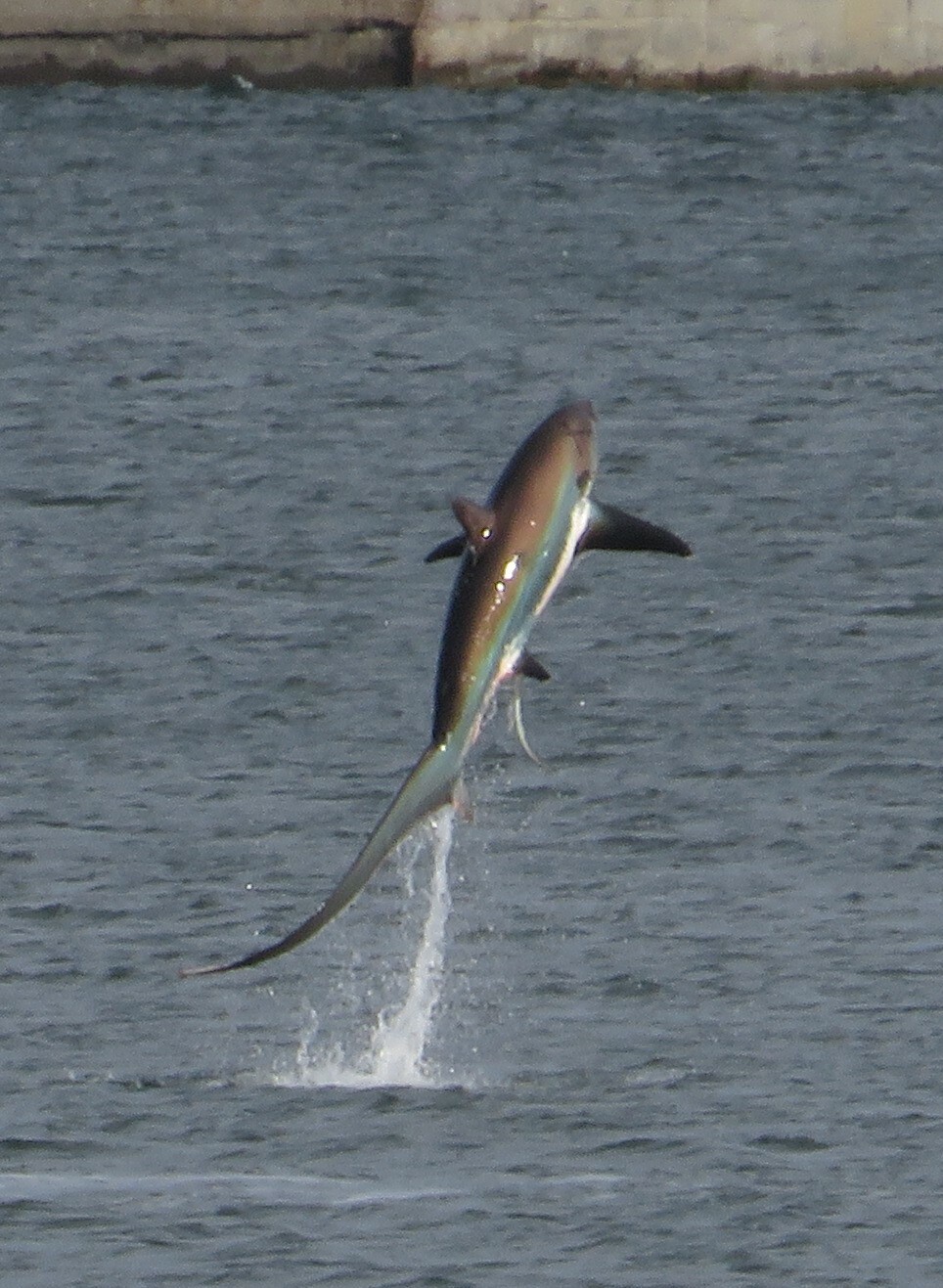

The thresher shark (Alopias vulpinus), often called the common thresher, is one of the ocean's most remarkable predators, a sleek, powerful shark whose upper tail lobe is as long as the rest of its body. That extraordinary scythe-like tail is not just for show: threshers use it as a weapon, slapping and stunning schools of baitfish before circling back to eat the dazed prey. For anglers, the thresher is a spectacular offshore gamefish, a hard-running, high-jumping fighter that is also excellent on the table, with the added quirk that its hunting style means it is very often hooked in the tail.
Threshers are members of the mackerel shark family, relatives of the mako and the great white, and share that group's warm-blooded, high-performance physiology. They roam temperate and subtropical waters worldwide, offshore and along the coast, and are a prized target on both U.S. coasts, particularly off Southern California, where they are a classic recreational shark, and in the Northeast and elsewhere. Reaching them means fishing offshore over productive water, often with a chum slick and oily baits, and being ready for a fish that fights with both power and acrobatics.
This guide covers where thresher sharks live, how to identify them, the offshore tackle and rigs they require, the baits and techniques that hook them (including the tail-hooking quirk), how to fight and land a strong shark, and how to handle and eat this outstanding gamefish.
Understanding Thresher Shark Behavior
Thresher sharks are pelagic and coastal-pelagic predators of temperate and subtropical seas. They range from nearshore waters out over the open ocean, often following bait and favoring productive zones, temperature breaks, current edges, and areas where baitfish concentrate. Off Southern California, for example, threshers move inshore seasonally to feed on abundant baitfish, bringing them within reach of anglers, while in other regions they are more of an offshore target. Like other mackerel sharks, they are warm-blooded, powerful swimmers built for chasing fast prey.
Setting Up a Thresher Shark RigTheir signature is that tail. The upper lobe of the caudal fin is enormously elongated, roughly half the shark's total length, and the thresher uses it as a hunting tool, swimming into or around a school of baitfish and slapping with tremendous force to stun and injure multiple fish at once, then returning to eat them. This unique behavior is central to understanding thresher fishing: because they strike prey (and baits) with the tail, threshers are very frequently foul-hooked in the tail rather than the mouth, which has big implications for how you fight and, especially, how you must handle and release them.
Threshers feed primarily on schooling fish, mackerel, sardines, anchovies, herring, and other baitfish, as well as squid. They are drawn to concentrations of bait and, like makos, respond well to a chum slick that broadcasts scent and mimics a wounded-bait scenario. They are also known, like their mako relatives, for jumping, and a hooked thresher can put on an impressive aerial display, made all the more dramatic by that whipping tail.
Because they follow bait and warm water, thresher fishing is seasonal and location-dependent. Learn when threshers are present in your area and where the bait concentrates, fish the productive water, and use scent to draw these roaming predators to your baits.
Water temperature and bait are the twin keys to locating threshers, just as they are for makos. Threshers favor a temperate band of water and stack up along the breaks where cooler and warmer water meet and where baitfish gather. In Southern California, the classic thresher grounds are the nearshore zones where sardines and anchovies concentrate in the warmer months, and anglers time their trips to that seasonal push. Elsewhere, threshers may be more of an offshore proposition along the shelf and its temperature edges. In every case, finding the bait, and the right water temperature holding it, is what puts you where threshers are hunting. Sea-surface-temperature charts and your onboard gauge, plus watching for bait schools and diving birds, turn the search into a targeted one.
Threshers can also be somewhat crepuscular and light-sensitive, often feeding most actively in the low light of dawn and dusk when bait schools are vulnerable near the surface. Timing your fishing to these windows, and to the moving stages of the tide where relevant, can concentrate the action into productive periods rather than a long, slow soak.
How to Identify Thresher Shark
The thresher is unmistakable thanks to its tail, but note the key features:
- Enormously long upper tail lobe. The defining feature, the upper caudal lobe is about as long as the shark's body, unlike any other shark.
- Compact, deep body and small mouth. A relatively stout, deep body with a short head and a surprisingly small mouth for the shark's size.
- Metallic coloration. The back is a dark, often metallic blue-gray to brownish or blackish, fading to white below; the common thresher typically shows a white patch extending up over the pectoral fin bases.
- Large eyes. Moderately large eyes (very large in the related bigeye thresher, a separate species).
The common thresher can be confused with the bigeye thresher (which has enormous eyes and a groove on the head) and the pelagic thresher (smaller, found in the Indo-Pacific). The huge tail identifies it as a thresher; the eye size, coloration, and the white patch over the pectoral base help pin down the common thresher. Correct identification matters for the regulations.
Best Tackle for Thresher Shark
Threshers are large, strong, and can leap, so offshore shark tackle is required.
Rod and reel: A heavy stand-up or trolling rod paired with a large-capacity conventional reel (in the 30 to 80 class or heavier for big fish) with a strong, smooth drag. Threshers make strong runs and, when tail-hooked, can fight with the leverage of their whole body, so line capacity and drag matter.
Line: Heavy mono or braid, typically 50 to 100 pound, with plenty of capacity.
Leader: A wire leader (single-strand or cable) or very heavy leader is essential to withstand the shark's teeth and rough skin, and, given the frequency of tail-hooking, a long, tough leader also helps when the line is wrapped around the tail.
Hooks: Strong, sharp non-offset circle hooks, which improve corner-of-the-jaw hookups (helping avoid gut-hooking) and are better for release.
How to Build a Big Shark RigBecause a tail-hooked thresher effectively tows its whole body sideways, fights can be long and grueling, so gear built to apply real pressure over a sustained battle is important. As always with sharks, flawless connections and quality drags are essential.
Bait, Chumming, and Technique
Threshers are drawn to oily baitfish and to chum slicks, much like makos. The two main approaches are drifting a chum slick with baits and slow-trolling or drifting live and dead baits through areas holding thresher forage.
The Best Way to Catch SharksFor the chum-slick method, run offshore to productive water, temperature breaks, bait concentrations, and areas where threshers are known to feed, and set up a drift with a steady chum slick. Fish whole or chunk oily baits (mackerel, sardines, herring, bonito) on wire leaders and circle hooks, suspended at staggered depths with floats or balloons along the slick. Slow-trolling rigged or live baitfish through productive water is also highly effective, especially where threshers are actively feeding on bait schools.
A key technique note tied to their tail-slapping behavior: because threshers stun baits with the tail, they very often make an initial pass, slapping at the bait, before eating. This is why so many are tail-hooked, the hook catches the tail during the slap. Some anglers, knowing this, set the hook on the initial contact; others let the fish come back and eat. Either way, expect the possibility of a tail-hooked fish, which fights differently (and requires careful handling on release).
Slow-trolling deserves special mention because it plays directly into the thresher's hunting style. Trolling a rigged or live bait at a slow pace through water holding bait schools presents exactly the kind of target a cruising thresher is looking to slap and eat, and it lets you cover water to find fish that are spread out. Keep baits swimming naturally, use a fishfinder to locate bait and mark sharks, and be ready for the distinctive way a thresher often engages, a tap or slap followed by the weight coming on as the fish returns to eat the stunned bait. When drifting a slick, staggering baits at different depths and keeping the chum steady mimics a wounded-bait situation and pulls threshers up the scent trail the same way it draws makos.
Bait quality matters. Fresh, oily baitfish that put scent in the water and look lively are far more effective than tired, washed-out offerings, so keep your baits fresh and rotate them regularly. Match the local forage where you can, if threshers are keyed on sardines or mackerel, a matching bait is hard to beat.
Fighting and Landing
A hooked thresher is a superb fight, strong, dogged runs and, often, spectacular jumps. When mouth-hooked, the fight is a more conventional shark battle of pressure and runs. When tail-hooked, the shark is essentially being pulled backward and can fight with extraordinary, prolonged power, using its whole body against you, so be prepared for a long, tough battle. Let the circle hook set with steady pressure, use a harness or rod belt for a big fish, and keep firm, steady pressure while letting the shark run when it needs to.
Massive Thresher Shark OffshoreBe ready for jumps and sudden changes in direction, and never underestimate a green thresher at the boat, that powerful tail can deliver a dangerous blow, and a fresh shark is strong and unpredictable. Keep the crew clear and have your tools and plan ready before the fish is close.
Pace yourself and use the boat. A big thresher, especially a tail-hooked one, can turn the fight into a long war of attrition, so a harness or rod belt and a smooth, powerful drag are worth their weight. Let the captain maneuver to keep a good angle and to follow a running fish rather than trying to muscle it from a fixed position. Gain line steadily on the drops and never give slack, particularly when the shark jumps, keep a slight bow in the rod so an airborne thresher cannot come up tight against a locked drag and part the line. Methodical, controlled pressure both lands the fish faster and leaves it in better shape for release.
Handling and Releasing Safely
Careful handling and release is essential, for the shark and for your safety, given that whipping tail. Many anglers release threshers, and where they are kept, any fish not retained must be released well.
How to Safely Remove Hooks From Sharks- Mind the tail. A thresher's tail is a powerful weapon; keep well clear of it during landing and handling, as a swing can injure.
- Keep the shark in the water. Release boatside when possible rather than bringing a large shark aboard.
- Use circle hooks and dehookers. A corner-hooked thresher can often be released quickly; if deeply or tail-hooked in a way that is hard to reach, cut the leader as close as safely possible.
- Minimize fight and handling time. Especially important for tail-hooked fish, which can be exhausted by a prolonged backward fight, land and release them as efficiently as you safely can.
Always follow current thresher shark regulations, which include size and bag limits and gear requirements (such as non-offset circle hooks) that vary by region and change over time. Correct identification and responsible handling are essential.
Eating Thresher Shark
Thresher is widely regarded as one of the very best-eating sharks, firm, mild, white flesh, excellent grilled as steaks. As with all sharks, the key is immediate handling: bleed the fish and ice it quickly to prevent the flesh from developing an ammonia taste from urea. Where harvest is legal and you choose to keep a thresher within the rules, a well-handled one is superb table fare, the meat steaks beautifully and takes to the grill as well as swordfish. Given conservation considerations, many anglers keep only what they will actually use and release the rest carefully.
Putting It All Together
The thresher shark is a one-of-a-kind gamefish, a powerful, high-jumping offshore shark that hunts with the longest tail in the sea and often ends up hooked by it. Run offshore to productive water, set a chum slick, and fish oily baits on wire leaders and circle hooks, or slow-troll baits through feeding fish; then settle in for a strong, acrobatic fight, especially if the shark is tail-hooked. Mind that tail, handle and release these sharks with care, follow the regulations, and you will have tangled with one of the most extraordinary predators in the ocean.
Ready to put it into practice? If you are new to offshore shark fishing, your first trips will go far more smoothly with an experienced hand aboard who already knows the grounds, reads the temperature breaks, and can show you how to handle a green thresher safely, there is no faster way to shorten the learning curve than time on productive water with someone who has done it.
For more on chasing sharks and offshore gamefish, see our guides on how to catch mako shark, how to catch hammerhead shark, and how to catch blue shark.