Fish
Fish Fire
Fire Hike
Hike Bird
Bird

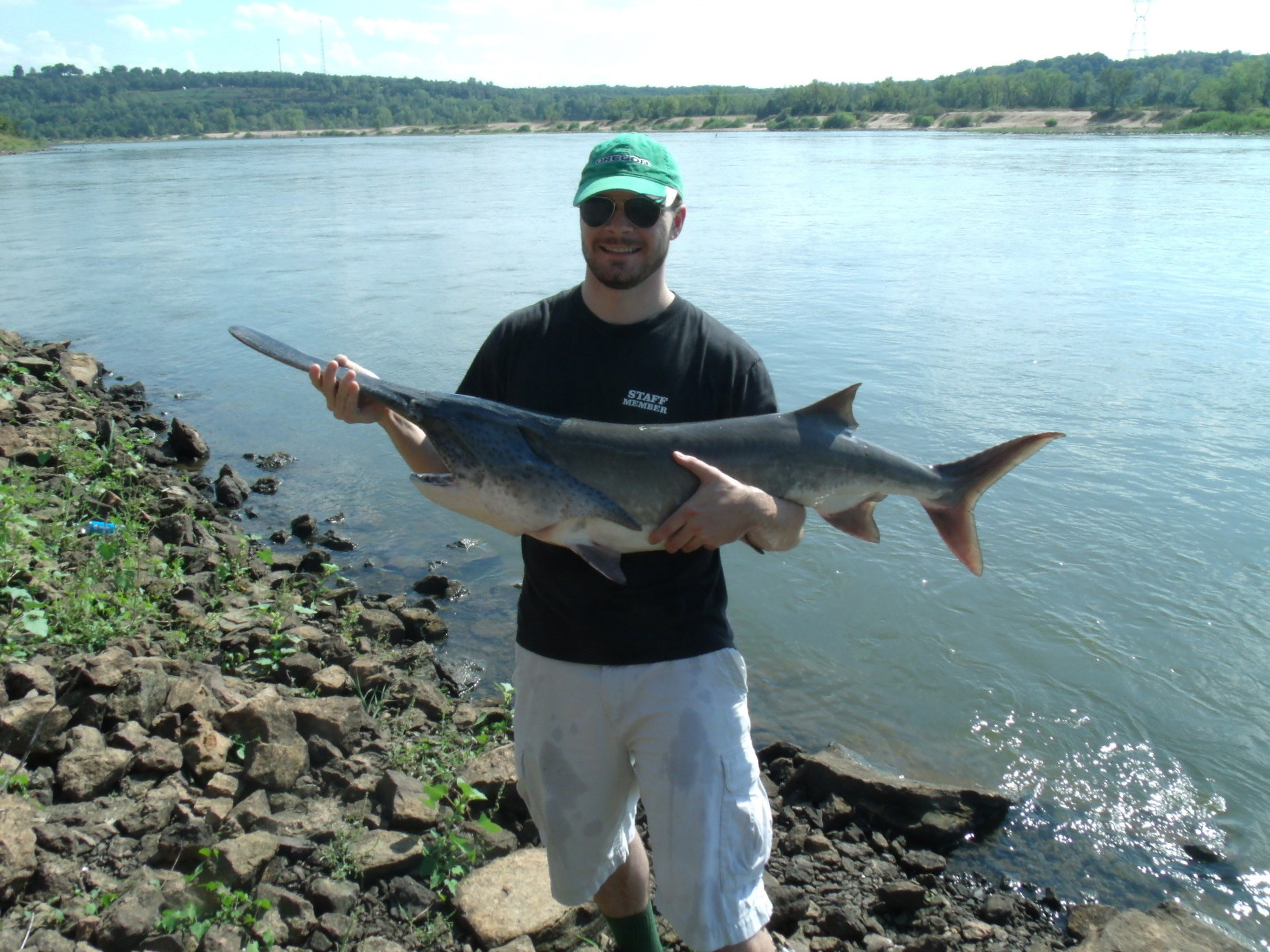

The paddlefish is one of the strangest, largest, and most ancient fish an angler can pursue in North American fresh water, a smooth-skinned, shark-tailed giant with an enormous, paddle-shaped snout, gliding through big rivers filter-feeding on microscopic plankton. It's a genuine living fossil, essentially unchanged for tens of millions of years, and it grows huge: paddlefish commonly reach 30-60 pounds and can exceed 100 pounds and 7 feet.
Here's the twist that makes paddlefish unlike any other fish in this guide: because they eat nothing but tiny zooplankton, filtered from the water through their gills, you can't catch a paddlefish on bait or lures. They simply won't bite. Instead, paddlefish are pursued by snagging, casting heavy treble hooks and sweeping the rod hard to hook the fish in the body as it swims through concentrations of them. It's a specialized, seasonal, tightly regulated fishery, and it's a thrilling one: snagging into a 50-pound river monster is an unforgettable experience. This guide explains exactly how it works.
Beginner's Guide to Snagging PaddlefishMeet the Paddlefish
The paddlefish (Polyodon spathula), widely called spoonbill or spoonbill catfish (though it's not a catfish), is a large, smooth-skinned, scaleless fish with a long, flat, paddle-shaped snout (rostrum) that can be a third of its body length, a shark-like body and tail, and a huge mouth. That paddle is a sensory organ, covered in electroreceptors that help the fish detect the swarms of plankton it feeds on. It's a cousin of the sturgeon, and like sturgeon it has a cartilaginous skeleton and ancient lineage.
Key facts:
- Size: commonly 30-60 pounds; big ones exceed 100 pounds and 7 feet. Even an average paddlefish is a very large fish.
- Filter feeder: it swims with its mouth open, straining zooplankton from the water with comb-like gill rakers. It eats no bait fish, insects, or lures, which is why it can't be caught conventionally.
- Habitat: large, slow rivers and their connected reservoirs and backwaters, especially the Mississippi and Missouri river systems and their tributaries. It's a fish of big, open, flowing water.
- Range: the Mississippi River basin broadly, from the Dakotas and Montana down to the Gulf, across the central US, with strong fisheries in Oklahoma, Missouri, Montana, and neighboring states.
- Long-lived: paddlefish are slow-growing and can live 20-30+ years, which (like sturgeon) makes them vulnerable and is why the fishery is carefully managed.
That size, that alien paddle, and that filter-feeding biology make the paddlefish one of the most remarkable fish you can target, and snagging is the way it's done.
Why You Snag Paddlefish (Not Hook Them)
Because paddlefish eat only microscopic plankton and never strike bait or lures, anglers legally catch them by snagging: casting a heavy weighted treble hook out, letting it sink, and then making a hard, sweeping pull of the rod to drive the hook into the body of a paddlefish as it passes. You essentially "blind-cast and sweep" through water where paddlefish are concentrated (below dams and in known holding areas during their spring run), feeling for or blindly hooking the big fish.
How to Snag and Release PaddlefishThis is a completely different game from hook-and-bait fishing. You're not waiting for a bite, you're rhythmically casting and sweeping, covering the water column, until you feel the sudden, heavy, unmistakable resistance of a big fish. Snagging paddlefish is legal only in specific states, specific waters, and specific seasons, with strict rules, so the first step is always checking your local regulations (see below).
Snagging Gear and Rigs
Paddlefish are big and snagging is demanding, so the tackle is heavy-duty:
- Rod: a long (7-9 ft), stout, heavy-power rod (surf or heavy musky/catfish class) with backbone to sweep hooks and fight big fish.
- Reel: a large, strong conventional or big spinning reel with a good drag and high line capacity.
- Line: heavy braid, commonly 50-100+ lb, for strength and to move heavy weights and big fish.
- Rig: the classic paddlefish snagging rig is a large, weighted treble hook, a big treble (often 8/0-12/0) with a heavy weight (several ounces) fixed at or near the hook so it casts far and sinks fast. Many use a treble crimped or tied above a bank/pyramid sinker, or specialized weighted snag hooks.
The rig has to cast a long way, sink quickly to the right depth in current, and drive a big hook home on the sweep, hence the heavy weights and stout hooks. Sharp hooks matter enormously.
The Snagging Technique
The mechanics, once you're set up, are a rhythm:
- Cast the weighted treble out into the current or across a known paddlefish lane, and let it sink to near the bottom or to the depth fish are holding.
- Sweep the rod hard, a long, powerful pull, then reel up the slack as you drop the rod back, and sweep again. You're moving the hook through the water in strong arcs.
- Feel for the fish. A snagged paddlefish feels like suddenly hooking into something huge and alive, heavy, throbbing, powerful. (You'll also snag bottom and debris; learn the difference.)
- Set and fight. When you feel a fish, sweep hard to bury the hook, then hang on, a big paddlefish fights with deep, powerful, dogged runs.
Timing and location matter enormously: the best snagging is during the spring spawning run, when paddlefish move up rivers and concentrate below dams and in specific holes, making them findable and catchable. Fishing shoulder-to-shoulder with other snaggers below a dam during the run is a classic scene in paddlefish country.
A few practical notes: vary your sweep depth until you connect, since paddlefish may be running near the bottom, mid-column, or higher depending on the water. Keep your hooks needle-sharp and check the points often, snagging into rock and wood dulls them fast. And once you hook a big one, be prepared to follow it along the bank or with the boat, because a fresh 50-pounder will make long, unstoppable runs that no drag will simply stop.
Where and When to Catch Paddlefish
Location: the heart of paddlefish snagging is the big rivers and reservoirs of the Mississippi/Missouri basin, Oklahoma (a premier destination), Montana, Missouri, Kansas, and neighboring states all have managed fisheries. Target the tailwaters below dams, river channels, and known holding holes where paddlefish stack up during their migration. Concentration is everything, since you're snagging blindly.
Timing: the fishery is highly seasonal, centered on the spring spawning run (roughly March-May depending on latitude and water conditions), when paddlefish migrate upriver and bunch up below dams. States set specific, often short, snagging seasons around this window. Rising, warming spring water triggers the run. Outside the season and legal waters, you cannot snag them, so plan around your state's dates.
Regulations and Conservation: Read This First
Paddlefish are ancient, slow-growing, long-lived, and were seriously depleted across much of their range by overharvest (especially for their roe, sold as caviar), dams, and habitat loss. As a result, the fishery is strictly regulated, and rules vary widely by state, and following them isn't optional.
Snag and Release Paddlefish ResearchBefore you go:
- Check your state's regulations carefully, legal waters, dates, permits/tags, daily and season limits, size limits, and legal snagging methods all vary and change.
- Many places require a special paddlefish permit or tag, and some have mandatory reporting or check stations.
- Some waters are catch-and-release only, or closed, and in some states paddlefish are protected and cannot be taken at all. Never snag where it isn't expressly legal.
- Handle released fish gently, support the body, minimize air time, and revive them, since they're a conservation priority.
- Caviar rules are strict: selling paddlefish roe is tightly controlled and often illegal for anglers; know the law.
Snagging paddlefish responsibly, within the rules, is part of a carefully balanced system that keeps these living fossils around.
The Amazing Paddle: How It Works
The paddlefish's most striking feature, that huge, flat, paddle-shaped snout, isn't for digging or fighting; it's a sophisticated sensory antenna. The rostrum is covered in tens of thousands of tiny electroreceptors (ampullary organs) that detect the weak electrical fields given off by the swarms of zooplankton the fish feeds on. As a paddlefish cruises open water with its cavernous mouth agape, the paddle helps it sense and steer into the densest concentrations of plankton, which it then strains from the water using long, comb-like gill rakers. In effect, the fish "sees" its microscopic food electrically, in the murky, low-visibility big-river water where eyesight would be useless.
This remarkable adaptation is also why paddlefish are impossible to catch conventionally: there is simply no prey-capture behavior to exploit with a bait or lure. The fish never chases, strikes, or bites, it filters. Understanding that biology is the whole reason snagging exists as the method for catching them, and it's part of what makes the paddlefish such a fascinating, alien animal to pursue.
Paddlefish vs. Sturgeon: Ancient Cousins
Paddlefish are frequently mentioned alongside sturgeon, and for good reason, they're close relatives, both members of an ancient group of cartilaginous, primitive fishes that have survived largely unchanged since the age of dinosaurs. They share a cartilaginous skeleton, a shark-like tail, a lack of true scales over most of the body, long lifespans, and slow growth. But they're easy to tell apart: the paddlefish has that unmistakable long, flat paddle snout and a huge smooth body, while sturgeon have a more tapered, shovel-like snout, rows of bony scutes (armor plates) along the body, and four barbels in front of a downward-pointing sucker mouth. Sturgeon are bottom-feeders that root for food; paddlefish are open-water filter-feeders. If it has a giant paddle and smooth skin, it's a paddlefish; if it has armored scutes and barbels, it's a sturgeon.
A Conservation Comeback
The paddlefish's story is one of decline and careful recovery, and it's essential context for anyone who fishes for them. Once abundant and widespread across the Mississippi basin, paddlefish were hammered in the twentieth century by a combination of forces: overharvest (especially commercial fishing for their roe, which is sold as valuable caviar once Caspian Sea sturgeon caviar became restricted), dams that blocked their long spawning migrations and drowned the flowing, gravel-bottomed habitat their eggs need, and habitat degradation from channelization and pollution. Paddlefish disappeared entirely from some states and crashed in others.
The response has been a broad, coordinated conservation effort: strict harvest regulations and permit/tag systems, hatchery stocking programs that raise and release young paddlefish, habitat and flow restoration, and research (including the tag-and-release studies that biologists run during snagging seasons). Thanks to this work, many paddlefish populations are stable or recovering, and well-managed snagging fisheries, like Oklahoma's famous program, which even runs a paddlefish research and processing center, coexist with conservation. This is exactly why the rules around paddlefish are so strict and so important: the fishery only stays open because anglers respect the limits that keep the species healthy.
Cleaning and Eating Paddlefish
Paddlefish are genuinely good eating, the boneless, firm white meat is often compared to other mild white fish or even to scallops/swordfish in texture, and it's excellent grilled, fried, blackened, or smoked. Since paddlefish have a cartilaginous skeleton (no true bones), cleaning is different from a normal fish.
How to Clean and Cook a Paddlefish- Cleaning: there are no scales and no bony skeleton. You cut boneless loins/steaks from along the body, removing the skin and, importantly, trimming away the red meat and the dark bloodline, which can be strong-flavored. Many people soak the cleaned meat.
- The "moon"/notochord: paddlefish have a central cartilaginous rod (notochord) rather than a backbone; you work around it.
- Cooking: the trimmed white meat is mild and firm, great grilled or fried. Some famously smoke paddlefish, which is superb.
- Caviar: the roe of female paddlefish is prized as caviar, but harvesting/selling it is tightly regulated, always follow the law.
Well-trimmed and fresh, paddlefish is a legitimately excellent table fish and a highlight of the harvest for those who keep a legal one.
Pursue a Living Fossil
The paddlefish is like nothing else you'll fish for: a giant, plankton-straining, paddle-nosed relic of deep time that you catch not by fooling it, but by snagging into it during its spring run on a big river. It demands heavy gear, a snagging rhythm, attention to a short seasonal window, and, above all, respect for the regulations that keep this ancient species healthy. Do it right, and you'll do battle with one of the largest, oldest, and most bizarre fish in North America.
For its ancient cousins the sturgeon, which share these big rivers and a similar deep lineage, see our guides to the lake sturgeon and the shovelnose sturgeon. And for another giant of the same waters you catch with rod and bait, see how to catch the blue catfish.
If it's your first paddlefish season, consider going out with an experienced local snagger who knows the run and the rules, someone with the heavy gear, the dialed-in timing, and the legal know-how to put you on a river giant while you learn the rhythm. Either way, do your homework on your state's dates, waters, and permits before the run starts, and you'll be ready when the fish push upriver.