Fish
Fish Fire
Fire Hike
Hike Bird
Bird


The manta ray is one of the most searched-for "catches" in the ocean, and one of the biggest misunderstandings in fishing. Type "how to catch a manta ray" into any search bar and you'll find plenty of curiosity but very little straight talk. So here it is: you do not catch manta rays. They are protected in U.S. waters and across much of the world, they are physically impossible to hook on purpose, and they are worth far more to you alive and gliding past your boat than they ever could be on the end of a line.
That doesn't mean this page is a dead end. If you fish saltwater long enough, especially off Florida, the Gulf, Hawaii, or Southern California, you will eventually share the water with a manta, and you might even hook one by accident. Knowing what you're looking at, what the law says, and how to release one safely is real, useful angling knowledge. This guide covers all of it: how to tell a manta from the rays you can target, why they can't be caught the normal way, exactly what to do if one gets tangled in your gear, and the legal, jaw-dropping way to actually get close to these animals.
Meet the manta: the ocean's gentle giant
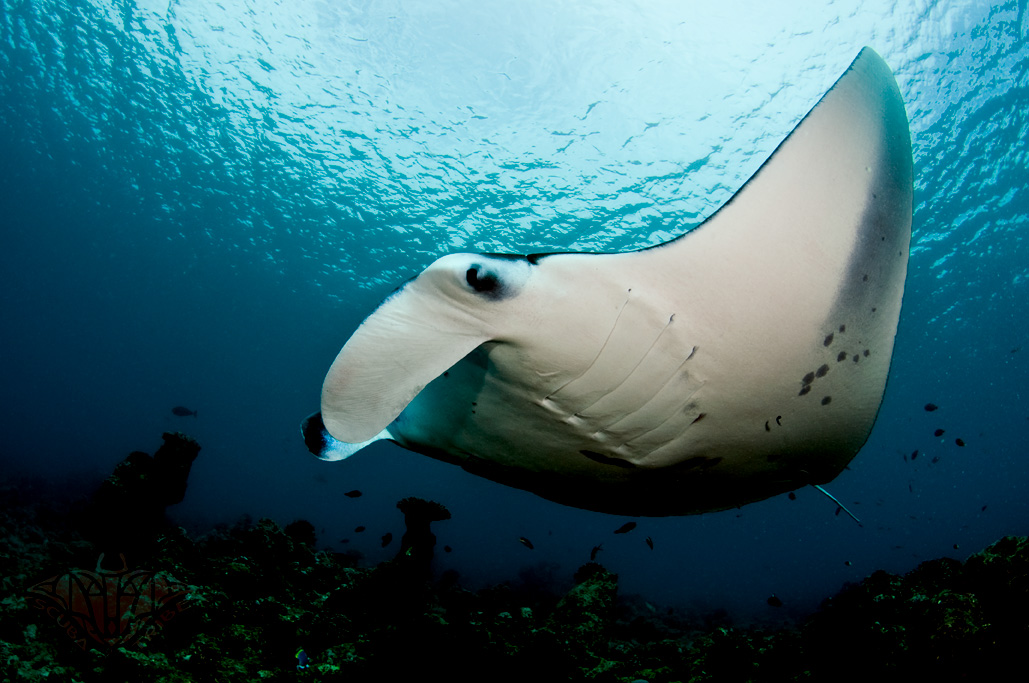
Manta rays are the largest rays on earth. The giant oceanic manta (Mobula birostris) can span more than 20 feet wing-tip to wing-tip and weigh over 3,000 pounds. Its smaller cousin, the reef manta (Mobula alfredi), still reaches 12 feet across. Both are unmistakable once you know the silhouette: a flat, diamond-shaped body with enormous triangular "wings," a pair of paddle-like cephalic fins that unroll from either side of the mouth, and a wide, forward-facing mouth held open as they feed.
Here is the single most important fact for any angler: mantas have no stinger and no teeth worth mentioning. Unlike stingrays, they carry no venomous barb on the tail. Unlike sharks, they don't bite. They are pure filter-feeders, cruising open water with their mouths agape to strain tiny plankton, krill, and fish larvae through specialized gill plates. A manta could not attack you if it wanted to, and it never wants to.
The Insane Biology of the Giant Manta RayThat biology is exactly why they can't be caught on rod and reel. A fish takes a bait or lure because it's hunting prey or defending territory. A manta filters microscopic food from the water column and has no interest whatsoever in a chunk of cut bait, a jig, or a trolled plug. There is no bait, no rig, and no technique that will make a manta ray eat a hook. Every "manta catch" you've ever seen a photo of was either a different species entirely, or an animal that was foul-hooked or entangled by accident.
Where and when anglers cross paths with mantas
You don't seek mantas out, but if you fish the right water at the right time, they find you. In U.S. waters, giant mantas cruise the warm Gulf Stream edge off Florida and up the Southeast coast, over the reefs and wrecks of the Gulf of Mexico, and around the Hawaiian islands year-round. Reef mantas and mobulas often show in Southern California in warm-water years, riding the same plankton-rich currents that draw baitfish and, behind them, the pelagic gamefish you're actually trolling for.
They're most visible in the warmer months, when plankton blooms concentrate their food near the surface. Anglers most often see them "tailing" or "barrel-rolling" on top in calm conditions, feeding through a slick, or shadowing a school of bait. A manta gliding through your chum slick or under your drift boat isn't stalking your baits, it's simply working the same productive water you found. Learning to recognize that big, slow, wing-flapping silhouette from a distance gives you time to steer your spread around it and avoid an accidental foul-hooking in the first place.
Why you legally cannot target a manta ray
Beyond the biology, the law settles the question. The giant manta ray is listed as Threatened under the U.S. Endangered Species Act (listed in 2018), and manta rays are protected in the state waters of Florida, Hawaii, and elsewhere, Florida has prohibited the harvest, landing, and even the intentional targeting of manta rays for decades. Internationally, both manta species are protected under CITES Appendix II and CMS, and dozens of countries ban their capture outright.
In practical terms that means:
- You may not target, harass, harvest, or land a manta ray.
- You may not remove one from the water for a photo.
- If you accidentally hook or entangle one, you are legally obligated to release it with as little harm as possible.
Mantas are also biologically incapable of absorbing fishing pressure. They mature slowly, often not until 8 to 10 years old, and a female typically gives birth to a single pup every two to three years. A population that reproduces that slowly cannot bounce back from being fished. That's why every fishery that ever targeted them collapsed, and why they're protected today.
Manta Rays: The Gentle Giants of the OceanHow to identify a manta ray (and its look-alikes)
Because mantas are off-limits, correct identification actually matters, you need to know when the big dark shape under your boat is a protected animal versus a ray you're allowed to catch. Here's how to tell them apart at a glance.
Manta ray, Huge (10–20+ feet across), diamond-shaped, with pointed wing tips and two horn-like cephalic fins that unfurl in front of a wide, terminal (front-facing) mouth. Coloration is black-on-top, white-underneath with a unique pattern of dark spots on the belly, that belly pattern is like a fingerprint researchers use to ID individuals. Mantas glide with slow, graceful wing-beats and often feed at or near the surface.
Devil rays (mobulas), Smaller cousins that look like miniature mantas. Same protections generally apply; treat any mobulid the same way you'd treat a manta.
Stingrays (southern, cownose, eagle rays), These are legal to catch in most places. They're far smaller, have a bottom-facing mouth (they feed on the seafloor), and, critically, carry a venomous barb on the tail. If it has a stinger, it's not a manta. See our guide on how to catch stingray for the species you actually can target.
Skates, Flat, diamond-bodied bottom-dwellers with a thorny back and no venomous barb. Also legal quarry; details in how to catch skate.
The rule of thumb: if the animal is enormous, feeding open-mouthed in the water column, and has two fins curling in front of its face, it's a manta, leave it be.
How to Identify an Individual Manta RayHow mantas feed, and why no bait works
Understanding how a manta eats drives home why it's impossible to hook one deliberately. Mantas are ram filter-feeders. They swim forward with their mouths wide open, funneling water in with those cephalic fins and pushing it out through their gills. Fine plankton gets trapped on flap-like filter pads and swallowed; the filtered water exits the gill slits. A big manta processes tens of thousands of gallons of water a day this way.
They'll perform slow barrel-rolls in a rich plankton patch to stay inside the food, chain-feed nose-to-tail in groups, and gather by the dozens where currents concentrate their prey. What they never do is chase, ambush, or bite anything. There is simply no predatory instinct for a lure or bait to trigger. This is also why mantas are drawn to lights at night, not to hunt fish, but because lights concentrate the plankton they filter.
Their intelligence is part of what makes them so compelling. Manta rays have the largest brain-to-body ratio of any fish, they appear to recognize individual divers, and studies suggest they may even be self-aware. These are not the mindless "sea monsters" old sailors imagined; they're curious, deliberate animals that will circle back to investigate a calm swimmer or a boat. That curiosity is exactly why respectful in-water encounters work so well, and why treating them as a catch, rather than an animal to observe, misses the whole point.
How Manta Rays FeedWhat to do if you accidentally hook or entangle a manta
It happens: a manta swims through your trolling spread, brushes a longlined leader, or gets a foul hook in a wing while feeding near your baits. Because these animals are protected, how you handle the next few minutes matters legally and for the animal's survival. Here's the safe, correct procedure.
Do not try to lift it. A manta is far too large and heavy to bring aboard, and lifting one out of the water can crush its own internal organs and tear its gills. Keep the animal in the water at all times.
Don't fight it to exhaustion. If you realize you're attached to a manta, stop the boat, slack the line, and work calmly. A green, powerful manta thrashing on a taut line does more damage to itself than a controlled release.
Cut the line close, and remove what you can safely reach. If the hook or leader is accessible at the surface and you can reach it without endangering yourself, remove the hook or cut the leader as close to the animal as possible. Never leave a trailing loop of line, entanglement, not the hook itself, is what kills these animals over time. Use a long-handled dehooker or line cutter; keep your hands away from the wings, which can deliver a stunning blow simply by flapping.
Let it swim off on its own. Once free, give the manta room and let it descend under its own power. Do not chase it for a photo.
The video below shows dive crews freeing an entangled manta, the same principles apply from a boat: keep it in the water, minimize the fight, cut close, remove all line.
Divers Free a Manta Ray From Fishing LineIf you see a manta already trailing hooks or line and you can't safely help it, note the location and report it to your regional NOAA Fisheries office or local marine authority, rescue divers are often dispatched for entangled mantas.
The right way to get close: dive, snorkel, and guided trips
Here's the good news for anyone who typed "how to catch a manta ray" because they're captivated by the animal: you can get closer to a manta legally, and have a better experience, than you ever could with a rod. The most famous encounter on earth is the Kona, Hawaii night manta snorkel and dive, where boats set lights that concentrate plankton and mantas barrel-roll within inches of floating snorkelers. It's one of the great wildlife experiences on the planet, and it's completely legal and sustainable.
Manta Ray Night Snorkeling in Kona, HawaiiReef mantas also gather predictably at cleaning stations and feeding aggregations in places like the Maldives, Indonesia's Raja Ampat and Nusa Penida, Australia's Lady Elliot Island, and Mexico's Revillagigedo (Socorro) islands. Responsible operators follow a simple code: don't touch, don't chase, don't block the animal's path, and stay low and calm. Mantas are curious and will often approach a still, respectful diver on their own terms.
A few pointers make these encounters better and safer for the animal. Never touch a manta, their skin carries a protective mucus layer that guards against infection, and a single touch can strip it away. Keep your fins from kicking up sediment near cleaning stations, where mantas hover to let small fish pick parasites from their bodies; a spooked manta will abandon the station and the cleaner fish that depend on it. Approach from the side rather than head-on, hold your position instead of swimming at the animal, and let the manta set the distance. Do this and a giant that could never be lured to a hook will often glide within arm's reach entirely of its own free will, a far bigger thrill than any "catch," and one you get to repeat trip after trip because the animal swims away unharmed.
If you're planning a saltwater trip, the smartest move is to book a captain who knows the local waters. A good guide can put you on the fish you can legally catch, and if a manta shows up, they'll know exactly how to give you a safe, unforgettable look without breaking the law or harming the animal.
The bottom line
You cannot catch a manta ray, and that's a good thing. They're protected, they're biologically impossible to hook on purpose, and they're one of the ocean's true wonders. Learn to identify them so you know what you're looking at, know how to release one safely if you ever hook one by accident, and channel your fascination into a legal encounter, a Kona night dive, a Maldives cleaning station, or simply a respectful moment watching one glide past your boat. That's the only "catch" a manta ray has to offer, and it beats anything you'd land on a rod.
Want to fish the same waters where mantas roam, for the species you can keep? Check out how to catch stingray, how to catch skate, and how to catch nurse shark to put a plan together.