Fish
Fish Fire
Fire Hike
Hike Bird
Bird

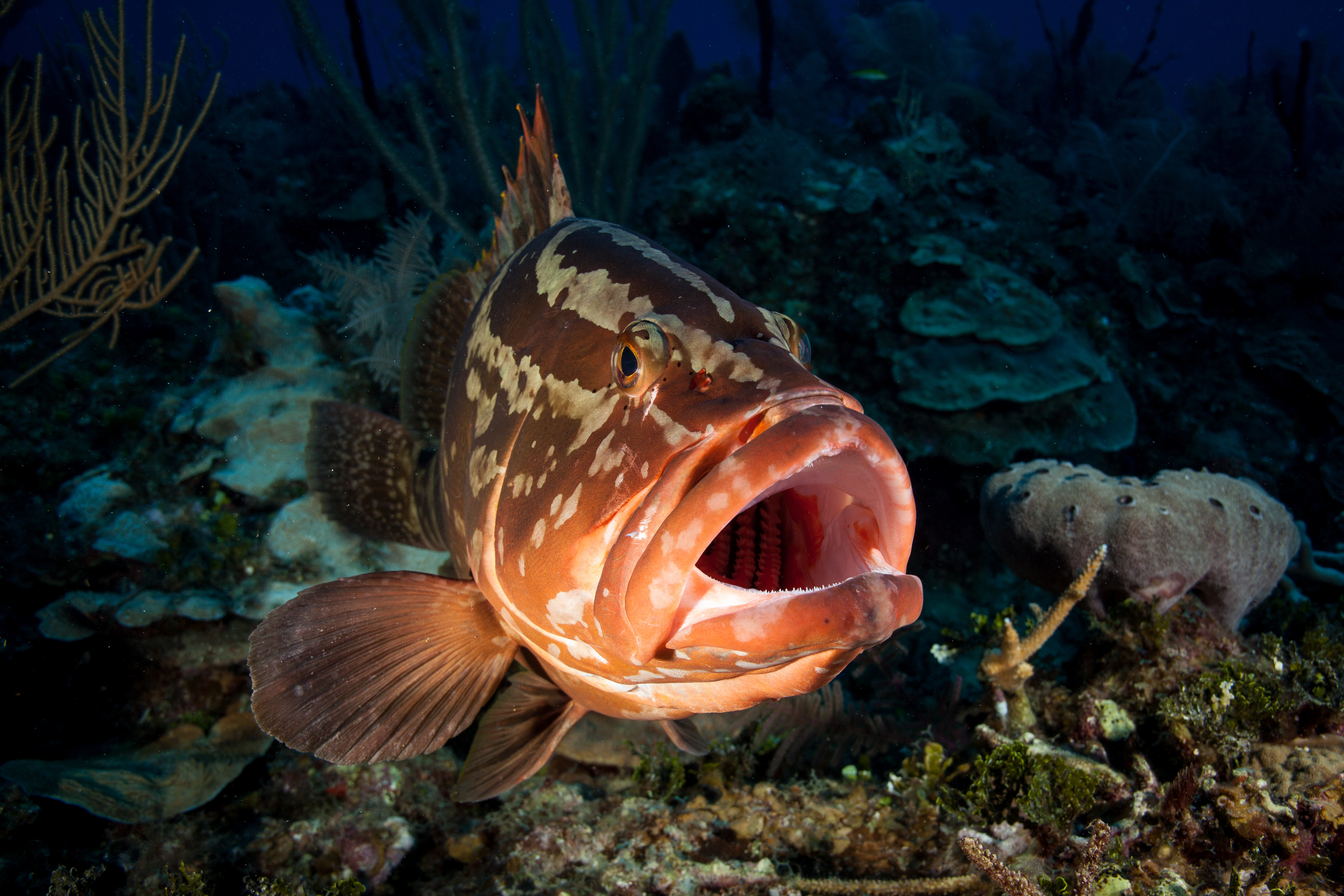

The Nassau grouper (Epinephelus striatus) is one of the most iconic and beloved reef fish in the tropical western Atlantic and Caribbean, a curious, boldly barred grouper that once anchored fisheries across the region. Today it carries a different distinction: it is a protected species, listed as threatened and closed to harvest in United States waters and many other jurisdictions after decades of overfishing collapsed its famous spawning aggregations. If you catch one, in most places you are required to release it, and everywhere you should.
That does not mean the Nassau grouper has no place in a fishing guide. Anglers fishing Caribbean and South Florida reefs still hook them incidentally while targeting snappers and other groupers, and knowing how to identify a Nassau grouper, how to handle it, and how to release it unharmed is exactly the knowledge a responsible angler needs. This species is also a conservation success story in progress, protecting it and its spawning aggregations is how it comes back.
This guide covers the Nassau grouper's behavior and biology, how to identify it (so you know what you have on the line), the reef fishing that hooks them, and, most importantly, how to release one safely so it swims away to spawn another season.
A Protected Species: Release Required
Before anything else: the Nassau grouper is protected. In U.S. federal and state waters, harvest and possession are prohibited, and it is illegal to keep one. Many Caribbean nations have their own closures, size limits, and seasonal bans built around the spawning aggregations. Assume you must release any Nassau grouper you catch, and check the specific regulations wherever you fish.
Nassau Grouper: An Endangered SpeciesThe reason is history. Nassau grouper gather in enormous spawning aggregations at predictable times and places, tens of thousands of fish converging on the same reef promontories around the winter full moons. Those aggregations made the species catastrophically easy to overfish, and many have been wiped out entirely. Protecting the remaining fish, and especially leaving spawning aggregations alone, is the whole ballgame for this species' recovery. Everything in this guide is written with release in mind.
Understanding Nassau Grouper Behavior
Nassau grouper are classic reef ambush predators, and famously curious ones, divers frequently report them approaching closely, even following them around a reef. They hold on and around coral reefs, ledges, and structure, generally from shallow water down to a few hundred feet, with juveniles using seagrass beds, mangroves, and shallow patch reefs as nursery habitat before moving to deeper reef as they grow.
Facts About the Nassau GrouperLike other groupers, they are opportunistic, fish-and-crustacean-eating ambush predators that dart from cover to engulf prey with a powerful suction of their large mouths. They hold tight to structure and, when hooked, bolt straight back into it, the same rock-diving instinct that defines all reef grouper fishing. Their curiosity and aggression mean they readily take a bait meant for a snapper or another grouper, which is precisely why anglers hook them incidentally.
Nassau grouper grow slowly and live a long time, several decades for the largest fish, reaching well over three feet and fifty pounds, though most fish encountered today are considerably smaller. Like many groupers, they are protogynous hermaphrodites: most individuals mature first as females and some later transition to males. That life history matters for conservation, because heavy fishing that removes the largest fish can skew the sex ratio and further hamper reproduction. It is one more reason the species is so slow to recover once its numbers fall.
Their diet shifts with size. Small Nassau grouper in the seagrass and patch-reef nurseries feed heavily on crabs, shrimp, and other crustaceans; as they grow and move to deeper reef, fish become a larger part of the menu. Throughout their lives they remain ambush hunters, relying on the reef for cover and striking prey that ventures within range of their cavernous mouths. Understanding that they are tied to structure, and that they will move to intercept an easy meal, explains both why they are hooked incidentally and why they dive straight back for the rocks the instant they feel the hook.
The Nassau grouper's most important behavior, from a conservation standpoint, is its spawning aggregation. In the cooler months, fish migrate, sometimes long distances, to gather at specific reef sites around the full moon, changing color and forming dense masses to spawn. These aggregations are the beating heart of the population and the reason the species is so vulnerable; many jurisdictions close fishing entirely during aggregation season.
How to Identify Nassau Grouper
Correct identification is essential, you need to recognize a Nassau grouper immediately so you can release it properly and avoid any violation. Key features:
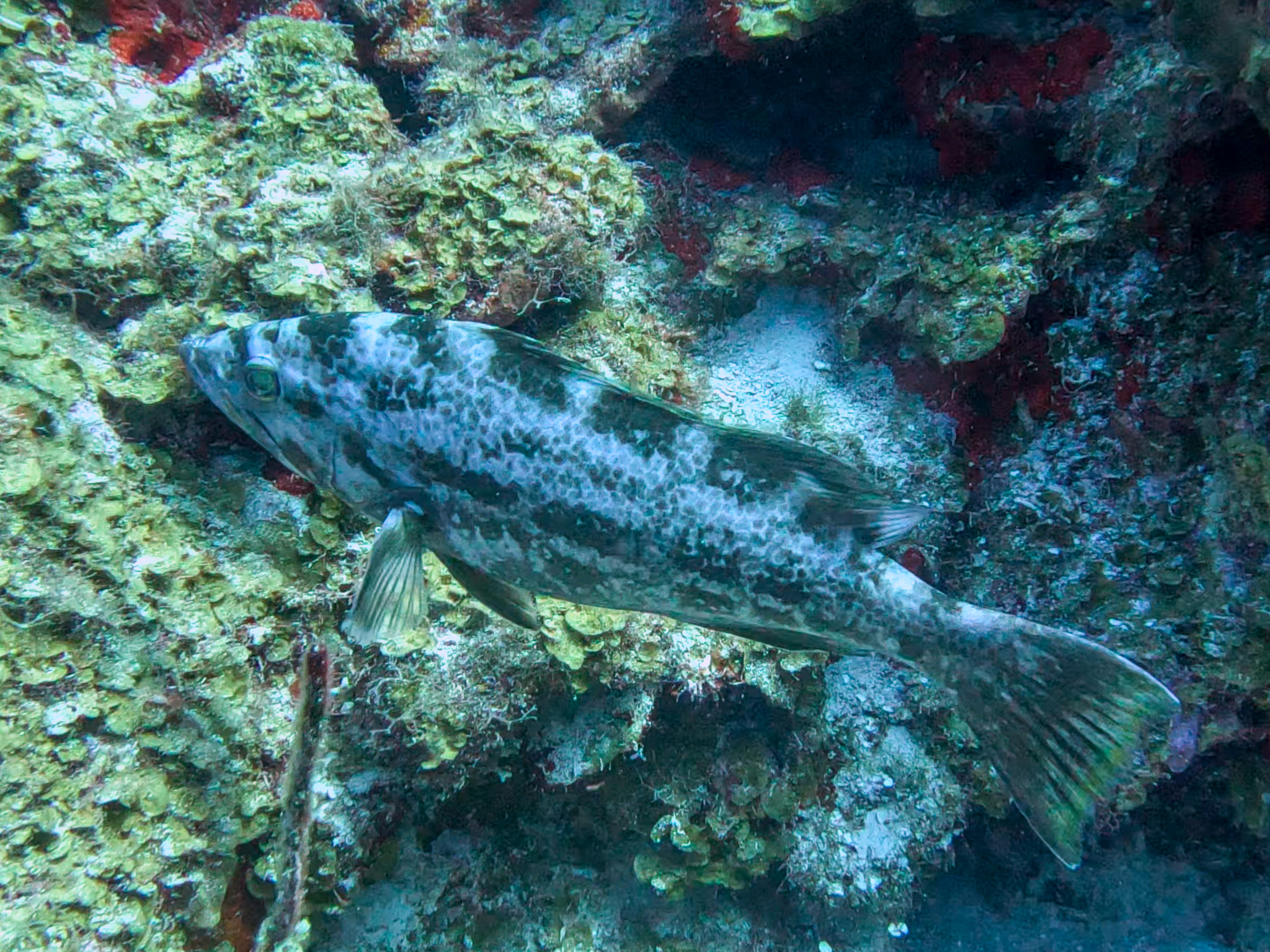
- Bold dark bars. Several dark brown or olive bars run vertically down a pale tan or cream body; the pattern is variable and the fish can lighten or darken quickly.
- The black saddle spot. A distinct black saddle blotch sits on top of the tail base (caudal peduncle), one of the most reliable field marks.
- The "tuning fork." A dark band runs from the snout through the eye and forks on top of the head, forming a tuning-fork shape.
- Spotted eye. A ring of small dark spots surrounds the eye.
- Color-change ability. Nassau grouper shift dramatically between pale, barred, and dark phases depending on mood and activity, so rely on the saddle spot and tuning fork rather than overall color.
The combination of the black saddle at the tail base and the tuning-fork mark on the head confirms a Nassau grouper even when the barring is faint. It can be confused with the tiger and yellowfin groupers, but neither shows that clean black caudal saddle.
Tackle and How They Are Hooked
Because you are releasing every fish, the goal is to hook Nassau grouper cleanly, fight them efficiently, and get them off quickly. The reef fishing that hooks them is standard grouper fishing, and using the right gear dramatically improves a released fish's survival.
Rod and reel: A stout conventional bottom outfit with backbone to pull a fish away from the reef fast. The quicker you land it, the better its odds on release, so favor power over finesse whenever a Nassau grouper is a possibility.
Line and leader: Heavy braid (50 to 80 pound) and a heavy leader (60 to 100 pound) so you can apply real pressure and not draw out the fight.
Circle hooks: Non-offset circle hooks are the single most important choice. They hook fish in the corner of the jaw rather than deep in the gut, which makes for a clean release and is required in many reef fisheries.
Circle Hooks for Clean Reef ReleasesBait: Live or fresh-dead baitfish and cut baits fished on the bottom around reef structure, the same presentations that catch snappers and other groupers. A Nassau grouper's curiosity means it will often be the first to a bait, sometimes swimming right up to investigate before it commits.
Do not undergun your tackle when reef fishing anywhere Nassau grouper live. A prolonged fight on light line exhausts the fish and lowers its chance of survival, and heavy tackle lets you turn a fish's head out of the rocks quickly, which is better for everyone.
It is also worth thinking about where and how you fish if you want to avoid hooking Nassau grouper in the first place. On shallow coral reefs and patch reefs in the Caribbean and South Florida, an incidental Nassau grouper is always a possibility, and there is nothing wrong with that as long as you release it well. But if you are specifically trying to keep other legal species and reduce the chance of tangling with a protected fish you will only be releasing, moving off the prime coral heads and fishing sand edges, deeper structure, or different bait presentations can shift your catch. Know the reefs you fish, and know that the healthiest coral heads are exactly where the curious Nassau grouper is most likely to be waiting.
Fighting and Landing
When a Nassau grouper eats, the drill is the same as any reef grouper: let the circle hook load the rod, then lift and crank immediately to pull the fish up and away from the structure before it dives into a hole. The first few cranks decide the outcome. Keep steady, heavy pressure.
Dropping Baits for Reef FishLand the fish as quickly as you can. The whole point of efficient tackle and technique here is to minimize the fight so the fish is in good shape when it comes up, because it is going right back over the side.
Set your drag heavy and be ready the instant you drop a bait onto reef structure where Nassau grouper live. Unlike a fish you are playing for sport on light tackle, here you want the fight over fast: the longer a grouper is on the line, the more lactic acid builds up in its muscles and the harder its recovery. A short, decisive fight on heavy gear is not just more effective at keeping the fish out of the rocks, it is genuinely kinder to a fish you are obligated to release. If you feel a fish rock you up and hang in the reef, keeping steady pressure will often coax it back out; slack line lets it settle in for good.
Releasing Nassau Grouper Safely
This is the most important section in the guide. A Nassau grouper you release well swims off to spawn; one released carelessly may not survive. Best practices:
- Keep it in the water if you can. Unhook the fish boatside without lifting it, using a dehooking tool. If you must handle it, wet your hands, support its body horizontally, and never hold it vertically by the jaw.
- Use a circle hook and dehooker. A corner-of-the-jaw circle hook usually pops out in seconds. If the fish is hooked deep, cut the leader close rather than digging for the hook.
- Treat barotrauma. A fish brought up from depth may show a distended belly, bulging eyes, or stomach protruding from its mouth, signs of expanded gases. Use a descending device to return it to depth, or vent it properly if you know how. Do not just toss a bloated fish back on the surface; it cannot swim down and will die.
- Minimize air time. Every second out of the water hurts. Have your tools ready, get a quick photo if you must while supporting the fish horizontally, and return it immediately.
Descending devices, weighted clips or inverted hooks that carry a fish back down and release it at depth, dramatically improve survival for reef fish pulled up from deep water, and they are the gold standard for releasing groupers with barotrauma.
Conservation and the Future of the Nassau Grouper
The Nassau grouper's story is a cautionary tale and, potentially, a comeback. Its predictable spawning aggregations, once a natural marvel, were fished until many vanished. Recovery depends on protecting the fish that remain and, above all, leaving spawning aggregations undisturbed.
Grouper Spawning Aggregation ResearchAs an angler, the best thing you can do is know the fish, release every one carefully, respect all closures, especially seasonal aggregation closures, and support the science and management working to bring the species back. Fishing near a known aggregation site during the spawn, even catch-and-release, can disrupt the very behavior the population depends on, so give those sites a wide berth in season.
There are encouraging signs. Where aggregations have been protected, through no-take reserves, seasonal closures, and enforcement, some Nassau grouper populations have begun to stabilize or even rebuild, a reminder that this species can recover when given the chance. Anglers and dive operators who value seeing a curious Nassau grouper on the reef have every reason to protect it: a living, spawning grouper is worth far more to the reef and to the fishing and tourism economy over its long life than a single fish in a cooler. Reporting tagged fish, participating in citizen-science surveys, and simply modeling careful catch-and-release for other anglers all contribute to the comeback. The Nassau grouper's fate is genuinely in the hands of the people who share the water with it.
Putting It All Together
The Nassau grouper is a fish to admire, identify, and release. Recognize it by the black saddle on the tail base and the tuning-fork mark on the head; if you hook one while reef fishing, fight it quickly on stout tackle with a circle hook, keep it in the water, treat any barotrauma with a descending device, and send it on its way. Respect the closures and steer clear of spawning aggregations. Handled right, the fish you release today is part of this remarkable species' recovery.
Want to fish Caribbean and Florida reefs the right way? Before you go, confirm the current closures and protected-species rules for the exact waters you are fishing, rig with non-offset circle hooks, and keep a dehooker and a descending device within reach on deck. Know the reefs well enough to turn a fish out of the coral fast, and have your release tools ready before you drop a bait. Fish that way and you will fish responsibly and effectively, and every Nassau grouper you meet will swim back down to spawn.
For more on chasing reef and bottom species, see our guides on how to catch goliath grouper, how to catch yellowfin grouper, and how to catch scamp grouper.