Fish
Fish Fire
Fire Hike
Hike Bird
Bird

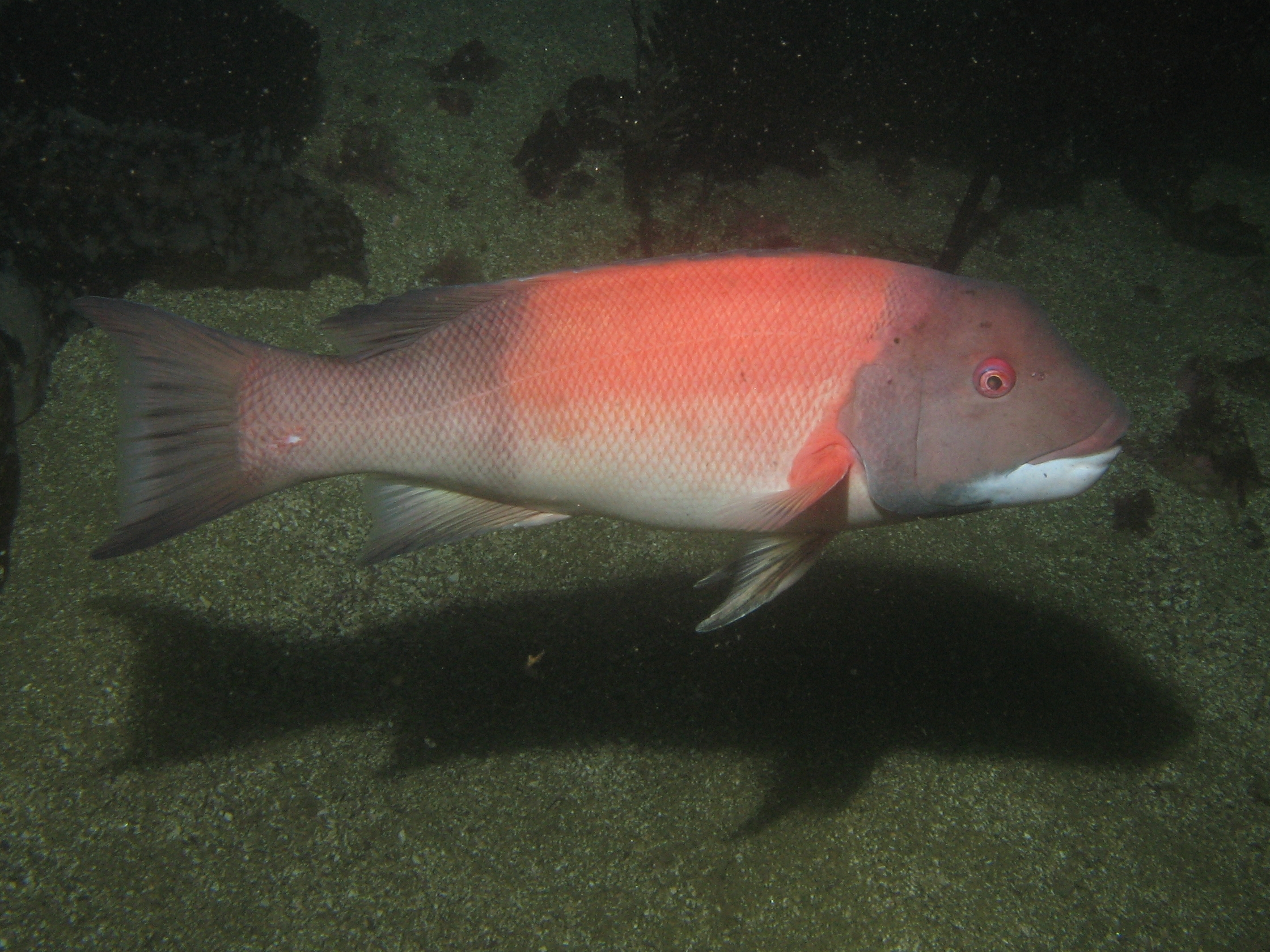

The California sheephead is one of the most distinctive and rewarding fish on the West Coast reef. Big males are unmistakable, a blunt, black head and tail, a rosy-red midsection, a snow-white chin, a fleshy hump on the forehead, and a set of protruding, doglike front teeth built for crushing shellfish. They pull hard, they live in the nastiest rock and kelp, they're notorious bait-stealers, and they're some of the best-eating fish in Southern California waters. Learn how to fish for them properly and you'll add one of SoCal's signature reef species to your catch.
This guide covers everything: how to identify a sheephead and understand its strange biology, where and when to find them, the baits and rigs that finally beat their bait-thieving ways, and how to muscle a good one out of the rocks before it breaks you off.
Part of what makes sheephead such a satisfying target is that they're a true "reef puzzle" fish. They're smart, they're structure-bound, and they'll test your ability to read the bottom, present a bait cleanly, and win a short, brutal tug-of-war. They're also accessible to just about everyone, you can catch them from a party boat over the offshore islands, from a kayak picking apart nearshore reefs, or standing on a jetty with a rod and a bag of shrimp. That combination of challenge and accessibility is exactly why they've become such a beloved Southern California species.
What is a California sheephead?
Despite the name, the California sheephead (Bodianus pulcher) is not a bass or a porgy, it's a large member of the wrasse family, and one of the biggest wrasses in North American waters. Males can top 30 inches and 30-plus pounds, though most fish you'll catch run 2 to 12 pounds, and a male in the high teens or better is a genuine trophy that most anglers remember for years.
The species is famous for two things. First, its dramatic color change between sexes: females are a fairly plain rosy-pink to reddish all over, while dominant males develop the striking black-red-black tricolor pattern and the bulging forehead. Second, and this is the wild part, every sheephead starts life as a female and can later transform into a male. They're protogynous hermaphrodites: when a dominant male dies or is removed, the largest female in the area will change sex to replace him. That biology has real consequences for the fishery, because removing the big males can shift the whole population, so many anglers practice selective harvest and release the largest breeders.
Sheephead are also equipped with powerful jaws and canine-like teeth, plus a second set of crushing plates in the throat. They use them to pry and grind urchins, crabs, mussels, and other hard-shelled prey off the reef, which explains both their preferred baits and their maddening ability to strip a hook clean.
How to Catch Sheephead in Southern CaliforniaWhere and when to find sheephead
Sheephead are a warm-temperate reef species ranging from Monterey Bay in Central California down through Baja and into the Gulf of California, with the best fishing concentrated in Southern California and around the Channel Islands. They are utterly tied to hard structure, you will essentially never catch one over open sand or mud. If you're not fishing rock, reef, kelp, or man-made structure, you're not fishing for sheephead. Focus on:
- Rocky reefs and boulder fields, The classic sheephead habitat. They patrol rock piles, ledges, and the broken bottom where shellfish live.
- Kelp beds and kelp edges, Sheephead work through kelp forests hunting invertebrates. The edges and holes within the kelp are prime.
- Breakwalls, jetties, and pier pilings, Accessible, shellfish-covered structure holds sheephead within reach of shore and pier anglers.
- Deep reefs and high spots (30–150+ feet), Bigger males often hold on deeper structure and around the offshore islands.
Sheephead feed by day, so unlike many reef fish they bite well in daylight, mid-morning through afternoon can be excellent. They're active year-round in their range but bite best in the warmer months from late spring through fall. A moving tide almost always improves the bite, as current pushes them to feed actively along the structure.
It pays to understand how sheephead relate to their reef. They aren't roamers like pelagic fish; a given stretch of rock or a particular kelp hole will hold sheephead day after day, and the same spot can produce fish trip after trip once you find it. They tend to hold tight to the bottom and to vertical relief, the base of a ledge, the down-current side of a boulder, the edge where sand meets rock. When you're fishing from a boat or kayak, use your sounder to find that hard, broken bottom and position so your bait lands right in it; being even a boat length off the structure can be the difference between a steady pick and a dead rod. From shore, target the rockiest, most shell-encrusted structure you can reach, the ugly, snaggy spots that scare off casual anglers are exactly where sheephead live.
California Sheephead TipsBest baits for sheephead
Match the hatch: sheephead eat hard-shelled invertebrates, so the best baits are exactly what they crunch on the reef.
- Shrimp, Live or fresh dead shrimp, and ghost shrimp, are among the most reliable sheephead baits and are deadly from shore and pier.
- Crabs and crawfish, Small live crabs, sand crabs, and pieces of larger crab are premium baits that big sheephead can't resist.
- Mussels and clams, Fresh mussel or clam meat is a natural, though it's soft and gets picked apart quickly.
- Squid, Strips of fresh or frozen squid are tough, stay on the hook, and catch plenty of fish, a great "starter" bait when live shellfish aren't available.
- Urchin, Where legal, cracked urchin is a top-tier sheephead bait, since it's a favorite natural food.
- Ghost shrimp and sand crabs, Pumped from the flats or gathered in the surf zone, these local natural baits are deadly and free, and they're especially effective from shore.
The universal complaint about sheephead is that they steal bait relentlessly. The fix is a tough bait (squid, or crab with the shell left on for the hook to bite into), a sharp hook buried properly, and paying close attention so you set the moment you feel weight rather than waiting.
A useful trick when the bite is soft or the fish are pressured is to downsize both bait and hook. A smaller, neatly presented piece of shrimp or squid on a compact hook draws more committed bites than a big, sloppy gob that a wary sheephead can nibble at from the edges. Conversely, when you're specifically hunting the big males on deeper reefs, a whole crab or a large chunk of squid weeds out the small fish and tempts the trophies. Keep a couple of bait options rigged and ready so you can switch based on what's happening, sheephead moods change with the tide and the pressure, and the anglers who adjust catch the most.
Rigs and how to fish them
Because sheephead live in snaggy rock and kelp, your rig has to get bait to the bottom, stay pinned near structure, and give you a fighting chance to pull a hooked fish up and out.
Carolina rig, A sliding egg sinker above a swivel, then a leader to the hook. This lets the sheephead pick up the bait and move off without feeling the weight, and keeps the bait near the bottom. It's a favorite for a reason.
The Carolina Rig for California SheepheadDropper-loop rig, The classic SoCal rock-fishing rig: a bank sinker on the bottom with one or two baited hooks tied on dropper loops above it. It holds bottom in current and presents baits right in the strike zone. If the sinker snags, you can often break it off and save the hooks and fish.
How to Tie a Dropper-Loop RigHigh-low / fish-finder from shore, From piers, jetties, and the surf, a simple sliding-sinker or high-low rig with shrimp or squid fishes the shellfish-covered structure effectively.
Whatever the rig, use enough weight to hold bottom, a hook in the 1/0–4/0 range matched to the bait, and a leader strong enough to survive abrasion on the rocks. When a sheephead bites, it often gives a couple of sharp "tap-tap" pecks as it works the bait, come tight and set firmly, then immediately lift and reel to get its head up.
Reading the bite takes a little practice. Because sheephead are picking and crunching at your bait rather than inhaling it, the classic mistake is to swing on the first tap and pull the bait right out of the fish's mouth. Instead, let those first pecks happen, wait for the rod to load with steady weight, and then set hard. Some anglers describe it as "feeding" the fish a second before coming tight. Once you've felt a few sheephead bites you'll learn the rhythm, but until then, err on the side of a slight pause before you set, you'll hook a much higher percentage of the fish that are actually eating.
Braid-to-leader connections and hook sharpness matter more with sheephead than with almost any other reef fish, precisely because your window to convert a bite is so small. Retie after any fish that took you into the rocks, touch up or swap hooks that have dulled on shell and stone, and keep your terminal tackle simple so you can rig fresh quickly when you break off, and with sheephead fishing, you will break off from time to time. That's the price of admission for fishing the gnarly structure where the biggest fish live.
Landing and handling
The fight with a sheephead is short but intense. The instant it's hooked, a sheephead dives straight back into the rocks or kelp to break you off, so the number-one rule is to muscle it up and away from structure immediately. Don't give a big one line near the bottom; lock down and lift. Once you get its head up and pumping toward the surface, the danger largely passes.
Use a stout rod with plenty of backbone, a reel with a strong drag, and heavier line than you might think you need for a fish of that size, the structure, not the fish's weight, is what breaks you off. A net makes boatside landing easy.
Set your drag on the heavy side before you drop, because there's no time to adjust it once a sheephead is diving for the rocks. Braided main line helps here too: its lack of stretch lets you feel the subtle tap-tap bite through the water column and transmits your hook-set instantly to a fish that may be sitting deep on structure. Pair the braid with a length of tougher mono or fluorocarbon leader for abrasion resistance at the business end. If you do get buried in the rocks, don't immediately break off, sometimes going slack for a moment lets a sheephead swim back out of the hole on its own, and you can resume the fight. It doesn't always work, but it saves enough fish to be worth the try.
For the table, sheephead are excellent, firm, white, sweet fillets that are prized eating. Bleed and ice your fish, and consider releasing the largest males to protect the breeding population, since those big fish drive the sex-change dynamics of the whole reef.
Know the regulations before you keep one. California manages sheephead with a minimum size limit, a daily bag limit, and seasonal depth restrictions that are tied to the broader groundfish rules, and those regulations change from year to year. Sheephead grow slowly and mature late, and because of their sex-changing biology the population is sensitive to overharvest of the biggest fish, so the rules exist for good reason. Always check the current California Department of Fish and Wildlife regulations for the size limit, bag limit, and any depth or seasonal closures in effect before you fish, and when in doubt, release the fish. A party-boat captain will also keep you legal, since staying current on the rules is part of their job.
Shore Fishing for California SheepheadCleaning a sheephead is straightforward once you get past the tough skin and heavy rib cage; the video below walks through filleting one.
How to Fillet a California SheepheadWhere to catch them
Southern California and the Channel Islands are the heart of sheephead country, the kelp reefs off San Diego, Orange County, Los Angeles, Santa Barbara, and the islands all hold good numbers, and the fish are reachable from boats, kayaks, jetties, and piers. Catalina, San Clemente, and the northern Channel Islands are especially known for producing big, colorful males for anglers willing to make the run. Wherever you fish, the key is pinpointing the hard, broken bottom and the kelp edges that hold sheephead, then timing your trip to a moving tide, narrow your search to the right reef and the right current window and you'll get into fish far faster than prospecting blind.
If you're fishing the California kelp and reef, keep building your skills with our guides on how to catch calico bass, how to catch white seabass, and how to catch yellowtail amberjack.