Fish
Fish Fire
Fire Hike
Hike Bird
Bird

Florida's bay scallop season is not one season. It is three, only one of them runs on its own calendar, and the zone that opened first in June is shut by Labor Day while the others run on into late September.
That is the whole planning problem, and it is worth getting right before you book anything, because the drive between the zones is hours rather than minutes.
What you are actually collecting
A bay scallop is Argopecten irradians, and it is a different animal from the sea scallop that arrives at a restaurant as a single pale disc.
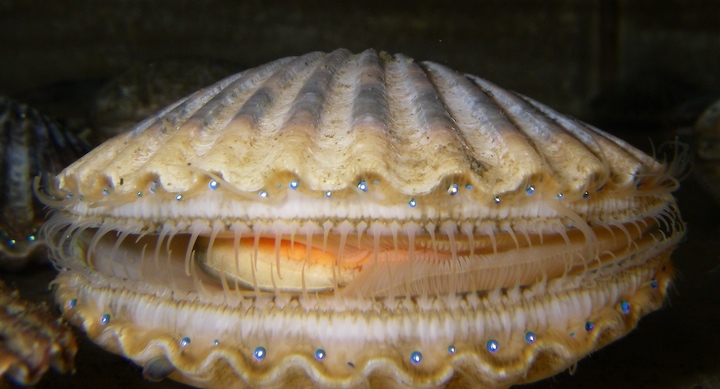
It is small, roughly the size of a child's palm, with a fluted fan-shaped shell that is mottled brown or gray on top and pale beneath. It lives in shallow seagrass, it is not attached to anything, and it does not burrow. It simply sits on the bottom among the blades, which is why this is a snorkeling activity rather than a digging one.
Two things about the animal change how you look for it. The first is that it swims. A scallop that feels threatened claps its valves together and jets off in a clattering, erratic line, and once you have seen one do it you will start noticing the movement rather than the shell.
The second is the eyes. Along the edge of the mantle, between the two shells, a bay scallop carries a row of small iridescent blue eyes. They are genuinely eyes, with a lens and a retina, and there are dozens of them. On the bottom in clear water they read as a line of tiny blue beads, and a great many experienced scallopers are looking for that line rather than for the shell itself.
A bay scallop also lives about a year. It spawns and dies, which means every season is fished on a single new crop, and it explains why a good year and a bad year can sit next to each other with no obvious cause.
The zones, and why they are managed separately
Florida manages this as separate zones along the Gulf coast, each with its own dates. These are the current ones, and they are not interchangeable.
Franklin County through northwestern Taylor County, which is the Carrabelle, Lanark and St. Marks water, runs July 1 through September 24.
The Fenholloway through Suwannee Rivers zone, which is the Keaton Beach and Steinhatchee water and the one most people mean when they say they are going scalloping, runs June 15 through Labor Day. It opens earliest and closes earliest.
Levy, Citrus and Hernando counties, meaning Cedar Key, Crystal River and Homosassa, runs July 1 through September 24.
Two zones are not available at all. St. Joseph Bay and the rest of Gulf County are closed for 2026. The Pasco zone closed effective August 6, 2026.
The zones exist because the resource is patchy and local. Bay scallops do not range far, each bay is effectively its own population, and a bay that had a poor set can be shut without touching the one forty miles away. Treating "Florida scallop season" as a single thing is how people end up driving to a closed bay.
The limits, which are measured in volume
Almost every shellfish limit in this library is a count. This one is not, which surprises people.
In the Gulf through northwestern Taylor County zone and the Levy through Pasco zone, the limit is two gallons of whole bay scallops in the shell, or one pint of bay scallop meat, per person. The vessel limit is a maximum of ten gallons of whole scallops in the shell, or half a gallon of meat.
The Fenholloway through Suwannee River zone is different for the first two weeks. From June 15 to 30 the limit there is one gallon of whole scallops in the shell, or one cup shucked, per person, and five gallons whole or two pints shucked per vessel.
Two practical notes follow from that. The first is that you need a way to measure, because a bucket is not a gallon and an officer at the ramp will want to see the volume rather than take your word for it. The second is that the per-person and per-vessel figures for meat are not in proportion to each other, which looks like an error and is simply how the rule is written. Take the numbers as stated rather than reasoning from them.
Everyone harvesting needs a Florida saltwater fishing license unless they are exempt or fishing under the no-cost shoreline option, and the licensing question across state lines is covered in shellfish licenses by state.
Harvest is permitted by hand or with a landing or dip net only. No dredges, no rakes, no scoops on poles.
How To Catch Scallops: Where To Find Them and the Gear You NeedWhere they actually are
The animal lives in seagrass, so the search is a search for the right grass rather than for the right depth.
What you want is a healthy bed of turtle grass in clear shallow water, thick enough to hold cover but not so dense that you cannot see the bottom between the blades. Scallops sit in the gaps. A bed that has been scoured to sand holds nothing, and a bed so thick it reads as a solid green mat is one you cannot work visually.
Water clarity decides the day more than anything else. Scalloping is a looking activity, and a bay stirred up by a couple of windy days is a bay where you will swim for two hours and find six scallops. Wind out of the west on this coast is generally the problem.
Work in a line rather than in circles. The productive method is to drift or swim slowly across a flat in one direction, scanning a band a few feet wide, and to turn around and come back on a parallel line rather than milling about. People who find scallops are covering ground methodically; people who do not are swimming in loops around the boat.
And pay attention to where you found the first one. They are patchy at a scale of yards, not miles, so a scallop usually means more scallops within a short swim.
The gear
Bay scalloping needs less equipment than any other activity in this library, and two of the items on the list are legal requirements rather than conveniences.
A divers-down flag or buoy, which is the law rather than a courtesy and is dealt with properly in its own section below. This is the item people leave at home and it is the one that gets a citation.
A mask and snorkel that actually fit, since the entire activity is looking at the bottom through a few feet of water. A leaking mask ruins a scalloping day faster than bad weather.
Fins, though shorter ones than a diver would use. You are covering flats slowly rather than moving through current, and long blades are awkward in shallow grass.
A mesh bag on a float, which is where the scallops go. A bag clipped to you fills, gets heavy and drags; a bag on a small float follows you and keeps the catch in the water.
A measuring container, meaning something you know the volume of, because the limit is stated in gallons and pints rather than in numbers of animals.
A cooler with plenty of ice, ready before you leave the dock. This is Gulf water in high summer, scallops are a shellfish, and warm scallops in a bucket in the sun deteriorate quickly.
And a dive skin or a long-sleeved rash guard, which is the item people wish they had brought. You are floating face down on a flat in the middle of a Florida summer day, and the back of your legs and neck get the full sun for several hours.
The flag, and why it is not a courtesy
Florida takes divers-down warning devices seriously and the numbers are specific.
A divers-down symbol displayed in the water must be at least twelve by twelve inches. One displayed on a vessel must be at least twenty by twenty-four inches.
Divers have to stay within one hundred feet of the flag or buoy in rivers, inlets and navigation channels, and within three hundred feet on open water. Vessels have to stay at least three hundred feet away from a divers-down device in open water and at least one hundred feet away in rivers, inlets and channels, and must slow to idle speed if they come closer than that.
This matters more here than at most dive sites for an obvious reason. Scallopers are face down, ears in the water, in shallow bays with a lot of boat traffic, wearing dark wetsuits or nothing distinctive, and they are not looking up. The flag is the only thing telling an approaching boat that there are people in the water, and it works only if you stay near it.
If you are swimming from a boat, the flag on the boat covers you as long as you stay within the distance. If you are working away from the boat, tow a float with a flag on it.
Handling and cleaning them
Scallops die fast in warm air, and unlike a clam or an oyster you cannot simply leave them for later.
Get them on ice as they come out of the water rather than at the end of the session. A mesh bag hanging in the water is fine while you are swimming; a bucket on the deck in the sun is not.
Cleaning is a single motion once you have seen it done. Slide a spoon or a short blunt knife along the inside of the flat shell to cut the adductor free, open the animal, and scrape everything away except the white cylinder of muscle in the middle. That muscle is the scallop you eat. Everything else, the frill, the dark gut sac and the roe, comes off in one sweep with the spoon.
Some people keep the roe, which is edible and good, and most Florida scallopers do not bother. The gut sac is not eaten.
Expect the yield to be small. Two gallons of whole scallops in the shell reduces to a modest amount of meat, which is why the rule offers a pint of meat as the alternative measure, and why a boat limit is a reasonable dinner rather than a freezer full.
How to Shuck a ScallopWhy the season moves and the bays close
Bay scallops depend on seagrass completely, and seagrass depends on water clarity, so anything that clouds a bay for a season works its way through to the scallops the following year.
That is the mechanism behind most of the closures on this coast. A bay that loses grass to a bloom, a freshwater pulse or a dredging event loses the habitat the next generation needs to settle into, and because the animal lives about a year there is no reservoir of older scallops to carry the population through a bad set. The fishery is always one crop deep.
It also means the closures are not punishments and they are not permanent. A bay closed this year can reopen when the grass and the set recover, and the state moves the boundaries and the dates accordingly. It is a responsive fishery in a way that very few are, and it is the reason the zone table changes from one year to the next rather than sitting still.
Which is also the argument for checking the current rules on the morning you go rather than trusting an article, including this one. The habit is the same one that governs shellfish biotoxin closures: the resource decides, the agency publishes, and last season's information is not information.
Putting it together
Pick the zone first, then the date, because only one of the three zones runs on its own calendar and it opens two weeks before the others.
Confirm the zone is open on your date, since St. Joseph Bay and Gulf County are closed for 2026 and the Pasco zone closed on August 6.
Buy the license, bring a way to measure gallons, and bring the flag.
Find clear water over healthy turtle grass, swim slow parallel lines rather than loops, and look for a row of small blue eyes rather than for a shell.
Ice them as you go, clean them with a spoon, and expect less meat than the volume suggests.
And treat a windy forecast as a reason to move the trip. Clarity is the whole activity, and there is no technique that compensates for not being able to see the bottom.
The other Florida shellfishery, running on the opposite calendar and with the animal going back alive, is in stone crab claws in Florida. The shrimp on the same coast are in cast net shrimping in Georgia and Florida. The food-safety habits that apply to any warm-water shellfish are in the R rule is right for the wrong reason, and the tide arithmetic that governs the flats is in minus tides for clamming.