Fish
Fish Fire
Fire Hike
Hike Bird
Bird

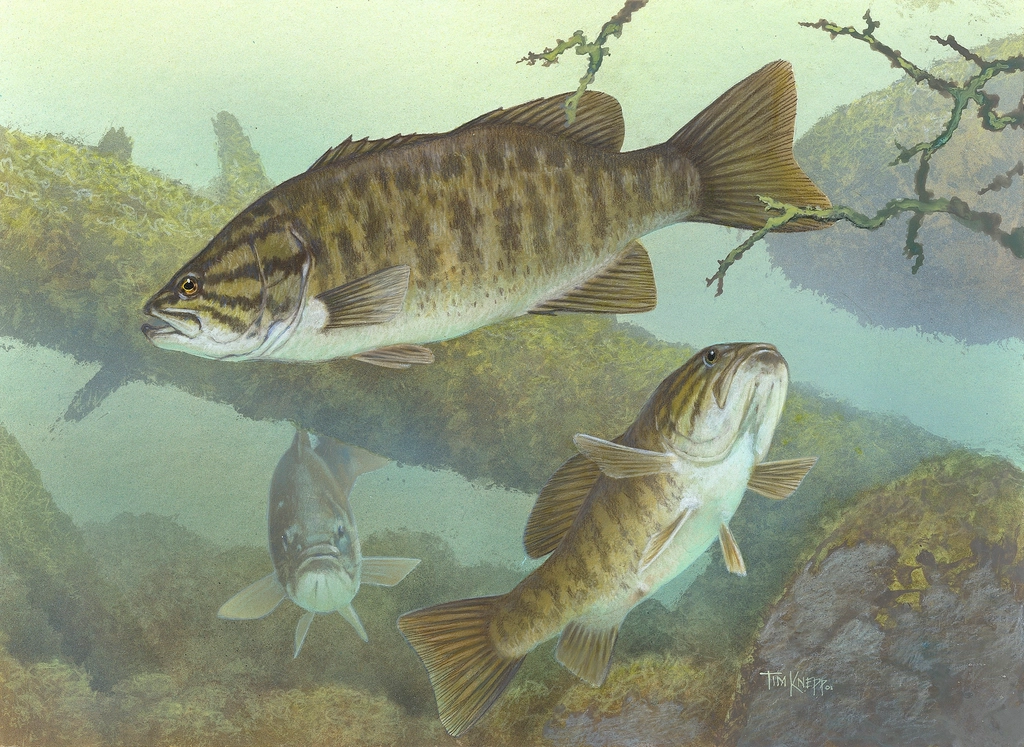

Pound for pound, the smallmouth bass is the hardest-fighting fish in freshwater. Hook one in current and it will cartwheel across the surface, bulldog for the bottom, and peel drag in a way a largemouth of twice the size never will. "Bronzebacks" live in cool, clear, rocky water, the smallmouth rivers of the Midwest and East, the deep natural lakes of the North, and the tailwaters and reservoirs in between. They're aggressive, they school, and once you understand what they relate to, they're one of the most rewarding fish you can target. This guide breaks down how smallmouth behave, how to find them in both rivers and lakes, and the exact techniques, with step-by-step rigging, that put them in the net.
Want to shortcut the learning curve? Learn to read rock and current, match your bait to the crayfish and baitfish smallmouth eat, and slow everything down when the bite gets tough. If you also chase their green cousin, start with our guide on how to catch largemouth bass.
Meet the Bronzeback
The smallmouth bass (Micropterus dolomieu) is a member of the sunfish family and a close cousin of the largemouth, but the two are easy to tell apart. Smallmouth are bronze, brown, or olive with dark vertical bars (not a horizontal stripe), red-tinged eyes, and, as the name says, a smaller mouth whose upper jaw ends under the eye, not past it. They rarely reach largemouth size: a 3-pounder is a strong fish, a 5-pounder is a trophy almost anywhere, and the world record sits right around 11 pounds. What they lack in bulk they make up for in raw power and stamina.
Smallmouth are a cold-water, clear-water, hard-bottom fish. Where largemouth love weeds, wood, and warm murky ponds, smallmouth want rock, gravel, current, and clarity. They eat crayfish above all else, which is why so many smallmouth baits are brown or green-pumpkin and crawl along the bottom, along with baitfish (shad, shiners, sculpins, gobies), hellgrammites, and insects. Find rock and crayfish in cool water and you've found smallmouth.
What Drives Smallmouth Behavior
Everything a smallmouth does is dictated by water temperature, current, and their crayfish-and-baitfish diet. Their comfort zone is roughly 65–75°F, and their metabolism tracks the calendar:
- Spring: As water climbs through the 50s, smallmouth push shallow onto rock and gravel to feed, then spawn on hard bottom when it hits about 60°F. Pre-spawn and post-spawn are the best trophy windows of the year.
- Summer: In lakes, fish slide out to deeper rock, humps, points, and ledges in 15–35 feet. In rivers they hold in current seams, riffles, and around current-breaking boulders where oxygenated water funnels food to them.
- Fall: Cooling water triggers a heavy feed as smallmouth chase baitfish shallow to pack on weight. This is prime time for reaction baits.
- Winter: Fish go deep and slow, stacking in the deepest wintering holes and basins. Tiny finesse baits fished agonizingly slowly are the only game.
Where to Find Smallmouth: Rivers vs. Lakes
Smallmouth live in two very different worlds, and how you fish for them changes with each.
In rivers and streams, smallmouth are all about current and rock. They won't fight the full force of the flow; instead they tuck into the calm water right beside it, waiting to ambush food the current delivers. Target current seams (the line where fast and slow water meet), eddies behind boulders and bridge pilings, the heads and tails of pools, riffle-to-pool transitions, and any laydown or rock ledge that breaks the flow. In a river, if you can read the water and find the ambush spots, you can catch smallmouth all day.
In lakes and reservoirs, smallmouth relate to structure and bottom composition. The magic words are transition and rock: look for humps, long tapering points, offshore reefs, rock piles, and, critically, bottom transitions where rock meets sand or gravel meets clay. Smallmouth cruise these edges hunting crayfish and baitfish. Modern electronics (side-scan and forward-facing sonar) have transformed lake smallmouth fishing, but even without them, focusing on main-lake rock in 8–25 feet will find fish most of the year.
The Techniques That Catch Smallmouth
Smallmouth respond to both finesse (slow, subtle, bottom-focused) and reaction (fast, aggressive) presentations. Here are the core methods, how to rig each, and when to reach for it.
The Tube, the classic crayfish imitator
A hollow tube jig is arguably the greatest smallmouth bait ever made, it perfectly mimics a fleeing or bottom-hugging crayfish.
How to rig it: Slide an internal tube jighead (1/8 to 3/8 oz) into the hollow body, insert the head, work it up to the nose, and pop the line-tie out through the tube wall. Match the weight to depth and current: lighter for shallow or slack water, heavier to hold bottom in deep water or current. Green pumpkin, brown, and smoke are the go-to colors.
How to fish it: Cast it out, let it fall to the bottom on a semi-slack line (it spirals enticingly on the drop, watch for a tick), then drag and hop it slowly over rock. In rivers, dead-drift it through seams and pools. Most bites come on the fall or the pause, so stay in contact with the bottom and set on anything that feels different.
How to Rig and Fish a Tube Jig for SmallmouthThe Ned Rig, when they won't eat anything else
The Ned rig is a small, buoyant finesse bait that catches smallmouth in every condition, and it's the easiest technique for a beginner to get bites on.
How to rig it: Thread a short (2.5–3 inch) buoyant soft-plastic stick (a Z-Man Finesse TRD is the standard) onto a mushroom-shaped jighead (1/16 to 1/6 oz), pushing the head into the nose so the bait sits straight. That's it.
How to fish it: Cast out, let it sink, and drag it slowly along the bottom with tiny hops and long pauses. The buoyant tail stands up off the bottom like a feeding crayfish or minnow. It looks alive doing nothing, which is exactly why it works on pressured and neutral fish.
How to Fish a Ned Rig for SmallmouthThe Drop Shot, the summer deep-water king
When smallmouth pull out to deep rock in summer, nothing beats a drop shot for keeping a bait hovering in their face.
How to rig it: Tie a drop-shot hook (size 1 to 2/0) onto your line 12–24 inches above the end using a Palomar knot, then run the tag end back down through the top of the hook eye so the hook stands out horizontally. Tie a drop-shot weight (1/4 to 1/2 oz) to the bottom of the tag. Nose-hook a 4-inch finesse worm or minnow bait (a Roboworm or a Damiki-style minnow) so it hovers.
How to fish it: Drop it straight down or cast it to deep structure, let the weight hit bottom, keep a tight line, and shake the rod tip gently in place, the bait quivers seductively without moving off the spot. It's the deadliest deep-water finesse presentation there is.
How to Fish a Drop Shot for SmallmouthThe Jerkbait, clear-water magic
In cold, clear water, especially spring and fall, a suspending jerkbait triggers vicious reaction strikes from smallmouth that won't chase anything faster.
How to rig and fish it: Tie a suspending jerkbait (a Rapala Shadow Rap or Megabass Vision 110) straight to a fluorocarbon line, or use a small loop knot for extra action. Fish it with a jerk-jerk-pause cadence, and let the pause do the work, in cold water, pauses of 3 to 10 seconds while the bait hangs motionless draw the strike. The colder and clearer the water, the longer the pause.
How to Fish a Jerkbait for SmallmouthTopwater, the most thrilling smallmouth bite
Few things in fishing beat a smallmouth crushing a topwater in calm morning water. It's a warm-water game from late spring through fall, best at dawn, dusk, and on overcast days.
How to rig and fish it: Tie on a walking bait (a Heddon Zara Spook), a prop bait or plopper (a Whopper Plopper), or a popper (a Rebel Pop-R), a loop knot helps a walking bait "walk the dog." Work it over shallow rock, points, and flats with a steady rhythmic cadence, and pause it near obvious ambush spots. When a smallmouth blows up, wait until you feel the weight of the fish before setting.
How to Fish Topwater for SmallmouthHair Jigs and Football Jigs, big-fish baits
For the biggest smallmouth, and for cold water when fish won't move far, a hair jig or football jig dragged on bottom is a giant-killer.
How to rig and fish it: A hair jig (a hand-tied bucktail or marabou jig, 1/8 to 3/8 oz) is fished as-is, no trailer needed; the hair breathes on its own. Fish it dead-slow: cast out, let it sink, and creep it along bottom with long pauses, or vertically hover it in a wintering hole. A football-head jig (3/8 to 1/2 oz) with a craw trailer excels dragged across deep rock and gravel, its wide head standing the trailer up and deflecting off rock to trigger strikes. Both are slow, deliberate, big-fish presentations.
How to Fish a Hair Jig for Big SmallmouthCrankbaits and Search Baits, cover water fast
When you need to locate active fish across a big flat or a new stretch of river, tie on a moving bait.
How to rig and fish it: A crankbait (a Rapala DT series or Strike King 5XD) ties straight on and is retrieved steadily so it bangs and deflects off rock, pick a diving depth that matches where the fish are holding. A spinnerbait and a swimbait (a Keitech on a jighead) round out the search-bait arsenal, letting you fan-cast a lot of water quickly to find the schools before you slow down with finesse baits.
How to Fish Crankbaits for SmallmouthLive Bait: The Great Equalizer
If artificial lures feel overwhelming, or the fish simply won't cooperate, nothing out-produces live bait for smallmouth, it's how many anglers catch their first bronzeback, and it fools even the wariest fish. The three best baits mirror the smallmouth's natural diet:
- Crayfish are the number-one smallmouth food. Hook a live craw through the tail (from underneath, point out) or through a horn, add just enough split shot to reach bottom, and drift or crawl it through rock. In rivers, a craw dead-drifted through a pool is almost unfair.
- Hellgrammites (the larval stage of the dobsonfly) are a river-smallmouth delicacy. Hook one under the collar behind the head on a light wire hook and drift it through riffles and seams under a small float or with a single split shot.
- Live minnows and shiners shine in lakes and cooler water. Nose-hook or dorsal-hook a 2–4 inch shiner on a plain hook, fish it under a float over rock, on a split-shot rig, or on a small jighead, and let it swim naturally.
Keep it simple: a light-wire size 1 to 2/0 hook, a couple of split shot, and a natural bait fished slowly on or near the bottom will catch smallmouth anywhere they swim. Check your state regulations, some trout and smallmouth waters restrict live baitfish.
Gear for Smallmouth
Smallmouth fishing is a finesse-forward, spinning-rod game, though you'll want a baitcaster for the bigger reaction baits:
- Primary finesse spinning combo: A 7-foot medium or medium-light spinning rod with a fast tip, paired with a Shimano Stradic 2500 or Daiwa BG 2500 reel, handles tubes, Ned rigs, drop shots, and finesse plastics.
- Reaction baitcasting combo: A 7-foot medium-heavy baitcaster with a Lew's or Shimano SLX reel throws jerkbaits, crankbaits, spinnerbaits, and football jigs.
- Line: Spool the spinning reel with 10–15 lb braid to a 6–8 lb fluorocarbon leader, the braid gives sensitivity and hooksets, the invisible fluoro leader is essential in clear water. Use 10–12 lb fluorocarbon straight on the baitcaster.
- Terminal tackle and baits: Tubes and tube heads, Ned-rig mushroom heads and buoyant stick baits, drop-shot hooks and weights, a suspending jerkbait, a topwater or two, and a few hair jigs and football jigs, in green pumpkin, brown, smoke, and natural shad, cover every technique above.
When and Where to Go
Smallmouth can be caught year-round, but spring and fall are the golden seasons, cool water pulls big fish shallow and feeding. On a lake, fish main-lake rock, points, and humps; on a river, read the current and fish the seams and eddies. In summer, go deeper (drop shot and tube) and fish early and late; in the cold months, slow everything down with a hair jig or drop shot in the deepest water you can find. Match your approach to conditions: reaction baits when fish are active and shallow, finesse rigs when they're deep, cold, or pressured.
Putting It All Together
The fastest way to become a better smallmouth angler is time on the water learning to read it. Teach yourself to identify the rock and current that hold fish, match your presentation to the season, and keep notes on where and when you connect. When you're scouting a new river or lake, use Guidepole to find legal access points, boat launches, and public land along the water, and to check current conditions before you go, then work the seams, points, and rock transitions with the techniques above until you crack the pattern. A day on the water with a local guide who lives it is another proven way to shorten the curve: a good one will put you on fish, teach you to read the rock and current that hold them, and show you hands-on how to rig and work each presentation.