Fish
Fish Fire
Fire Hike
Hike Bird
Bird

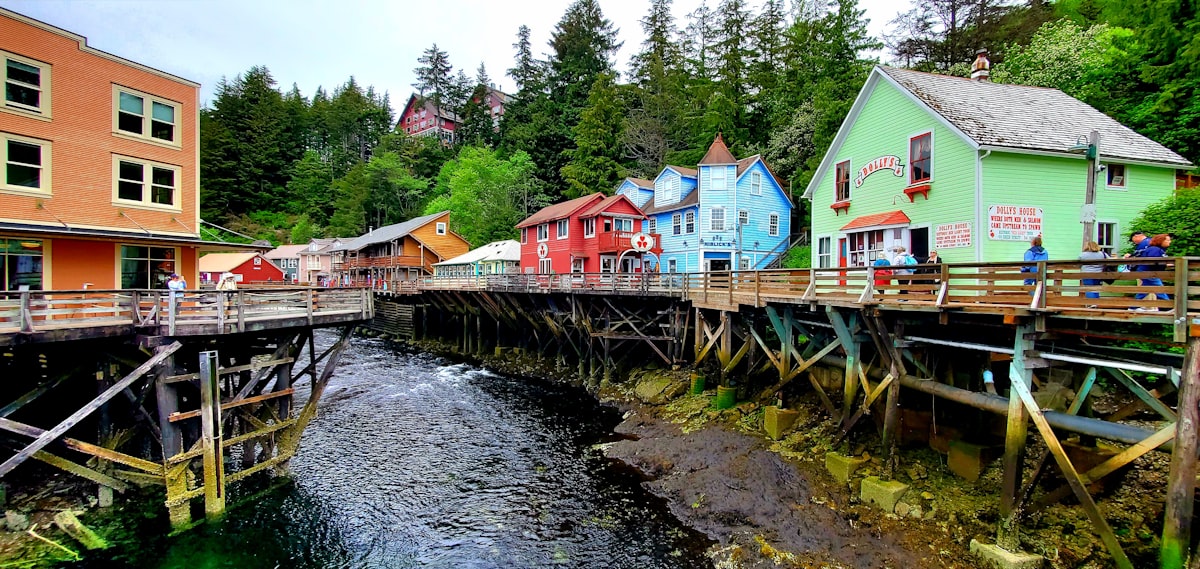

Ketchikan sits on the southwest shore of Revillagigedo Island in the Tongass National Forest, the largest temperate rainforest on the planet. The town stretches along a narrow strip of waterfront backed by steep, forested mountains, and it rains here more than almost anywhere in the United States (over 150 inches annually). That rain feeds the streams, the streams feed the salmon, and the salmon feed an industry that gave Ketchikan its nickname: the Salmon Capital of the World.
The title isn't honorary. Ketchikan historically processed more salmon than any other city on Earth, and the commercial heritage is visible in the cannery buildings, totem poles, and Creek Street boardwalk that define the town. For recreational anglers, the legacy translates to fishing water that holds all five species of Pacific salmon, king, silver, pink, chum, and sockeye, in a compressed geographic area surrounded by old-growth rainforest.
Five Species of Salmon
Ketchikan is one of the few places where an angler can realistically catch all five species of Pacific salmon in a single season. Each species has its own run timing, its own character, and its own fishing approach.
King Salmon (Chinook), The largest and most prized. Kings enter Ketchikan waters from May through July, with the peak in June. Fish average 20 to 35 pounds, with occasional kings over 50. They're caught by trolling herring and hoochies at depth (40 to 120 feet) near the current edges and underwater structure in Tongass Narrows and the surrounding passages. A 40-pound king on medium tackle is a 20-minute fight against a fish that uses the channel's current as an ally.
Silver Salmon (Coho), The acrobat. Silvers run from late July through September, averaging 8 to 12 pounds. They're the most exciting fighters, explosive jumps, long runs, and a stubbornness that makes every fish feel bigger than it is. Silvers hit a wider variety of presentations than kings, including casting and fly fishing.
Pink Salmon (Humpback), The workhorse. Pinks flood the streams and salt water in July and August during even-numbered years (the strong cycle in Southeast Alaska) and odd years to a lesser degree. They're small (3 to 5 pounds) but plentiful, catching 20 in a session is realistic. Ketchikan Creek, flowing right through the center of town, fills with spawning pinks so dense you can see them from the street.
Chum Salmon (Dog Salmon), The underrated fighter. Chums run from July through September, averaging 8 to 15 pounds. They don't jump like silvers, but they pull with a dogged power that surprises anglers who underestimate them. Chums in their ocean-bright phase are excellent on light tackle.
Sockeye Salmon (Red Salmon), The most difficult on rod and reel. Sockeye are present in Ketchikan waters but are harder to target with conventional gear because they feed on plankton, not baitfish. When they do bite, usually on small flies or lures drifted through their holding water, they're among the strongest fighters for their size.
Halibut, The Bottom Dweller
Pacific halibut hold on the sandy and gravel bottom of the channels and passages surrounding Ketchikan. Fish of 20 to 80 pounds are standard on half-day trips, with barn doors over 100 caught on longer trips to deeper structure.
Most Ketchikan charters fish salmon and halibut on the same outing, trolling for salmon first, then dropping to the bottom for halibut. The combo format is the most popular trip type and gives visitors the full Ketchikan experience.
Lingcod, Rockfish, and Bottom Fish
The rocky reefs and pinnacles in the surrounding passages hold lingcod (20 to 40 pounds), yelloweye rockfish (the prized "red snapper"), black rockfish, quillback, and Pacific cod. These species are caught on halibut rigs and targeted specifically on reef trips.
The Tongass Rainforest Setting
Ketchikan's fishing takes place in the world's largest temperate rainforest. The waterways are flanked by old-growth Sitka spruce and western red cedar, with bald eagles on every tree, black bears on the stream banks, seals in the channels, and humpback whales in the deeper passages. The scenery is as much a part of the experience as the fishing.
Ketchikan Creek, flowing through the center of town under Creek Street, is one of the most accessible salmon-viewing spots in Alaska. During the pink and chum runs, thousands of fish push through the creek just feet from the pedestrian boardwalk.
Cruise Ship Fishing
Ketchikan is the first Alaska port for northbound cruise ships, and the charter fleet is designed for cruise-ship schedules. 3- to 4-hour charters depart from the cruise ship docks and put anglers on fish quickly, Tongass Narrows' productive water starts within minutes of the harbor. The short format works because the fish are close.
Private charters (your group has the boat to yourselves) are the standard, Ketchikan doesn't run large headboats. That means personalized attention, more flexibility, and the ability to target specific species.
When to Go
- May–June: King salmon, the premier target, the biggest fish, the first run of the season
- July–August: Silvers, pinks, chums, halibut, the full species overlap, peak charter season
- September: Late silvers, chums finishing, halibut consistent, the transition, fewer cruise ships
- October: The season winds down, but lingcod and rockfish fishing continues