Fish
Fish Fire
Fire Hike
Hike Bird
Bird


The Great Smoky Mountains are the oldest mountains on Earth, over 300 million years old, worn smooth by time into the rounded, forested ridges that define the Southern Appalachian skyline. The streams that pour off these mountains have been flowing since before the last ice age, and they still carry the fish that colonized them when the glaciers retreated: Southern Appalachian brook trout, the only trout native to the eastern United States.
These aren't stocked brook trout. They aren't transplants from New England or the Rockies. They're a genetically distinct strain that has lived in these specific streams for thousands of years, surviving logging, mining, acid rain, and the introduction of non-native rainbow and brown trout that displaced them from the lower elevations. Today, pure-strain Southern Appalachian brookies exist only above 3,000 feet, in the smallest, coldest, most remote headwater streams, often above waterfalls that non-native species can't climb.
Fly fishing for them is not about trophy sizes. The fish average 5 to 8 inches, with a 10-inch brookie being genuinely large. What it's about is the experience: casting a dry fly into a plunge pool in a stream barely three feet wide, surrounded by old-growth hemlock and rhododendron, in a national park that protects more old-growth forest than anywhere else in the eastern US, and catching a fish whose ancestors have been in that exact pool since before Columbus.
Bryson City, North Carolina, the self-proclaimed Fly Fishing Capital of the South, is the gateway to this water.
The Brook Trout Headwaters, Fishing Above the Falls

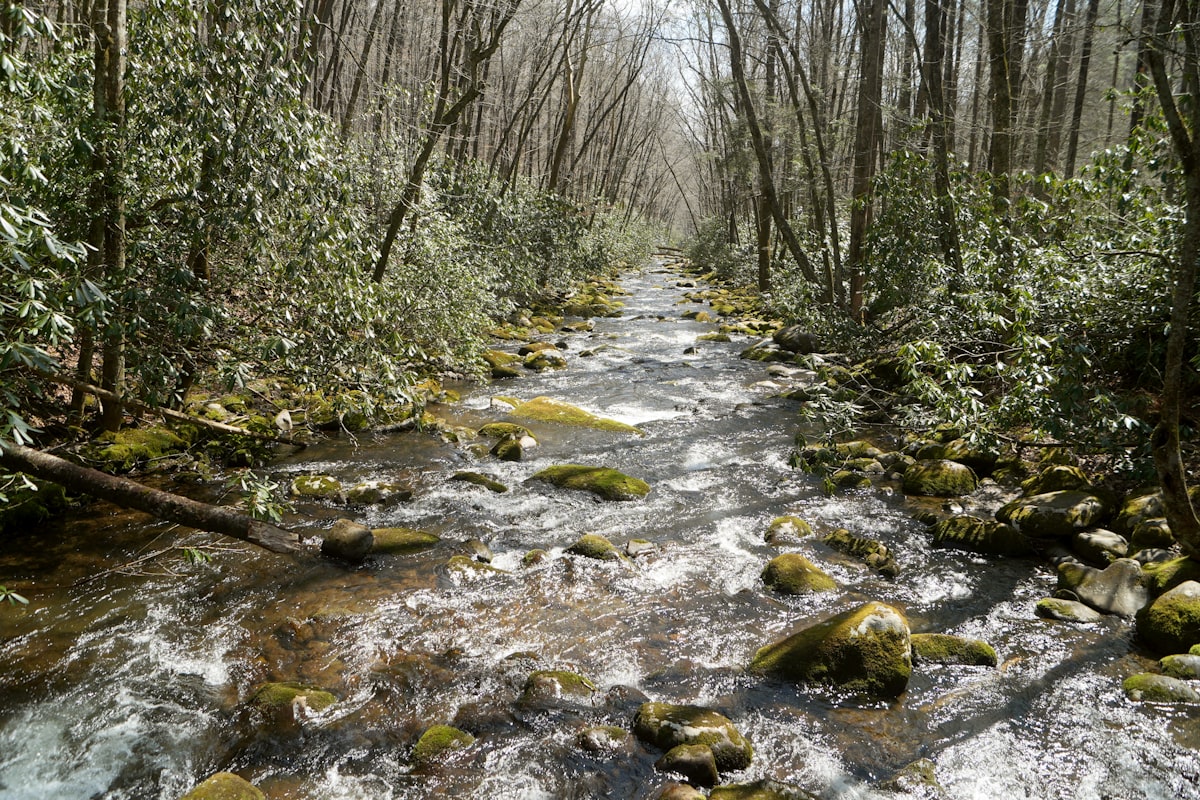
The native brookies live above 3,000 feet, in streams so small you can step across them. These are headwater creeks, steep, cascading, tumbling through boulder gardens and plunge pools in a corridor of rhododendron so dense it forms a tunnel over the water. The canopy is so thick that even at noon, the light is dim and green-filtered.
Finding these streams requires a hike. The park maintains over 800 miles of trails, and many of them follow, or cross, brook trout streams. The best brookie water is typically a mile or more up a trail, above a waterfall or gradient barrier that non-native species can't pass. The park has actively restored brook trout habitat by removing non-natives from some headwater streams and letting the brookies repopulate, which has been remarkably successful.
The technique is simple because it has to be. The streams are too tight for conventional fly casting. You're roll-casting or bow-and-arrow casting a 7-foot rod with three feet of leader, dropping a small dry fly into a plunge pool the size of a bathtub. The fish are not selective, they eat anything that looks like food, because in these cold, nutrient-poor headwaters, every calorie matters. A #14 Elk Hair Caddis, a #14 Yellow Stimulator, or a #16 Parachute Adams is all you need. The fish eat on the first drift if your approach didn't spook them.
The challenge isn't the fly. The challenge is stealth. Brook trout in small streams are hypersensitive to vibration and shadow. Heavy footsteps on the bank, a rod flash over the water, or a shadow crossing the pool, any of these will shut down every fish in the stream for 10 minutes. The anglers who catch brook trout in the Smokies are the ones who approach like herons: slow, low, and patient.
Brook Trout Streams to Start With
The park doesn't publicize its best brook trout water (for conservation reasons), but several well-known streams offer accessible brookie fishing:
- Lynn Camp Prong (Tremont area), accessible from the Middle Prong Trail
- Ramsey Prong, a moderate hike to excellent high-elevation brook trout water
- Eagle Creek and Hazel Creek headwaters, remote streams reached from Fontana Lake (boat shuttle required)
The Freestone Rivers, Browns and Rainbows Below

Below the brook trout zone, the Smokies' mid- and lower-elevation streams hold rainbow trout and brown trout in larger water, still small by Western standards, but wide enough for real casting and big enough to hold fish over 12 inches.
Deep Creek
Deep Creek is the marquee stream near Bryson City, a large freestone creek five minutes from town that's famous for its brown trout population. The lower sections hold browns that average 10 to 14 inches, with occasional fish over 18 in the deeper pools and undercut banks. The creek has a variety of water, pocket water, riffles, runs, and long glassy pools that hold pods of rising fish during hatches.
Brown trout in Deep Creek are more selective than the brook trout above. They hold in shaded lies, feed in low light, and spook more easily in the wider water where they have more escape routes. Dawn and dusk are the best windows for the bigger fish.
Cataloochee Creek
Cataloochee is considered by some locals to be the best brown trout stream in the park, wider than most Smokies creeks, with room to cast and fish that see fewer anglers because the drive to the valley is long and winding. The lower sections fish like a small river rather than a creek, and the brown trout here grow larger on average than most park streams.
Note: Cataloochee Valley suffered significant damage from Hurricane Helene and may have limited access, check current conditions before planning a trip.
The Oconaluftee River
The Oconaluftee flows through Cherokee (the Eastern Band of Cherokee Indians reservation) and is one of the larger rivers in the area. It's stocked in sections, but also holds wild fish in the upper reaches where it enters the park. The river is more accessible than the backcountry creeks and fishes well from the road.
Outside the Park, Nantahala and Tuckasegee
The Nantahala River west of Bryson City is a tailwater, cold water released from Nantahala Lake keeps the river at ideal trout temperatures year-round. It's ranked as one of Trout Unlimited's Top 100 Trout Rivers and holds rainbow and brown trout in a four-season fishery that's more forgiving than the park's wild streams.
The Tuckasegee River flows right through Bryson City and offers easy-access trout fishing, stocked in the delayed-harvest sections (catch-and-release October through June) and holding wild fish in the less-accessible stretches.
The Hatch Chart, Following the Colors
The Smokies hatch calendar follows a color progression that old-timers have taught for generations: dark flies early, light flies in summer, dark flies again in fall.
- February–March: Early Black Stoneflies (#14-16) and midges (#18-22). The first insects of the year bring the first risers. Little Black Caddis (#16-18) hatch on warmer days.
- April: March Browns (#12-14), the first major mayfly hatch. Quill Gordons (#12-14) overlap. Hendricksons (#12-14) on some streams. The dry-fly season begins in earnest.
- May: Light Cahills (#14-16) and Sulfurs (#16-18) take over as the water warms. Yellow Sally stoneflies (#14-16), "Yella Sallies" in local parlance, emerge on every stream and are one of the most important dry-fly opportunities of the year.
- June–July: Yellow Sallies continue. Terrestrials (ants, beetles, inchworms) become important as the land hatches take over from the aquatic ones. Summer dry-fly fishing in the Smokies is more about terrestrials than mayflies.
- August–September: Terrestrials dominate. Hopper patterns work on the lower, wider streams. The brook trout in the headwaters eat anything that lands on the water.
- October–November: Fall BWOs (#16-20) and return of darker stonefly patterns. Brown trout move for the spawn, and streamer fishing in the lower streams produces the biggest fish of the year.
The Fly Box
The Smokies fly box is simple, the old patterns still work because the old insects are still hatching:
Dry flies: Parachute Adams (#12-18), the one fly if you could only bring one. Elk Hair Caddis (#14-16, tan and black), Yellow Stimulator (#12-16), Yellow Humpy (#14-16), Light Cahill (#14-16), Sulfur Parachute (#16-18), BWO Comparadun (#16-20), Foam Beetle (#14-16), Ant (#16-20)
Nymphs: Pheasant Tail (#12-18), Hare's Ear (#12-16), Prince Nymph (#12-14), Tellico Nymph (#12-14), a Southern Appalachian pattern you won't find in Western fly boxes, Copper John (#14-16)
Streamers: Woolly Bugger (#8-10, olive and black), Muddler Minnow (#8-10)
The Gear
Rod: 7.5- to 8.5-foot 3-weight or 4-weight. The shorter, lighter rod is essential, Smokies streams have tight canopies, overhanging rhododendron, and casting lanes measured in feet, not yards. A 9-foot 5-weight is unwieldy in this water. Many anglers bring both a 7-foot 3-weight for the headwater brookies and an 8.5-foot 4-weight for the larger freestones.
Leaders: 7.5 feet tapered to 4X or 5X for most situations. Shorter leaders work better in tight quarters. Go to 6X for the glassy pools where bigger browns feed.
Line: Weight-forward floating. Dress it often, the laurel and rhododendron branches will strip the coating if you're not careful.
Wading: Felt soles are the traditional choice for Smokies wading (the rocks are slippery), but check current park regulations as these rules change. Knee-high boots or wet-wading in summer (the water is cold but not unbearable) are common.
License: No license is required to fish inside Great Smoky Mountains National Park. You do need a North Carolina or Tennessee license for waters outside the park (Nantahala, Tuckasegee, etc.).
The Culture, Bryson City and the Fly Fishing Capital of the South

Bryson City calls itself the Fly Fishing Capital of the South, and the claim has substance. The town sits where Deep Creek meets the Tuckasegee River, with the national park's streams fanning out in every direction and the Nantahala a short drive west. Swain County, Bryson City's home, is 86% national park, national forest, and Blue Ridge Parkway land.
The town is home to the Fly Fishing Museum of the Southern Appalachians, which sits on the bank of the Tuckasegee and tells the story of fly fishing in these mountains from the Cherokee to the present. It's a small museum, but it's the only one in the country dedicated to Southern Appalachian fly fishing heritage.
The local guide services, some family-owned for decades, run backcountry trips specifically for native brook trout, bushwhacking into headwater streams that don't appear on most maps. Other established guides offer everything from beginner instruction on the Tuckasegee to technical dry-fly trips on the park's wild streams.
The culture here is distinctly Southern Appalachian, the patterns have names like "Yella Humpy" and "Thunderhead," the old-timers tell stories about their grandfathers fishing these same pools, and the connection between the community and the water is measured in generations, not seasons. This isn't a destination that was invented by a marketing campaign. It's a place where people have been fishing these streams since before there was a national park.
When to Go
- April–May: March Browns and Quill Gordons, the dry-fly season begins, wildflowers in the park
- June–July: Yellow Sallies, terrestrials, high-elevation brook trout at their most accessible
- September–October: Fall colors, BWOs returning, brown trout moving, streamer season, the most beautiful time
- Winter: The park streams are open year-round, and winter midge fishing in the Smokies is productive and solitary